
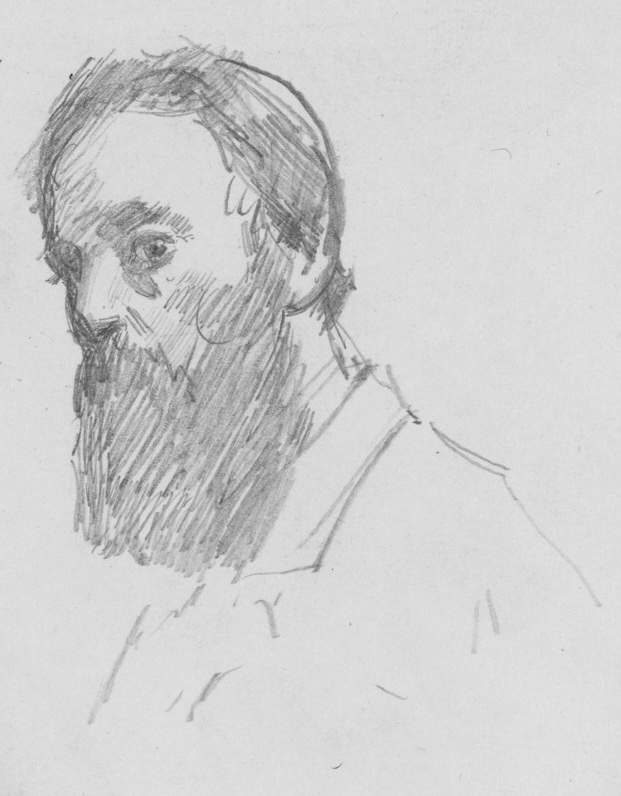
Portrait of Albert Moore by Sydney Prior Hall. [Click on the image for more information.]
lbert Moore was born at York on 4 September 1841, the youngest of fourteen children of William Moore, a portrait and landscape painter, and his second wife Sarah Collingham. He was educated at Archbishop Holgates's School and at St. Peter's School in York. He received artistic instruction as a child from his father and older brothers, four of whom became artists, including the well-known Henry Moore R.A. and John Collingham Moore. He also studied briefly at the York School of Design. He was precociously talented: in 1853, at age eleven, the Department of Science and Art at South Kensington awarded him a medal for one of his drawings. He moved to London in 1855 with his widowed mother where he attended the Kensington Grammar School.
In 1857 Moore exhibited for the first time at the Royal Academy and subsequently exhibited there almost annually until his death. He entered the Royal Academy Schools in May 1858, where his fellow students included Henry Holiday, Simeon Solomon, William Blake Richmond, Fred Walker, and Marcus Stone. He studied there for only a few months, however, as he found its teachings too restrictive.
In May-July 1859 Moore visited France with the architect and designer William Eden Nesfield, and in the 1860s he received several commissions to decorate the interior of churches and country houses through his friendship with Nesfield. During the early 1860s he also designed stained glass, including a window in 1864 for Morris, Marshall, Faulkner and Co. Then, in the winter of 1862-63, he travelled to Rome, where he spent four or five months. Here he painted Elijah's Sacrifice. This visit undoubtedly hastened his conversion to classical subjects. Another key event occurred in 1865, when he exhibited The Marble Seat at the Royal Academy — this led to a lifelong friendship with James McNeill Whistler. Between 1865-70 there was a close relationship between their oeuvres.
Moore first exhibited at the Dudley Gallery in 1866. Two years later he executed in tempera the frieze-like painting A Greek Play above the proscenium of the Queen's Theatre, Long Acre, and in 1872-73 he painted the Peacock Frieze for Frederick Lehmann's house at 15 Berkeley Square. When he was offered the headmastership of the Birmingham School of Art in 1876, he turned it down because it would have meant leaving London, and also because he felt that the time he would have to commit to teaching would not allow him enough time to paint. In 1877 he exhibited at the first Grosvenor Gallery exhibition and he continued to exhibit there until 1887 when he shifted his loyalty to the New Gallery. He also exhibited at the provincial centres in Birmingham, Glasgow, Liverpool, and Manchester. In November 1877 he testified on Whistler's behalf in the famous Whistler versus Ruskin lawsuit.
Moore was elected an associate of the Royal Society of Painters in Water Colours in 1884, the only official recognition he ever received. Although he was a candidate a number of times for election to the Royal Academy, his somewhat outspoken and uncompromising views antagonized academicians and proved a bar to his admission. In 1890 he experienced the first symptoms from the malignant tumour in his leg that would ultimately lead to his death. In 1892 a second operation was required for the tumour in his thigh. He died on 25 September 1893 at his home at 2 Spenser Street, Westminster, shortly after completing his last major painting, The Loves of the Winds and the Seasons. He was buried in Highgate Cemetery. In 1894 a memorial exhibition of his work was held at the Grafton Galleries, London.
Bibliography
Asleson, Robyn. Albert Moore. London: Phaidon, 2000.
Baldry, Alfred Lys. Albert Moore: His Life and Works. London: George Bell and Sons, 1894.
Chester, Austin. "The Art of Albert Moore." The Windsor Magazine XXII (September 1905): 369-82.
Colvin, Sidney. "English Painters of the Present Day. II. Albert Moore." The Portfolio I (1870): 4-6.
Green, Richard. Albert Moore and his Contemporaries. Newcastle Upon Tyne: Laing Art Gallery, 1972. 9-10.
Hedberg, Gregory. "Albert Moore." The Victorian High Renaissance. London: Lund Humphries, 1978. 129-35.
"Henry and Albert Moore." The Art Journal XLIII (June 1881): 161-64.
Monkhouse, Cosmo. "Albert Moore." The Magazine of Art VIII (1885): 191-96. Internet Archive version of a copy in the University of Toronto Library. Web. 21 August 2026.
Wood, Christopher. Olympian Dreamers. London: Constable and Co. Ltd., 1983. 156-71.
Created 21 August 2026
Last modified 14 September 2026