
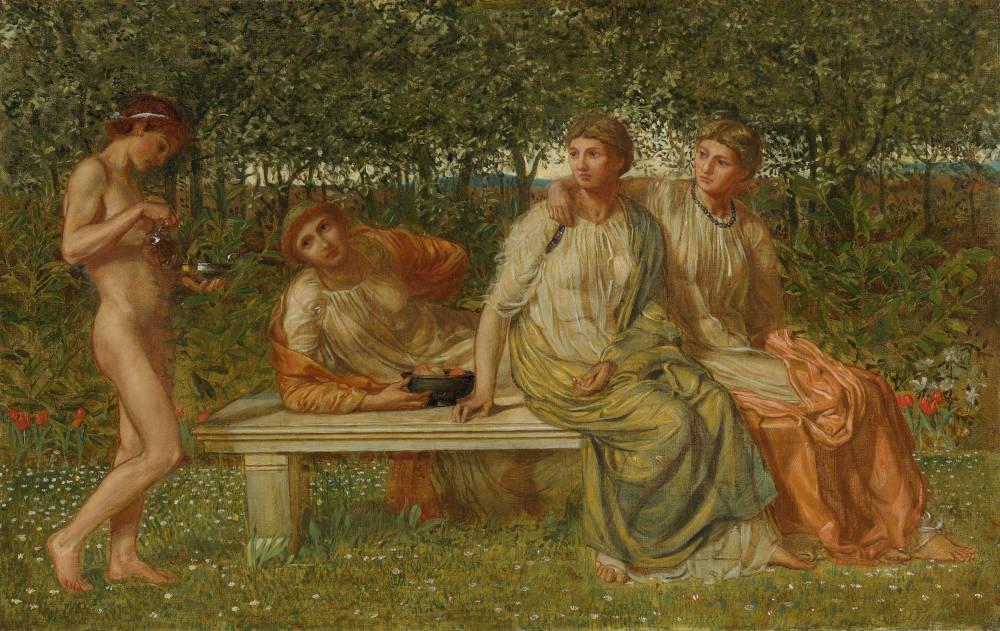
The Marble Seat by Albert Joseph Moore, ARWS (1841-1893). 1865. Oil on canvas, 18 ½ x 29 ⅜ inches (47 X 74.6 cm). Private collection. Courtesy of Sotheby's. [Click on the image to enlarge it.]
Moore exhibited The Marble Seat at the Royal Academy in 1865, no. 586. Although small in size and only briefly discussed by critics at the time, it has subsequently come to be recognized as one of the key landmarks that introduced the early Aesthetic Movement, particularly in terms of Aesthetic Classicism. Robyn Asleson has expanded upon this in her chapter "The Analysis of Beauty":
His evolving conception of painting in abstract terms, as a problem of linear and chromatic arrangements, was radical in its time, reversing the prevailing view that descriptive storytelling constituted the chief function of art. With increasing clarity, Moore asserted the revolutionary idea that the artist's choice of subject was actually immaterial – 'merely a mechanism for getting beautiful people into beautiful situations' – and that line, colour and form had their own independent story to tell. His approach put into rigorous practice the artistic theories that would soon crystallize as the Aesthetic Movement. But although other artists would join him in eliminating narrative content from their paintings, no British artist of the nineteenth century matched Albert Moore's commitment to adapting aesthetic theory to works of art. [77]
It was James Whistler's admiration for this work when he saw it on display at the Royal Academy that led to their life-long friendship and the close collaboration in their work, particularly over the next five years, which was their period of greatest intimacy. While Moore introduced Whistler to the art of classical Greece, Whistler in turn brought about Moore's discovery of Japanese art. These dual influences were essential for the development of Moore's mature style. The painting shows three classically dressed women on a bench, one reclining and two seated, the one with her right arm around the shoulders of her friend. A naked male youth to the left is pouring wine into a metal cup. The painting is a harmony in green and orange and is higher in tone than Elijah's Sacrifice, the other work that he showed at the same Royal Academy exhibition which was quite dark and sombre.
The poses of the two women to the right in The Marble Seat were influenced by two similar figures from a sculpture group from the east pediment of the Parthenon that Moore saw in the Elgin Room at the British Museum. Another obvious influence was the draped female figures from his fresco The Four Seasons that he had exhibited at his one-man show at his studio in Newman Street in 1864. Asleson feels that The Marble Seat may well have shocked its Victorian audience because of the nudity of the male figure: "Unaccustomed to male nudity in recent art, most would have considered this encounter between a naked ephebe, and two fully clothed, mature women indecent and bizarre" (80).
Allen Staley has pointed to the possible influence here of Moore's friend Simeon Solomon's watercolour Sappho and Erinna in a Garden at Mytilene, dated February 1864. This work features the two female poets embracing and seated on a marble bench in a garden. As Staley points out, Moore's painting "has a superficially similar subject of classically dressed ladies sitting out of doors on marble furniture. It is probably right to describe the similarity as superficial and, hence, to ascribe little importance to it, but we must acknowledge that each artist must have been conscious of what the other was doing" (127).
Contemporary Reviews of the Painting
F.G. Stephens in The Athenaeum praised this work. He too noted the influence of the Elgin Marbles:
Among the most striking pictures here are two very original works by Mr. A. Moore, both in the North Room, having diverse subjects, so as to show his wealthy invention and scope of artistic power…. Contrasted in subject, but equally fine in conception, is a little picture of a Greek theme, styled The Marble Seat (586). Three Greek women, or goddesses, sit and recline on a marble bench that is placed upon the flower-enriched sward and near sparse trees, between whose trunks appear the antique country and distant mountains. For them a youth, the Ganymede of the hour, pours wine into a calix; they regard him with eyes and with an air that have the true antique expression. Their attitudes are evidently derived from those of the grandest female statues in the world, i.e., The Fates, now in the Elgin Room; they are, however, not plagiaries, but wisely reproduce something of that irreproachable majesty which Phidias gave. The execution of these works is rough, their surfaces are harsh, their composition grave and noble, their inspiration of the highest Art. [658]
William Michael Rossetti, in his review in Fraser's Magazine, recognized a phase of classical revival occurring amongst submissions to the Royal Academy that year, particularly among younger painters. He compared Moore's contribution to that of Simeon Solomon's Habet:
The work with which we started by coupling it, The Marble Seat, by Mr. Albert Moore, represents classic social life from a different point of view – no longer the dramatic and passionate, but with that conception of ideal repose and silent remoteness which predominates when the mind yields itself up to the contemplation of antiquity, as if hushed voices and gliding bedimmed forms could be discerned in a city of the dead, a dead-alive population, not quite tangible nor yet supersensual, half cognizant of "the true life, not ours." Regarded thus, Mr. Moore's picture of Athenian women, and a naked youth who pours yellow wine. reaches back much further than Mr. Solomon's to the roots of the typical classic feeling, and, by persons who share in that feeling, will be rated as a singular success, very fully sustaining that of his fresco of last year. No light and no system of chiaroscuro at all suffice for Mr. Moore, whose sole object is to paint a picture high in aesthetic and classic ideal. [744]
Related Material
Bibliography
Asleson, Robyn. Albert Moore. London: Phaidon, 2000. 77-79.
Baldry, Alfred Lys. Albert Moore: His Life and Works. London: George Bell and Sons, 1894. 30.
The Marble Seat. Sotheby's. 19th Century Paintings/ Lot 76. Web. 22 August 2026. https://www.sothebys.com/en/auctions/ecatalogue/2011/19th-century-paintings-n08738/lot.76.html
Rossetti, William Michael. "The Royal Academy Exhibition." Fraser's Magazine LXXI (June, 1865): 736-53.
Staley, Allen. "Albert Moore." The New Paintings of the 1860s. New Haven and London: Yale University Press, 2011. 127-28.
Stephens, Frederic George. "Fine Arts. Royal Academy." The Athenaeum No. 1959 (13 May 1865): 657-58.
Created 18 May 2022; commentary added 22 August 2026