
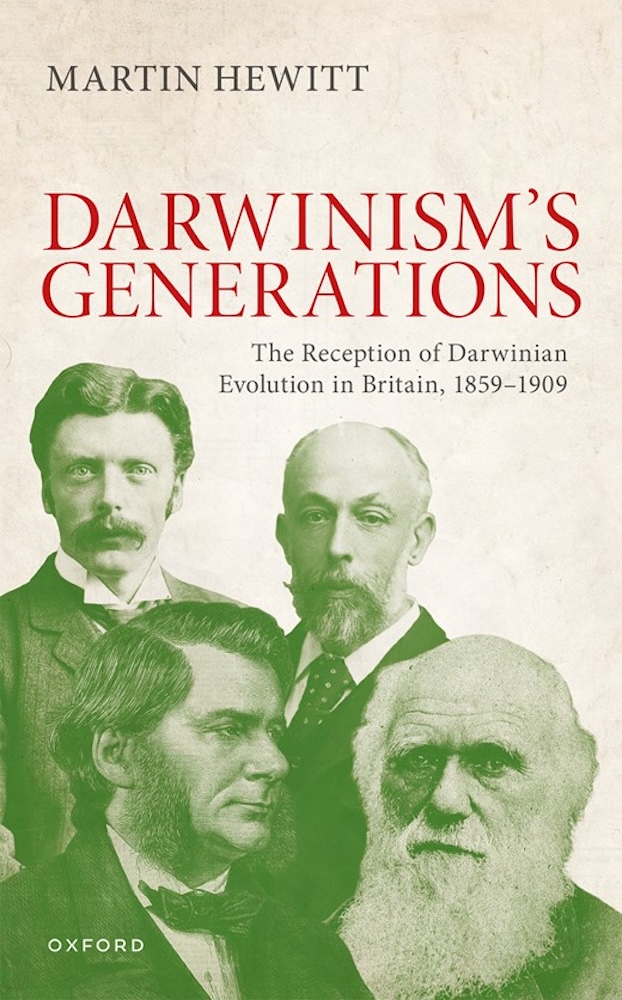

n Darwinism's Generations Martin Hewitt sets himself the task of "us[ing] an examination of the responses to Darwin and Darwinian ideas in the fifty years after the publication of The Origin of Species to explore the importance of generational dynamics in the history of nineteenth-century Britain" (2-3). With this study, Hewitt tests the utility of the generation as a unit of historical analysis while painting a detailed portrait of the first half-century of the reception of Charles Darwin's ideas in Britain.
What counts as a generation? As the kids say, it's complicated. "Fundamentally," Hewitt asserts, "a generation is a non-arbitrary age cohort," which seems simple enough. But for this cohort to be analytically useful, that is, productive of meaningful historical analysis, the cohort must also be "the outcome of a 'structurating force'," something that lends the feeling of being part of a definite generation in the minds of its members. This could be "a common location in history, a similar age encounter with key events or new ideas, [or] a shared experience of life-cycle specific institutions" like those involving education, Hewitt writes. Two additional, arguably thornier and more psychological elements are also in the mix: "a similar pattern of memory as against mediated history" along with "the shared perspectives of a common age" (9).
Yet for every line drawn between generations, there will always be individuals on the cusp who confound the neat generalization. Inconveniently for the historian, age-related changes of ideological position might also be unevenly distributed. While one person's youthfully uncritical enthusiasm for Darwinism might wane over time, another person might cleave stubbornly to a knee-jerk skepticism for decades. If they're on the different sides of a generational line, this difference might be explained (or explained away) by generational analysis. If they're on the same side, however, they constitute a problem for the generationally-inclined historian. A cognate difficulty crops up with historical periodization. To draw a clear demarcation between periods of history seems, at times, a fool's errand. Imagine trying to draw a rigid line between, say, the late Romantics and the early Victorians. Historical reality is invariably messier than historians' attempts to sort that reality into neat chronological boxes. Nonetheless Hewitt gamely makes the effort, seeing the generation as on par with grand analytic unities of gender, race, and class in terms of its importance to historians.
In fact, Hewitt's larger quarry has little to do with Darwin or Darwinism per se. Rather, Hewitt is interested in the nature of historical change, and he finds in Darwin's ideas an ideal case to test his various hypotheses. While Hewitt develops his conceptual framework from the relevant studies of the philosopher José Ortega y Gassett (1883-1955) and the sociologist Karl Mannheim (1893-1947), he repeatedly returns to the question of "saltational" change in history, that is, moments when a set of ideas — about, say, the genesis of homo sapiens — seem to change all at once. In this, his work is also in conversation with that of the philosopher Thomas Kuhn (1922-1996), whose studies in the history of science, particularly The Copernican Revolution (1957), gave rise to a general theory of scientific change outlined by Kuhn in his influential The Structure of Scientific Revolutions (1962). A dyed-in-the-wool Kuhnian would say that scientific change also proceeds discontinuously, in jumps: One day the world seems this way, the next day it seems that. In the history of science, Kuhn's model of scientific change gave rise to a debate: Could the history of an idea change overnight, all at once? Or was that history to be written in terms of dailiness, the mineral creep of particulars, an idea shared over meals and in the odd free moment by the water cooler that then, slowly, extends to change the minds of an entire community? (On the reception of Structure, see Buchwald 2012.)
Spoiler alert: At least when it comes to Darwinism, Hewitt makes a substantial case in favor of continuity. Over the course of more than four hundred closely printed pages, accompanied by hundreds of densely argued footnotes, an eleven-page, single-spaced appendix in which the members of each generational cohort of interest to Hewitt are listed with birth and death dates, and a bibliography that runs to nearly forty pages, Hewitt parses this voluminous data set seeking to isolate a few specific kinds of effects. "Period effects" are "the impact of Darwin's work and the debates it prompted." "Age effects" are "the differential openness to new ideas of the young and old," while "cohort effects" are "the changes which would eventually be wrought by the substitution of one generation by another" (3).
Hewitt divides his generations at the years 1812/13, 1829/30, 1844/45, 1860/1, and 1875/76. Each generational band consists of fifteen to eighteen years, which is somewhat narrower than the twenty- to twenty-five-year period that conventionally defines a generation. Hewitt recognizes six cohorts: the late Romantic or Georgian generation, "indelibly marked by the consequences of the French Revolution and the wars against Napoleon," followed by the early Victorians, including Darwin himself. Next came the mid-Victorians, chief among whom, of course, was Queen Victoria herself. According to Hewitt, this generation was "shaped by the experience of the reform agitations of 1830-32" as well as "the visible emergence of an urban-industrial society" (14). They were followed by the "high Victorians," figures like William Morris (1834-1894) and Thomas Hardy (1840-1928), who were in turn followed by the late Victorians and the Edwardians, of whom the youngest, marking the outer limit of the group, were those who died during or after World War II, such as David Lloyd George (1863-1945) and H. G. Wells (1865-1946). Through it all, Hewitt finds no sudden and sweeping change that causes the broad acceptance of Darwinism; rather, the suite of ideas ebbed and flowed through Victorian society according to generational patterns.
Darwin's ideas provide a useful laboratory to test the hypothesis that generations are more than mere chronological accidents, that they have a coherence that is historically relevant. It helps that Darwin was himself relatively long-lived, with a career spanning more than forty years, from the publication of The Voyage of the Beagle (1831), based on his experiences in the Galápagos Islands, to his final study, on earthworms, in 1881, and a posthumous paper on instinct in 1883. Thanks in no small part to his longevity and productivity, Darwin's ideas circulated in British society over the course of many decades, during which Hewitt's identified generational cohorts waxed and waned. With the Victorian expansion of mass publishing, Darwin's ideas were pervasive, reaching into lecture halls and working class parlors, where Victorians could be found reading his work directly as well as reading about his work in one of the many periodicals that were widely available. For these reasons, the members of Hewitt's generational cohorts really did find themselves frequently and often deeply in conversation with Darwin and Darwinism, as a signal part of the Victorian era. Darwin was famously criticized, particularly by those who rejected the implications of his ideas for religious orthodoxy. Less often noted, however, is how beloved Darwin also was, as a writer to whom readers repeatedly returned, over the course of many years, for refreshment. As his books went through edition after edition, his readership expanded but also deepened. "New issues meant new audiences," Hewitt writes, "but also nostalgic re-readings." (17)
Starting with the publication of The Origin of Species in 1859, Hewitt proceeds chronologically, with chapters devoted to study of generational responses to a series of watershed events: the immediate reception of Origin, the upheaval of thought that attended the publication of The Descent of Man in 1871, Darwin's death and its reverberations through the 1880s, and the Edwardian debates about Darwinism at the fin de siècle. Hewitt caps his analysis with a concluding chapter that starts with the centenary celebrations, in 1908-09, of Darwin's birth, celebrations that offered late Victorians and Edwardians an opportunity to reconsider Darwin's contributions.
In his first chapter, devoted to "The Publication of On the Origin of Species," Hewitt considers the immediate reception of the text. Outside Darwin's immediate circle of friends and supporters, the reception was chilly. Even those warmly inclined toward Darwin's ideas struggled with the dense and difficult text as well as with its limited availability. For all of its immense success, Mudie's subscription library remained too costly for many, and Origin's controversial reputation made it unpopular among library buyers for mechanics' institutes and similar associations. Spurred by Huxley's promotional efforts, Darwinism soon picked up steam, but this growing readership did not translate immediately into a growing acceptance, as Hewitt shows in detail (42-44).
As controversies simmered, evolutionary ideas crept into pockets of mid-Victorian intellectual life, of which perhaps the most important was the publisher John Chapman's literary salon, where Herbert Spencer (1820-1903), George Eliot (1844-1889), and George Henry Lewes (1817-1878), among others, including Darwin's great promoter and interpreter Thomas Henry Huxley (1825-95), gathered to discuss Darwin's ideas. Much of this conversation wound up in the pages of the influential Westminster Review. One surprising measure of the widening acceptance of Darwin's ideas was the steady publication of rebuttals of them, which were often informed by the increasingly relevant, related discourses on the nature of deep time and revelations from the fossil record. What really helped Darwin's case, in fact, was that each defense of a divine controlling influence was harder to credit than the last. Take, for instance, P.H. Gosse's Ophthalmos (1857), in which the author went so far as to claim that, rather than testifying to anything real, "the fossil evidence was a sort of grand tromp l'oeil, created by God to test humanity's faith." (49; italics in original) In addition to such astonishing nuggets of extreme denial of evolutionary evidence, Hewitt's analysis also includes interesting glimpses of evolutionary discourse in the provincial scientific societies, organized groups of energetic thinkers who, sometimes but not always spurred by a visit from the indefatigable Huxley, gathered in the evenings in towns like Sheffield and Hull, eager to share their thoughts about Darwin's stunning hypothesis (52-55).
In his second chapter, "In the Wake of the Origin," Hewitt tracks these early responses and the ongoing debates to which they gave rise. In the 1860s, Darwinism had penetrated the culture so deeply that references to, for instance, the increasingly fuzzy border between apes and humans, showed up with ever more frequency in widely read periodicals like Punch. Fresh support for evolution emerged from other quarters as well, such as the publication of studies of deep time like Lyell's Antiquity of Man (1863), which marshalled evidence to suggest that humanity was indeed of great age despite the chronology of human existence suggested by the Bible, and linked this point of view with discussions of Darwin's ideas (89-90).
In 1864, a group of sympathetically-minded associates who regularly shared ideas over dinner organized formally as the X-Club, with Huxley at the center, along with the botanist J.D. Hooker (1817-1911), the physicist John Tyndall (1820-1893) and the archaeologist John Lubbock (1834-1913). Over the succeeding decade many others were drawn into the group. Of these, many if not most were born in the 1820s and were just then coming into their own socially and professionally; in later years, as Hewitt shows, their intellectual commitment to, and engagement with Darwinism would carry the marks of this first powerful context of sociability. Similar developments were afoot in other, less formally organized groups of anthropologists, paleontologists, and geologists who found Darwin's ideas congenial because they seemed to support and extend other, more favored modes of apprehending human history and deep time, e.g., Spencerianism and Lamarckism (95-98).
Others, who were on the fringes or even wholly outside the X Club — such as the conservative Linnean Society, where much cloak-and-dagger stuff went on among the botanists — remained inward-turning and concerned with internecine struggles even as Darwinism gained speed everywhere else. As Hewitt shows, the generational effects here are indeed striking, for complaints about the "Linnean approaches," characterized by "pre-Darwinian views of species" held among botanists, reached even into the twentieth century. Meanwhile, the initial vociferous opposition of the original anti-Darwinians gradually softened, giving way to suspensions of judgment and other, similarly disengaged positions. John Ruskin, for instance, remained unconvinced of Darwin's ideas while also being equally reluctant to claim outright that Darwin had got it all wrong, preferring to cast aspersions on the foolish ways in which his ideas had sometimes been taken up (119).
There followed a period of uneasy peace. There was a particular detente over natural selection, the idea being still sufficiently loosely specified to make space for divine design in the minds of religious believers. This detente crumbled after the appearance of The Descent of Man in February of 1871, after which it was impossible to paper over the most discomfiting of Darwin's ideas, that "man is descended from a hairy quadruped, furnished with a tail and pointed ears, probably arboreal in its habits," as Darwin bluntly expressed it (qtd on p. 165). Hewitt's third chapter, on "The Descent of Man and the High Victorians," canvasses Darwin's respondents in the last quarter of the nineteenth century. "There was a sudden intensification of engagement in Darwin's ideas," Hewitt says of this period. "Indifference was replaced by investigation. Bystanders became disputants" (165).
As Hewitt shows, Descent became a rallying point for the High Victorians, and not just in London and the pages of London-centric publications like Punch and the Westminster Review. Here the generational aspect is broadly evident, involving a "very definite break" with those who had gone before; but the contrast was particularly stark in the provinces: "Where advocates of Darwinism are visible on the provincial lecture platform," Hewitt writes, "they tend to be high Victorians, challenging the orthodoxy of their elders" (114). Of special interest here is the section devoted to Darwinism among theologians. Caught up in the rising popularity of materialism, the theologians found themselves on ever thinner ice. The stakes had become very high indeed, and perhaps nowhere more so than in the debates over abiogenesis, that is, the idea that there was no role for divine design in "the critical transition from inert matter to life" (209). At the same time, new groups proliferated on both sides of the issue, pro and con. While the Neo-Darwinians "sought to take seriously Darwin's own hesitancies about the adequacy of natural selection" as an explanation for "evolutionary change" (269), the new anti-Darwinists among the Edwardians attempted to distance themselves from the main lines of Darwinism, often by emphasizing its most controversial elements and diminishing the more accepted ideas as passé (367-72).
For all its comprehensiveness, however, Darwinism's Generations does not deal in detail with the reception of Darwinian ideas beyond Britain (apart from a glancing occasional reference to Darwinians in Canada). Darwin's ideas did, however, find their way to the Continent as well as the Middle East and Japan. (See, for example, Glick [1988] and Elshakry [2013].) Knowing more about the generational aspects of their diffusion in these more far-flung places, relative to London anyway, might have shed light both on the evolution of Darwinism as well as on the general utility of the generation as a category of analysis. Studying generational effects in a wider variety of contexts could usefully complicate the notion of a generation and might even reveal cultural limitations of the category, if they exist in the first place.
Carefully researched and immensely detailed, Darwinism's Generations offers a history of Darwinism as if painted by Brueghel, with hundreds of busy figures crowding the canvas. They are all, however, in shadow — for just out of the frame stands the towering figure of Darwin himself, whose unlikely ideas about seemingly every living thing, from apes to finches, slime molds, and earthworms, gave rise to the preoccupations of the century. For the generations that followed him, Darwin's longevity and productivity only deepened their difficulties. With this book Hewitt shines a powerful light on this Darwin-shadowed world, permitting readers to observe the legions wriggling there — reading, writing, and arguing, celebrating wins and despairing over setbacks. Even if it is not completely comprehensive, Hewitt's massive effort tells us much about how these figures, singly and in groups, confronted Darwinism, making sense of what they could and making different degrees of peace with what they could not.
Links to Related Material
- Charles Darwin on the reception of the Origin
- Charles Darwin’s Theory of Evolution and the Intellectual Ferment of the Mid- and Late Victorian Periods
- John Ruskin's Response to Darwin
- The Polyglot Darwin: A Review of Marwa Elshakry's Reading Darwin in Arabic
- What Made Darwinism Useful to J.D. Hooker?
Bibliography
[Book under review] Hewitt, Martin. Darwinism's Generations: The Reception of Darwinian Evolution in Britain, 1859-1909. Oxford and New York: Oxford University Press, 2024. 494 pages. ISBN 978-0-19-289099-3
Buchwald, Jed Z. "Kuhn's Structure Four and a Half Decades Later." Historical Studies in the Natural Sciences 42.5 (November 2012): 485-490,
Elshakry, Marwa. Reading Darwin in Arabic, 1860-1950. Chicago and London: University of Chicago Press, 2013. [Review by Diane Josefowicz]
Glick, Thomas F., ed. The Comparative Reception of Darwinism. Second edition. Chicago: University of Chicago Press, 1988.
Kuhn, Thomas H. The Copernican Revolution. Cambridge, MA: Harvard University Press, 1957.
—. The Structure of Scientific Revolutions. Cambridge, MA: Harvard University Press, 1962.
Created 4 February 2026
Last modified 13 August 2026