

dward Frederick Brewtnall was a versatile artist who worked in a variety of genres, mediums, idioms, and styles. Difficult to categorize, his work extended from landscape to social observation, from lightly humorous genre to poetic imaginings of mythologies, fairy tales and medievalist fantasies. This wide range enabled him to prosper within the highly competitive world of the Victorian art market. He exhibited in the principal institutions, became a member of the leading artistic societies of the time, and contributed wood engravings to Once a Week, The Dalziels’ Bible Gallery, Good Words for the Young and The Graphic. His work was the subject of numerous reviews in the press, and he was well-known to a large middle-class audience.
Bound by economic necessity, and always a working professional, Brewtnall tried to satisfy diverse tastes. But his all-pleasing strategy had its risks. Principally, it meant that he was perceived by many as a dilettante – an artist with no distinctive identity who shifted restlessly between subjects and genres to match changes in fashion and had no central focus. The crux of this apparent instability was his movement between realism and fantasy; as M. H. Spielmann suggests in The Magazine of Art, Brewtnall ‘tried to persuade himself that he might take the commonplace in modern life as his subject,’ but was equally interested in ‘romance’ where his ‘imagination’ can take over (51).
Victorian critics generally stressed the incongruity of working in two antithetical idioms, but it is perhaps more productive to view Brewtnall as an adept in both fields: though an effective commentator on modern life, he ran that interest in parallel with his interest in the exotic and fantastical. In each domain, Brewtnall assimilates diverse influences to create a rich and multifaceted oeuvre.
The Chronicler of Contemporary Life
Brewtnall’s interest in contemporary society was further subdivided by his focus on middle and working-class life. In each of these domains he employs devices which reveal him to be an inventive artist.
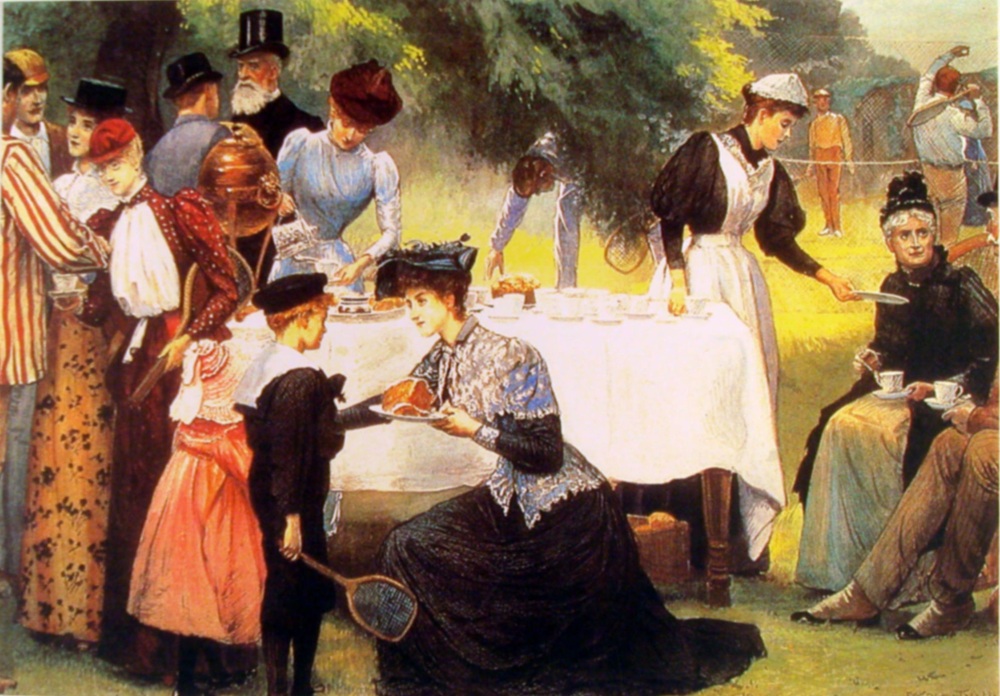
Brewtnall’s take on contemporary middle-class life in Tea and Tennis.
His treatment of the bourgeois experience is highly idealized, representing well-dressed characters engaged in leisure activities or social rituals. Tea and Tennis (c. 1880, Wimbledon Lawn Tennis Museum) exemplifies this approach, showing a party that engages in the game and takes some light refreshment: characters are in conversation as maids serve tea, and in the centre ground a boy is offered a plate of cake. It is a reassuringly unchallenging scene in the tradition of W. P. Frith’s panoramic views of the bourgeoisie at play, but more interesting are the ways in which Brewtnall conveys the immediacy of his event. He stresses the sunlight nowness by deploying a palette in a high register, placing a brightly illuminated passage of white (the tablecloth) in the middle ground and surrounding it with brightly coloured and patterned costumes and lividly green grass. He also employs compositional and figural devices that convey spontaneity – notably in his movement of the figures to the margins, where they are edited and cut off by the frame, and further accentuates that journalistic effect by showing the characters engaged in half-completed actions. Indeed, Tea and Tennis has a refreshing directness that must surely reflect the influence of French painting, especially in its use of the editing effects in work by Manet and Degas; it also recalls the shimmering luminosity and changing light of work by James Tissot.
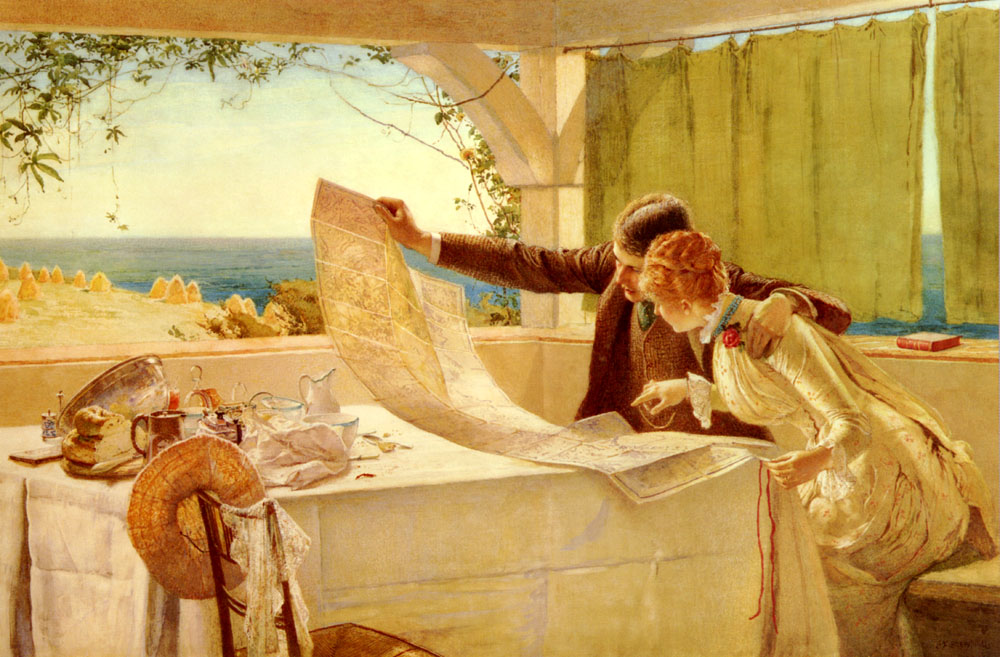
Marriage as sweetness and light, a young husband and bride in the summer of their lives: Brewtnall’s The Honeymoon.
That sort of here-and-nowness is equally apparent in The Honeymoon (1880, Private Collection). This painting has the directness of Tea and Tennis: brightly illuminated, its physical light acts metaphorically to suggest the lightness of newly-wedded happiness. The palette is a sophisticated play on whites and creams that must surely reflect the impact of J M Whistler’s ‘arrangements,’ and the composition is again a representation of half-caught action as the young couple peruse an unfolded map that contains information on their next visit and hints, perhaps, at the unfolding course of their married life.
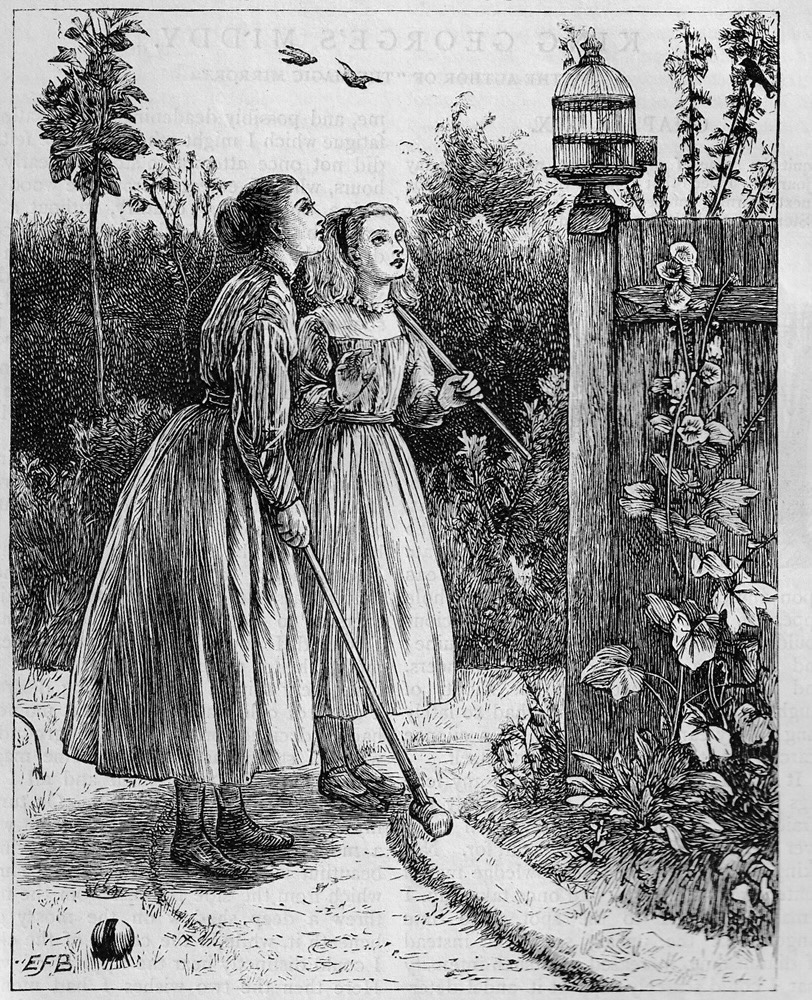
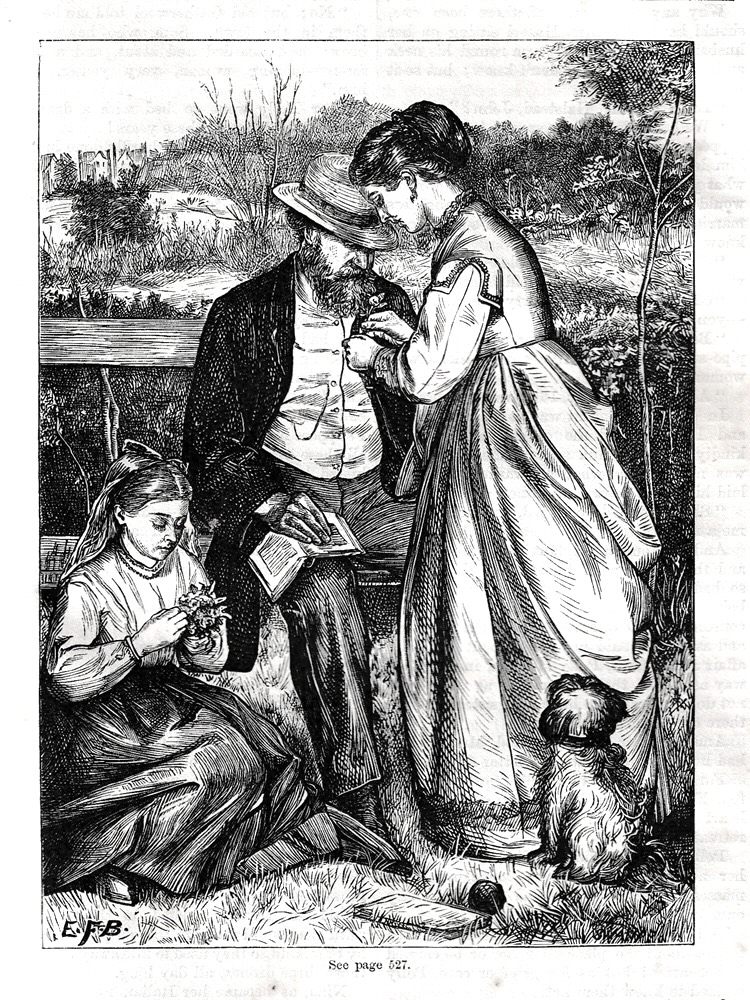
A bountiful life: Left: The Liberated Bird;. Right: An illustration for ‘Polly’s Old Sweetheart.’
Such sweetness celebrates the care-free bourgeois idyll, of life without pressing material anxieties, and Brewtnall carries that vision into his wood-engravings in Once and Week (1867) and Good Words for the Young (1869). In The Liberated Bird, he represents two girls contemplating the emptied cage as they interrupt their game of croquet in the setting of a well-appointed garden; and in Polly’s Old Sweetheart we have another celebration of the values of the leisured classes in the form of an idealized family group, complete with a figure of the ‘good wife’ and a dog to symbolize fidelity. These images recall the ‘pleasure and leisure’ imagery of Alfred Cooper, and seem almost dream-like in their emphasis on innocent freedom.Yet Brewtnall was a powerful delineator of the other end of the social scale as well. In his work for The Graphic in the 1870s he emulates the hard-hitting realism of Hubert Herkomer and Frank Holl, producing images which stand in sharp opposition to his lyrical picturing of middle-class life. A Jumble Sale (Graphic, 1892) is an absolute contrast to Tea and Tennis, this time showing the poor and lower middle classes trying on clothes or otherwise looking for a bargain: economic survival is the game this time. The shabby appearance of the characters contrasts with the wealthy dress of those enjoying their tea, and the tone is subdued rather than celebratory, an effect powerfully projected by the dour tones of the wood-engraving.
Brewtnall produced many similar images for the pages of The Graphicin accordance with its mission to raise public awareness of poverty, but one of his most powerful reflections on deprivation appears in an edition of Bunyan’s Pilgrim’s Progress. His illustration depicts Mercy giving a coat to a poor man on a snow-bound day; the figure of poverty is a ragged and ill-fed man, who though a literary invention could be a pauper of the late nineteenth century.
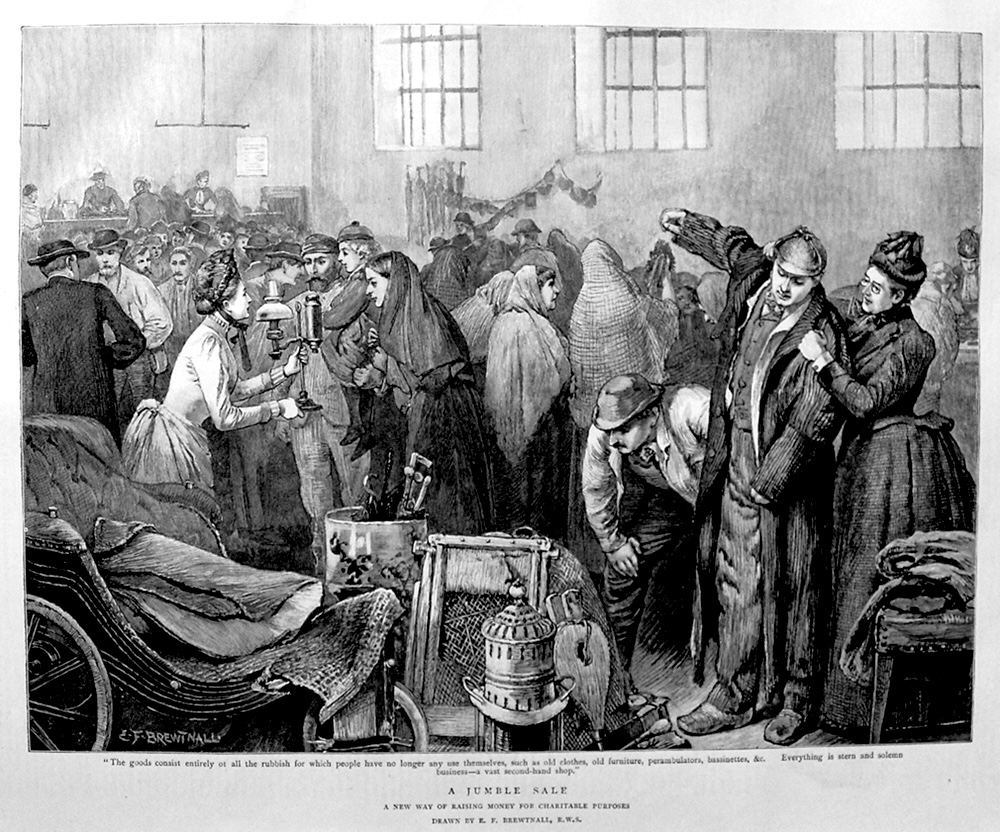
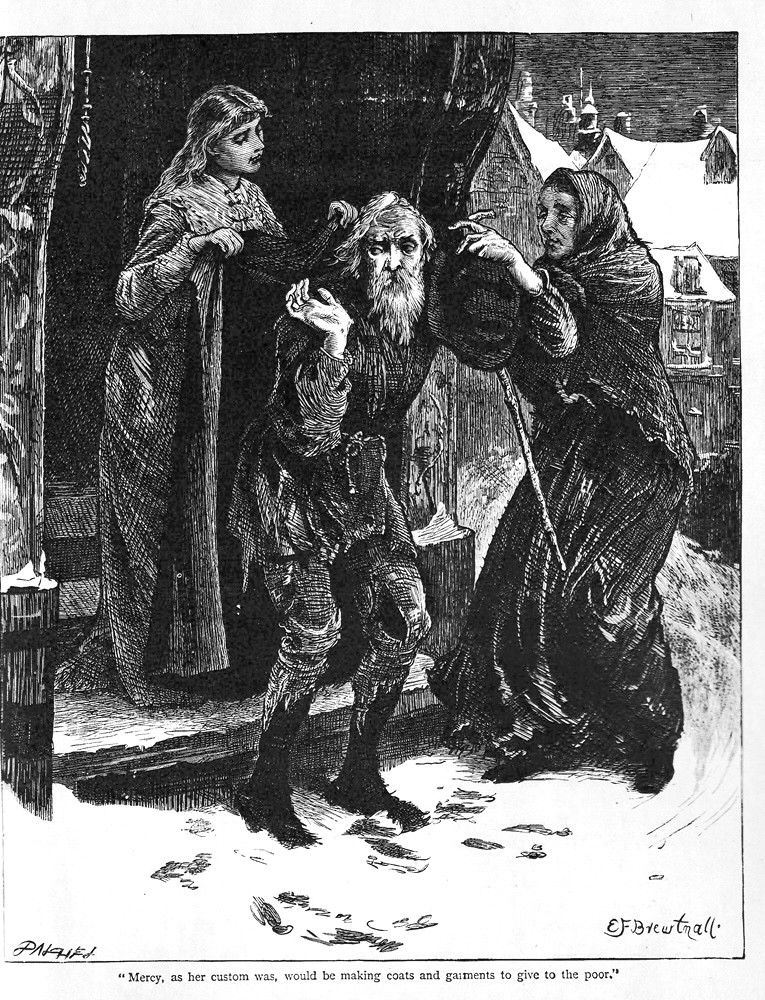
Left: a Jumble Sale; Right: Mercy tending to the Poor.
From Realism to Escapism
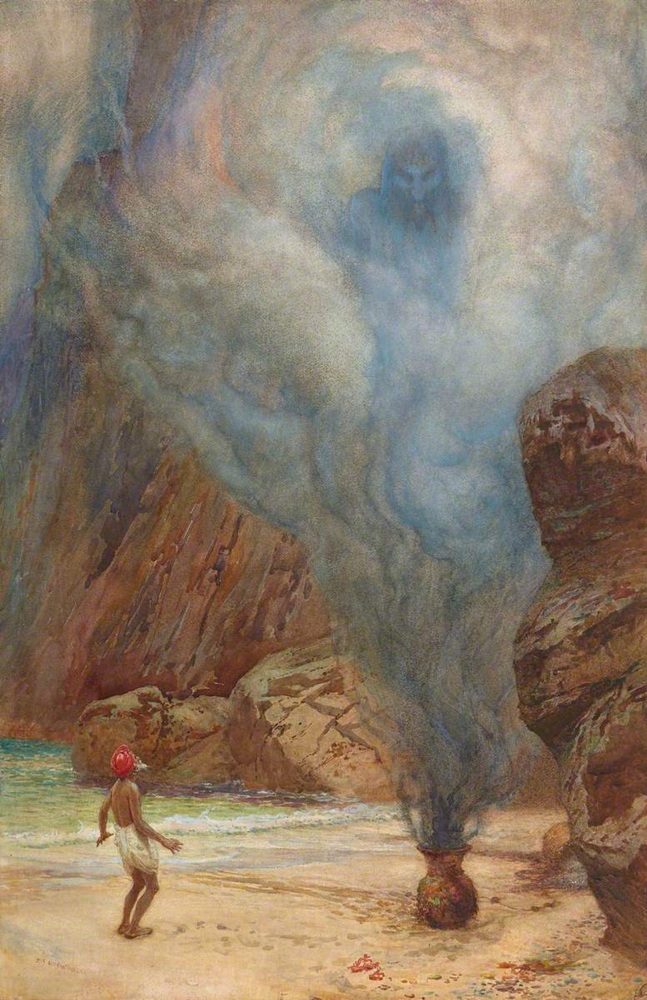
Brewtnall’s fantastical imagination: Sinbad and the Genie.
Brewtnall ranged eclectically over a range of fantastical and mythological subjects, in each case providing a vivid realization of his imaginative scenes. In particular, he focused on incongruous encounters between humankind and the magical or strange. He established this format in his diploma work for entry to the Royal Watercolour Society, presenting the moment in Sinbad and the Genie (1870, Private Collection) when the genie makes his first appearance, billowing out of the lamp in a blue smoke, with the diminutive Sinbad looking up in astonishment.
Equally striking are a A Visit to a Witch. (1882, Private Collection), The Dragon’s Cave (1891, Private Collection) and The Frog Prince. (1881, Private Collection). These fairy tale subjects would have appealed to the contemporary audience as typical pieces of Victorian escapism in line with Edward Burne-Jones’s neo-medieval fantasy and the neo-classical imaginings of Frederic Leighton and Laurens Alma-Tadema; but Brewtnall’s main aim, it seems, is to visualize not only the oddness of an encounter but the interface between reality and the dream-like. This interest is realized in spatial contrasts of open/closed, with some sort of obfuscating, dissolving barrier between the zones and between the domains of experience.
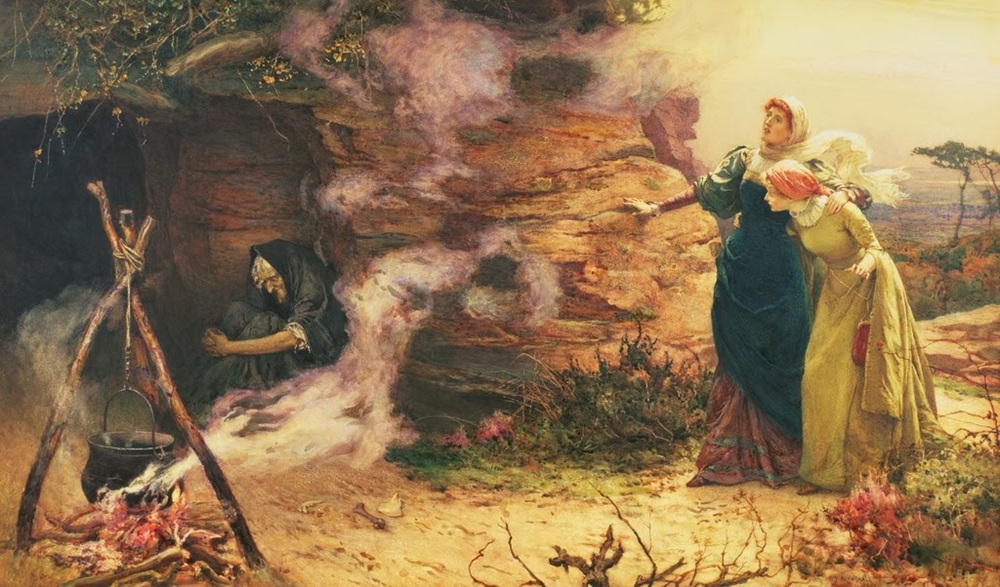
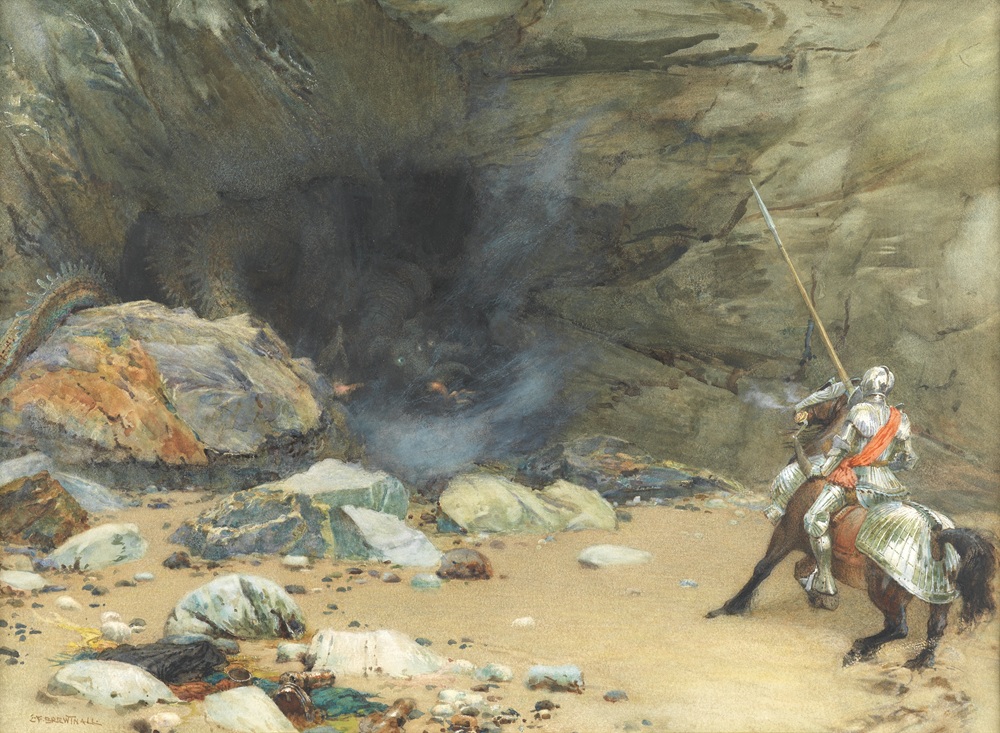
Left:Visit to a Witch; Right: The Dragon’s cave.
In A Visit to a Witch he contrasts the open space occupied by the visitors with the enclosure of the witch’s cave, with a skein of smoke marking the division between the real and the supernatural; in The Dragon’s Cave, the difference is again marked in the distinction between the knight’s open ground and the misty, rocky opening; and in The Frog Prince. the worlds of the real and magical are differentiated by disparities of scale, with the princess associated with the verticals of falling water and the frog with the irregular outlines of foliage. These compositional arrangements give coherent form to Brewtnall’s theme of strange meetings, but not every critic was impressed. Some regarded his fantasies, in the words of a commentator in The Spectator, as a pretentious ‘sham,’ wondering of the Visit to a Witch, ‘what is the use of the whole thing?’ (‘Art,’ 691). None, however, could deny the quality of his ‘beautiful’ colour (‘The Frog Prince,’ 42), which he uses to endow his compositions with hallucinatory vividness and intensity.
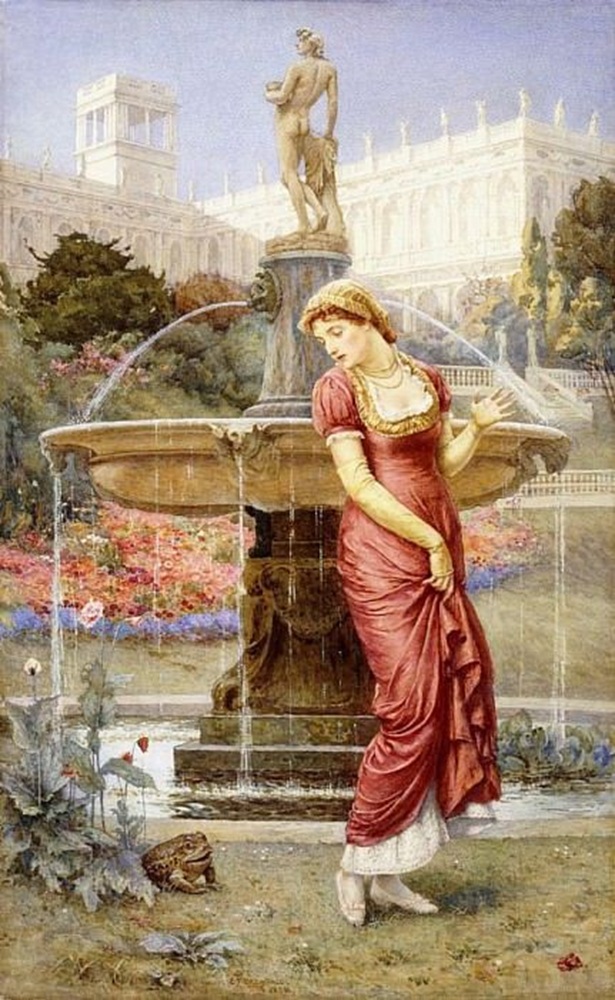
The Frog Prince.
That visionary quality is best realized, perhaps, in The Sleeping Beauty (1902, Warrington Art Gallery). In this fairy tale romance Brewtnall again focuses on the point of contact between two worlds: the waking world is represented by the prince, and the world of dreams by the princess. Those domains are divided compositionally by placing the first in the foreground and the second in the background; a marble pier accentuates the division and the prince is shown at the very moment when he is about to step into the princess’s space and awaken her. Brewtnall also symbolizes the division by contrasting the whiteness of the bower and the princess’s gown with the luxuriant flowers in the foreground, which he carries over into the design on the prince’s costume: one suggests the sepulchre, the blankness of death and unconsciousness, the other acts as a sign of teeming, regenerative life.
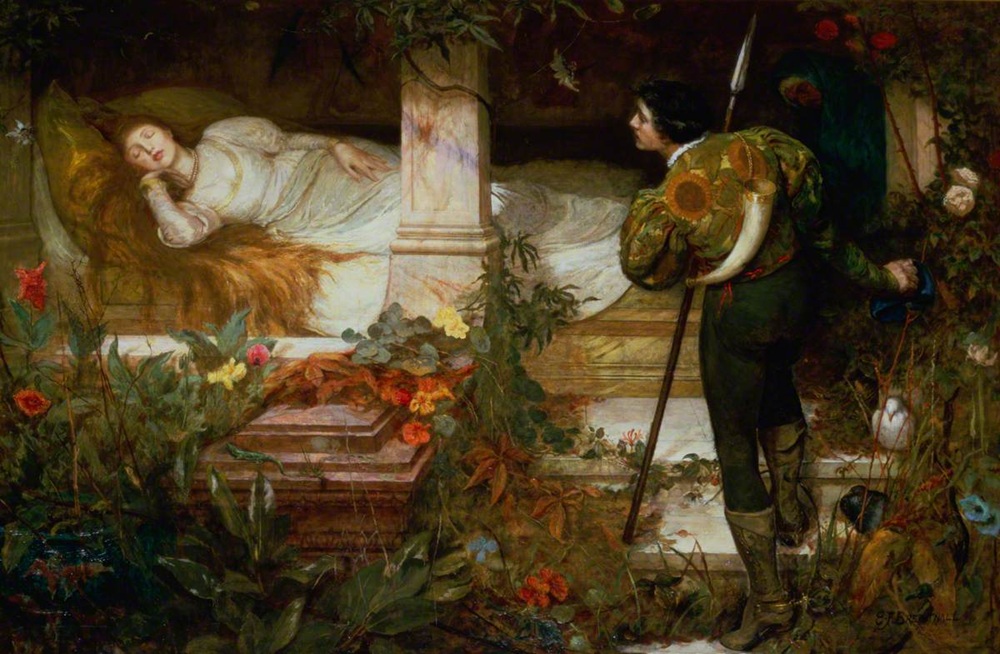
The Sleeping Beauty.
Brewtnall’s approach is a distinctive treatment of a popular Victorian subject which was also painted by Edward Burne-Jones in his Briar Rose series, by Walter Crane in his picture-books for children and my others such as John Collier.
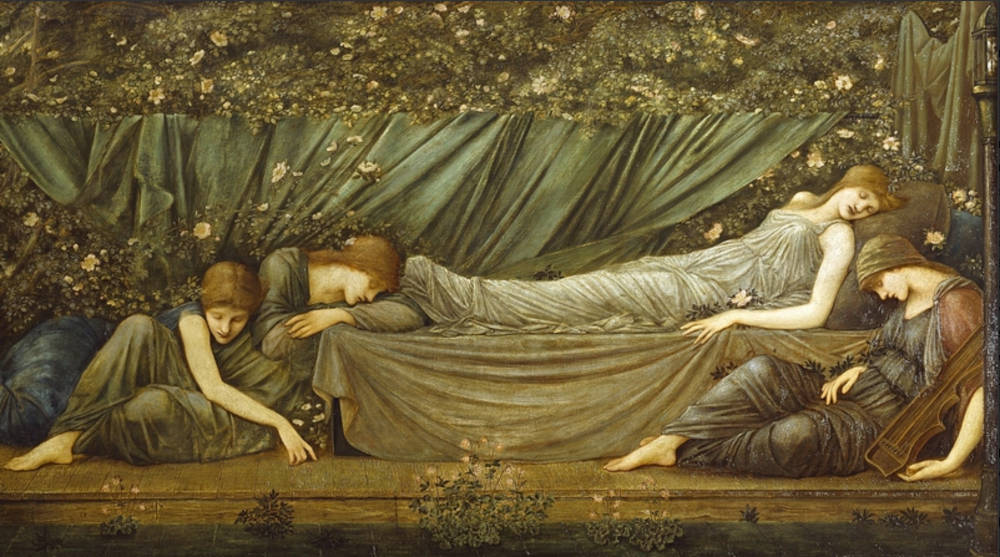
Burne-Jones’s treatment of the Sleeping Beauty in the Briar Rose series.
In Brewtnall’s work the motif is infused with a vibrant intensity: his palette recalls the lusciousness of J. W. Waterhouse’s mythological scenes, and though produced at the very end of the Victorian age (1902) the painting combines Pre-Raphaelite medievalism and the Aesthetic colour contrasts of Whistler and Albert Moore. Once again, Brewtnall absorbs diverse influences, but still manages to produce a work distinctly his own, and is best understood as the author of intricate and sometimes challenging work. He deserves to be better known than he is.
Bibliography
’Art.’ The Spectator 55 (1882): 690 –92.
‘The Frog Prince.’ The Artist and Journal of Home Culture (1 February 1881): 42.
Good Words for the Young (1869).
Once a Week (1867).
Spielmann, M. H. ‘Christian and Evangelist.’ The Magazine of Art 15 (1892): 52.
Created 15 September 2026