
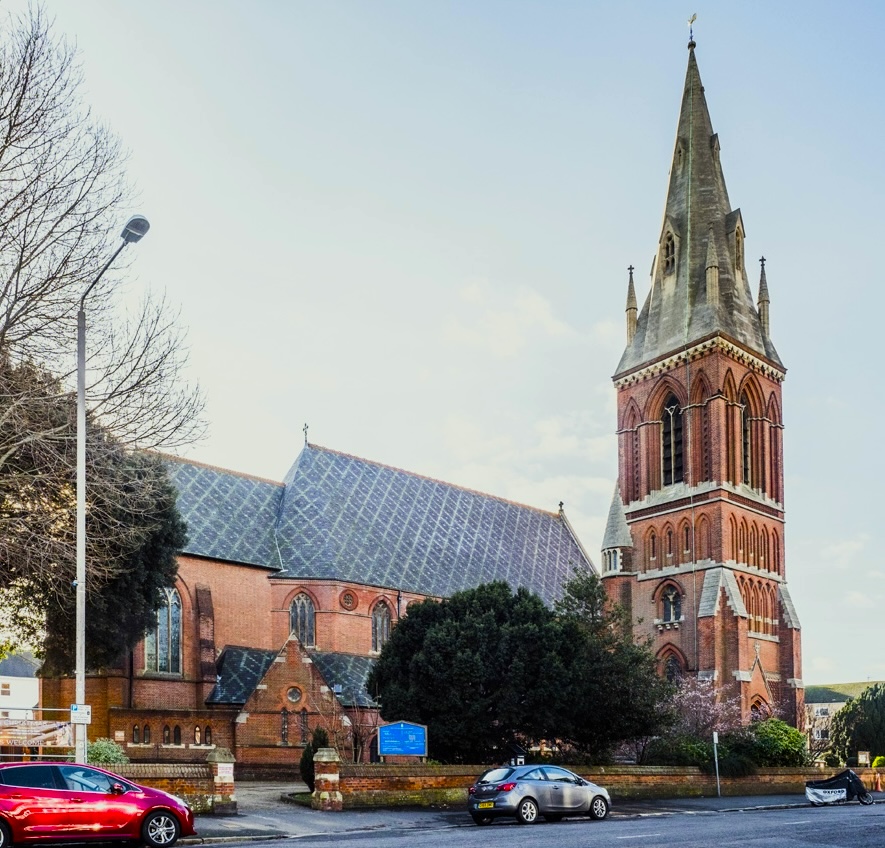
View from South Street. Photograph by John Salmon. [Click on all the images to enlarge them.]
St Saviour's, in South Street, Eastbourne, on the south coast of Sussex, was founded by George Whelpton (1797-1873), a wealthy pill manufacturer, on land donated by the Duke of Devonshire. George's son, Henry Whelpton (1857-1897), woud be the first incumbent. One of G.E. Street's early churches, St Saviour's foundation stone was laid on 17 October 1865, and it was consecrated on 31 January 1867 (dates from church information board). The steeple was added later, in 1870-72, to complete Street's design; at 176' high, it serves as a prominent landmark in the town. The baptistery was added at the west end in 1892, and the south chapel was built in 1903. Another addition, described in the listing text as a "church room," came much later, in 1954. The exterior might seem conventional enough, in red brick with Bath stone dressings — except that the grey slate-tile roofs have a pattern of green diapering. Then, the stone bands and the brickwork above the church entrance (through the north-west tower) have some eye-catching patterned detailing too. Also unusual is the canting of the gabled north chapel, as seen above at the end of the north aisle roof, and the narrow apse at the east end.
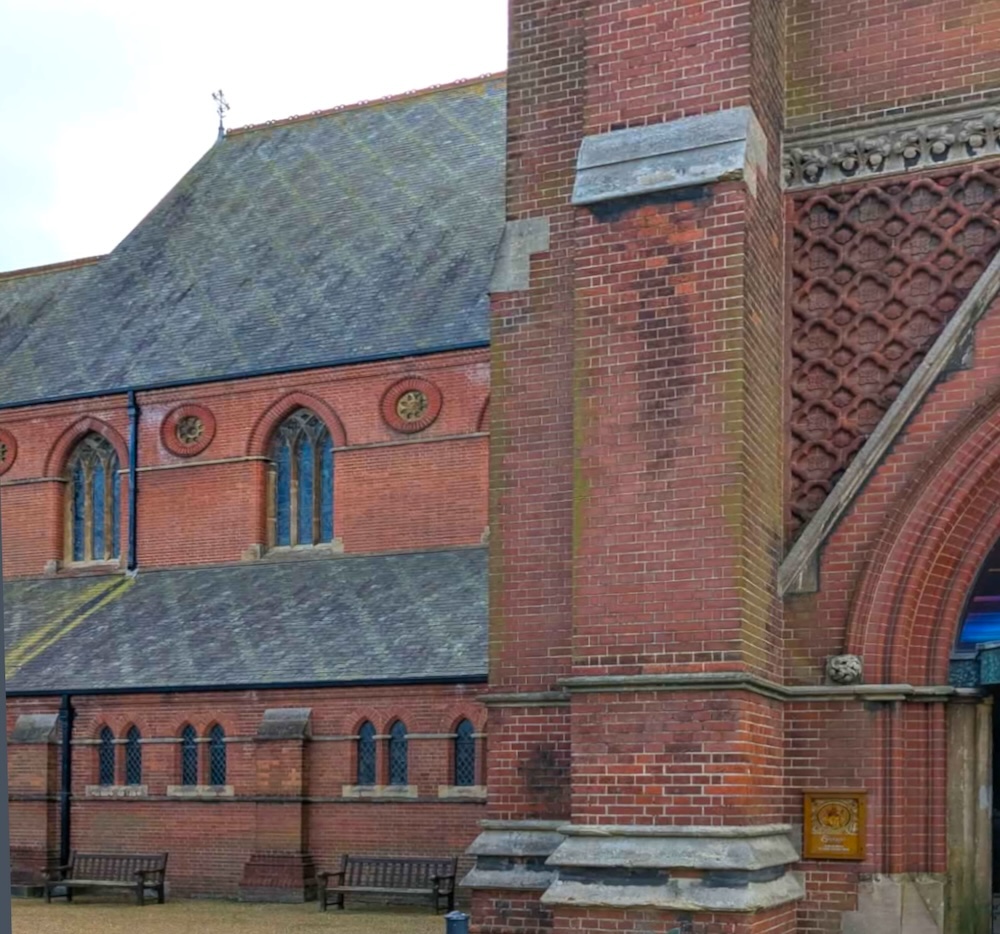
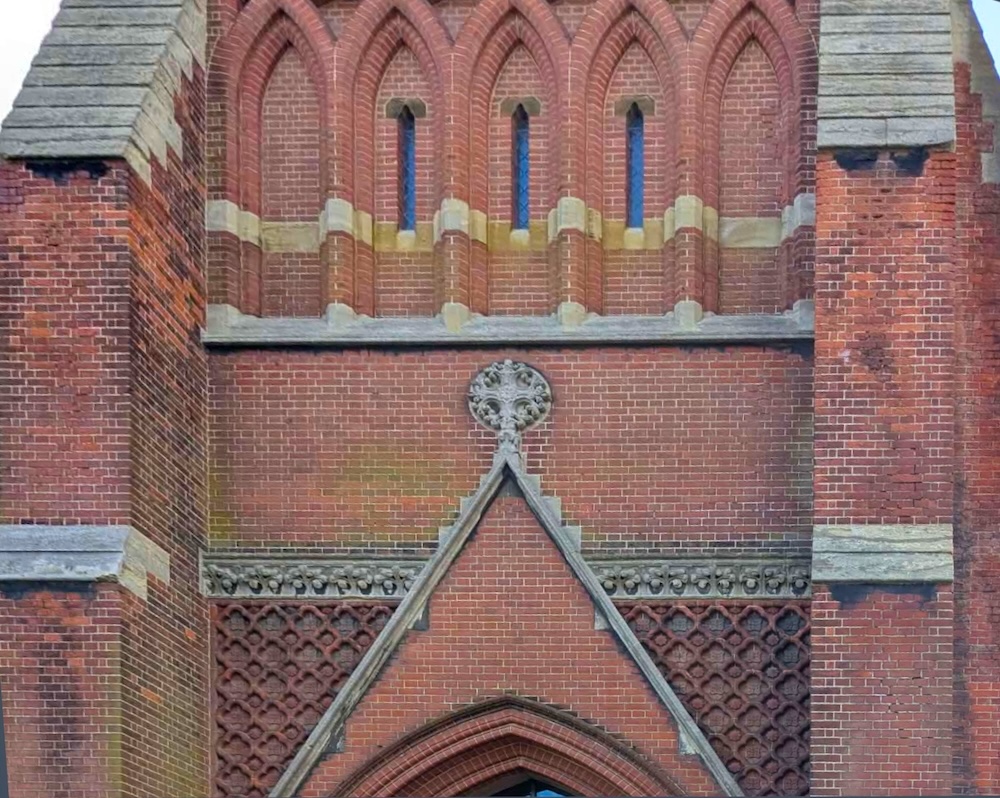
Details. Left: Seen at the north-west, below and adjacent to the tower, the various embellishments on the slate, stone and brickwork. Right: Above the entrance gable and recessed main doors, the stone dressings ribbon across five pointed arches, the middle three housing small slit windows. A floriate cross adorns the peak of the doorway gable in the tower's north wall. Photographs by Robin Banerjee.
Iain Nairn and Nikolaus Pevsner describe the church as the "only worthwhile" Victorian church in the town (486), finding it "excellent" with "a noble steeple" (71), and A.E. Street, in his memoir of his father, describes St Saviour's rightly as one of this architect's "important" churches. Noting that these churches exhibit, as a group, "a marked beauty of outline," he comments particularly on Street's "great skill in the treatment of the junction of the tower and spire, whether there are pinnacles and parapets, or one of the many forms of broaches, and in the treatment, placing, and projection of the spire lights, so that there is no sense of any abruptness in the change from the perpendicular line of the tower to the slope of the spire, but the whole mass seems to spring to the sky from the ground itself in one great sweep." Such churches, says the younger Street, show at once that "their youthful author was something out of the common run" (204). The listing text particularly picks out the design of the steeple, and "the canted treatment of the east end of the nave."
Interior
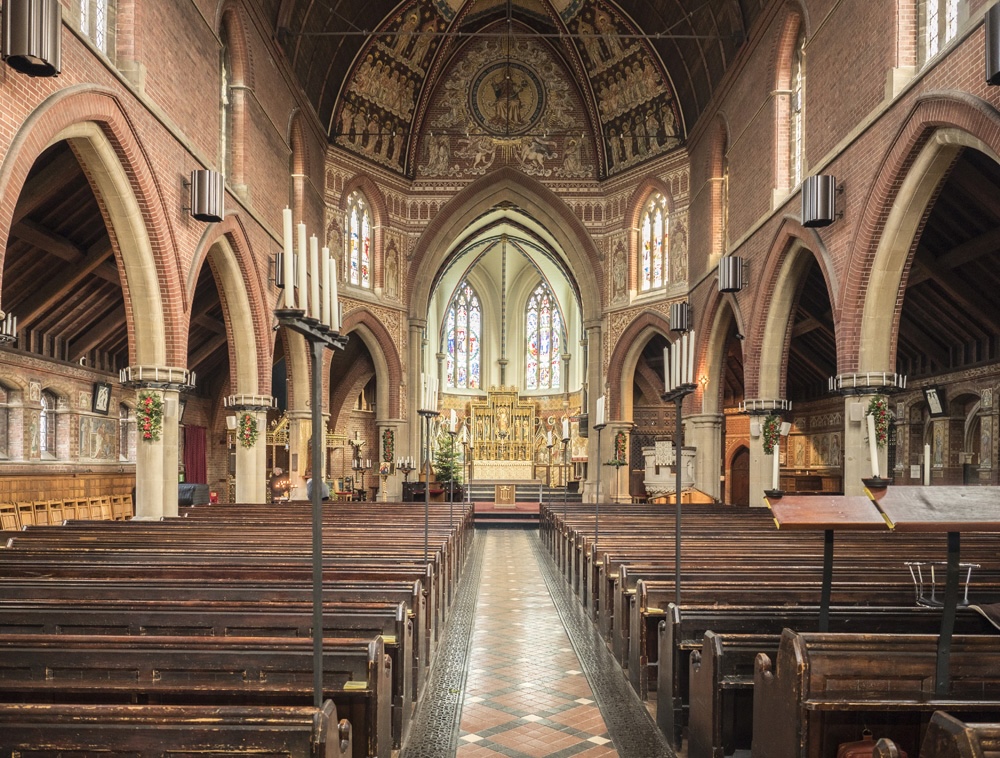
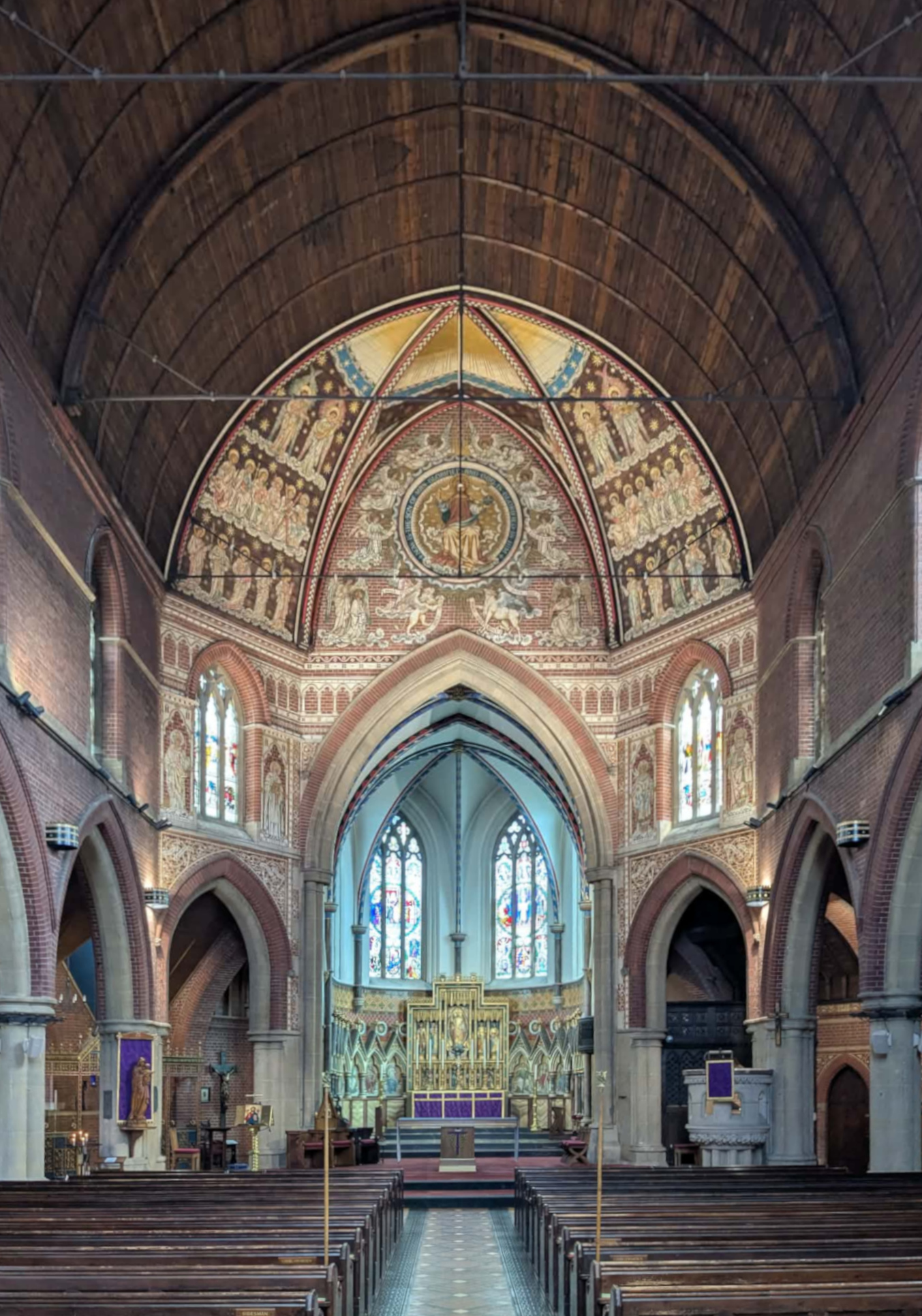
The wide nave with its exposed brick walls and its high roof, its focus on the richly decorated chancel. Photograph by John Salmon.
However, the interior is even more impressive. Expected to accommodate one of those great Victorian congregations (which increased exponentially in the summer months at this popular seaside resort), it is six bays wide, with the aisles remaining quite narrow. The narrowing effect towards the east is of course intentional, making that part of the interior the chief focus — Street was an ardent Tractarian, and this was very much a Tractarian church. The chancel, where the spiritual life of the church was embodied in the ritual of communion, was to be marked by the most intense application of decorative skills, influenced by what the architect had seen on his travels in Italy.
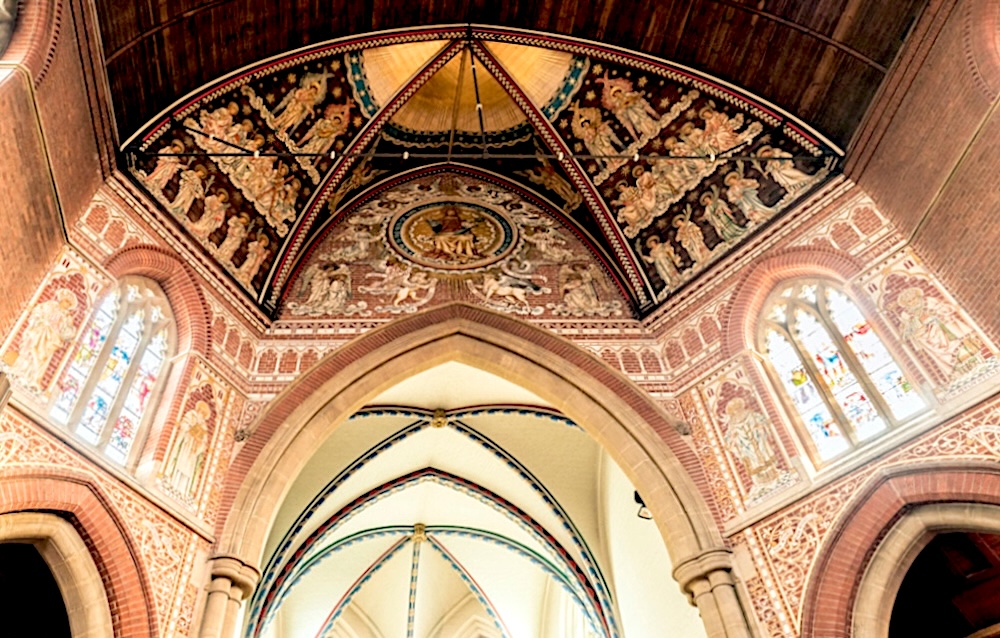
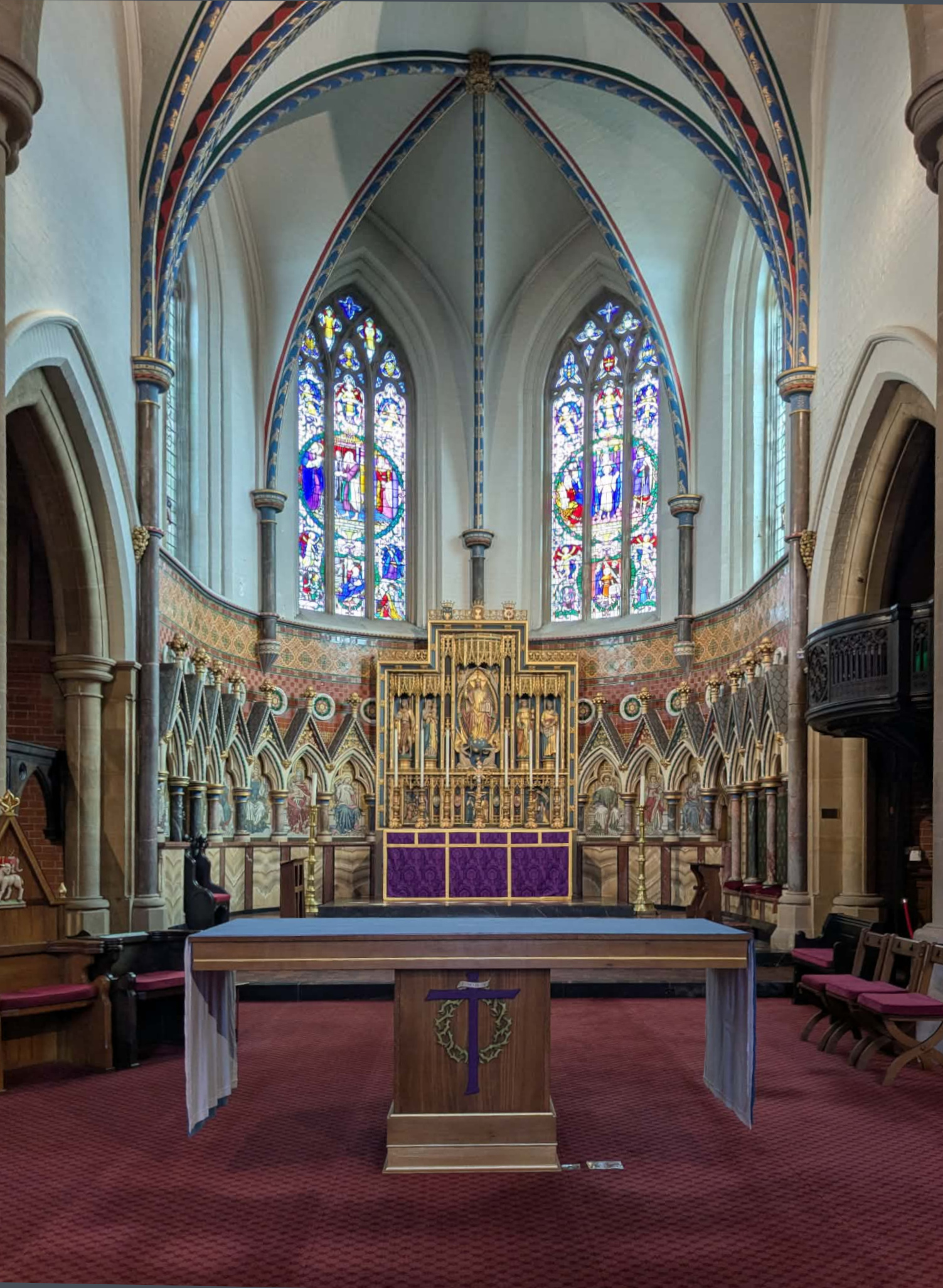
Left to right: (a) Closer view of the chancel, showing the plain boarding of the nave roof giving way to the elaborate and colourful ornamentation of the chancel. (b) The great constrast of the chancel, filled with light and colour and symbolic meaning. (c) The altar, gilded altarpiece and surrounding mosaics. Photographs by Robin Banerjee.
Ideas that would later flower into Street's sumptuous scheme for St Paul's Within the Walls in Rome, had an early airing now in the 60s, in this fashionable town, where he had the encouragement not only of Whelpton senior, but of another wealthy local benefactor, Mrs Harriot Manby. Mrs Manby's second husband was for some time Honorary Secretary of the Institution of Civil Engineers, and she had a connoiseur's eye for such refinements and effects. She "provided substantial funds for the decoration of the church interior for more than 20 years" ("150 years of St Saviour’s"). Indeed, after the plainly boarded nave roof and red-brick walls, the chancel arch and complex decoration of the sanctuary has a dramatic effect. The change starts with Christ in glory presiding over the chancel arch, supported by angels, the four evangelists and important figures from church history. According to the listing text, this was executed by Clayton and Bell. Beyond the arch is the white-painted and ribbed ceiling, altar and reredos, a semi-circle of niches decorated with mosaic saints, and more colourful floor-tiling. The effect is dazzling — especially as lit by the tall stained-glass East windows. The circular marble pulpit, glimpsed on the right of the chancel arch in front of the pews, was carved by Thomas Earp. Metalwork such as the lectern and the screen to the north chapel would have been executed by Thomas Potter, whose partial list of churches supplied numbers St Saviour's among his clients.

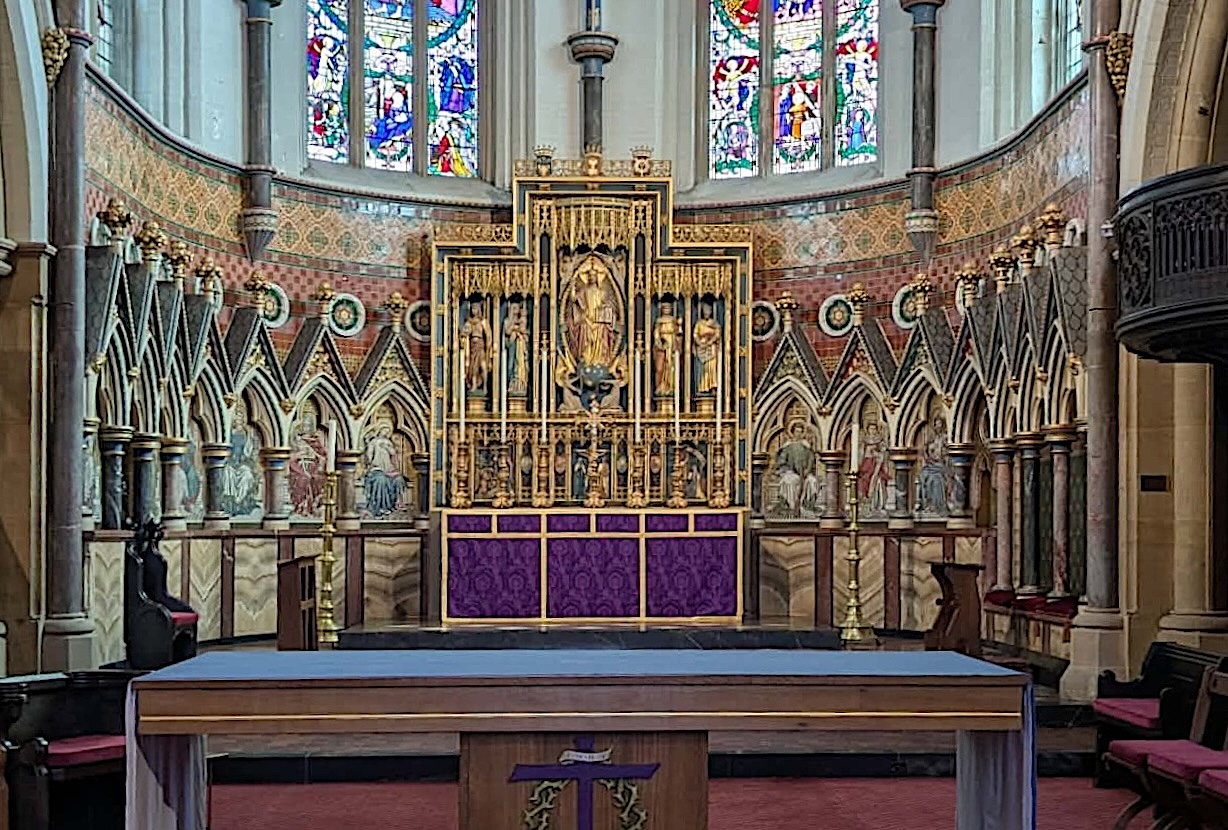
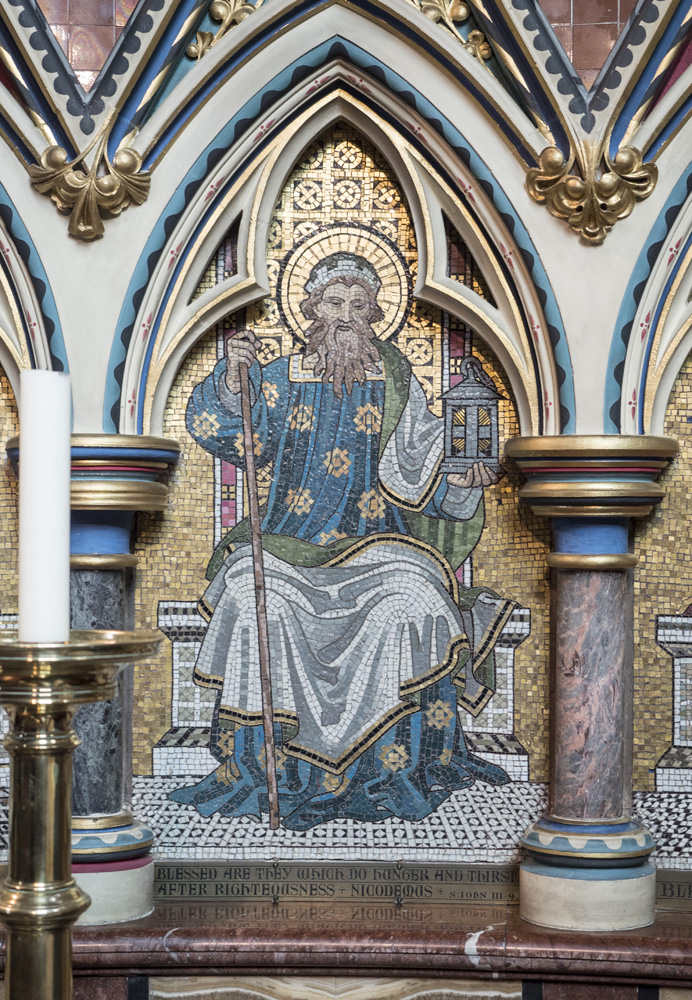
Left: Closer view of the intricately carved and gilded altarpiece, and the mosaic-series on the apse walls. Photograph by Robin Banerjee. Right: One of the niches, showing Nicodemus with his lantern: he came to Jesus discretely, by night, in his search for truth (see John, 3). Photograph by John Salmon.
The fittings, including the pulpit, would have been designed by Street himself, but, according to the listing text again, the original reredos was "lost," and replaced in 1937. This later one harmonises well with the other decorative elements: it too has a series of niches, much smaller in scale, with Christ in Glory, and his saints around him — emphasizing the theme of the chancel arch painting. Unfortunately, Eastbourne suffered heavily from the bombing raids of World War II, and the stained glass is not original. Still, it was designed by a much-admired stained glass artist of a later period, Christopher Webb (1886-1966), and is very striking.
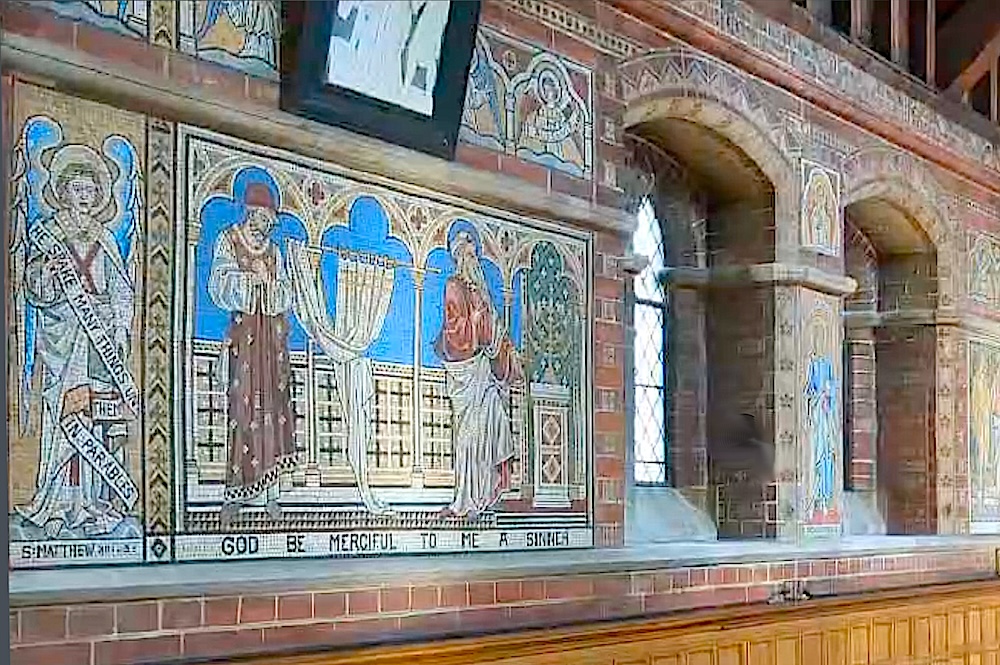
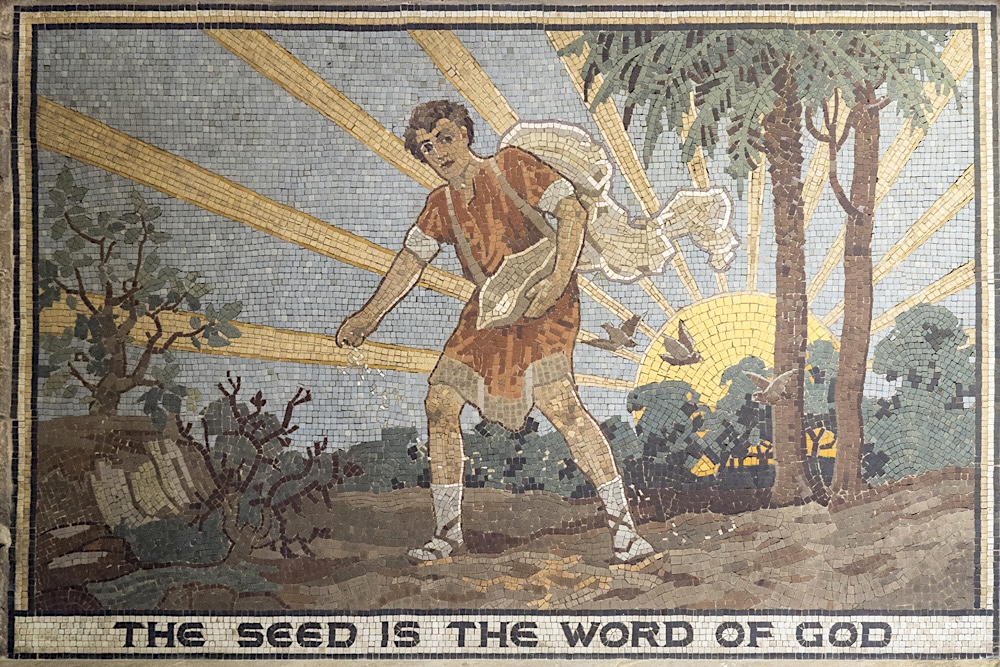
Examples of the mosaics along the north and south aisle walls. Left: a scene from the parable of the Pharisee and the publican (Luke 18, 9-14). Photograph by Robin Banerjee. Right: The parable of the sower (Luke 8, 5-15). Photograph by John Salmon.
From an aesthetic point of view, the width of the nave means that the mosaics along the aisle walls make less of an impact from the west end than those in the chancel apse. But they are deeply meaningful in themselves. In the parable of the Pharisee and the publican, on the left above, the publican, head bowed and hands clasped in earnest prayer, is contrasted with the self-righteous Pharisee who feels himself superior to others; value is placed on humility and consciousness of sin. On the right, the well-known parable of the sower encourages us to be like the "good ground" in which the message of the bible takes root and proves fruitful. The sun rises powerfully, with obvious symbolic significance, behind the vigorous action of the labourer in the field. Like the other parts of the church's decorative scheme, these scenes are instructive, persuasive and inspiring as well as visually appealing, and contribute to the whole experience of church-going. And they do help to prepare for the dramatic transition at the chancel arch. The church's own information board explains that they were "designed by Clayton and Bell and mostly executed by Capello and Salviati.
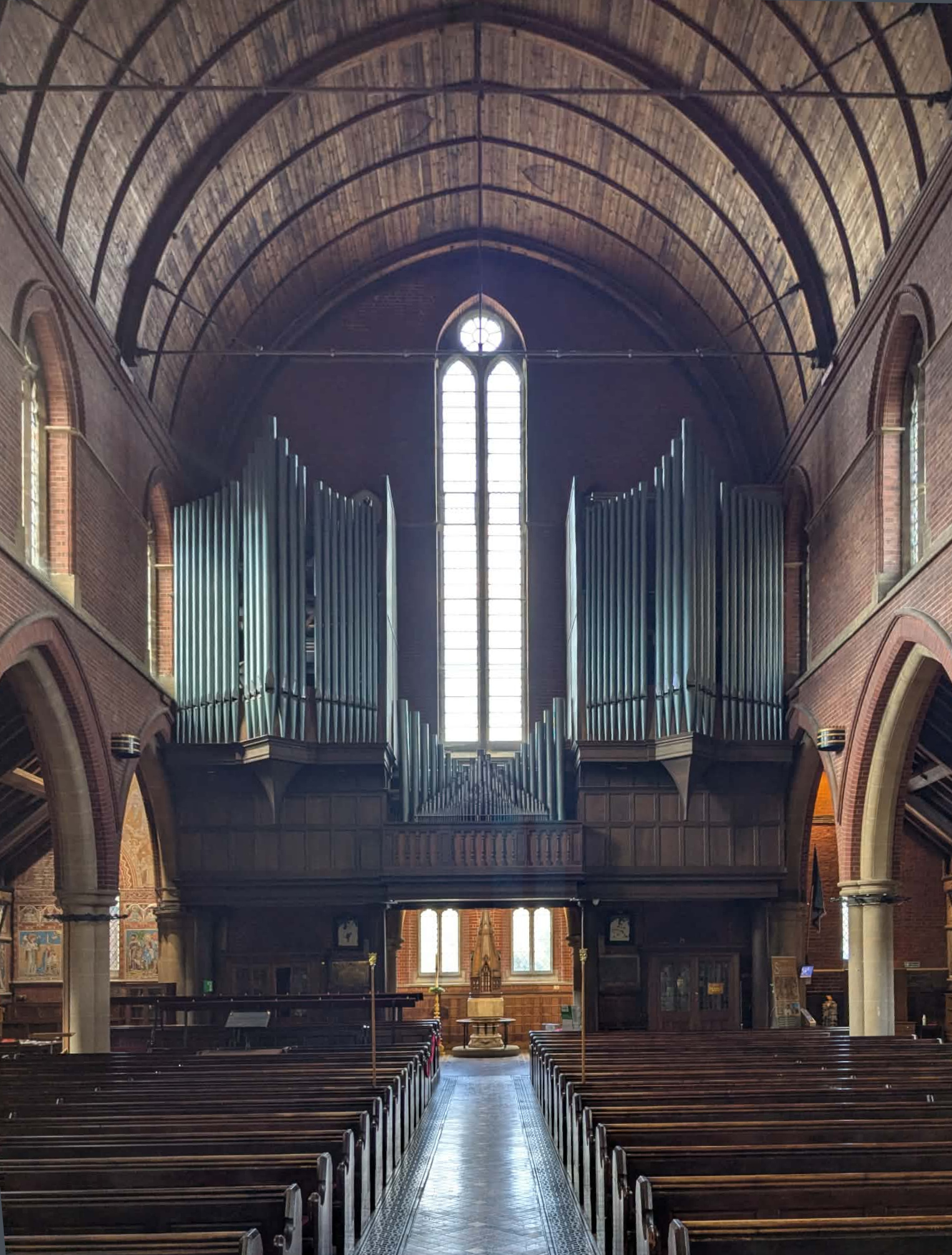
Looking west down the nave. The font can be seen at the west end.
Photograph by Robin Banerjee.
The church gets its high listing from Historic England for several specific reasons. The first is its success as architecture, its "generous scale ... splendid design with fine proportions and inventive detail"; the second, the presentation of its interior, its "outstanding scheme of decoration, added over a period of time, with noteworthy painted decoration over the entrance to the chancel and a series of mosaics, all by the well-known firm of Clayton and Bell." Street would doubtless have been gratified professionally by this assessment, although his fundamental aim was always to use his professional skills and aesthetc sensibility in the service of his religious beliefs, so that the church itself would stand as a convincing sermon for all who entered it.
Photographs by John Salmon and Robin Banerjee. You may use the images without prior permission for any scholarly or educational purpose as long as you (1) credit the photographer and (2) link your document to this URL in a web document or to the Victorian Web in a print document.
Bibliography
"150 Years of St Saviour's Church, Eastbourne." St Saviour's Eastbourne. Web. 3 April 2026. https://www.stsaviourseastbourne.org.uk/a-detailed-history-of-st-saviours
Carson, Patrick. Thomas Potter: Victorian Craftsman, 1804-1895. Vol. 2. 2 Vols. Privately printed, 2018.
Church of St Saviour, South Street, Eastbourne, BN12 4UT. Historic England. Web. 3 April 2026.
Nairn, Ian, and Nikolaus Pevsner. Sussex. Buildings of England series. London: Penguin, 2001.
Street, Arthur Edmund. Memoir of George Edmund Street RA, 1824-1881. London: John Murray, 1888. Internet Archive. Contributed by the Getty Research Institute. Web. 3 April 2026.
Created 3 April 2026