
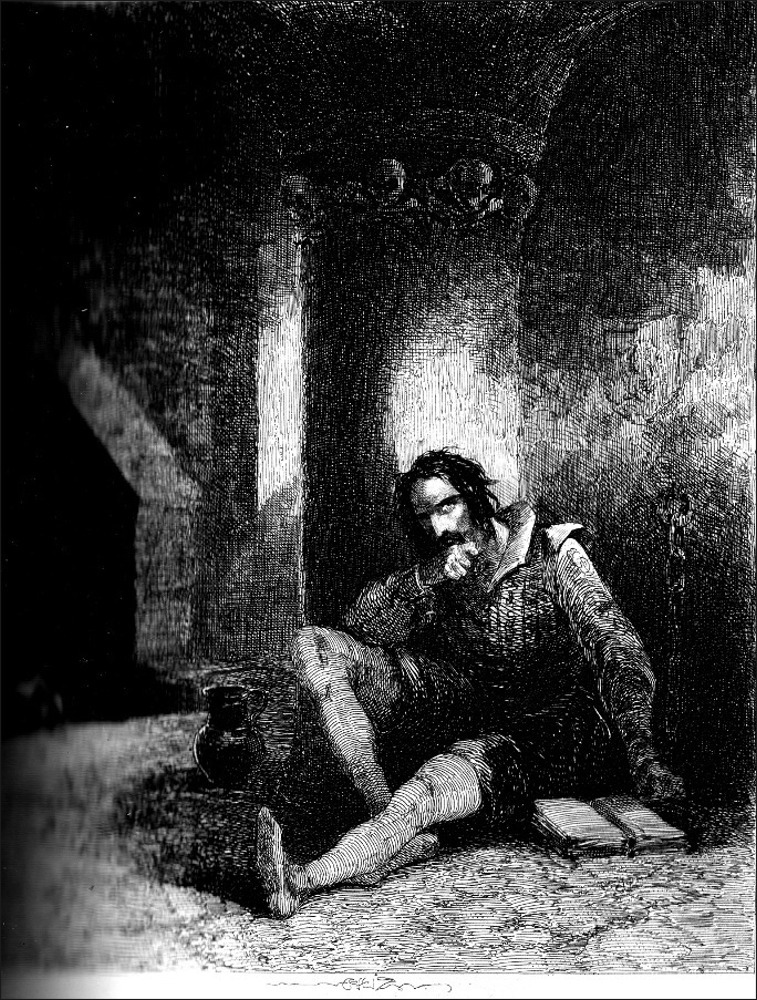
Rougemont's device to perplex Auriol
Phiz
August 1845
12.8 cm high by 10.9 cm wide (5 by 4 inches), framed
Facing page 196 in volume, for William Harrison Ainsworth's Auriol; Or, The Elixir of Life (London: Chapman and Hall, 1850)
[Click on the image to enlarge it and mouse over text for links.]
Scanned image & text by Philip V. Allingham.
[You may use this image without prior permission for any scholarly or educational purpose as long as you (1) credit the person who scanned the image and (2) link your document to this URL in a web document or cite the Victorian Web in a print one.]

Passage Illustrated: Was it merely a draught-induced dream after all?
"Now it comes," cried the listener.
"Oh, that I could shake off the conviction that this were not so — that my soul, though heavily laden, might still be saved! Oh, that I dared to hope this!"
"I must interrupt him if he pursues this strain," said the listener.
"Whether my crimes are real or imaginary — whether I snatched the cup of immortality from my grandsire's dying lips — whether I signed a compact with the Fiend, and delivered him a victim on each tenth year — I cannot now know; but if it is so, I deeply, bitterly regret them, and would expiate my offences by a life of penance."
At this moment Rougemont, attired in a dress similar to that of the prisoner, marched up the steps, and cried, "What ho, Auriol! — Auriol Darcy!"
"Who speaks?" demanded Auriol. "Ah! is it you, Fiend?"
"What, you are still in your old fancies," rejoined Rougemont. "I thought the draught I gave you last night would have amended you."
"Tell me who and what I am," cried Auriol, stupefied with astonishment; "in what age I am living; and whether I am in my right mind or not?"
"For the first, you are called Auriol Darcy," replied Rougemont; "for the second, you are living in the reign of his most Catholic Majesty James I. of England, and Sixth of Scotland; and for the third, I trust you will soon recover your reason." ["Book The Second — Cyprian Rougement," Chapter Five, "New Perplexities," pp. 196-197 in volume]
Commentary: The Return to the Earlier Chronological Setting and a Pensive Auriol
Certainly the most disjointed of Ainsworth's novels, and probably unfinished, this is the story of Auriol Darcy, a young Elizabethan who dreams (or did it really happen?) that he kills his great-grandfather, an alchemist who goes by the name of Dr. Lamb, in order to possess himself of the "elixir of life" which enables him to live on to the nineteenth century, subject from 1800 on to a curse which requires that he deliver up every ten years a woman he loves to the devil, otherwise known as Rougemont. [Worth, 120]
Ainsworth seems to have written himself into a corner, so that Phiz's showing Auriol once again in Elizabethan garb in this final serial engraving signals the narrative's adopting the dream vision gambit used most famously the year before by Charles Dickens to conclude the supernatural visions of Ebenezer Scrooge in A Christmas Carol. Ainsworth suddenly returns his protagonist to Dr. Lamb's Southwark laboratory, where (apparently) he has fallen asleep and has been dreaming his time-travel adventure. Consequently, Ainsworth has abandoned the conventional resolving of plot issues: Auriol has simply "lived centuries in a few nights" (last page of Chapter VI, "Dr. Lamb Again"). No such person as Ebba Thorneycroft, Rougement informs Auriol, has ever (in his experience) existed, although in his fitful slumbers Auriol has been raving about her. The head in the lower corner is presumably that of Rougement himself, acting as the raving youth's keeper in the bowels of Dr. Lamb's laboratory, with the skull-decorated pillar being precisely that which Lever has described as "a massive granite pillar, the capital of which was grotesquely ornamented with death's-heads and cross-bones" (193).
The final plate is suitably contemplative as, having experienced Auriol's adventures across the centuries, the character study of the pensive protagonist invites readers to consider whether the protagonist has actually learned anything about himself and derived any insights from those he has caused to suffer, including his own grandfather (Dr. Lamb) and his numerous amours, to say nothing of such distraught parents as Mr. Talbot and Mr. Thorneycroft.
Other Character Studies in Phiz's Narrative-Pictorial Sequence
- Mr. Tuffnell Trigge, The Barber of London
- Cyprian de Rougement: The Tomb of the Rosicrucian
- Cyprian de Rougement and Auriol Darcy: The Compact
Related Material Related to the Artist and the Author
- Hablot Knight Browne, 1815-1882; A Brief Biography
- William Harrison Ainsworth (1805-1882)
- William Harrison Ainsworth (1805-1882) — King of the Historical Potboiler: A Brief Biography
Bibliography
Ainsworth, William Harrison. Auriol; Or, The Elixir of Life. London: Chapman and Hall, 1850; George Routledge and Sons, 1865.
Ainsworth, William Harrison. Auriol; Or, The Elixir of Life. The New Monthly Magazine. July-August, 1845.
Ainsworth, William Harrison. Revelations of London. Ainsworth's Magazine: A Miscellany of Romance. London: John Mortimer, 1844-45 (Vols. VII & VIII).
Lester, Valerie Browne. Phiz: The Man Who Drew Dickens. London: Chatto and Windus, 2004.
Steig, Michael. Dickens and Phiz. Bloomington & London: Indiana U. P., 1978.
Sutherland, John A. "Auriol." The Stanford Companion to Victorian Fiction. Stanford, Cal.: Stanford U. P., 1989, rpt. 1990, 33.
Vann, J. Don. "Auriol; Or, The Elixir of Life in Ainsworth's Magazine, October 1844 — May 1845." Victorian Novels in Serial. New York: Modern Language Association, 1985. Pp. 24-25.
Worth, George J. "Appendix: Concise Synopsis of Ainsworth's Novels." William Harrison Ainsworth. New York: Twayne, 1972. Pp. 117-124.
Victorian
Web
Illus-
tration
Phiz
Auriol
Next
8 October 2026