
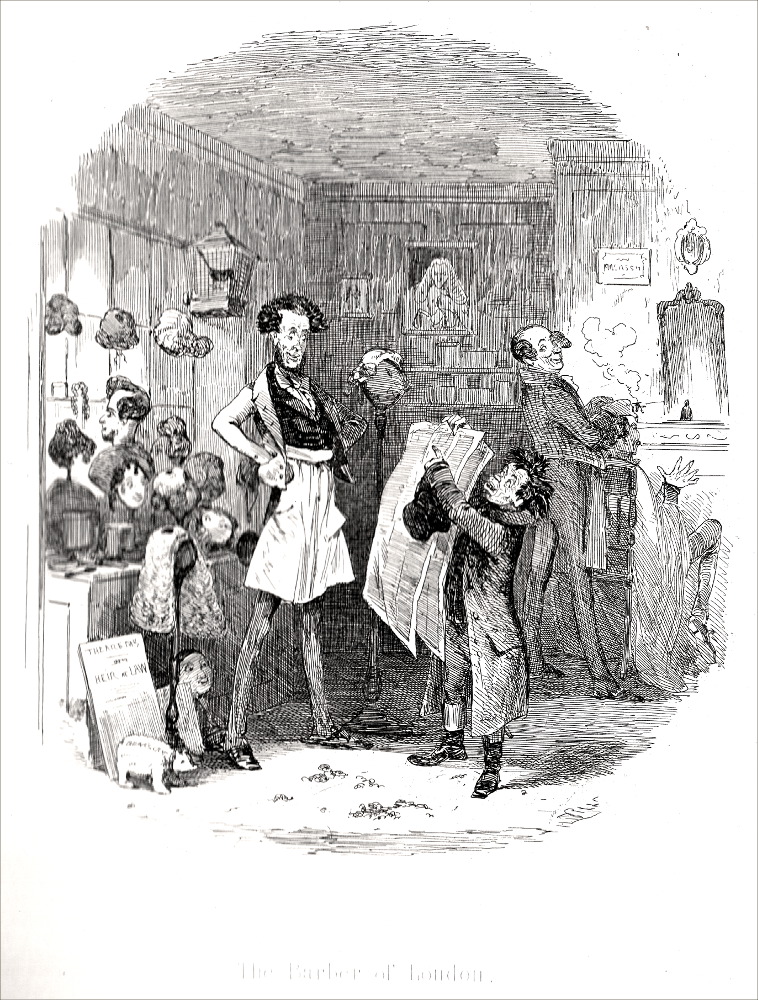
The Barber of London
Phiz
January 1845
12.9 cm high by 10.7 cm wide (5 by 4 ¼ inches), vignetted
Facing page 100, for William Harrison Ainsworth's Auriol; Or, The Elixir of Life (London: Chapman and Hall, 1850; rpt., 1865)
[Click on the image to enlarge it and mouse over text for links.]
Scanned image & text by Philip V. Allingham.
[You may use this image without prior permission for any scholarly or educational purpose as long as you (1) credit the person who scanned the image and (2) link your document to this URL in a web document or cite the Victorian Web in a print one.]

Passage Illustrated: A Portrait of "Mr. Tuffnell Trigge," Barber at Lincoln's Inn Fields
At the time of his introduction to the reader, Mr. Trigge had just advertised for an assistant, his present young man, Rutherford Watts, being about to leave him, and set up for himself in Canterbury. It was about two o'clock, and Mr. Trigge had just withdrawn into an inner room to take some refection, when, on returning, he found Watts occupied in cutting the hair of a middle-aged, sour-looking gentleman, who was seated before the fire. Mr. Trigge bowed to the sour-looking gentleman, and appeared ready to enter into conversation with him, but no notice being taken of his advances, he went and talked to his magpie.
While he was chattering to it, the sagacious bird screamed forth: "Pretty dear! — pretty dear!"
"Ah! what's that? Who is it?" cried Trigge.
"Pretty dear! — pretty dear!" reiterated the magpie.
Upon this, Trigge looked around, and saw a very singular little man enter the shop. He had somewhat the appearance of a groom, being clothed in a long grey coat, drab knees, and small top-boots. He had a large and remarkably projecting mouth, like that of a baboon, and a great shock head of black hair.
"Pretty dear! — pretty dear!" screamed the magpie.
"I see nothing pretty about him," thought Mr. Trigge. "What a strange little fellow! It would puzzle the Lord Chancellor himself to say what his age might be."
The little man took off his hat, and making a profound bow to the barber, unfolded the Times newspaper, which he carried under his arm, and held it up to Trigge.
"What do you want, my little friend, eh?" said the barber.
"High wages! — high wages!" screamed the magpie.
"Is this yours, sir?" replied the little man, pointing to an advertisement in the newspaper.
"Yes, yes, that's my advertisement, friend," replied Mr. Trigge. "But what of it?" ["Book the First — Ebba," Chapter VIII. "The Barber of London," pp. 99-100]
Commentary: Dr. Lamb's Deputy Flapdragon (Old Parr) Pops Up Again
Phiz has condensed several pages of description of the shop and the proprietor to present the arrival of Dr. Lamb's assistant, Flapdragon, from the previous chapters, as an applicant for the advertised position of assistant barber and perruquier or wig-stylist (at which he became adept in the reign of Charles the Second). As is the case with many of the serial plates, the chapter title is repeated in the caption for that monthly instalment's illustration as Ainsworth introduces readers to "The Barber of London" — "Mr. Tuffnell Trigge — Figaro himself could not be pleasanter" (95) in the chapter's opening paragraph. Phiz incorporates many details from the writer's verbal portrait of the gossip-retailing hair-cutter and stylist:
And now as to Mr. Tuffnell Trigge himself. He is very tall and very thin, and holds himself so upright that he loses not an inch of his stature. His head is large and his face long, with marked, if not very striking features, charged, it must be admitted, with a very self-satisfied expression. One cannot earn the appellation of the Barber of London without talent; and it is the consciousness of this talent that lends to Mr. Trigge's features their apparently conceited expression. A fringe of black whisker adorns his cheek and chin, and his black bristly hair is brushed back, so as to exhibit the prodigious expanse of his forehead. His eyebrows are elevated, as if in constant scorn.
The attire in which Mr. Trigge is ordinarily seen, consists of a black velvet waistcoat, and tight black continuations. These are protected by a white apron tied round his waist, with pockets to hold his scissors and combs; over all, he wears a short nankeen jacket, into the pockets of which his hands are constantly thrust when not otherwise employed. A black satin stock with a large bow encircles his throat, and his shirt is fastened by black enamel studs. Such is Mr. Tuffnell Trigge, yclept the Barber of London. ["Book the First — Ebba," Chapter VIII. "The Barber of London," 94]
Only here at the close of Chapter VIII of Book the First, "The Barber of London," do we learn that Flapdragon (alias, "Old Parr" and "The Old Venerable") is actually one "Gregory Morse" (102). The curtain also leaves readers wondering about the identity of the "sour-looking gentleman," and why he seems interested in hiring Flapdragon: "And they left the shop together" (103).
Victorian Barbers in 19th c. Illustrations
- The Barber's Shop by Cruikshank in Memoirs of Joseph Grimaldi (1838)
- Easy Shaving by Phiz in Martin Chuzzlewit (1843)
- "Whose image is that!" by W. H. C. Groome in Master Humphrey's Clock (1907)
- The Barber by George Barnard O'Neill
Related Material
- Hablot Knight Browne, 1815-1882; A Brief Biography
- William Harrison Ainsworth (1805-1882)
- William Harrison Ainsworth (1805-1882) — King of the Historical Potboiler: A Brief Biography
Bibliography
Ainsworth, William Harrison. Auriol; Or, The Elixir of Life. London: Chapman and Hall, 1850; George Routledge and Sons, 1865.
Ainsworth, William Harrison. Revelations of London. Ainsworth's Magazine. Vol. VII (October — December 1844) and Vol. VIII (January — May 1845).
Lester, Valerie Browne. Phiz: The Man Who Drew Dickens. London: Chatto and Windus, 2004.
Steig, Michael. Dickens and Phiz. Bloomington & London: Indiana U. P., 1978.
Sutherland, John A. "Auriol." The Stanford Companion to Victorian Fiction. Stanford, Cal.: Stanford U. P., 1989, rpt. 1990, 33.
Vann, J. Don. "Auriol; or, The Elixir of Life, published as Revelations of London in Ainsworth's Magazine, October 1844 through May 1845, in Ainsworth's Magazine, October 1844 — May 1845 (partal publication)." Victorian Novels in Serial. New York: Modern Language Association, 1985. Pp. 24-25.
Vann, J. Don. "Auriol; or, The Elixir of Life, in the New Monthly Magazine, July — August 1845." Victorian Novels in Serial. New York: Modern Language Association, 1985. P. 25.
Victorian
Web
Illus-
tration
Phiz
Auriol
Next
7 October 2026