
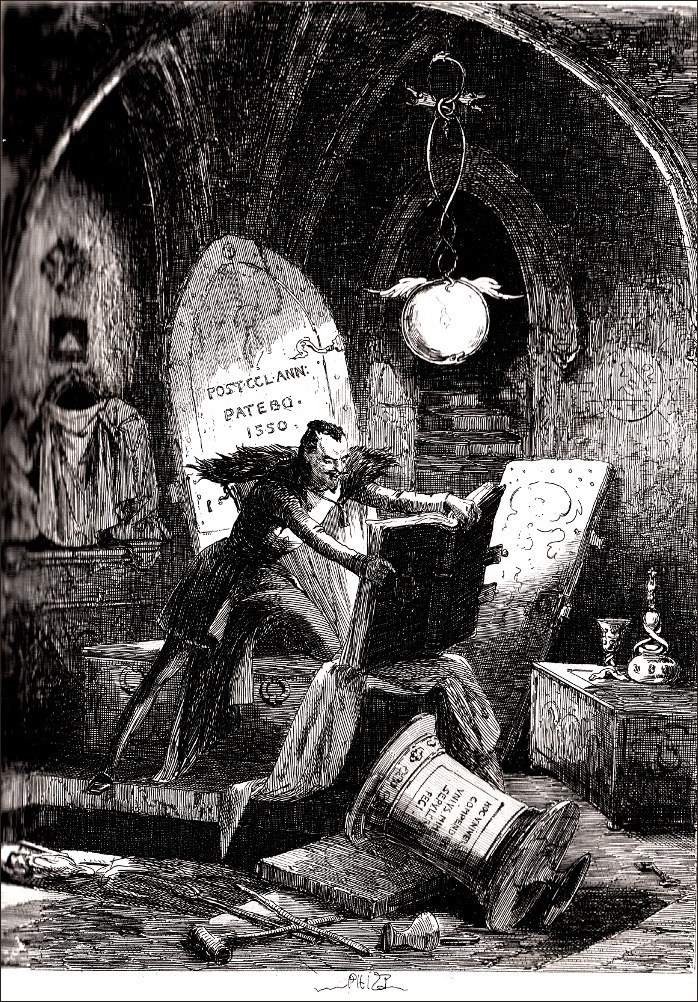
The Tomb of the Rosicrucian
Phiz
March 1845
13.4 cm high by 9.9 cm wide (5 ¼ by 3 ¾ inches), framed
Facing page 134, for William Harrison Ainsworth's Auriol; Or, The Elixir of Life (London: Chapman and Hall, 1850; rpt., 1865)
[Click on the image to enlarge it and mouse over text for links.]
Scanned image & text by Philip V. Allingham.
[You may use this image without prior permission for any scholarly or educational purpose as long as you (1) credit the person who scanned the image and (2) link your document to this URL in a web document or cite the Victorian Web in a print one.]

Passage Illustrated: Cyprian de Rougement, The Faustian Antagonist, Enters the Tomb
With this he hastily quitted the room, but returned almost immediately with a mallet, a lever, and a pitchfork; armed with which and the lantern, he crept through the aperture. This done, he found himself at the head of a stone staircase, which he descended, and came to the arched entrance of a vault. The door, which was of stout oak, was locked, but holding up the light towards it, he read the following inscription:
"In two hundred and fifty years I shall open!" cried Rougemont, "and the date 1550 — why, the exact time is arrived. Old Cyprian must have foreseen what would happen, and evidently intended to make me his heir. There was no occasion for the devil's interference. And see, the key is in the lock. So!" And he turned it, and pushing against the door with some force, the rusty hinges gave way, and it fell inwards.
From the aperture left by the fallen door, a soft and silvery light streamed forth, and, stepping forward, Rougemont found himself in a spacious vault, from the ceiling of which hung a large globe of crystal, containing in its heart a little flame, which diffused a radiance, gentle as that of the moon, around. This, then, was the ever-burning lamp of the Rosicrucians, and Rougemont gazed at it with astonishment. Two hundred and fifty years had elapsed since that wondrous flame had been lighted, and yet it burnt on brightly as ever. Hooped round the globe was a serpent with its tail in its mouth — an emblem of eternity — wrought in purest gold; while above it were a pair of silver wings, in allusion to the soul. Massive chains of the more costly metal, fashioned like twisted snakes, served as suspenders to the lamp.
But Rougemont's astonishment at this marvel quickly gave way to other feelings, and he gazed around the vault with greedy eyes. ["The Intermean — 1800," Chapter One, "The Tomb of the Rosicrucian," pp. 134-135]
Passage Illustrated: de Rougement opens his ancestor's tomb
The exact moment depicted, with de Rougemont greedily studying a huge volume (flanked by the Latin inscription about when the tomb will open), would seem to be the following:
Rougemont placed the point of the lever between the interstices of the broken stone, and, exerting all his strength, speedily raised the fragments, and laid open the grave [of his ancestor].
Within it, in the garb he wore in life, with his white beard streaming to his waist, lay the uncoffined body of his ancestor, Cyprian de Rougemont. The corpse had evidently been carefully embalmed, and the features were unchanged by decay. Upon the breast, with the hands placed over it, lay a large book, bound in black vellum, and fastened with brazen clasps. Instantly possessing himself of this mysterious-looking volume, Rougemont knelt upon the nearest chest, and opened it. But he was disappointed in his expectation. All the pages he examined were filled with cabalistic characters, which he was totally unable to decipher.
At length, however, he chanced upon one page the import of which he comprehended, and he remained for some time absorbed in its contemplation, while an almost fiendish smile played upon his features.
"Aha!" he exclaimed, closing the volume, "I see now the cause of my extraordinary dream. My ancestor's wondrous power was of infernal origin — the result, in fact, of a compact with the Prince of Darkness. But what care I for that? Give me wealth — no matter what source it comes from! — ha! ha!" ["The Intermean — 1800," Chapter One, "The Tomb of the Rosicrucian," pp. 136-137]
Commentary
In the "Intermean," set in 1800, devilish Rougement visits the tomb of his Rosicrucian ancestor, also named Cyprian de Rougement, to access that ancestor's considerable treasure horde. Instead of yielding up his own soul to the Devil to acquire this wealth, however, de Rougement bargains with the Dark Powers to deliver the soul of Auriol Darcy. In exchange for a mansion worth over a hundred thousand pounds, Auriol agrees to provide Cyprian with a female victim upon demand: his first target proves to be Auriol's beloved, Elizabeth Talbot.
The illustration, of course, merely serves to heighten the suspense as Phiz makes readers wonder what directions de Rougement's ancestor has left in the indecipherable "cabalistic characters," and how the present-day de Rougement is to deal with the infernal pact in order to access his ancestor's boundless wealth in silver, gold, and pearls. But, more significantly, this scene at the curtain of the chapter leaves readers wondering how the villain will capture Edith Talbot and seize Auriol's soul:
But I must not neglect another agent which is offered me. That bottle, I have learnt from yon volume, contains an infernal potion, which, without destroying life, shatters the brain, and creates maddening fancies. It will well serve my purpose; and I thank thee, Satan, for the gift. [137]
Related Material
- Hablot Knight Browne, 1815-1882; A Brief Biography
- William Harrison Ainsworth (1805-1882)
- William Harrison Ainsworth (1805-1882) — King of the Historical Potboiler: A Brief Biography
Bibliography
Ainsworth, William Harrison. Auriol; Or, The Elixir of Life. London: Chapman and Hall, 1850; George Routledge and Sons, 1865.
Ainsworth, William Harrison. Revelations of London. Ainsworth's Magazine. Vol. VIII (January — May 1845).
Lester, Valerie Browne. Phiz: The Man Who Drew Dickens. London: Chatto and Windus, 2004.
Steig, Michael. Dickens and Phiz. Bloomington & London: Indiana U. P., 1978.
Sutherland, John A. "Auriol." The Stanford Companion to Victorian Fiction. Stanford, Cal.: Stanford U. P., 1989, rpt. 1990, 33.
Vann, J. Don. "Auriol; Or, The Elixir of Life in Ainsworth's Magazine, October 1844 — May 1845." Victorian Novels in Serial. New York: Modern Language Association, 1985. Pp. 24-25.
Victorian
Web
Illus-
tration
Phiz
Auriol
Next
7 October 2026