
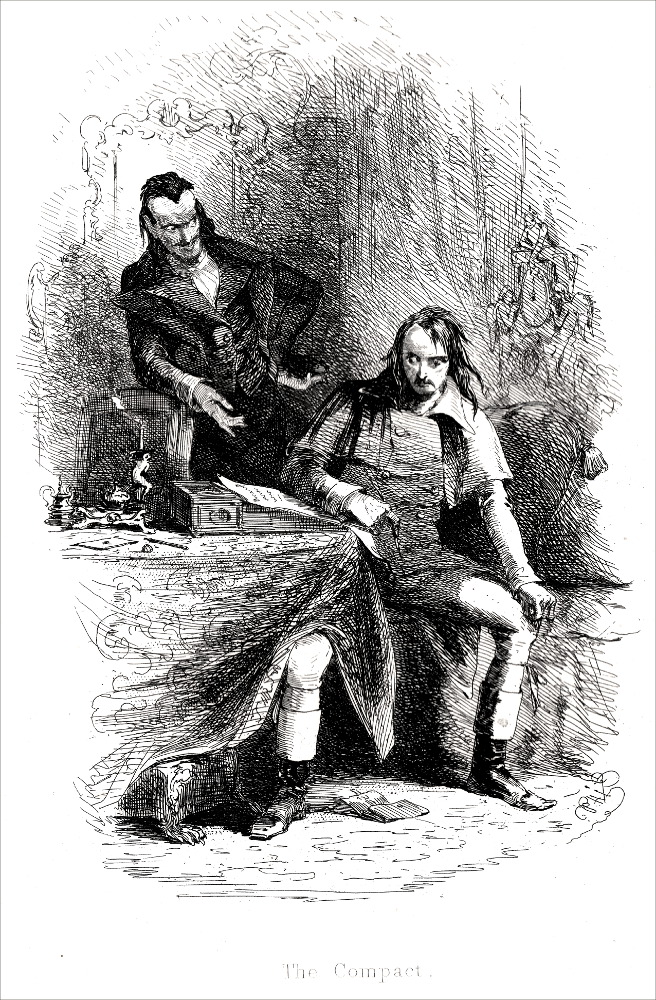
The Compact
Phiz
March 1845
14.7 cm high by 9.7 cm wide (5 ¾ by 3 ¾ inches), vignetted
Facing page 283 in serial, page 141 in volume, for William Harrison Ainsworth's Auriol; Or, The Elixir of Life (London: Chapman and Hall, 1850; rpt. 1865)
[Click on the image to enlarge it and mouse over text for links.]
Scanned image & text by Philip V. Allingham.
[You may use this image without prior permission for any scholarly or educational purpose as long as you (1) credit the person who scanned the image and (2) link your document to this URL in a web document or cite the Victorian Web in a print one.]

Passage Illustrated: Cyprian de Rougement bargains with luckless Auriol for a Soul
Proceeding towards the farther end of the room, they entered a small exquisitely-furnished chamber, surrounded with sofas of the most luxurious description. In the midst was a table, on which writing materials were placed.
"It were a fruitless boon to give you this house without the means of living in it," said Rougemont, carefully closing the door. "This pocket-book will furnish you with them."
"Notes to an immense amount!" cried Auriol, opening the pocket-book, and glancing at its contents.
"They are yours, together with the house," cried Rougemont, "if you will but sign a compact with me."
"A compact!" cried Auriol, regarding him with a look of undefinable terror. "Who and what are you?"
"Some men would call me the devil!" replied Rougemont carelessly. "But you know me too well to suppose that I merit such a designation. I offer you wealth. What more could you require?"
"But upon what terms?" demanded Auriol.
"The easiest imaginable," replied the other. "You shall judge for yourself."
And as he spoke, he opened a writing-desk upon the table, and took from it a parchment.
"Sit down," he added, "and read this." ["The Intermean — 1800," Chapter Two, "The Compact," pp. 283-284 in serial, pp. 140-141 in volume]
Commentary: Armed with his ancestor's boundless wealth, Rougement tempts Auriol
In the "Intermean," set in 1800, devilish Rougement enacts a Mephistopholean role by tempting the protagonist to sign away his soul in exchange for earthly riches. Here, Phiz provides a psychological twist by making the tempter and his victim doppelgangers or near-twins, although Rougement is both better dressed and better groomed than his dissolute victim. Facing constant pressure from "inexorable creditors" (probably as a result of his gambling), Auriol is particularly susceptible to Rougement's promise to make him one of the richest men in London, with a magnificent mansion in St. James's Square, well staffed with servants and "gorgeously furnished" (139). An added inducement is a pocket-book containing a vast sum in bank-notes. And what is the price of riches and happiness? A female victim whenever Rougement requires her. Presumably he has already such a victim in mind: Edith Talbot, Auriol's current amour.
"I leave you in possession of your house," pursued Rougemont; "but I shall return in a week, when I shall require my first victim."
"Your first victim! oh, Heaven!" exclaimed Auriol.
"Ay, and my choice falls on Edith Talbot!" replied Rougemont.
"Edith Talbot!" exclaimed Auriol; "she your victim! Think you I would resign her I love better than life to you?"
"It is because she loves you that I have chosen her," rejoined Rougemont, with a bitter laugh. "And such will ever be the case with you. Seek not to love again, for your passion will be fatal to the object of it. When the week has elapsed, I shall require Edith at your hands. Till then, farewell!"
"Stay!" cried Auriol. "I break the bargain with thee, fiend. I will have none of it. I abjure thee."
And he rushed wildly after Rougemont, who had already gained the larger chamber; but, ere he could reach him, the mysterious individual had passed through the outer door, and when Auriol emerged upon the gallery, he was nowhere to be seen. [143]
But will Auriol's repenting, and tearing up the compact change matters? Will the servants be able to keep out Rougement when he comes to call? Not likely. "I am lost!" conscience-stricken Auriol knowingly remarks to himself at the curtain of Chapters II/III.
Related Material
- Hablot Knight Browne, 1815-1882; A Brief Biography
- William Harrison Ainsworth (1805-1882)
- William Harrison Ainsworth (1805-1882) — King of the Historical Potboiler: A Brief Biography
Bibliography
Ainsworth, William Harrison. Auriol; Or, The Elixir of Life. London: Chapman and Hall, 1850; George Routledge and Sons, 1865.
Ainsworth, William Harrison. Revelations of London. Ainsworth's Magazine. Vol. VIII (January — May 1845).
Lester, Valerie Browne. Phiz: The Man Who Drew Dickens. London: Chatto and Windus, 2004.
Steig, Michael. Dickens and Phiz. Bloomington & London: Indiana U. P., 1978.
Sutherland, John A. "Auriol." The Stanford Companion to Victorian Fiction. Stanford, Cal.: Stanford U. P., 1989, rpt. 1990, 33.
Vann, J. Don. "Auriol; Or, The Elixir of Life in Ainsworth's Magazine, October 1844 — May 1845." Victorian Novels in Serial. New York: Modern Language Association, 1985. Pp. 24-25.
Victorian
Web
Illus-
tration
Phiz
Auriol
Next
7 October 2026