
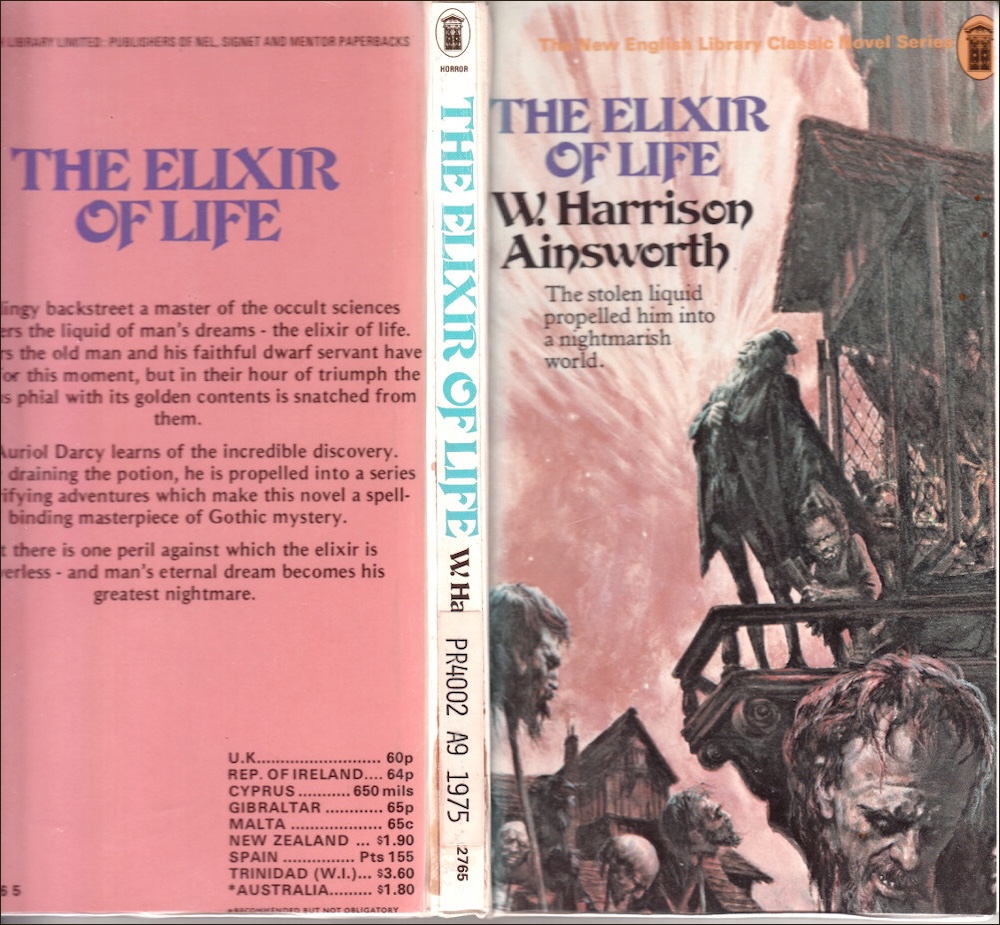
The Elixir of Life — "The stolen liquid propelled him into a nightmarish world." Cover illustration for William Harrison Ainsworth's Revelations of London (1845-46); afterwards, Auriol; Or, The Elixir of Life (London: Chapman and Hall, 1850). Colour, 17.5 cm high by 9.8 cm wide (6 ⅞ by 3 ¾ inches), framed.
A Lurid Back Cover Commentary: The Elixir of Life (1975)
In a dingy backstreet a master of the occult sciences discovers the liquid of man's dreams — the elixir of life. For years the old man and his faithful dwarf servant have strived for this moment, but in their hour of triumph the precious phial with its golden contents is snatched from them.
For Auriol Darcy learns of the incredible discovery. Eagerly draining the potion, he is propelled into a series of horrifying adventures which make this novel a spell-binding masterpiece of Gothic mystery.
But there is one peril against which the elixir is powerless — and man's eternal dream becomes his greatest nightmare. [New English Library Limited]
Commentary: A Promotional Book Cover
In fact, the 1975 book cover offers a somewhat garish visual synopsis of just the opening 1599 chapter of Ainsworth's Gothic thriller. The Tudor latticed window and house below establish the chronological setting, and the five severed heads point towards the initial location, Dr. Lamb's laboratory above Traitors' Gate at the south end of London Bridge. Looking at the startling light show on New Year's Eve, 1599, the alchemist touches the repulsive head of his deputy, Flapdragon or Old Parr. Thus, the cover omits entirely the principal character, Auriol Darcy, and does not hint at his nineteenth-century adventures.
Passage Realised by the 1975 Book Cover: Dr. Lamb's Balcony outside his Laboratory
On this night, and at the tenth hour, a man of striking and venerable appearance was seen to emerge upon a small wooden balcony, projecting from a bay-window near the top of a picturesque structure situated at the southern extremity of London Bridge.
The old man's beard and hair were as white as snow — the former descending almost to his girdle; so were the thick, overhanging brows that shaded his still piercing eyes. His forehead was high, bald, and ploughed by innumerable wrinkles. His countenance, despite its death-like paleness, had a noble and majestic cast; and his figure, though worn to the bone by a life of the severest study, and bent by the weight of years, must have been once lofty and commanding. His dress consisted of a doublet and hose of sad-coloured cloth, over which he wore a loose gown of black silk. His head was covered by a square black cap, from beneath which his silver locks strayed over his shoulders.
Known by the name of Doctor Lamb, and addicted to alchemical and philosophical pursuits, this venerable personage was esteemed by the vulgar as little better than a wizard. Strange tales were reported and believed of him. Amongst others, it was said that he possessed a familiar, because he chanced to employ a deformed, crack-brained dwarf, who assisted him in his operations, and whom he appropriately enough denominated Flapdragon.
Doctor Lamb's gaze was fixed intently upon the heavens, and he seamed to be noting the position of the moon with reference to some particular star.
After remaining in this posture for a few minutes, he was about to retire, when a loud crash arrested him, and he turned to see whence it proceeded.
Immediately before him stood the Southwark Gateway — a square stone building, with a round, embattled turret at each corner, and a flat leaden roof, planted with a forest of poles, fifteen or sixteen feet high, garnished with human heads. To his surprise, the doctor perceived that two of these poles had just been overthrown by a tall man, who was in the act of stripping them of their grisly burdens. ["Prologue 1599 Doctor Lamb," 6]
Related Material
- Hablot Knight Browne, 1815-1882; A Brief Biography
- William Harrison Ainsworth (1805-1882)
- William Harrison Ainsworth (1805-1882) — King of the Historical Potboiler: A Brief Biography
Scanned image and text by Philip V. Allingham. [You may use the images without prior permission for any scholarly or educational purpose as long as you (1) credit the person who scanned the image and (2) link your document to this URL in a web document or cite the Victorian Web in a print one.]
Bibliography
Ainsworth, William Harrison. Auriol; Or, The Elixir of Life. London: Chapman and Hall, 1850; George Routledge and Sons, 1865.

Ainsworth, William Harrison. Revelations of London.. Ainsworth's Magazine. Vol. VIII (January — May 1845).
Lester, Valerie Browne. Phiz: The Man Who Drew Dickens. London: Chatto and Windus, 2004.
The New English Library. "Cover" for The Elixir of Life by William Harrison Ainsworth. London: New English Library, NEL Paperback, May 1975.
Steig, Michael. Dickens and Phiz. Bloomington & London: Indiana U. P., 1978.
Sutherland, John A. "Auriol." The Stanford Companion to Victorian Fiction. Stanford, Cal.: Stanford U. P., 1989, rpt. 1990, 33.
Vann, J. Don. "Auriol; Or, The Elixir of Life in Ainsworth's Magazine, October 1844 — May 1845." Victorian Novels in Serial. New York: Modern Language Association, 1985. Pp. 24-25.
Created 5 October 2026