
The following essay incorporates material from a review appearing in Global 19th Century Studies. We thank the editors for permission to include it here.
 n Israel Zangwill's novel The Children of the Ghetto (1892), the "literature
and history" that an East End Jewish boy secretly "really care[s] for"
is "the history of Daredevil Dick and his congeners whose surprising
adventures, second-hand, in ink-stained sheets, were bartered to him for
buttons." When his schoolteacher burns these "treasures," the boy cries
"tears copious enough to extinguish" the flames (129). Zangwill did not
need to name Daredevil Dick's
genre: cheap yet precious, predictable yet sensational, liberally shared
yet verboten, this "history" is clearly a penny dreadful.
n Israel Zangwill's novel The Children of the Ghetto (1892), the "literature
and history" that an East End Jewish boy secretly "really care[s] for"
is "the history of Daredevil Dick and his congeners whose surprising
adventures, second-hand, in ink-stained sheets, were bartered to him for
buttons." When his schoolteacher burns these "treasures," the boy cries
"tears copious enough to extinguish" the flames (129). Zangwill did not
need to name Daredevil Dick's
genre: cheap yet precious, predictable yet sensational, liberally shared
yet verboten, this "history" is clearly a penny dreadful.
What, though, are penny dreadfuls? Apart from knowing a penny dreadful when we see it, how would we identify this genre, and how did Victorians identify it? What kind of work did penny dreadfuls intend to do, and what did they actually do, in popular culture? In 1963, Louis James investigated these questions in Fiction for the Working Man. Since then, "penny dreadful" scholarship has burgeoned. We are no longer defending penny fiction's cultural, historical, or literary value. We are showing what it explains about Victorian mass culture and what its long exclusion from literary history says about our professional community and its immediate ancestry.
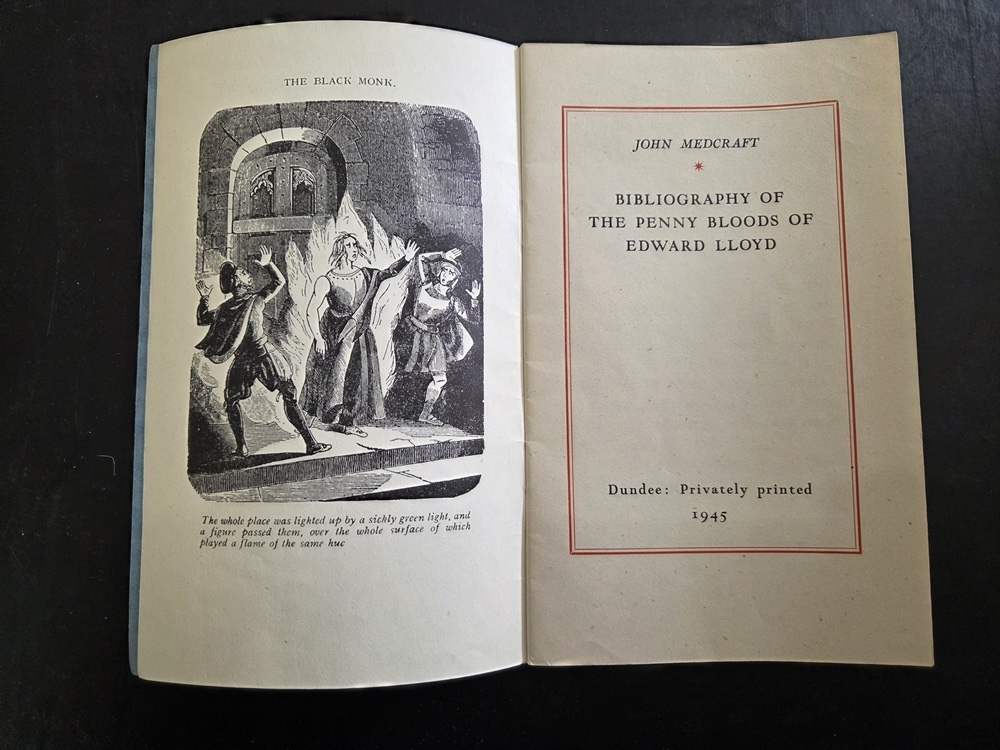
John Medcraft, Bibliography of the Penny Bloods of Edward Lloyd. Dundee: Privately printed, 1945. Author's collection.
The "Penny Politics" of the "Bloods"
Scholarly study of "penny bloods," the modern term for "dreadfuls" from the earliest period of penny fiction (c. 1830-50), has been made easier by digitization of a small fraction of the serials, especially the two distinct versions of James Malcolm Rymer's The String of Pearls (1846-7, revised and expanded 1850; a.k.a. "Sweeney Todd") and Varney the Vampyre, or, the Feast of Blood (1845-7). Scholars must still depend upon physical archives, which are themselves far from complete. Such research has been made easier by Marie Léger-St. Jean's open-access database Price One Penny: Cheap Literature 1837-1860 (2002-present). Not only does Léger-St. Jean identify the numbers of the penny periodicals in which key "dreadful" serials ran, she also names the research libraries that house them. The database is even searchable by library: you can find your closest institution and begin exploration there.
Early scholars of the "bloods" and "dreadfuls" emphasized their reputed transgressiveness and utopian potential. To James, Victorian penny fiction was "fiction for the working man," providing working people with escapist liberation from their toil. Late in the nineteenth century, "penny dreadfuls" attracted reactionary paranoia just like the comics, cult horror films, and rap music of twentieth-century America did (Springhall). However, it was also lucrative mass entertainment. How did penny publishers such as Edward Lloyd and John Dicks serve and exploit a Victorian public radicalized by inequality, famine, urban population explosion, and Chartism?
Rob Breton's The Penny Politics of Popular Fiction (2021) shows that penny fiction, Newgate novels, and other 1830s-40s narrative "low" culture were not "bereft of politics," but rather "pinched political content from radical papers," though usually to appeal rather than proselytize or inspire (Breton 2). Finding that penny fiction "could not and did not isolate" itself from the Chartist zeitgeist, Breton finds its writers and publishers trying, for a complex mix of reasons, to "be on the right side of history" (4). They saw their "common reader" as "a social and political malcontent" who wanted more from life than society provided–and also more from literature (13).
Starting with some of the generic antecedents of the "penny bloods," Breton finds the generations of "Newgate Calendars" increasingly politicized and sometimes sympathetic to pre-Chartist makers of good trouble such as the Luddites and the demonstrators massacred at Peterloo (Breton 19). The "Newgate Novel" followed, but genuinely radical examples were few. The most prominent of these, William Harrison Ainsworth's Jack Sheppard (1839), emerged as the "Newgate novel, the only one […] to demonstrate an openness to side with social unrest" (49). Serialized for the middle-class readers of Bentley's Miscellany beginning in 1839 (the year of the first Chartist petition campaign), Jack Sheppard was the "story par excellence of the working-class body that cannot be contained or repressed," and one that, before its serialization had even concluded, spawned four different London stage adaptations (50-2). While the notion of the "Newgate Novel" was a "perfect punching bag" that "allow[ed] itself to be read as promoting violent vengeance against anyone or anything that would deny sovereignty," Jack Sheppard radically proposes that "the criminal might first and foremost be a social victim," with traditionally British values, and therefore, when killed by the state machine, becomes a "martyr" for "freedom," and so resonated with a public sensitized to Chartist martyrdom narratives (74-9).
Informed by Ainsworth's mythmaking, "penny bloods" proved the next popular sensation. Noting that printing innovator Edward Lloyd's bloods' heyday overlapped with Chartism and that they demonstrate an awareness of working-class political concerns, Breton finds Lloyd conducting "a culture war under the clouds of" Chartism's "political war" (Breton 86-7). In Lloyd's three most enduring serials, Ada, the Betrayed (1842-3), Varney, the Vampyre, or the Feast of Blood, and The String of Pearls, all, incidentally, written by author-editor Rymer, there is nothing radical in intention. Breton asserts, for example, that "Sweeney Todd is not Chartist fiction, not radical fiction, far from it," but concerned with "hostile labor relations" (99). Though The String of Pearls "flippantly comments on the inability of the ruling class to rule," it examines "relations of production only at the level of employer/employee," not a political or structural level (104-7) and moreover betrays a "clear unease with the popular movement" (117). A broad survey of Lloyd and Rymer's output shows both of them interested in revealing class injustice but increasingly disenchanted with the Chartist political movement (Nesvet 90). Ada, Varney, and The String of Pearls try "to touch base with the readership," revealing that "the people's movement belonged to the people after all" (Breton 118-125). It is for, among other reasons, such glimpses into political and social history that we should study the bloods.
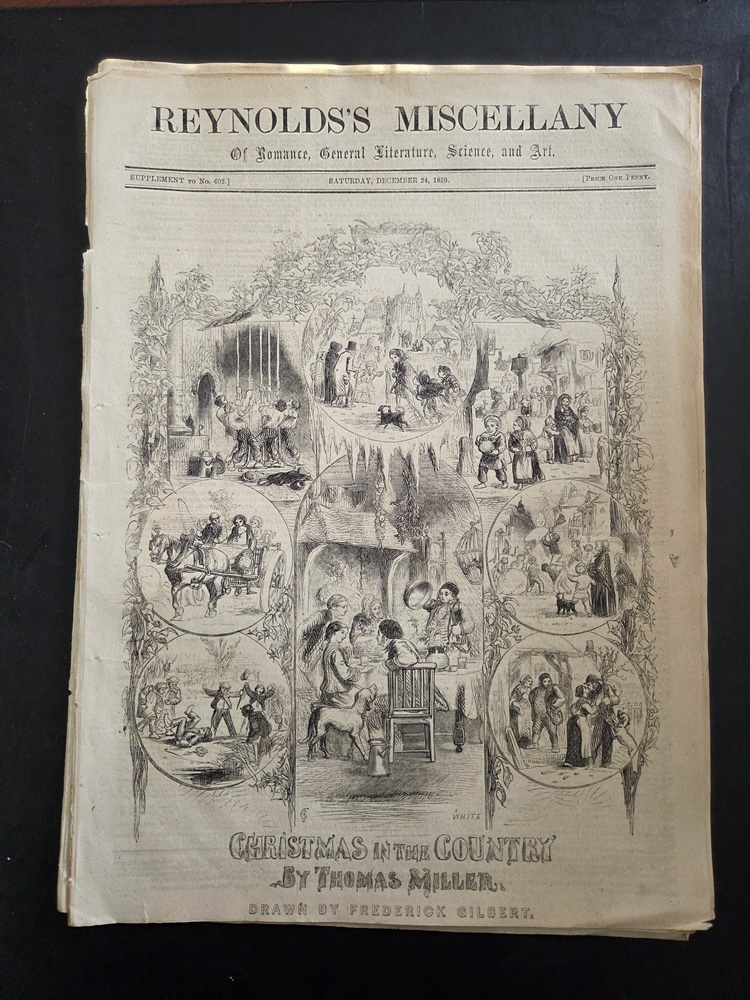
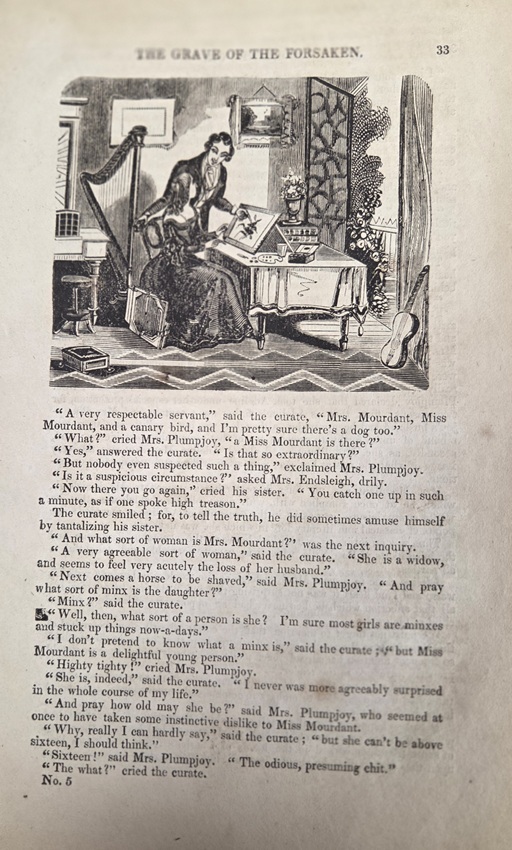
Left: Thomas Miller, "Christmas in the Country," illus. Thomas Miller. Reynolds's Miscellany, Supplement to no. 602, 24 December 1858, p. 1. Right: James Malcolm Rymer, Adeline, or, the Grave of the Forsaken. London: Edward Lloyd, 1842. Both images are from the author's collection.
"Dreadfuls" in Circulation
"The theory upon which the [Lloyd's] Holywell Street establishment depended," wrote the critic Phyllis Margaret Handover in the Times Educational Supplement in 1959, was "that in the process of corpse-making it was desirable to liberate as much as possible of the seven pints of blood circulating in the body." With palpable relief, Handover reveals that the muscularly evangelical Boy's Own Paper (1959) provided Victorian boys with what Handover, quoting its editor, judged "healthier and manlier" reading than the penny fiction that had preceded it (i). A noticeable feature of Handover's anxious recycling of Victorian moral panic about Lloyd's wares is her preoccupation with the image of circulation. The corpses in cheap, illustrated, Victorian serial fiction do not simply contain, and then let, blood: that blood is "circulating in the body" and, no doubt, also circulating in the Victorian body politic, as well as the body politic of 1959.
The circulation of the so-called "penny dreadfuls" and the kinds of circulation that occur within that body of fiction are the joint concerns of Manon Burz-Labrande's Penny Dreadfuls: The Circulation Patterns of a Victorian Popular Genre (2026). Burz-Labrande explains how the "sensational, dreadful" Victorian penny serials found unparalleled popular appeal and also "why [they] were so staunchly rejected" by middle-class critics ( 1). Burz-Labrande's "penny dreadful" is a genre within the larger medium of penny fiction. Distinguished by "astounding circulation numbers," the penny dreadful "encompasses serialized, sensationalist, gruesome fiction from the mid-1830s to the end of the 1880s that was primarily marketed to the working-class young, as literacy was increasing significantly" (1-2).
To Burz-Labrande, the "penny dreadful" matters firstly for its quantitative mass: for three generations, penny fiction was the "most sold type of publication," which made it a victim of success, as the critical establishment "tende[d] to weaponize […] successful circulation" as a sign of corruption (3-4). Penny dreadfuls and their original paratext "hinge […] on the concept of circulation" (8). They not only "circulated through the city […] fostering a new social spirit of gathering and satisfying a growing readership's morbid tastes," but also "circulated between literary genres" and were "filled […] with metaphors of circulation" (9). Finally, the notion of the "penny dreadful" circulates among us now in a "rich and complex" transmedia "afterlife" (11).
Burz-Labrande's first interior chapter, "From Oral Storytelling to Seriality," reconstructs how, and in what numbers, penny dreadfuls circulated and the social experience that they fostered: communal, out-loud reading. This means that their actual circulation numbers were much higher than print runs or sales figures imply. Seeing groups of working-class people, especially men and boys, gather in public to read alarmed those partial to the status quo, making "penny dreadfuls" seem a threat to public order, especially as the serials gave working men "something to talk about" that was seemingly beyond middle-class ken (20).
It is, however, important to note that penny fiction was often explicitly designed and advertised for family (as in the People's Periodical and Family Library) reading, inclusive of women and girls (Nesvet). The Children of the Ghetto (1892) depicts not only a boy mourning the incinerated Daredevil Dick but also two of his neighbors, the idealistic young woman Esther and worn-down "Dutch Debby" enjoying "a stock of old London Journals, more precious […] than mines of Ind"; Esther reads them "aloud" to Dutch Debby (Zangwill 160). The London Journal (1845-83) was an extraordinarily enduring penny paper sometime edited by the vastly prolific and now forgotten fiction writer J.F. Smith. Because working-class female social reading was not visible to the middle-class man in the street, it did not provoke the Foucauldian crackdowns that men's social reading "at night, in a dirty London street" did (Burz-Labrande 23).
Moving on to "Sensationalism and Entertainment" (1830-50), the focus of cheap literature for working-class readers moved from the pedantic to the entertaining (Burz-Labrande 29), including in "piracies" of authors such as Charles Dickens that innovatively dispensed with the originals' moralizing (31). Illustrated penny serials such as Rymer's The String of Pearls, A Romance developed a recognizable, "multimodal" style wherein plot and even typographical aesthetics served commercial, design, and social-reading imperatives (34-5); a style that, nearly 200 years later, you can still "hear" (43).
Penny dreadful circulation was also recirculation. Penny serial writers and publishers reanimated a dying mode, the Gothic, for new social and reading circumstances. Parodies such as Thomas Love Peacock's Nightmare Abbey (1818) and James Hogg's Confessions of a Justified Sinner (1824) show that well before 1830, Gothic fiction had stagnated, at least in the eyes of sophisticated readers. Burz-Labrande shows how Lloyd and his ilk reanimated it, infusing it into a previously uninitiated body politic that, like a vampire's lover, gave it new and enduring life. The urban Gothic penny dreadful "ascribed agency to the metropolis itself" as a living "maze" while that metropolis burgeoned in population and political and economic power (32).
Did penny fiction do the same for cities other than London, including the industrial towns of the North of England and the colonial capitals? Anthem Press's slim-volume format does not give Burz-Labrande space to say, but examples such as Rymer's ripped-from-the-headlines serial The Sepoys, or Highland Jessie: A Tale of the Present Indian Revolt (1858), published by Reynolds, depicts 1858 Delhi as a labyrinth of imperialist luxury and rebel rage that characters of a variety of ethnicities, classes, and relations to Empire have to navigate.
Burz-Labrande's final chapter brings the story of the penny dreadful up to the present moment. The idea of the "dreadful" circulates among us, often without any adaptation of individual works. Neo-Victorian fiction often mentions penny dreadfuls as a kind of media institution or cultural legend (66). New characters read penny dreadfuls for various passionate and character-defining reasons. Additionally, just as penny dreadfuls intertextually circulated older works such as Gothic standards, modern fiction and even television replicates that intertextuality. Burz-Labrande unpacks how the television show Penny Dreadful renders the sensational, episodic, populist "dreadful" a "cultural reference" (77). All these neo-Victorian works "preserve the dynamism of the original genre while evolving through the landscape of contemporary entertainment" (80).
Sherlock Holmes would have been a young adult when the term "penny dreadful" emerged to describe what the canonical Watson calls the "sensational literature" that Holmes voraciously read for its insights into criminal psychology and culture. In the 1998 Hollywood movie Mr Holmes, a nonagenarian Sherlock (Ian McKellen) denigrates his long-dead frenemy Watson's beloved Strand stories as "penny dreadfuls with an elevated prose style." Burz-Labrande's book reveals why Doyle develops Holmes as a dreadful reader and also how and to what effects modern works such as Mr. Holmes recirculate the spectral "dreadful."
"Must be a Penny"
What, though, is "that original genre?" How well does it map onto the actual landscape of Victorian cheap leisure reading? Springhall offered six barely synonymous, equally popular definitions of the "penny dreadful"; Stephen Basdeo and I trace the term to its 1869-70 inception, showing that it was an anachronistic epithet much later reclaimed as an endearment (Basdeo and Nesvet). Even after this, penny reading continued to be published and consumed by the masses, often without its readers and publishers considering it particularly terrifying or wanting it to be. In Zangwill's The Children of the Ghetto, a group of working-class East End Jewish altruists designing a periodical for their community exemplify this dynamic. Their paper, The Flag of Judah, contains imaginative literature as well as news and solicits sentimental poetry from its reader. It therefore has much in common with the 1840s periodicals of Edward Lloyd, the ones that carried "bloods" such as The String of Pearls, Adeline, and Ada. On account of its liberationist political vision, it might have even more in common with Reynolds's Miscellany, the delivery mechanism of the most radical dreadfuls. The editors of the Flag of Judah knew how to sell their paper to their community. "To appeal to the masses," one said, the paper "must be a penny" (Zangwill 361). What, then, distinguishes it from the penny dreadfuls? Or is it a "dreadful," only never called that because Zangwill's vibrant cast of characters includes no middle-class self-appointed cultural ombudsmen? If we read across the range of Victorian penny fiction and the papers that carried it, the notion that the "penny dreadful" was an easily recognizable genre begins to fray.
Actual people of the generation of Zangwill's boy reader of Daredevil Dick helped to establish the idea that the "penny dreadful" was a genre and to obscure Victorian penny fiction that did not fit that emergent genre's conventions. Unlike literary fiction, penny fiction was rarely if ever reviewed. Its earliest historians were therefore not professional literary critics but amateur collectors. "Penny blood" and "dreadful" collecting began to gain popularity during the First World War. Grown men who had been Victorian children scrambled to possess, catalogue, and share the fiction serials that had entertained them as Victorian boys; imaginably because in those pages was preserved a world without the horrors of trench warfare, in which there were horrors galore, but only preposterous ones. Joseph Parks, the earliest editor of a periodical dedicated to penny dreadful collecting, was a First World War veteran; he and his wife Lucy founded Vanity Fair: An Illustrated Magazine in 1917, when he was invalided out of the Army after combat duty (Nesvet 147). Another of the early scholar-collectors, John Medcraft, had lost his elder brother in the fighting and wrote a bibliography of his collection of "The Penny Bloods of Edward Lloyd," which was privately published in 1945. During the Second World War, while Medcraft's exurban London enclave (Ilford) was bombed and his family took refuge in the countryside, Medcraft, evidently haunted by his memory of the earlier war, secured his paper treasures in a purpose-built "gas-proof room" (149). Collecting Lloyd "penny bloods" and the later "dreadfuls" that were marketed to working-class boys, these men understood them as boys' fiction and their appreciation of them as a homosocial nostalgia trip. Today, scholars such as Breton and Burz-Labrande are building on their foundational "penny dreadful" scholarship while also questioning long-held assumptions about penny fiction.
Links to Related Material
- Penny dreadfuls, juvenile crime, and late-Victorian moral panic
- Punch satirizes the penny dreadful
- On Varney the Vampire, or the Feast of Blood, by Barbara T. Gates
- Phiz's initial serial illustrations for James Malcolm Rymer's A Mystery in Scarlet (1866)
- Victorian Periodicals on the Victorian Web
Bibliography
Basdeo, Stephen and Rebecca Nesvet. "Reappraising Penny Fiction." Victorian Popular Fictions Journal 4.2 (2022): 1-17.
Breton, Rob. The Penny Politics of Popular Fiction. Manchester: Manchester UP, 2021.
Burz-Labrande, Manon. Penny Dreadfuls: The Circulation Patterns of a Victorian Popular Genre. London and New York: Anthem Press, 2026.
Handover, Phyllis Margaret. "Enough of Bloods." The Times Educational Supplement. 4 December 1959.
James, Louis. Fiction for the Working Man. [1963, 1974] Brighton: Edwin Everett Root, 2017.
Léger-St. Jean, Marie. Price One Penny: Cheap Literature 1837-1860. 2002-.
Nesvet, Rebecca. James Malcolm Rymer, Penny Fiction, and the Family. Abingdon, Oxfordshire: Routledge, 2024.
Springhall, John. Youth, Popular Culture, and Moral Panics: Penny Gaffs to Gangsta Rap, 1830-1996. New York: St. Martin's Press, 1998.
Zangwill, Israel. Children of the Ghetto: A Study of a Peculiar People. [1892] Ed. Meri-Jane Rochelson. Detroit: Wayne State UP, 1998.
Created 24 April 2026
Last modified 27 April 2026