
Turner and Constable are routinely regarded as the greatest English landscape painters and among the greatest painters in art history’s long and complicated narrative. ‘Turner and Constable, Rivals and Originals,’ Tate Britain’s latest blockbuster (27 November 2025 – 12 April 2026), is an opportunity to assess their status and, more particularly, to view them as competing voices. Contemporaries enjoyed comparing their work – who was the greater painter, Turner or Constable? Which provided the truest representation of landscape? Which was fire, which water? This exhibition invites the modern viewer to engage in the same sort of analysis.
The differences seem apparent as the two artists positioned each other as rivals and occasionally rubbed each other up the wrong way. Turner famously added eye-catching colour to one of his paintings to upstage a work by Constable positioned next to it, although in practical terms their rivalry was very unequal: Turner was feted and acclaimed from early in his career, while Constable struggled to establish himself. This situation challenges conventional notions of how society worked in the nineteenth century, with Turner, the son of a barber from Covent Garden, making far more headway than Constable, whose father was a wealthy grain merchant from East Bergholt in prosperous Suffolk. Nevertheless, the lower-class Turner was generally viewed as an uncouth, slightly weird outsider with a chaotic manner, while Constable was always a respectable member of the establishment. This contrast is made clear in the opening room which juxtaposes the artists’ portraits – one a self-portrait which shows a raffish, bohemian Turner, his face and necktie delineated in expressive strokes, and the other Ramsay Reinagle’s depiction of Constable as a plump, well-dressed gentleman whose face emerges from a smoothly worked surface.
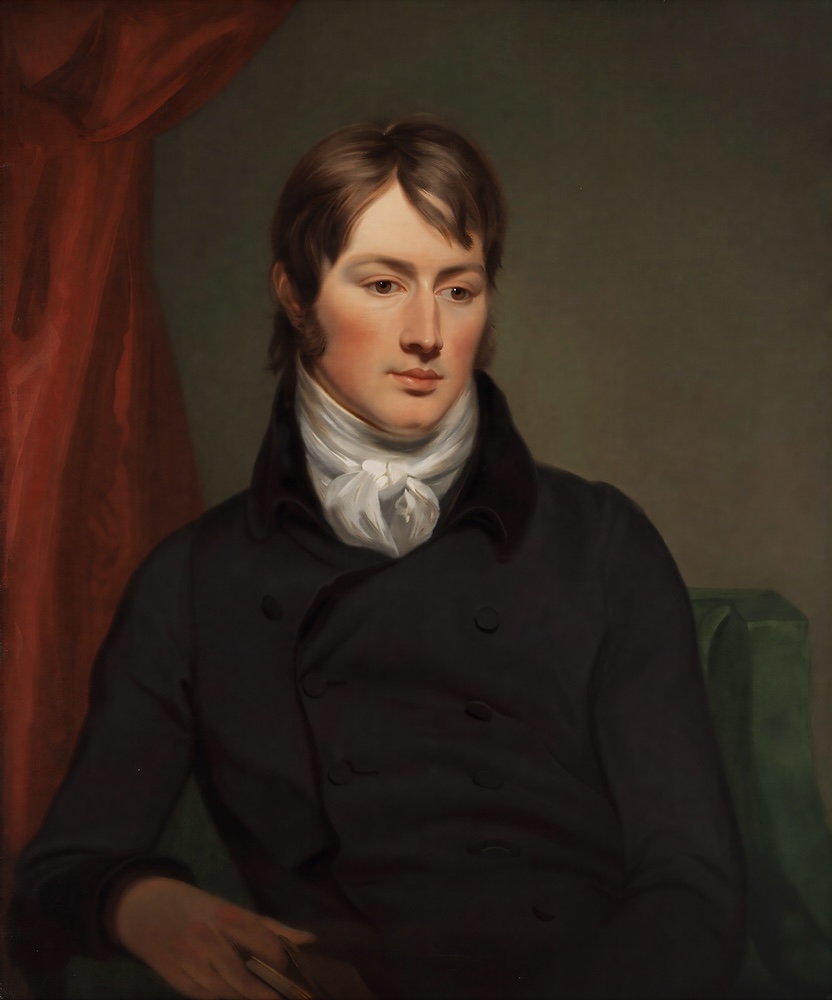

Left: John Constable, by Ramsay Reinagle. Right: J.M.W. Turner, Self-Portrait (click on all the images on this page to enlarge them, and for more information about them.
These portraits show both artists aged 23–24; Turner (who lived to the age of 76) looks like a youth, Constable (who only lived to 60), already seems middle-aged.
The opposition suggests polarities, and at the first glance the work seems fundamentally, irreconcilably opposed. Constable is set up as the conservative who Anglicizes the Dutch landscapes of Ruysdael and chronicles the Picturesque as he focuses on the English idyll of pre-industrial landscapes, the harmonies of man and nature, and the provincial workings of a small part of Suffolk as he endlessly, obsessively returned to his home county. Much loved by contemporary and modern observers for his traditionalism, he seems, we might say, the perfect little Englander. Turner, on the other hand, is projected as the adventurous traveller, the chronicler of nature’s cruelty and the violent power of the elements in Sublime evocations of the land and sea, sometimes marked with the presence of Victorian industry, that often seem closer to Impressionism and Modernist abstraction than to the art of his time. Turner, it appears, is the innovator, Constable the poet of the English idyll in a period when his evocations of the green and pleasant land were an affirmation of patriotism in defiance of the Napoleonic war and the pressure of foreign threats. Those differences are well drawn out in the exhibition, a matter of contrasting paintings such as Constable’s The White Horse with Turner’s Hannibal Crossing the Alps or The Storm at Sea. The arrangement of the display – with alternate rooms dealing with each painter – stresses their dissimilarities.

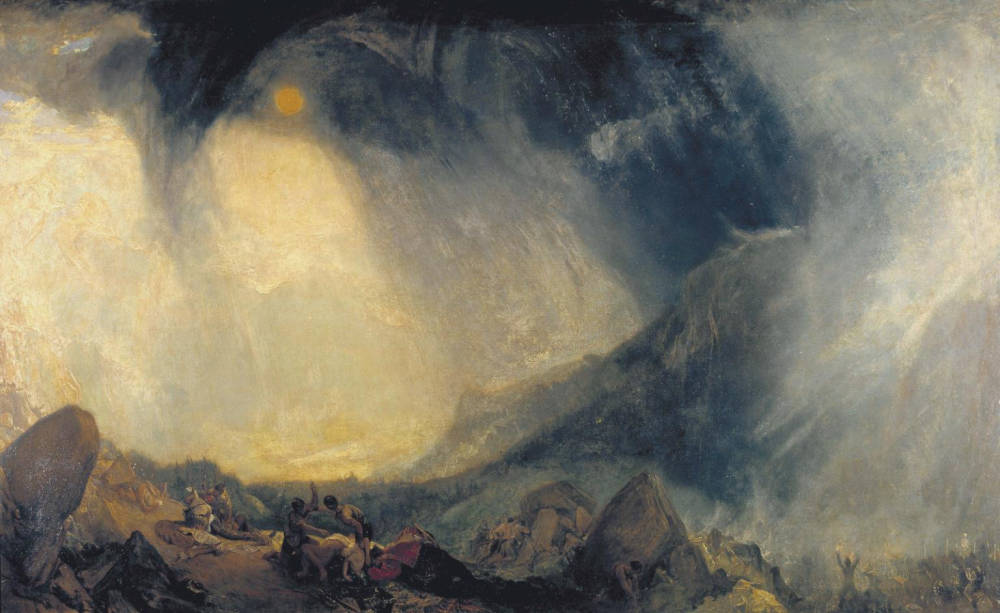
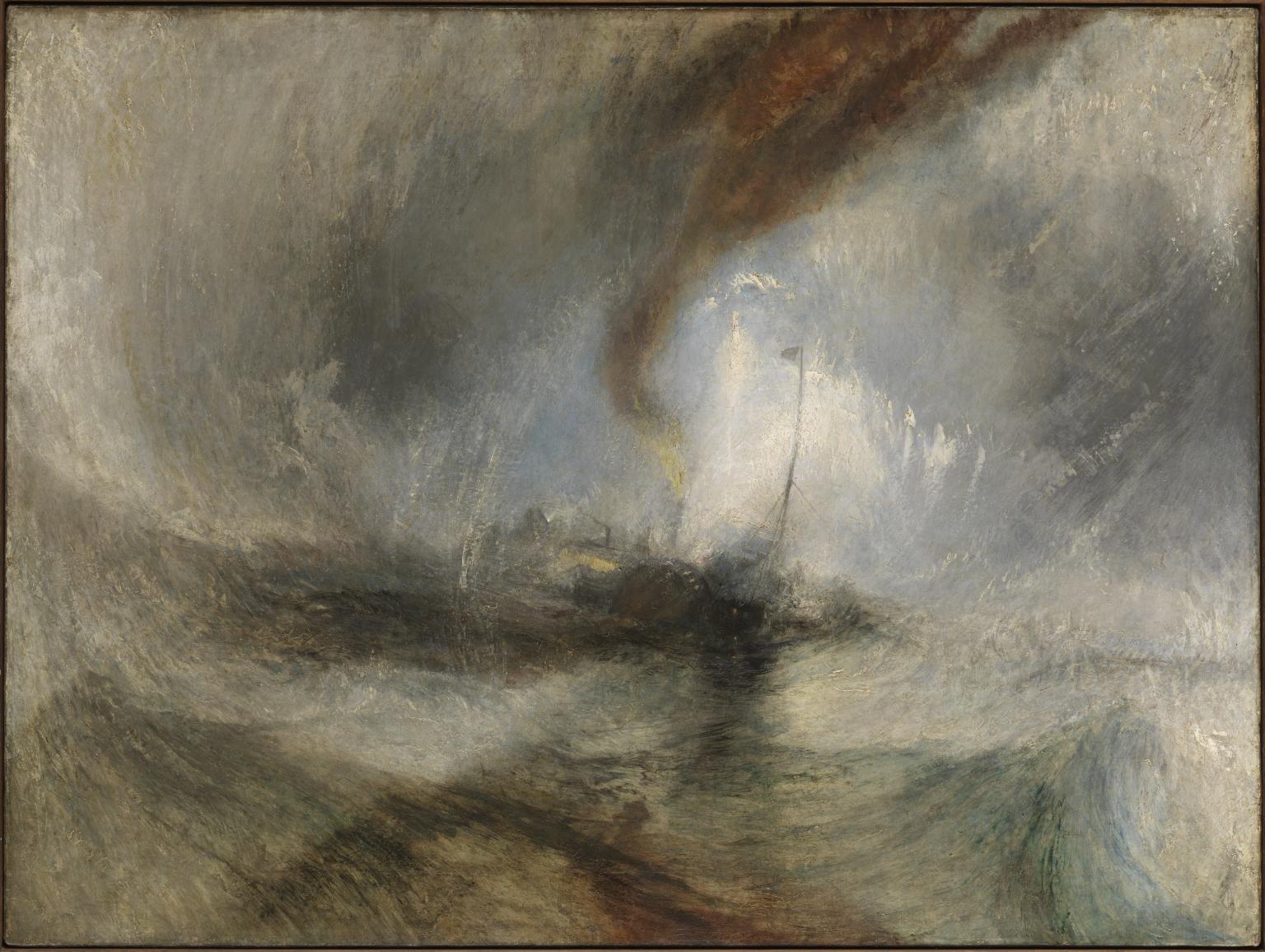
Left: Constable, The White Horse (1819). Middle: Turner, Snow Storm: Hannibal and His Army Crossing the Alps (1814); Right: Turner, Snow Storm: Steam Boat off a Harbour’s Mouth(1842).
The exhibition’s great strength, however, is the way in which it reveals their many similarities as well. A careful selection of work reveals how both created architectural drawings and both started their careers painting topographical scenes. Such images seem tame compared to later, poetic creations on a vast scale: though sharing common origins, the painters rapidly developed their epic visions.
The exhibition shows how they were fundamentally united as Romantics with a Wordsworthian interest in the pantheistic relationship of man and nature. Both, indeed, are the poets of the pathetic fallacy and the wondrous intertwining of humankind and the material world. In Turner’s art, the turmoil of history is embodied in the elements as, for instance, in Hannibal in which the anxieties of the soldiers as they march to battle is both signalled and exacerbated by the tumult of the sky; and in Constable’s the quiet contentment of working on the waterways – a recurrent theme – is framed in the serenity of a limpid afternoon in green pastures. In one, man is the tiny registration of a convulsive nature and in the other he is part of a benevolent creation: looking from one to the other is like embracing Wordworth’s extremes in The Prelude and in Lyrical Ballads. What both artists affirm is the expressiveness of a nature that is alive with feeling, a mirror of the mind, and informed with a greater order. The predominance of those beliefs means that some of the paintings are almost twins, the work of one rather than two sets of hands. Constable’s Salisbury Cathedral and Turner’s Buttermere Lake, both meditations on the suspended wonder of a moment haunted by a rainbow, stress the connection.


Left: Constable, Salisbury Cathedral from the Meadows (1831). Right: Turner, Buttermere Lake (1798).
At the same time, Turner and Constable are shown to be the great poets of nature as nature – especially the character of trees and the workings of an English sky and its endless changeability. Constable’s oil sketches convey his sensitive mapping of a shifting atmosphere, and a display of Turner’s sketchbooks reveals how they too are the records of how things appeared in a passing moment – the colour of the sun, the effects of light though branches moving in a breeze, the twitch of the leaves. Such poetic observation values the commonplace and ordinary, transforming all that passed before the artists’ eyes into a transcendent vision that stretches from damp riversides populated with scraggy weeds and rotten wood to the travails of a paddle-streamer caught in the vortex of a sea that rises and falls like a massive earthquake. The effect, always, is visceral and synaesthetic: we can feel the tipping deck, feel the lashing wind, smell the odours of the vegetation, both rank and refreshing, and sink our shoes into stinking mud.
But most of all, the exhibition has a surprise. Many would think of Turner as the more ‘modern’ of the two painters insofar as his later work seems abstract, a field of colour rather than a representation of a specific motif; his Norham Castle, Sunrise, which is purely a matter of dissolving light and colour, exemplifies the point. Yet the works shown here indicate that Constable’s treatments are often as painterly as Turner’s, treating his surfaces as expressive rather than descriptive marks. Passages in The Leaping Horse are flat painterly signs that prefigure modernist art as surely as the explosive red in Turner’s The Burning of the Houses of Lords and Common. Unexpectedly, Whistler, Monet and Rothko suddenly seem like the descendants of Turner and Constable, and it’s sometimes difficult to view the English painters except through the lens of retrospection. Were Turner and Constable French – and it is fair to say that Constable was admired in France – they would probably have a much higher status than is currently the case. Brilliant colourists and proto-abstractionists, they are still in the avant-garde: no wonder their work was controversial when it appeared two hundred years ago.


Left: Constable, The Leaping Horse (1825). Right: Turner, The Burning of the Houses of Lords and Commons (1835).
This is, in short, a provocative and highly intelligent exhibition that is both expertly curated and visually overpowering, with paintings organized so that, for example, there is a breathtaking contrast between a small series of studies in one room and huge canvases in the next. Works have been drawn from many sources, including those in private collections that have never before been exhibited, and the pictures’ labels are both informative and well-written. There are also some peripheral pleasures – Constable’s tiny painting seat that he took into the field, Turner’s paintbox and brushes, and a clip from Mike Leigh’s film, Mr Turner, which shows the artist (Timothy Spall), winding up his rival.
‘Turner and Constable, Rivals and Originals’ is promoted as a ‘definitive’ show and a ‘one in a lifetime’ opportunity to see such work. That assessment is entirely accurate. Never less than a revelation, and ultimately much more than an exploration of rivalries, it’s essential viewing for anyone with an interest in British art and its place in the wider story of European painting.
Related Material
Created 11 December 2025