
Note: Most of the images used in this review are installation shots, courtesy of the museum, and the rest are from our own site. Click on all the images to enlarge them, and sometimes for more information about them. — JB
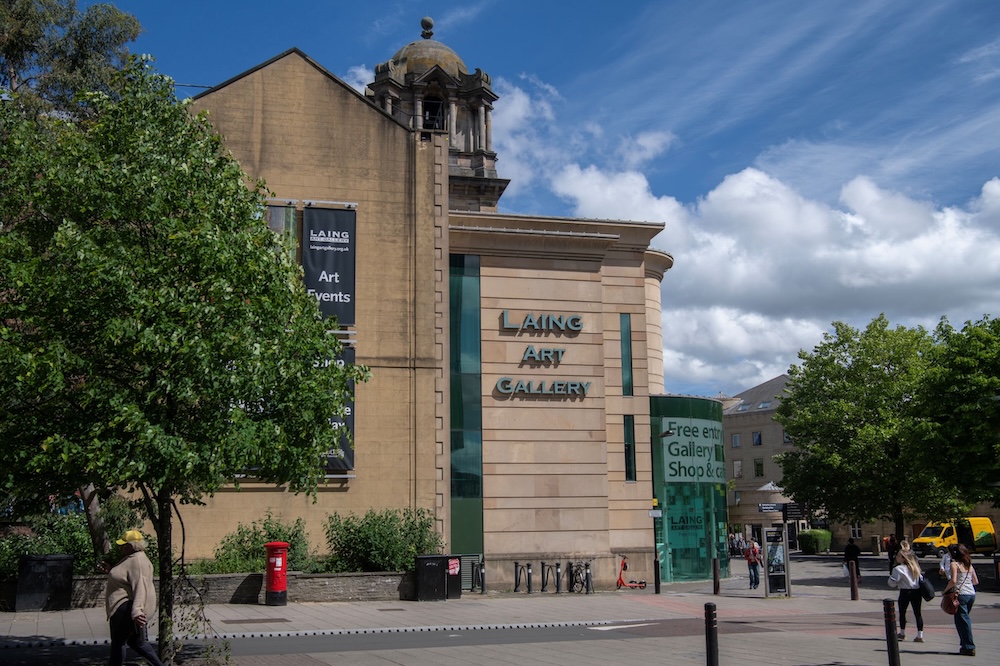
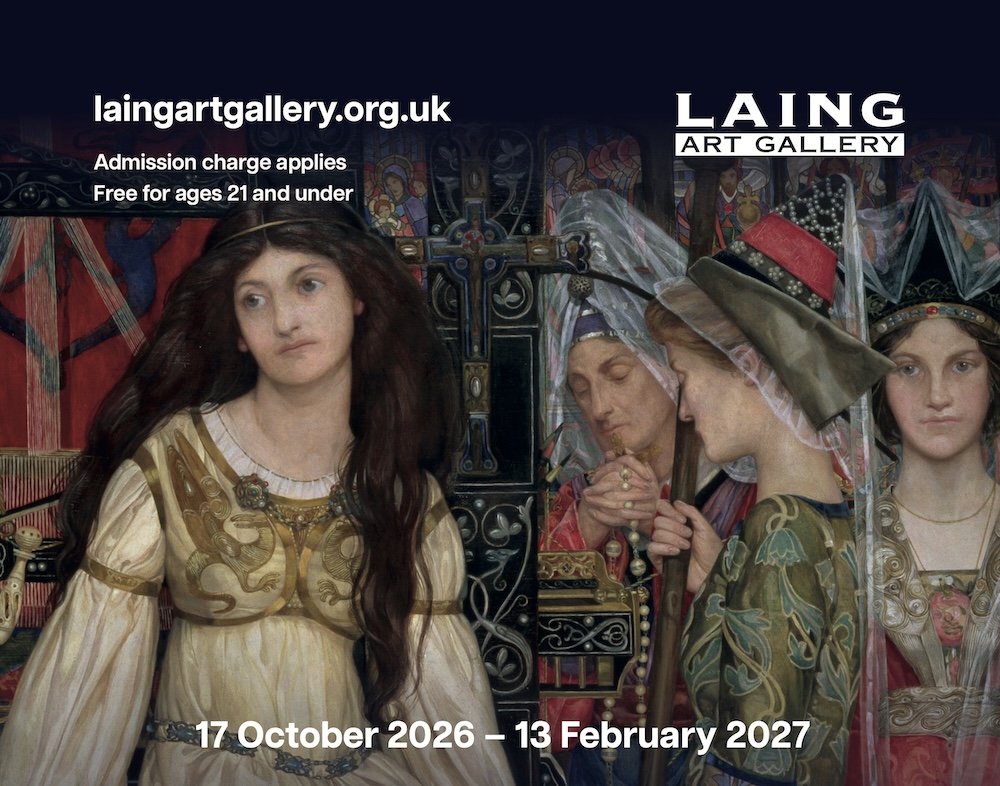
Left: Laing Art Gallery, Newcastle. Right: Poster the exhibition, featuring Kate Bunce's The Keepsake, based on D.G. Rossetti's poem, "The Staff and Script."
Rather surprisingly, the Laing Art Gallery's Pre-Raphaelites: Art and Poetry is the first exhibition to specifically explore the connections between poetry and Pre-Raphaelite art, and I returned to Newcastle after a gap of more than fifty years to see it. The title, of course, recalls the early publication of the Pre-Raphaelite Brotherhood, The Germ, later issues of which were retitled Art and Poetry. It is obvious, then, that right from the beginning of the Pre-Raphaelite Movement, these young artists were aware of the links between the visual arts and the written word, leading to a revival of the concept of "un pictura poesis" (as in painting so is poetry). The Pre-Raphaelites were, as is well known, greatly influenced by literature, from the work of early poets like Dante Alighieri, Giovanni Boccaccio, and Geoffrey Chaucer, to the "Romantic" English poets like John Keats, and finally Victorian poets like Alfred Tennyson, Robert Browning, D. G. Rossetti, Christina Rossetti, Algernon Swinburne, William Morris, and Coventry Patmore.
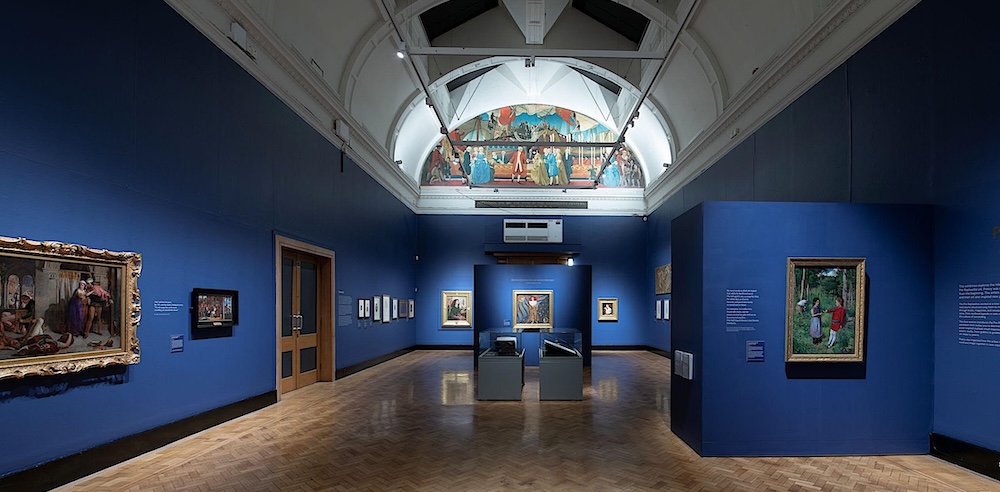
Introductory Section of Exhibition. William Holman Hunt's The Eve of St. Agnes, inspired by Keats is to the left, while Millais's The Woodsman's Daughter, derived from a poem by Coventry Patmore, is to the right.
The range, therefore, is large, and although this is not a huge exhibition as compared, for instance, with A Call to Art. William Morris and the Pre-Raphaelites, which is being held concurrently at the Fitzwilliam Museum in Cambridge, the Newcastle show is still fairly comprehensive. It includes over a hundred works, including paintings, drawings, prints and book illustrations, illuminated manuscripts, as well as decorative objects like embroideries, tapestry, metalwork, and stained glass. Art by major Pre-Raphaelite artists like Dante Gabriel Rossetti, John Everett Millais, Arthur Hughes, Edward Burne-Jones and William Morris is featured. Works by important female artists, including Elizabeth Siddal, Alice Boyd, Kate Bunce, Eleanor Fortescue Brickdale, and Julia Margaret Cameron are also represented.
While the Fitzwilliam has the luxury of owning a major collection of Pre-Raphaelite art, the Laing owns only two major Pre-Raphaelite paintings, but fortunately both are masterpieces. According to the co-curators of the exhibition, Lizzie Jacklin and Esmé Whittaker, the idea for this exhibition came from thinking about these paintings, Burne-Jones's Laus Veneris and Holman Hunt's Isabella and the Pot of Basil, and their connections to poetry.
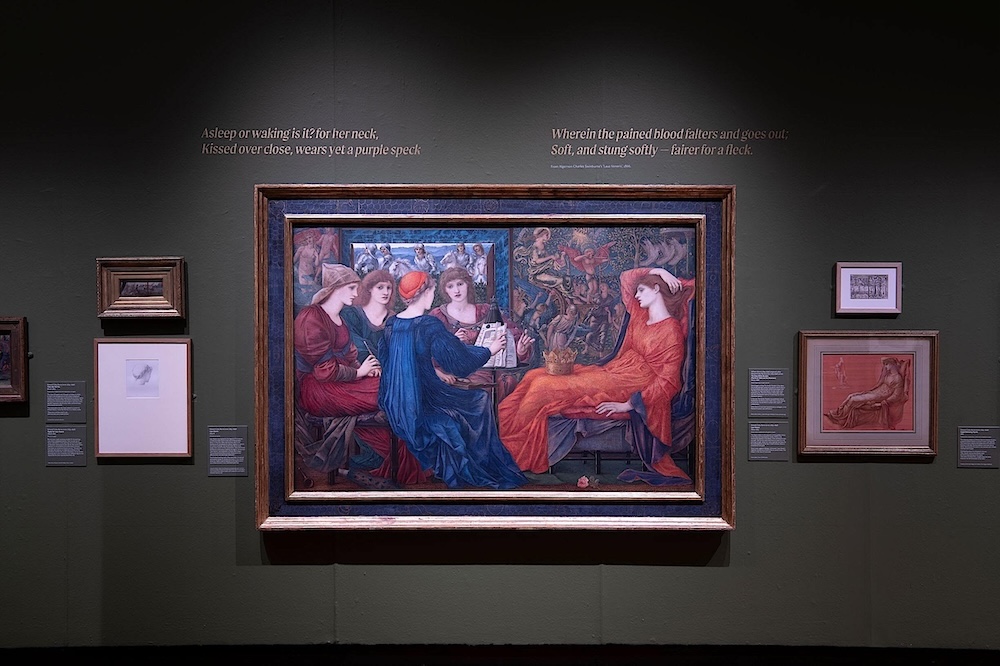
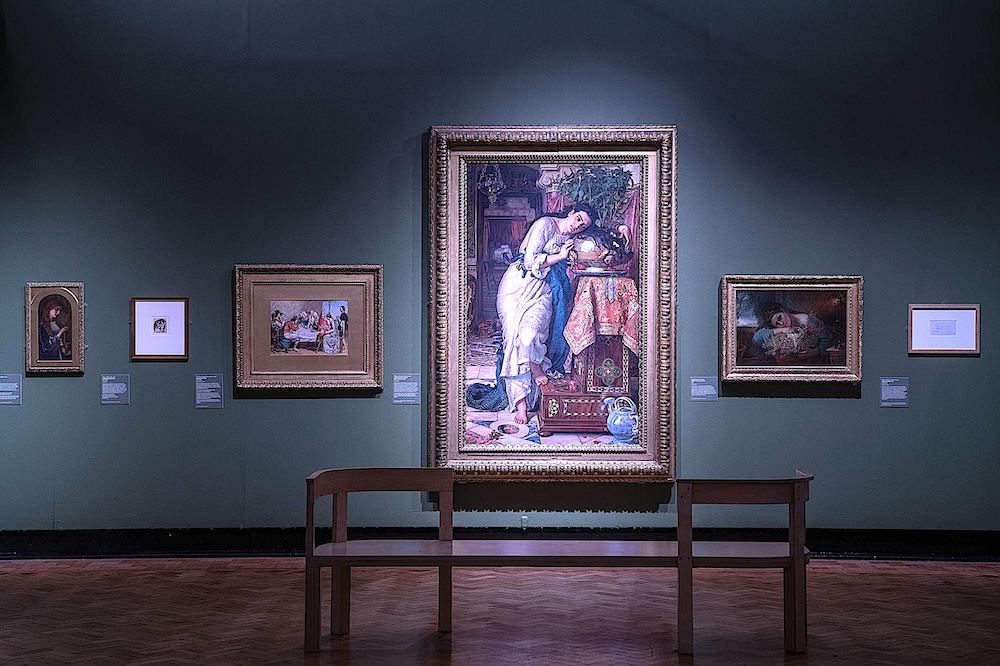
On display. Left: Burne-Jones's Laus Veneris, and studies with a quotation from Swinburne's "Laus Veneris" above. Right: Holman Hunt's Isabella and the Pot of Basil.
Burne-Jones's Laus Veneris was inspired by the famous German medieval legend of Tannhäuser, a knight and poet who found the Venusberg. Both Swinburne and Morris wrote poems which retold this tale. Hunt's painting is derived from Keats's poem "Isabella, or the Pot of Basil" which is, in turn, taken from a tale in The Decameron by Boccaccio. In the Laing's own collection, however, these two works are not shown simply in the context of other Pre-Raphaelite works from the period. The curators' idea was to provide them with both a literary and artistic context, while also exploring wider connections between art and poetry within Pre-Raphaelitism. In the Victorian period, when poetry was more popular, educated viewers would have recognized and understood the literary sources for the paintings.
This exhibition was felt to be particularly important because the curators realized viewers in the North East of England had not had an opportunity to see a major Pre-Raphaelite show since the Laing's earlier Pre-Raphaelites. Painters and Patrons in the North East of 1989. They resolved to structure the exhibition around the literary sources and dialogues that relate to the visual works, rather than chronologically, and thus better highlight how particular poems and poets feature across Pre-Raphaelitism, from its initial phase to later iterations of the movement. Their concept was to showcase the creative collaboration between poetry and art, not only how poetry could inspire art but also, to a lesser extent, how art could, in turn, inspire poetry.
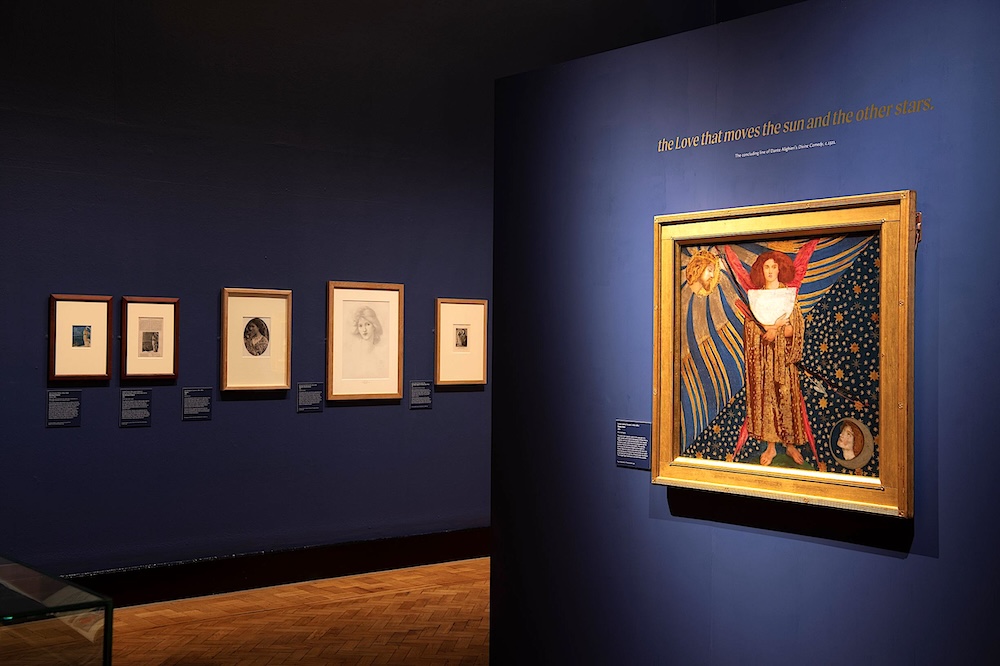
Rossetti's Dantis Amor, displayed with the concluding line of Dante's Divine Comedy written above it.
Loans of works have been secured from both public and private collections from across the U.K. I found it particularly gratifying that works were selected, not just from major galleries like the Tate Britain and the Birmingham Museum and Art Gallery, but from venues that the average person with an interest in the Pre-Raphaelites might never have had a chance to visit, like the Higgins, Bedford; the Tullie House Museum and Art gallery in Carlisle; and the Williamson Art Gallery and Museum in Birkenhead. I have been attending Pre-Raphaelite exhibitions for fifty years and I tend to judge an exhibition by whether there are works included I have never seen in person before and knew only from reproductions in books. Although there were a number of drawings here I had not seen before, the major revelation for me was finally seeing in person D.G. Rossetti's early oil painting of 1851, Hist! said Kate the Queen, from the collection of Eton College and derived from Robert Browning's "Pippa Passes."
The exhibition features three distinct themes; "Poems Past," "Romantic Rhymes," and "Victorian Visions."
"Poems Past"
In "Poems Past" the curators point out that the Pre-Raphaelites were inspired by a wide range of early literature, including the poetry of Ancient Greece, particularly Homer, to poets like Dante and Chaucer from the thirteenth and fourteenth centuries, up to Shakespeare in the sixteenth century. Many of these poems delve into familiar themes, such as the search for love and the morality of human behaviour. The introductory section of the exhibition, not surprisingly, features works from the first phase of Pre-Raphaelitism, or immediately preceding it, including Ford Madox Brown's The Seeds and Fruits of English Poetry — not only the finished painting but a preliminary drawing for it. Brown's focus here is the critical role of Chaucer, one of the inaugural English poets to write in vernacular English rather than Latin. To Chaucer's left are Milton, Spenser and Shakespeare, while to his right are Byron, Pope and Burns. Another key work in this section is Holman Hunt's The Flight of Madeline and Porphyro during the Drunkenness attending the Revelry, taken from Keats's "The Eve of St. Agnes," a seminal work in the history of Pre-Raphaelitism because it was Rossetti's admiration for it, when it was shown at the Royal Academy in 1848, that led to the friendships that, in turn, ultimately resulted in the formation of the Pre-Raphaelite Brotherhood. Birmingham's small version of Henry Wallis's masterpiece Death of Chatterton, portrays the suicide of the neglected English poet who died at age seventeen.
Left: Rossetti's coloured chalk drawing of Proserpine with two chalk drawings for Astarte Syriaca in the background. Right: Rossetti's Fazio's Mistress (1863-73).
Particularly featured in this section, however, are works by Rossetti inspired by Dante, such as his Paulo and Francesca of 1862. Rossetti's Fazio's Mistress (1863-73) shows the influence not only of a poem by the early Italian poet Fazio Degli Uberti, but also of Venetian High Renaissance painting on contemporary British art more generally. This painting is an example of Rossetti's "Double Work of Art," because, being both an artist and poet, he wrote a translation of a fourteenth century poem by Fazio to accompany it.
Chaucer, of course, had a major influence on the work of both Burne-Jones and Morris, who had admired him since their student days at Oxford. For Burne-Jones this influence extended not merely to paintings and watercolours, but also to book illustration, embroideries, stained glass, and tile designs — his work as a book illustrator reached its zenith in the Kelmscott Chaucer. As another example of the influence of early literature on the Pre-Raphaelites, the curators offer a poem entitled "The King's Quair," attributed to King James I of Scotland, which inspired a series of murals painted on the staircase of Penkill Castle by William Bell Scott. Scott also did a series of six etchings based on his murals, a series represented here by drawing studies lent by the National Galleries of Scotland.
Edward Burne-Jones and William Morris, designers, embroidery of Love Leading the Pilgrim through the Briars, derived from Guillaume de Lorris's "Roman de la Rose," translated by Chaucer as "The Romaunt of the Rose."
"Romantic Rhymes"
"Romantic Rhymes," the second thematic section, showcases the influence of poetry from the seventeenth to early-nineteenth century. The writings of the "Romantic poets" were an early inspiration for members of the Pre-Raphaelite Brotherhood, particularly Keats, but also Byron, Shelley and Wordsworth, who were all in their "list of Immortals" that included the writers and artists they most admired. Among the highlights in this section are William Holman Hunt's Isabella and the Pot of Basil, based on Keats's poem, and Arthur Hughes's Madeleine, likely the heroine of Keats's poem "The Eve of St. Agnes."
"Victorian Visions"
"Victorian Visions," the concluding and largest section of the exhibition, looks at how artists in the Pre-Raphaelite circle were influenced by contemporary poetry, particularly that of Tennyson, but additionally poets like Rossetti and his sister Christina, the Brownings, Swinburne, and Morris. Edward Burne-Jones masterpiece Laus Veneris was inspired by a poem of the same name by Swinburne. Rossetti, as well as Morris and Swinburne, would on occasion write poems to directly accompany a visual work of art. In Rossetti's case, the combination of a painting and a poem could provide different responses to the same idea, thus forming what is known as a "double work of art." One other example of this in the exhibition is Rossetti's chalk drawing of Proserpine on which one of his sonnets is inscribed. Rossetti's wife Elizabeth Siddal, herself a poet as well as an artist, is represented by a number of drawings in this section including St. Agnes Eve and Lady Clare, both based on poems by Tennyson. A number of wood engravings after Rossetti, Hunt and Millais for the famous Moxon Tennyson of 1857 are also included in this section.
Here, it was a particular pleasure to see Edward Burne-Jones's early pen-and-ink drawings from the late 1850s, of which I am particularly fond. Two superb examples are shown: Childe Roland to the Dark Tower Came, based on a poem by Robert Browning, and Going to the Battle, based on one of Morris's poems. Two other works by Burne-Jones inspired by Morris's poem "The Story of Cupid and Psyche" for The Earthly Paradise — a watercolour and a wood engraving — are included as well. One of the most beautiful paintings in the entire exhibition, Arthur Hughes's The Rift within the Lute (1861-62), derived from Tennyson's The Idylls of the King, is also on display in this section.
Arthur Hughes's The Rift within the Lute (1861-62). [Click on this for more information.]
Having visited the exhibition twice during my short stay in Newcastle, I asked myself whether it was worthwhile coming all the way from Canada to see it: my answer was an enthusiastic yes. This was a scholarly exhibition and not just an assemblage of beautiful objects. I felt the co-curators had done an excellent job in proving their premise, aided by the text panels, labels, and the catalogue, that for the Pre-Raphaelites art was not a separate fine art form but a truly collaborative endeavour with poetry. A major attraction of the exhibition, too, is that it gives Pre-Raphaelite enthusiasts an opportunity to see many works not generally easily accessed. The exhibition is also beautifully installed.
Exhibition Catalogue
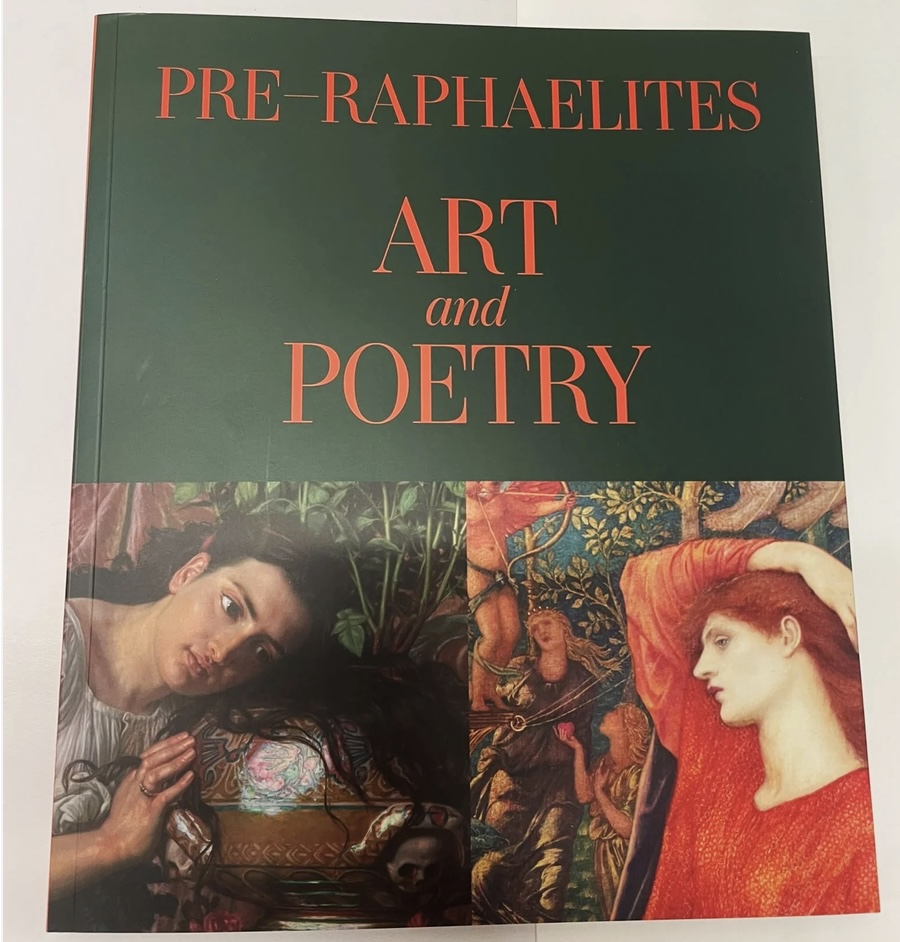
A well-illustrated 120-page catalogue for Pre-Raphaelites Art and Poetry accompanies the exhibition. It contains informative essays by the co-curators Lizzie Jacklin and Esmé Whittaker, and another by Pre-Raphaelite scholar Serena Trowbidge. The essays help to explain the context for the exhibition, highlighting the connections between poetry and art, and bringing fresh perspectives on the subject. There are no formal catalogue entries, which I personally regret, because the labels for the show were uniformly excellent in explaining how the works fit into the exhibition's context. The final section of the catalogue does, however, present images of important works accompanied by excerpts of the poems from which they were derived, which partly compensates for this deficiency. Fortunately a "List of Exhibited Works" is included as well at the end of the catalogue. For those unable to attend the exhibition in person, the catalogue is still well worth buying.
Bibliography
Jacklin, Lizzie and Esmé Whittaker, Eds. Pre-Raphaelites Art and Poetry. Newcastle: Laing Art Gallery, North East Museums, 2026. pp. £24.00.
Created 11 November 2026