
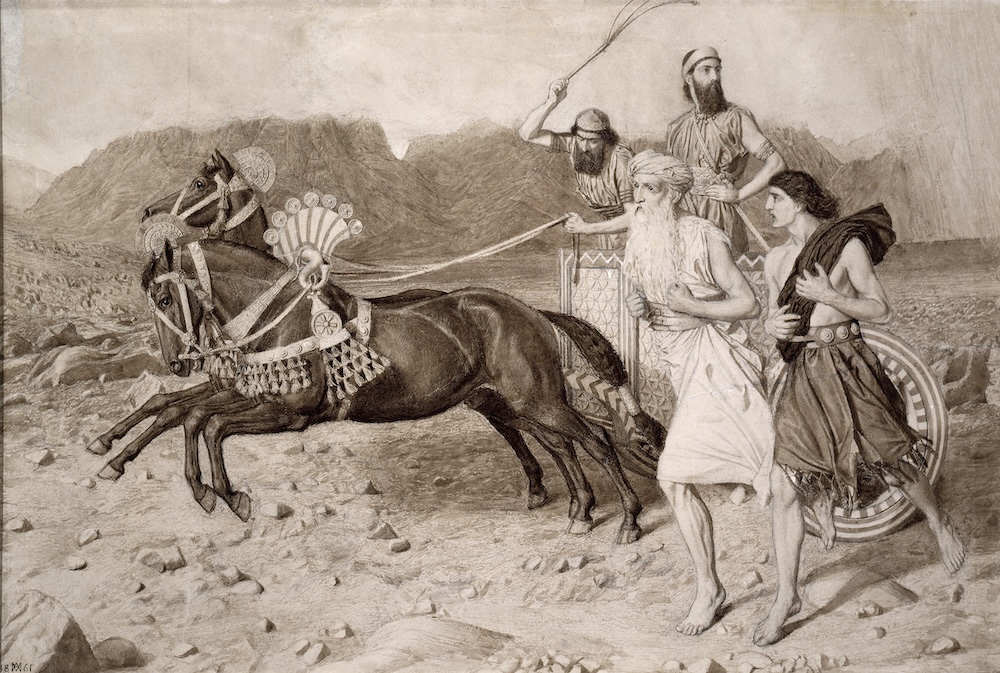
Elijah Running to Jezreel before Ahab's Chariot, by Albert Joseph Moore, ARWS (1841-1893). 1861. Brush, pen and brown ink over graphite, heightened with scratching out, on light tan laid paper; 19 3/8 x 27 15/16 inches (49.2 x 71 cm). Collection of the National Gallery of Canada, accession no. 47163. Image courtesy of the author.
Moore exhibited Elijah Running to Jezreel before Ahab's Chariot at the Royal Academy in 1861, no. 909, a drawing that appears to be unique in Moore's oeuvre. During the early and mid-1860s Moore produced a number of works illustrating stories from the Old Testament, but this drawing was the first to be exhibited, along with a small oil painting The Mother of Sisera Looked out a Window. The subject of the drawing is taken from I Kings 18:46: "And the hand of the LORD was on Elijah; and he girded up his loins, and ran before Ahab to the entrance of Jezreel." Through the power of God, Elijah outran King Ahab's chariot from Mount Carmel to the gates of Jezreel, a distance of almost twenty miles. This episode in the biblical story comes immediately after the contest between Elijah and the prophets of Baal, a subject that Moore was to paint two years later in 186 in his major painting from this period, Elijah's Sacrifice. The choice of subject matter in this drawing, the head of the prophet Elijah, and the landscape background suggest the influence of the Pre-Raphaelites, especially Ford Madox Brown and William Holman Hunt. As Robyn Asleson has noted: "In style, the drawing recalls the awkward, angular poses and hard-edged linearity that Pre-Raphaelite artists had adopted in their earliest drawings and prints" (27). Moore was to use a similar landscape background inElijah's Sacrifice.
A. L. Baldry has commented on this drawing: "The drawing of Elijah running before Ahab's chariot in Jezreel, of which another version in pen-and-ink is in [the] possession of Mr. Hollyer, has an interest, even beyond what it possesses as a dramatic composition, as one of the first of the biblical illustrations with which the young artist tentatively concerned himself while he was feeling his way towards the more absolutely individual methods of expression and types of subjects that afterwards almost exclusively occupied him" (27). The closely related drawing in pen and black ink mentioned by Baldry is in the collection of the York Art Gallery (object no. YORAG:R2862). The York drawing is possibly, although not necessarily, a preparatory study for the large sepia wash drawing. Although the two drawings are very close in composition, there are slight differences in the figures, particularly the head of the charioteer, and in the background.
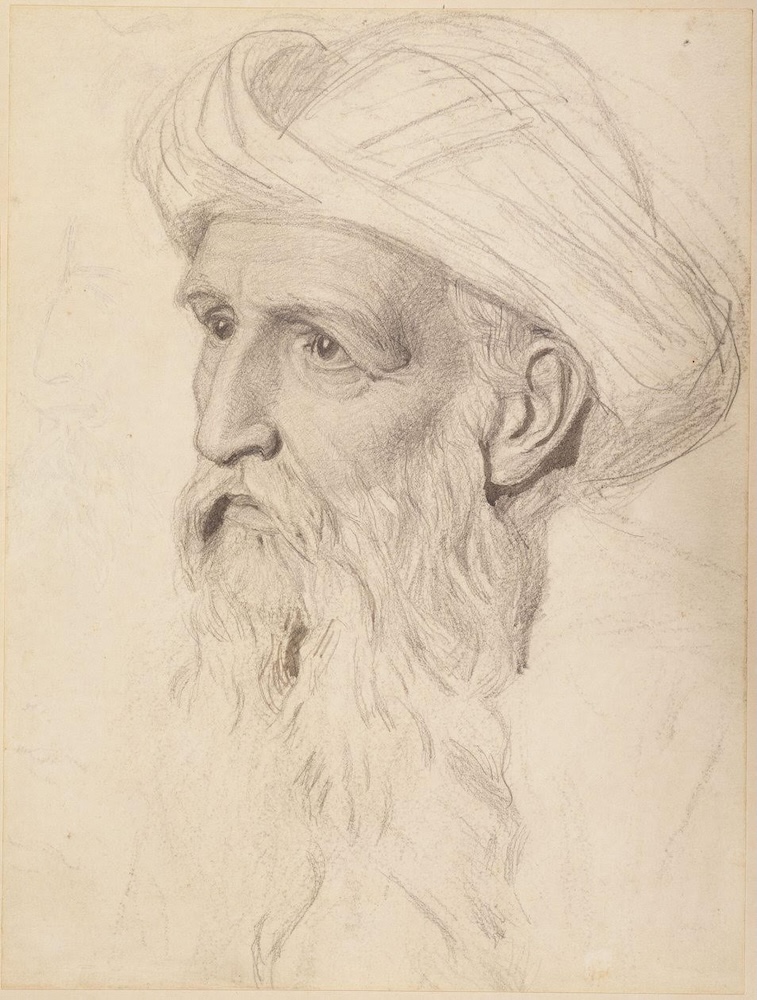
Study of the head of Elijah. 1861. Pencil on paper. 22 x 16 inches (55.8 x 40.7 cm). Collection of Birmingham Museum and Art Gallery, inventory no. 1927P912. Image courtesy of Birmingham Museums Trust under the terms of Creative Commons 0.
A pencil study for the head of Elijah is in the Birmingham City Museum and Art Gallery. Studies for the horses taken from Assyrian reliefs, and for the figure beating the horses to urge them to go faster, were included in a sketchbook sold at Christie's, London on 8 June 2000. The drawing of the charioteer later sold at the Peter Rose and Albert Gallichan sale at Christie's on 30 September 2021, lot 142. This drawing of the bearded male figure beating the horses shows how important it was for Moore to get the action correct in the finished drawing. Baldry reported that:
In nothing, however, did his strong regard for the exact expression of nature show so plainly as in the preliminary drawings for the few pictures in which he dealt with figures in movement or action. In all of these the play and motion of the limbs, the flow and flicker of the drapery, the momentary gesture or pose of arrested action, were all learned by heart in a succession of studies from models performing the movements and going through the actions that he was representing in his pictures, This habit of making drawings from figures actually moving was one to which he accustomed himself at an early stage of his practice. The charioteer with uplifted whip flogging the horse in the drawing of 'Elijah running before Ahab's chariot in Jezreel' was, perhaps, the first exhibited proof of it; the correct rise and fall of the man's arm, and the eager craning forward of his neck and shoulders, were secured by giving the model a cushion to flog and by noticing the recurrence of particular details of movement which produced the impression of strong action. [83]
Allen Staley feels Moore undertook this large and carefully worked drawing because he was inspired by the example of a drawing by his friend Simeon Solomon showing another obscure Old Testament subject, David Dancing before the Ark, drawn but not exhibited in 1860:
As biblical illustrations, both might be deemed somewhat irreverent in showing patriarchal figures in action – dancing and running – that seem out of character, undignified, and a bit ludicrous. Both drawings are complex, multi-figure compositions containing a quantity of archeological detail, which apparently draws attention to itself in the harnesses and trappings of the horses pulling Ahab's chariot in the Moore…. Moore never again did anything quite like the Elijah Running to Jezreel either, and, after this one drawing, horses would disappear from his oeuvre forever. Nevertheless, he did not abandon the venerable academic goal of painting large biblical compositions and returned to almost the same chapter and verse from I Kings for the subject of his ambitious Elijah's Sacrifice exhibited in 1865. He also retained a lifelong attraction to running figures. [121-22]
The Assyrian Reliefs from Nineveh that had recently been installed at the British Museum in 1860 also had a very major influence on Moore's drawing, not only on the figures, but also on its overall style. As Asleson has written:
The influence of the reliefs on Elijah Running to Jezreel is evident in the construction and ornamentation of Ahab's chariot, the details of the horse's equipage, and the distinctive headgear and costumes of Moore's figures. But in addition to adapting specific objects from the Nineveh reliefs, Moore also tried to imitate the style in which they were executed. Working in low relief, Assyrian artists defined their imagery through linear outline, rather than three-dimensional modelling. Similarly, Moore emphasized the tense, angular silhouettes of his figures and the internal lines of drapery and musculature. He set his scene before a flat landscape backdrop which minimizes the illusion of recession into space" (30). Colin Cruise has pointed out that these Assyrian reliefs had been a major influence on Simeon Solomon's pen-and-ink drawing of Queen Esther Hearing the News of the Intended Massacre of the Jews of 1860, and this drawing, in turn, may have influenced Moore's drawing of the following year. [97]
Bibliography
An Aesthetic Odyssey. The Peter Rose and Albert Gallichan Collection. London: Christie's (September 30, 2021): lot 142, 147.
Asleson, Robyn. Albert Moore. London: Phaidon, 2000. 27-32.
Baldry, Alfred Lys. Albert Moore. His Life and Works. London: George Bell and Sons, 1893. 27 & 83.
British Art on Paper. London: Christie's (June 8, 2000): lot 31, 38.
Cruise, Colin. Love Revealed. Simeon Solomon and the Pre-Raphaelites. London: Merrell, 2005, cat. 47, 97.
Green, Richard. Albert Moore and his Contemporaries. Newcastle Upon Tyne: Laing Art Gallery, 1972. 9 & 12.
Hedberg, Gregory. "Albert Moore." The Victorian High Renaissance. London: Lund Humphries, 1978. 138.
Lanigan, Dennis T., and Douglas E. Schoenherr. A Dream of the Past. Pre-Raphaelite and Aesthetic Movement Paintings, Watercolours and Drawings from the Lanigan Collection. Toronto: University of Toronto Art Centre, 2000, cat. 49, 147-148.
Lanigan, Dennis T. Beauty's Awakening. Drawings from the Pre-Raphaelites and Their Contemporaries from the Lanigan Collection. Ottawa: National Gallery of Canada, 2015, cat. 39, 106-07.
Staley, Allen. The New Painting of the 1860s, Between the Pre-Raphaelites and the Aesthetic Movement. New Haven, CT: Yale University Press, 2011. 121-123 & 126.
Created 9 October 2026