
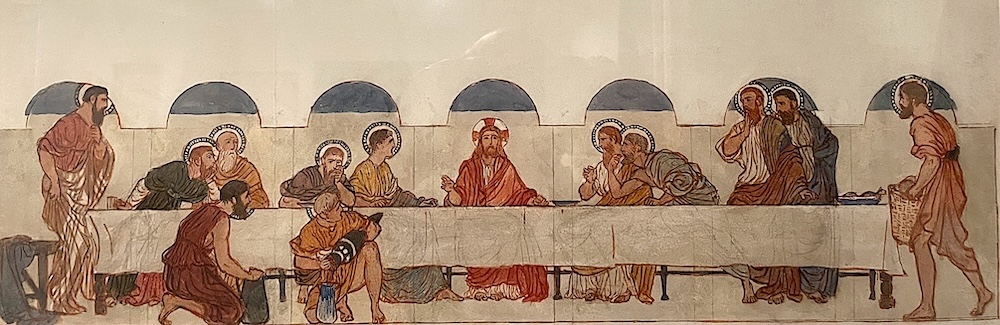
Study for The Last Supper for the Church of St. Alban's, Rochdale, Lancashire, by Albert Joseph Moore, ARWS (1841-1893). Graphite and watercolour, on off-white paper; 9 5/8 x 23 5/8 inches (24.4 x 60 cm). Private collection, image courtesy of the author.
This watercolour was one of the designs for frescoes that Moore exhibited at Architectural Exhibition Society held at the Conduit Street Galleries in May 1867. It is a study for the wall painting of The Last Supper that Moore executed as a reredos for the Church of St. Alban's, Rochdale, in 1865. He was probably commissioned by the building's architect, Joseph Clarke, to design and execute the mural decorations for the church, for which Moore was paid £700. Clarke noted on 25 May 1864 that Moore had already started executing his fresco designs at St. Alban's. It is an unusual design of this subject, dictated largely by the architecture of the building. Christ, clad in a white robe and red overmantel, sits in the centre, a red cruciform halo around his head, and making a gesture of blessing with his right hand. His twelve disciples, sitting, standing, or kneeling, are grouped around the table, seven to the left and five to the right. The disciple to the far right brings a basket of bread, while a kneeling disciple in the left foreground pours wine from an amphora into a jug. The figure third from the right in this cartoon bears a resemblance to Albert Moore, although it is unknown whether this was intended as a self-portrait by the artist.
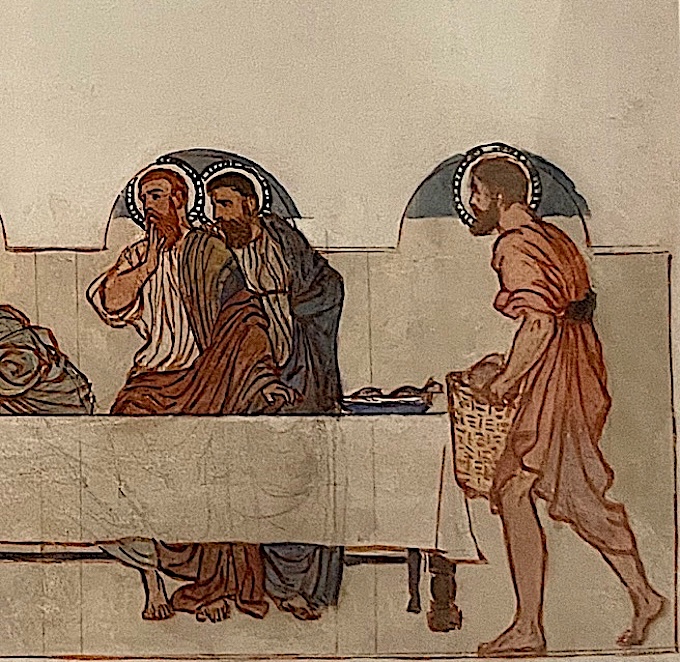
Closer view of disciples on the right.
A.L. Baldry considered the wall paintings for this church
perhaps the largest and most important decorative works which Albert Moore ever executed. They were, like the Coombe Abbey designs, painted in oils upon a plaster surface, and kept him engaged during a great part of both 1865 and 1866….These paintings, which occupy the whole of the upper part of the chancel, consist of several separate subjects. At the east end, above the altar, is an arcaded reredos, on the wall spaces of which is depicted The Last Supper in a composition of great beauty and ingenuity. The manner in which the pillars of the arcading have been used to determine the grouping of the figures, and have been brought into congruity with the design, is worthy of note; and the freedom from convention which is characteristic of this whole work is an additional proof of the artist's desire to find his own way [Baldry, Albert Moore, 31]
The Last Supper was located at the east end above the altar of the chancel, and was the first fresco completed. Although the design is somewhat reminiscent of his compositional study for The Last Supper intended for the Dutch Church, Austin Friars, but never executed, this earlier design had to be greatly modified to fit with harmony within the Gothic architectural framework of the Church of St. Alban's. The arches and windows of the church broke up the walls into awkward configurations that, as Robyn Asleson has pointed out, "proved a severe trial to Moore's ingenuity" (61). Nevertheless, as Aslson points out, "rather than gloss over these obstructions, Moore very deliberately incorporated them into his designs," and "The Last Supper was executed more successfully in harmony with the existing architecture than some of his subsequent designs" (61).
Moore's murals are no longer extent because the church was demolished in the early 1970s. Painting in oils on plaster in the English climate tends to be unstable. Baldry, in his book on Modern Mural Decoration, noted that at the start of his career, Moore "painted some important decorations in oils upon the walls of churches and private houses…. But almost invariably the results have been disastrous. Admirable designs, handled with great skill, and marked by beauties of draughtsmanship and colouring, have quickly decayed, and have become in a few years mere travesties of what they were originally" (35-36). Even by 1894, Baldry found that Moore's colours had unfortunately suffered not a little from atmospheric influences.
Moore worked up his designs for the St. Alban murals in his usual meticulous fashion. Asleson has commented that Moore made careful studies from both nude and draped models in his studio, and arranged cushions and boxes to simulate the architectural features of the church (see p. 61). His small-scale studies were later enlarged to their actual size and were then pinpricked for chalk transfer to the walls of the church. Some of his studies for his St. Alban murals survive in private and museum collections, including a number in the Victoria and Albert Museum.
Contemporary Reviews of The Last Supper
E. W. Godwin, in his review in The Building News of The Architectural Exhibition held in May 1867, praised Moore's designs for frescoes despite finding the drawings somewhat slight and sketchy. He also felt Moore had possibly executed his designs in bad faith because he did not admire the architecture of the building:
In looking at Mr. Moore's design for the fresco executed by him at Rochdale it is necessary to know that all the lower part of the wall is painted red. So that, although the drawing before us may look somewhat fiery in its general tone of colour, the fresco does, in fact, look exceedingly luminous and tender, possessing only red enough sufficiently to unite the lower part of the wall with the roof. There is, however, one fault which is almost inexcusable — the figures are out of scale with the architecture. It is quite possible that the building is ill-designed, and that the painter looked upon the architect as anything but a brother artist. If such were the case, we think the painter would have done wisely to decline the work; if such were not the case, then Mr. Moore has entirely missed the great purpose of his art [336].
When Godwin contrasted Moore's work at Rochdale with his unexecuted design for the Dutch Church at Austin Friars, which was also included in The Architectural Exhibition, Godwin noted that in the latter design "There are no architectural forms to rouse the ire of the artist; and working, therefore, in a better spirit, he has produced a better work. [336]Bibliography
Asleson, Robyn. Albert Moore. London: Phaidon, 2000. 60-62.
Baldry, Alfred Lys. Albert Moore. His Life and Works. London: George Bell and Sons, 1893. 9, 31.
Baldry, Alfred Lys. Modern Mural Decoration. London: George Newnes Ltd., 1902 35-36.
British Art on Paper. London: Christie's (June 8, 2000): lot 32, 39.
Godwin, Edward William: "The Architectural Exhibition, 1867." The Building News XIV (17 May 1867): 335-38.
Created 9 October 2026