

Design for a Mosaic for Central Panel of the Houses of Parliament (Charity and Faith with St. Patrick), by Albert Joseph Moore, ARWS (1841-1893). 1869. Watercolour on paper. Dimensions unknown. Collection of the Victoria and Albert Museum. Image taken from The Studio. [Click on the images on this page to enlarge them.]
According to The Studio, this and the accompanying design exemplify the British government's treatment of artists:
It is the custom of our Government officials to struggle to make reasons for not doing things they obviously ought to do. When the particular thing they ought to do involves the encouragement of art, their struggles to shelve the whole matter become quite painful. As an illustration of this, the case of Albert Moore's designs for the mosaic panels in the Central Hall of the Houses of Parliament is worth noting. These designs were prepared by him some time in the sixties, and have been in the board of Works ever since. Two or three years ago the suggestion was made that the completion of the panels was about due, so the officials hve examined the drawings and decided they would like to have a little more detail in them. Seven years ago Albert Moore died. [263]
Scanned image and text by George P. Landow. You may use this image without prior permission for any scholarly or educational purpose as long as you (1) credit the person who scanned it and (2) link your document to this URL in a web document or cite the Victorian Web in a print one.
Additional Commentary by Dennis T. Lanigan
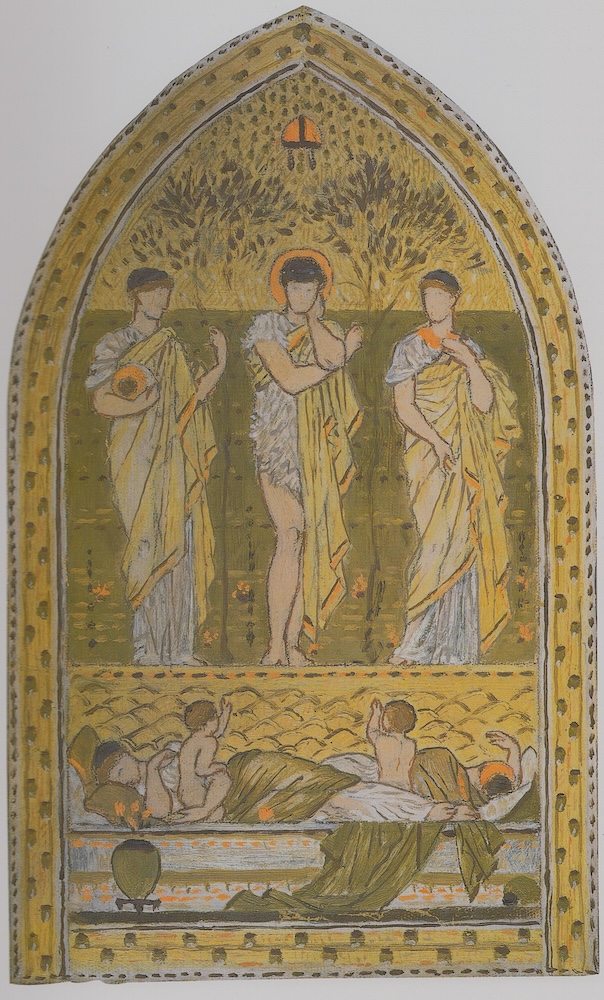
Design for a mosaic for Central Panel of the Houses of Parliament (Charity and Faith with St. Patrick) . 1869. Watercolour on paper. 14 x 8 ½ inches (35.5 x 21.6 cm). Collection of Public Records Office, Kew, London, shown in Asleson, Plate 70, facing p. 74.
In January 1869 Moore received a commission from Austen Henry Layard, the Commissioner of the Board of Works, to submit a design for a mosaic for the decoration of the Central Hall of the new Palace of Westminster. Layard quite rightly felt that mosaics would offer greater permanence and brilliance than fresco. The mosaics were to be produced by Giuseppe Salviati's Venice and Murano Glass and Mosaic Company. Initially four mosaics were planned, one to be designed by each of four artists – Frederic Leighton, Val Prinsep, Edward Poynter and Moore. In June 1869, however, Leighton and Prinsep were dropped, leaving Moore and Poynter to design two designs each at a fee of £150 per cartoon. The designs were intended to represent subjects emblematical of one of the four divisions of the United Kingdom – England, Scotland, Wales and Ireland. Moore was to design cartoons for Saint Andrew and Saint Patrick. Layard hoped that by having Moore and Poynter working together the projected designs could be brought into harmony with each other so as to form parts of one coherent theme. The designs were to have a gold background and the cartoons were to be coloured to the extent that the mosaicist would be in no doubt as to what was intended. Moore worked his cartoons in a limited palette of pale green, orange, grey and yellow, the latter intended to represent gold.
Moore completed his cartoons by the third week of July. Robyn Asleson records the reply from the Office of Works and Buildings in a letter of 10 August 1869: "while fully appreciating the extreme beauty and elegance of your designs, he [Layard] has arrived at the conclusion, although most reluctantly, that it will be impossible … to assimilate them to those of Mr. Poynter." It was Layard's opinion, the letter continued, "that the designs of Mr. Poynter are more appropriate to the material in which they are to be executed, and he can therefore only express to you his regret that he has unable to avail himself of those proposed by yourself, which he so much admires." As revealed in internal correspondence, Layard specifically objected to the monochromatic scheme and unsuitable style of Moore's drawings, and that his extraordinary decision to fail to honour the agreement was based, in addition to aesthetic judgment, on political pressure (Asleson 72-73). Asleson goes on to reveal that Moore was totally unprepared for this rejection and felt "an enormous sense of personal injury in having been humiliated so publicly and unexpectedly at a crucial moment in his career" (73).
The more finished design illustrated in The Studio in 1899 is now in the collection of the Victoria and Albert Museum. A. L. Baldry has described the subject of this cartoon:
In the first panel the patron saint of Ireland, clad in a tightly fitting tunic of white sheepskin, and draped with pale green, stands leaning on a shepherd's crook, round the staff of which is twisted a snake. He wears an orange cap, and his head is surrounded by a white halo. To the right and left of him stand two female figures, Fides [Faith] and Caritas [Charity], in transparent white robes wound round with pale green. Fides has an orange necklace and a white cap; Caritas a white cap, and in her arms is an orange pitcher. The figures are relieved against a grey background with some simply treated foliage in pale yellow-green. Below is an exquisite group of a nude child and two sleeping women in pale green and white draperies with touches of orange. They lie on a raised couch of white patterned with scarlet; in front is a green and white jar with red flowers, and the space behind the figures is filled with a white conventional wave pattern on a blue ground. The border surrounding the whole design is in lines of blue and white with spots of pale green. [38-39]
Bibliography
Asleson, Robyn. Albert Moore. London: Phaidon, 2000. 71-75 & 213n.120.
Baldry, Alfred Lys. Albert Moore. His Life and Works. London: George Bell and Sons, 1893. 38-39.
Baldry, Alfred Lys. Modern Mural Decoration. London: George Newnes Ltd., 1902. 56-57.
"Studio-talk." The Studio. XIX (1899): 263.
Created 23 April 2007
Image and commentary added 8 October 2026