
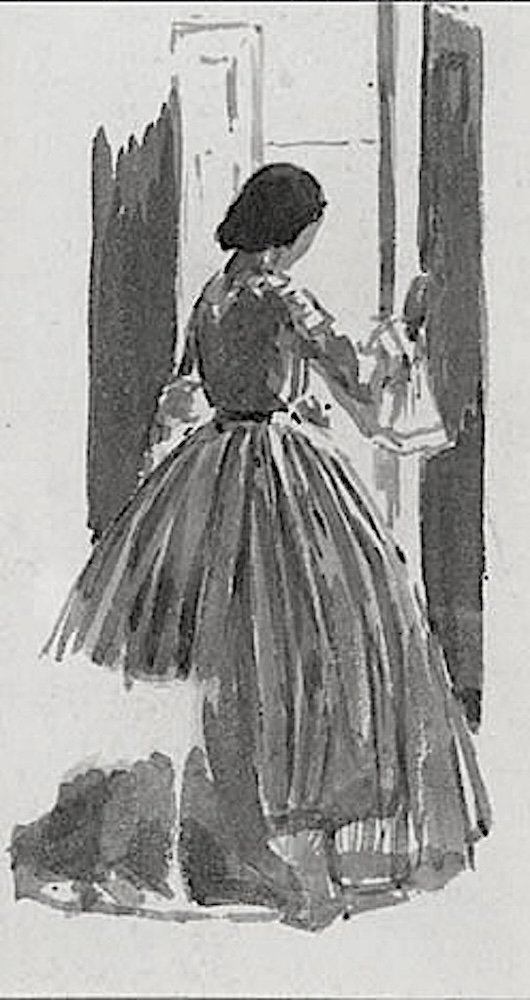
Lady at a Window, by Albert Joseph Moore, ARWS (1841-1893). c.1860. Brush and black/grey inks on white paper. 41/2 x 21/4 in. (11.3 x 5.8 cm). Private collection, image courtesy of the author.
This drawing, dating from c.1860, was once part of a Moore sketchbook which sold at Christie's, London, on 8 June 8 2000, lot 31. It possibly predates Moore's trip to Rome in 1862, after which he usually sketched models in classical drapery rather than contemporary dress. Although a rather slight drawing, it is of scholarly interest as it seems to indicate Moore's familiarity with contemporary photography.
Moore did use photography as a preparatory aid later in his career, so he was evidently interested in the medium, at least as an artistic tool. This drawing, however, suggests Moore may have recognised the potential of photography as an art form, particularly as regards the work of Lady Clementina Hawarden, who practiced photography only between the years 1857-1864. The way light dissolves form in several parts of the drawing is quite striking and rather reminiscent of the photographic effects of Lady Hawarden's work. She loved to pose her daughters, her favourite models, in fancy dress before full-length mirrors or windows. Hawarden exhibited her work at the Photographic Society of London in 1863 and 1864, and sold her work at the Bazaar held in the Horticultural Gardens for the benefit of the Female School of Art in 1864, although it is not known whether Moore attended these early photographic exhibitions.
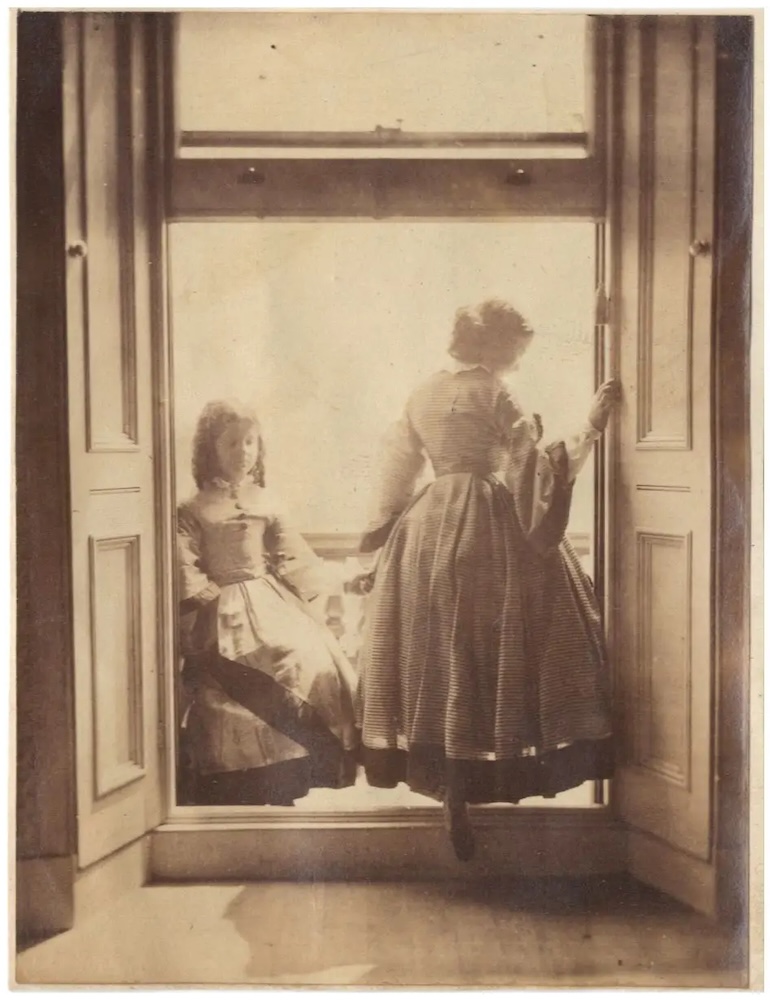
Portrait of Two Girls at a Window by Lady Hawarden,
c.1862. [Click on the image for more information].
A photograph by Hawarden closely related to this drawing, showing two girls at a window with the right-hand figure in a similar pose to the young woman in this drawing, sold at Bonhams in London on 19 March 2013, an item in lot 107. The similarity may, of course, be coincidental, and not necessarily proof that Moore knew of Lady Hawarden’s work: as Thomas Scott Buckle has pointed out in correspondence with the author, the poses may be similar, but the models' dresses are markedly different, and the window frames are of a different width. Nevertheless, the general likeness seems significant.
In addition to the possible influence of the photography of Viscountess Hawarden, another influence may have been two etchings by Francis Seymour Haden, The Letter, No. 1 and The Letter, No. 2 of 1863. Interestingly, these prints are, in fact, based on a photograph by Lady Hawarden.
Related Material
- Untitled (Clementina Maude before a window and her reflection in a mirror)
- Untitled (Clementina Maude barefoot with her back to the window and her reflection)
Bibliography
British Art on Paper. London: Christie's (8 June 2000): lot 31, 38.
Created 23 April 2007
Image and commentary added 8 October 2026
Last modified 14 October 2026