
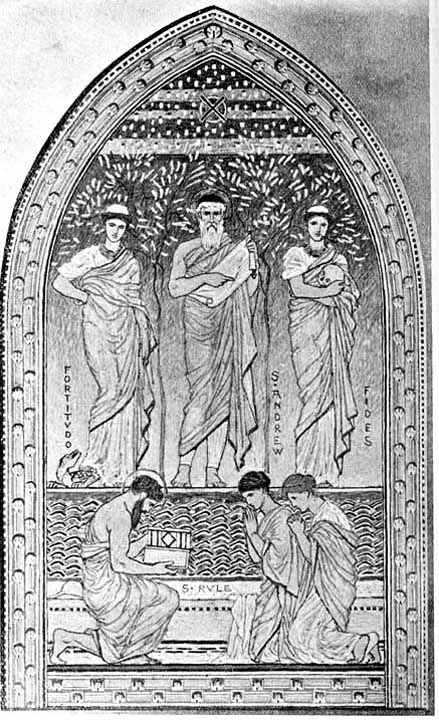
Design for a mosaic for Central Panel of the Houses of Parliament (Courage and Faith with St. Andrew) . 1869. Watercolour on paper, dimensions unknown. Collection of the Victoria and Albert Museum. Image taken from The Studio. Scanned image and text by George P. Landow. [Click on the image to enlarge it.]
Commentary by Dennis T. Lanigan
This is a design for a mosaic for the decoration of the Central Hall of the new Palace of Westminster commissioned in 1869 by Austen Henry Layard, the Commissioner of the Board of Works, Although both Moore and Edward Poynter had been asked to submit designs, Moore's designs were never executed and the commission ultimately went to Poynter alone. The two cartoons by Poynter were exhibited at the Royal Academy in 1870, St. George (no. 1006) and Fortitude (no. 997), while Moore showed his painting A Garden at this same exhibition. A critic for The Art Journal provided an explanation as to why Moore's mosaic designs were rejected: "It may be remembered that Mr. Poynter and Mr. Moore, who meet in this room, were at first associated in a joint commission for the Salviati mosaics. In the opinion of Mr. Layard, however, Mr. Moore's manner proved too classic for a Gothic interior, and therefore the whole work was entrusted to Mr. Poynter. A comparison of the styles of the two artists, as now seen in this exhibition, shows Mr. Poynter to be mediaeval, and Mr. Moore pseudo-classic" (171). Poynter's mosaic of St. George for England was installed in 1870 and his St. David for Wales in 1899. Mosaics for the remaining two arches of St. Andrew for Scotland and St. Patrick for Ireland, which were to have been by Moore, were not installed until the 1920s from designs by Robert Anning Bell.
A.L. Baldry has discussed Moore's St. Andrew cartoon which was similar in design and treatment to that for St. Patrick:
Saint Andrew, a venerable figure with a long white beard, in grey-blue drapery, and a black cap, holds a scroll in his left hand and points to it with his right, Round his head is an orange halo, on either side of him in white and pale blue draperies, with white caps and orange necklets, are Fides [Faith] holding a skull, and Fortitudo [Courage] with her foot on the head of a dragon. The background is brown, gradated into pale yellow, with green foliage. Below, against a wall of yellow and brown, with a base of white and yellow with red lines, is a group of three figures, a kneeling man holding a pale yellow casket, before which two women in pale grey and white draperies bow down. The border here is in lines of grey, white, and brown, with spots of yellow. It is a matter of great regret that these designs should never have gone beyond the preliminary stage. They are excellently adapted for reproduction in mosaic; and their distinctive colour would have added a touch of refinement to the gloomy hall, which, with his empty panels, stands to-day as a silent, but none the less expressive, commentary on our national parsimony in the encouragement of Art. [39]
Baldry in his book Modern Mural Decoration pointed out how appropriate Moore's designs were to be carried out in mosaic:
The pictorial quality has been carefully avoided, and any weakening of the main facts of the design by exaggeration of unimportant accessories has been guarded against with the shrewdest insight. He did not forget that such works need to be, above all, surface decorations with an architectural character, which makes them inherently part of the building in which they are placed; therefore he maintained a judicious reserve and aimed at largeness of line and strict simplicity in the arrangement of masses. He kept his colour, too, quiet and delicate, with just enough brilliancy to make it tell in a rather dark interior, but with no over-elaboration which would diminish its dignity. [57]
Even as late as 1902, Baldry was still advocating that Moore's designs be taken to fruition in mosaics.
Bibliography
Asleson, Robyn. Albert Moore. London: Phaidon, 2000. 71-75, 213n.120, & 213n.124.
Baldry, Alfred Lys. Albert Moore. His Life and Works. London: George Bell and Sons, 1893. 38-39.
_____. Modern Mural Decoration. London: George Newnes Ltd., 1902. 56-57.
"The Royal Academy." The Art Journal XXXII (June 1, 1870): 161-72.
"Studio-talk." The Studio XIX (1899): 263.
Created 23 April 2007
Commentary added 8 October 2026