
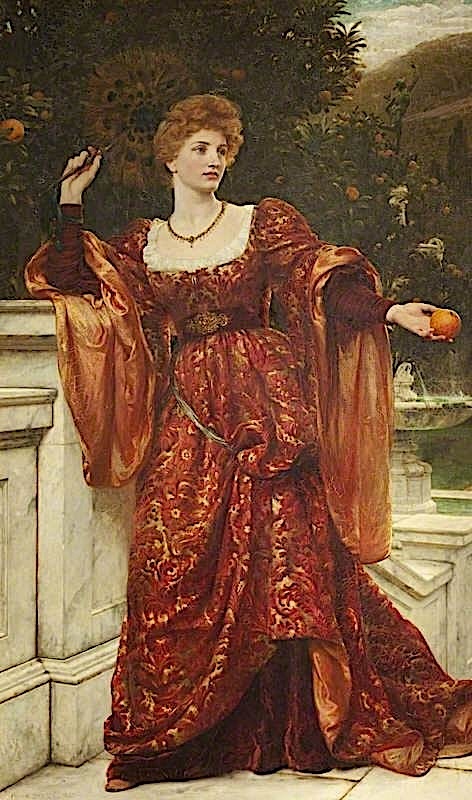
Hesperia, by Sir Frank Dicksee (1853–1928). 1887. Oil on canvas. 98 ¼ x 61 ¼ inches (250 x 156 cm). Collection of Harris Museum and Art Gallery, Preston, accession no. PRSMG:P819. Image courtesy of Harris Museum, Art Gallery & Library, reproduced for purposes of non-commercial academic research. [Click on the image to enlarge it.]
Dicksee exhibited Hesperia at the Royal Academy in 1887, no. 420. In Greek mythology Hesperia ("sunset glow") was one of three sisters who were the goddesses of the evening and the golden light of sunsets. She was also sometimes known as Erytheia ("the red one"). The Hesperides were the guardians of the tree bearing golden apples in the Garden of the Hesperides, located beyond Ocean in the far west of the world beyond the sunset. The golden apples were said to grant immortality when eaten. The sisters were aided in guarding the tree by the dragon Ladon who never slept. In Dicksee's painting Hesperia is portrayed as a beautiful maiden clad in a gorgeous red and gold brocade Renaissance dress, bearing a fan of peacock feathers in her right hand, and holding a golden apple in her outstretched left hand. The apple tree is located behind a white marble wall to the right of the goddess. A marble fountain is in the right midground. A bronze statue of Mercury, a row of hills, and a cloudy sky make up the background. Simon Toll passes on information from the Nottingham Guardian stating that the model for Hesperia was the comic actress Mary Eastlake, who was also the model for Dicksee's Sylvia of the same date.
The most famous Victorian picture dealing with the Garden of the Hesperides is Frederic Leighton's later version of 1891-92, now at the Lady Lever Art Gallery. Edward Burne-Jones did an oil painting of the Garden of the Hesperides of 1869-73 in the collection of the Hamburger Kunsthalle and a gesso on wood coloured and gilded low relief in the collection of the Victoria and Albert Museum. William Holman Hunt also did a coloured plaster relief panel, with his subject entitled Hercules in the Garden of the Hesperides, which is in the collection of the Manchester Art Gallery. The use of peacock feathers as a decorative accessory was not uncommon in Victorian art and include Frederic Leighton's Pavonia of 1859, G. F. Watts painting of a nude model A Study with the Peacock's Feathers of 1865, Frederick Sandys Vivien of 1863, and F. G. Stephens' Portrait of Clara Stephens Hesperia is also certainly in keeping with the common Victorian practice of giving what are essentially decorative paintings of attractive young women classical titles to make them more saleable.

Contemporary Reviews of the Painting
Claude Phillips in The Academy felt this painting was essentially decorative, lacking in sincerity of purpose, and not a tale taken from Greek mythology:
Mr. Frank Dicksee's idealized portrait Hesperia (420) may also take its place here, for it partakes to a great extent of the nature of a decoration. A beautiful woman of heroic life-size stands fronting the spectator, robed in splendid Venetian brocade of varying shades of crimson, and holding in her hand a branch bearing the golden fruit which has suggested the name of the picture. The work, like most of the young painter's productions, shows unerring skill of draughtsmanship, and the most strenuous effort to obtain brilliancy and charm of colour. If it is not the work of a born colourist, and lacks to some extent strength, vibration, and real decorative effect, it contains a fair measure of richness and harmony, and thus far justifies its existence; but if we look beyond, we are struck by a pervading emptiness and lack of real sincerity of feeling of purpose, such as have been of late in far too great a measure the characteristics of the artist, seeing that his aspirations lead him to attempt invariably those very branches of his art in which real virility and ideality of conception are indispensable qualities. [369]
A critic for The Art Journal found Dicksee's submission a disappointment: The Hesperia of Mr. Frank Dicksee, No. 420, beautiful as is the painting of the lady's dress, will again disappoint those who hope so much from the painter of Harmony and Evangeline(248). F.G. Stephens in The Athenaeum gave it grudging praise:
The Hesperia (420) of Mr. F. Dicksee is a Cinquecento decoration on a magnificent scale. Hesperia is a life-size lady in crimson and gold brocade, fair, handsome, and tall, leaning against a pedestal, holding out an orange, and surrounded by what is intended to suggest the gardens of the legend. This seems to us much the best of the painter's works. Indeed, it is one of the first that deserve to be called works. It resembles the pictures of Sir F. Leighton more closely than Mr. Dicksee's friends may desire; nevertheless, it is very acceptable as showing exactly at what he does aim. It is not quite first rate. There is a good deal in a "not," but we should be glad to be able to oftener give even negative praise. [708]
The Builder, however, had no qualms about calling Dicksee's submission a brilliant success: "Between Mr. Brett's two paintings hangs a 'bravura' work, as we should call it, by Mr. F. Dicksee, Hesperia (420), a gorgeous Renaissance Italian woman in a gorgeous garden, with a dress of the most sumptuous description, holding out an orange. The picture is almost startling in its brilliancy, but in its way it is certainly a success" (663). The Illustrated News not only liked the picture but provided an interesting anecdote about the model: "Mr. F. Dicksee's Hesperia (420), a beautiful young girl in a richly brocaded dress, holding in her hand one of the golden apples. It may be mentioned that this is the portrait of a lady who has, since it was painted, withdrawn from the world and its embellishments, and is now undergoing her noviciate in a convent" (584). The Magazine of Art much preferred Dicksee's entry of the previous year, Memories: "In Hesperia Mr. F. Dicksee's retrogression from the standard of last year is decided" (275).
Bibliography
Blackburn, Henry. Academy Notes XIII (May 1887): 73.
"Current Art." The Magazine of Art X (1887): 271-77.
"Oil Paintings at the Royal Academy." The Academy VIII (May-June 1887): 164.
Philips, Claude. "The Royal Academy." The Artist XXXI (21 May 1887): 368-69.
"The Royal Academy." The Builder LII (7 May 1887): 662-64.
"The Royal Academy." The Illustrated London News XC (21 May 1887): 584.
"The Royal Academy Exhibition." The Art Journal New Series XXVI (1887): 245-48 & 279.
Stephens, Frederic George. "Fine Arts. The Royal Academy." The Athenaeum No. 3109 (28 May 1887): 708-10.
Toll, Simon. Frank Dicksee 1853-1928, His Art and Life.Woodbridge: ACC Art Books, 2016, cat. no. FD.1887.1, 72-75 & 228.
Created 4 July 2026