

Memories, by Sir Frank Dicksee (1853–1928). 1886. Oil on canvas. 20 x 36 inches. Partially destroyed. Source of image The Magazine of Art, Volume X (1886-87), p. 221.
Dicksee exhibited Memories at the Royal Academy in 1886, no. 374. It was accompanied in the Royal Academy catalogue by these lines from Tennyson's poem "Break, Break, Break":
"Oh for a touch of a vanished hand
And the sound of a voice that is still."
Dicksee showed the painting later that same year at the Manchester Autumn Exhibition of Pictures. The picture shows a young woman, likely a daughter of the older woman sitting in a chair, seated at the piano and playing a song from memory. An even younger daughter lounges by the mother, her head resting on her mother's left leg. All three have melancholy wistful expressions on their faces as they think of their deceased husband and father. The family dog lies at the feet of the mother. The scene is situated in a dark, rich late Victorian middle-class interior. A garden can be seen through the window to the left. The model for the mother was Dicksee's childhood friend, Jessie Shepard (née Lee), who was married to the architect Henry Dunkin Shepard. Dicksee's watercolour portrait of Jessie inspired the pose of the background figure in Old Songs (1885, Private Collection), a painting which in turn was the basis for Memories (see Toll 69). Jessie was already in delicate health at the time Memories was painted and she died young in 1890. The painting was damaged in a fire and all that remains is a fragment showing the mother seated in a chair. Its composition is known, however, from an illustration in The Magazine of Art in 1887 and a watercolour compositional study in the Manchester Art Gallery.
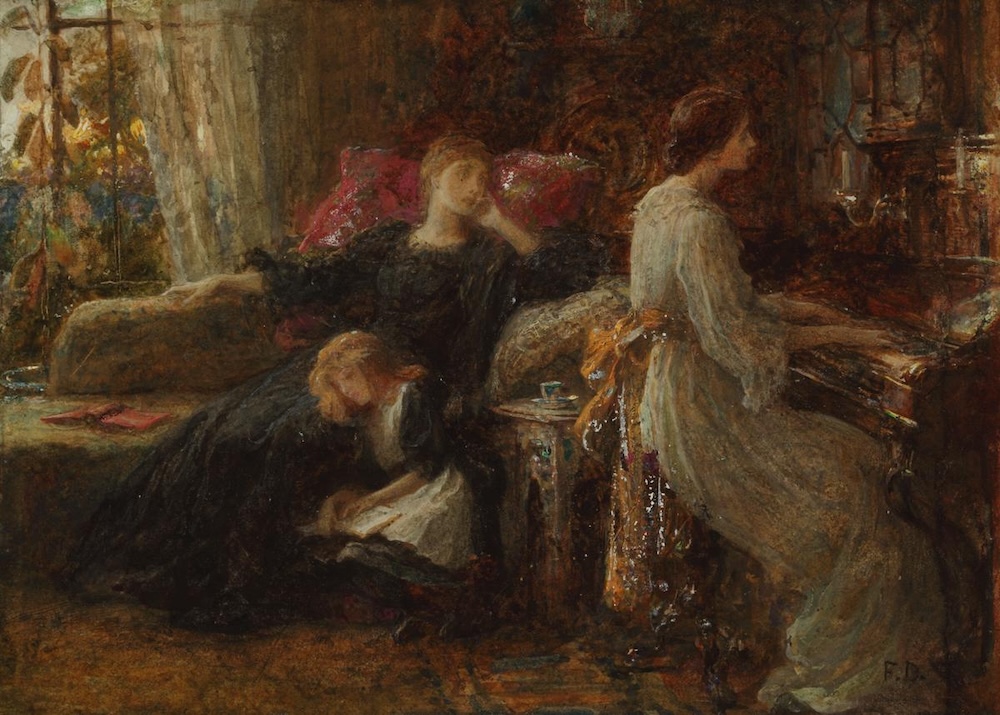
Memories. Watercolour, gouache and gum arabic on paper, 5 3/8 x 7 1/2 inches (13.6 x 18.9 cm). Collection of Manchester Art Gallery, accession no. 1917.46. Image courtesy of Manchester Art Gallery under a Creative Commons Attribution ShareAlike International (CC BY-SA 4.0) licence.
The watercolour study is close to the finished painting, although missing the family dog. An etching of the painting was made by Frank's cousin, Herbert Thomas Dicksee, and published in 1892 by C.E. Clifford & Co. Although Dicksee was best known for his romantic, medievalising pictures inspired by Pre-Raphaelitism and the Venetian High Renaissance, he did occasionally do contemporary "domestic drama" genre pictures in the manner of artists like William Quiller Orchardson. Other examples by Dicksee include his Ladies and Gentlemen of c.1880, A Reverie of 1895, and The Confession of 1896. Scott T. Buckle believes that Dicksee may have been influenced here, consciously or otherwise, by Henrietta Ward’s 1878 Royal Academy exhibit One of the Last Lays of Robert Burns, which also features a young woman seated at a keyboard instrument, a pondering figure seated behind, and a sleeping dog to the left.
Contemporary Reviews of the Painting
The critic of The Times felt this was one of the best works Dicksee had exhibited for some years:
Mr. Frank Dicksee's Memories is, to our mind, the most successful picture that he has painted for some years. The sentiment is ordinary enough, the subject being a widow stirred with emotion as her daughter or niece plays music that reminds her of happier days; but the treatment is refined and the drawing, of course, admirable. The artist has a genuine gift for the higher regions of domestic art, and his work in this direction is less likely to provoke hostile criticism than are his ventures into the fields of religious or tragic art. [qtd. in The Artist, 202]
Interestingly, however, The Observer felt exactly the opposite: "Mr. Frank Dicksee's Memories, a composition of three figures, a daughter's song recalling a mother's grief, is delicately conceived and executed, but it's more commonplace than anything he has painted of late years" (qtd. in The Artist, 202). A reviewer for The Art Journal liked the picture and felt it should have been better hung: "Memories, Frank Dicksee, A. Like all Mr. Dicksee's work this picture is full of refined sentiment and good honest painting, and should certainly have had a better place, especially as it is the artist's only contribution" (222). F.G. Stephens in The Athenaeum mentions only that "Mr. F. Dicksee sends a pathetic picture called Memories (374). The painting reminded The Illustrated London News of Dicksee's first success, Harmony: "Mr. Frank Dixie's [sic] Memories (374), a girl recalling on the piano 'the sound of a voice that is still,' unfortunately recalls to us also somewhat too vividly Mr. Dixie's first success" (508).
Sidney Hodges in The Magazine of Art gave it one of its most laudatory reviews:
This picture contains a deeper pathos than any previous work from the same hand, with the exception perhaps of Evangeline. True feeling is expressed in the face of the young widow as, with the child at her knee, she sits listening to the girl at the piano, and yearns with an indescribable yearning, "For the touch of a vanished hand, And the sound of a voice that is still." The effect of this picture, which is very deep and rich in tone, was damaged at the Academy by the proximity of some intensely light canvases. It was seen to better advantage in the Manchester Exhibition, where it was afterwards exhibited. [219-20]
The Art Journal in 1893 had these comments when discussing the etching after the painting by Herbert Dicksee: "In the twilight of summer day the widowed mother has laid aside her book to listen to the well-known chords of a once favourite piece of music. The younger sister plays quietly what she knows must be full of tender memories to the once happy wife and mother; the child is quieted by the music and the stillness of the hour, and even the dog rests motionless as if he, too, understood the whole story" (63).
Bibliography
Blackburn, Henry. Academy Notes XII London: Chatto and Windus (May, 1886): 53.
Collated Opinions on the Royal Academy." The Artist VII(1 June 1886): 200-07.
"Exhibition of the Royal Academy." The Art Journal New Series XXV (1886): 221-22.
Hodges, Sidney. "Mr. Frank Dicksee, A.R.A." The Magazine of Art. 10 (November 1886-October 1887): 217-22. Internet Archive. Web. 21 October 2014.
"New Art Publications, Engravings and Books." The Art Journal New Series XXXII (1893): 63.
"The Royal Academy." The Illustrated London News LXXXVIII (15 May 1886): 508.
Stephens, Frederic George. "The Royal Academy." The Athenaeum No. 3053 (1 May 1886): 589-91.
Toll, Simon. Frank Dicksee 1853-1928, His Art and Life. Woodbridge: ACC Art Books, 2016, cat. no. FD.1886.2, 67-70 & 228.
Victorian, Pre-Raphaelite & British Impressionist Art. London: Christie's (11 July 2018): lot 105.
Created 21 October 2014
Last modified 15 July 2026