
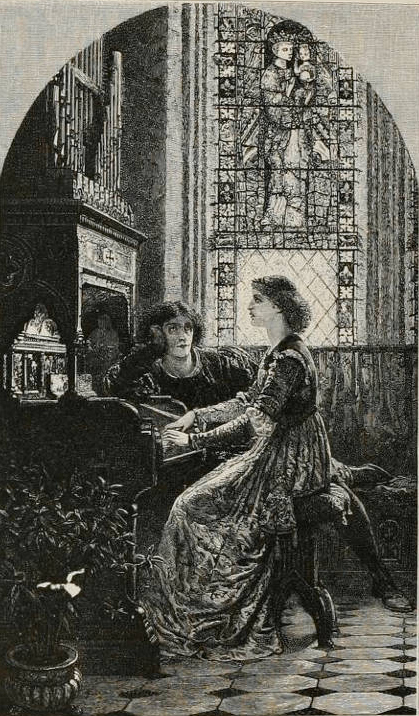
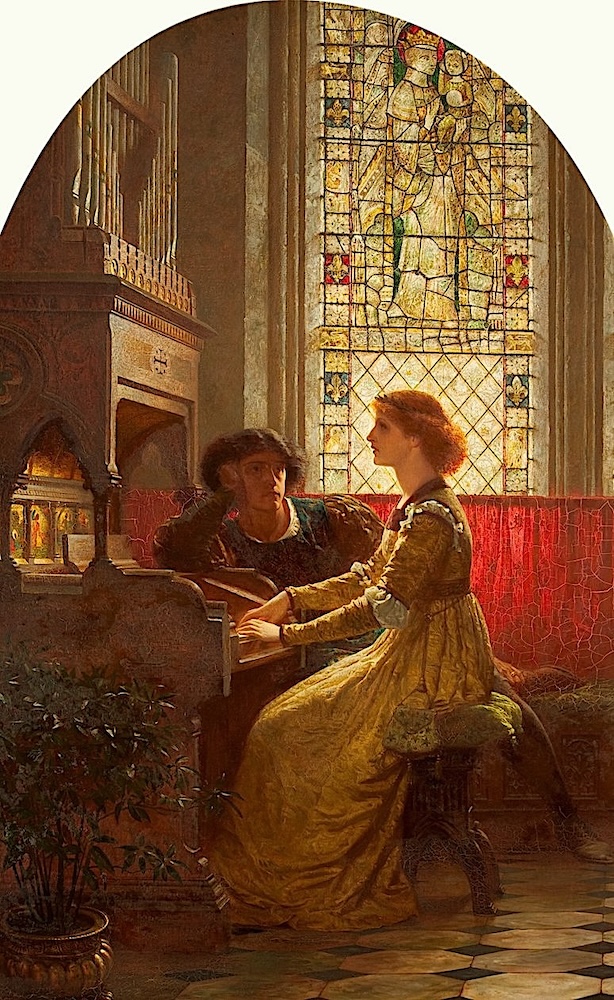
Harmony, by Sir Frank Dicksee (1853–1928). Left: 1877. Oil on canvas. 61 7/8 x 37 inches (157 x 94 cm). Collection of Tate Britain, accession no. NO1587. Image courtesy of Tate Britain, under the terms of the Creative Commons Attribution-NonCommercial-NonDerivatives licence (CC BY-NC-ND). Right: 1878. Oil on canvas. 46 x 27 1/4 inches (117 x 69.2 cm). Collection of Towneley Hall Art Gallery & Museum, Burnley, accession no. BURGM:paoil150. Image courtesy of Towneley Hall Art Gallery & Museum, reproduced for purposes of non-commercial academic research. [Click on images to enlarge them.]
Dicksee exhibited Harmony at the Royal Academy in 1877, no. 14, the second work he had ever shown there. It was voted "Picture of the Year" and basically made his reputation. It was purchased by the trustees under the terms of the Chantrey Bequest in the first year of their activity. It remains one of his most beautiful and important paintings. The idea for the picture originated when Dicksee was still a student at the Royal Academy schools and attended the Langham Sketching Club to improve his draughtsmanship. The club met regularly to make drawings on an agreed theme. One evening the topic chosen was "Music" and the original sketch he made during that session was the genesis of his idea for this picture. The idea of using a stained-glass window for the background was probably the result of the training he was receiving designing stained glass under Henry Holiday at this time.
Hilda Birchall has described the painting on the Tate Britain website:
Harmony is one of the best known pictures by Dicksee, depicting a young man staring adoringly into the eyes of a girl playing the organ. The model for the woman was Hilda Spencer who was then a student at Queens College, Harley Street where Dicksee taught drawing. She sits in a trance-like state, seemingly oblivious to her suitor's rapturous gaze. The painted furniture is reminiscent of the medieval figurative panels then being produced by William Burges (1827-81) and William Morris (1834-96). In addition the stained glass reflects the influence of Pre-Raphaelitism and, in particular, Henry Holiday (1839-1927). Holiday was introduced to the applied arts by Dante Gabriel Rossetti (1828-82) and Burges. In 1863 he began his career as a painter of stained glass, employing Dicksee for some years to make cartoons and research costumes and characters in the British Library. In recent years an interest in the formal qualities of Harmony has been overshadowed by a burgeoning interest in the iconography of the painting."
The subject of who the model is for the female figure does not appear to be straightforward, however. Simon Toll identifies the male model as Gaetano Meo (37). As for the female model he recounts that Dicksee had approached a beautiful young widow who had recently moved to London to pose for the female figure. Another story identifies the model as a pretty young guide who had shown Dicksee and his friends around Chatsworth. Toll also relates that Dicksee made studies from several of his young pupils at Queen's College, and names Margaret Spencer, Ethel Lewis and Helen Maud Holt (later Lady Beerbohm Tree) as possible models for the musician (38).
In terms of iconography Jan Marsh, for instance, felt Dicksee's depiction of the young couple was representative of nineteenth-century patriarchy with the young woman depicting the devoted wife and mother: "This theme can be compared with that of Frank Dicksee's Harmony … featuring a young couple in what had by now become the requisite medieval dress for all poetic subjects. The subject is symbolic of partnership, and the young woman's music – played on an organ decorated with painted scenes – represents the harmonious qualities of true wifehood. The same theme is repeated in the stained-glass image of Madonna and Child, and in the glow of warm light that infuses the atmosphere, a glossy tone that echoes the idealization of the image" (74).
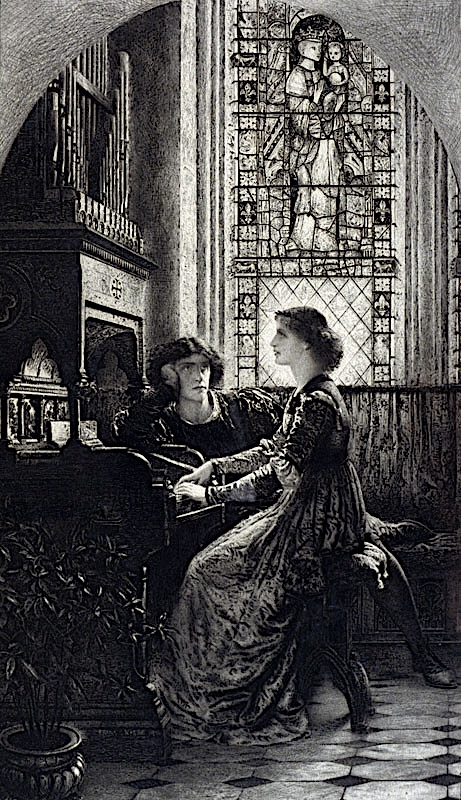
Harmony, 1880.
An etching of Harmony by the French etcher Charles Albert Waltner after Dicksee was published by Thomas Agnew & Sons in 1880, measuring 20 ½ x 12 ½ inches (52 x 31.8 cm). Image courtesy of Wake Forest Print Collection, inventory no. PC1989.10.
Contemporary Reviews of the Painting
Not surprisingly this painting was extensively reviewed when it was shown at the Royal Academy in 1877. The Architect praised its colour: "Harmony (14) by Frank Dicksee, takes the eye by a pretty glow of colour, and in the glass window background the tints have real beauty" (333). The critic of The Art Journal felt this picture was worthy of being chosen for the Chantrey Bequest:
Another young painter, who has taken not so much a stride as a spring forward, is Frank Dicksee; his Harmony (14), hangs in the place of honour…. It shows an auburn-haired girl seated at the organ on which a young man leans his elbow and gazes on her, as she plays with rapt admiration and holiest reverence. A richly-stained glass window above the lovers gives variety and volume to the harmony. In this chromatic scene Mr. Dicksee has given us one of the most perfectly toned harmonies in the Exhibition; and the Council of the Academy were perfectly right in purchasing the picture under the Chantrey bequest. [186]
F. G. Stephens in The Athenaeum surprisingly gave it somewhat of a mixed review:
The Council did well when they bought the Harmony (No.14), of Mr. F. Dicksee, with part of the Chantrey funds. The idea, indeed, is old; the design, and even the composition of the figures, are anything but new; still all must acknowledge the charms of the solemn and rich colouring, and the dignified and "religious light" of the scene. There is, however, a good deal of sentimentality in the picture. The whole is intensely luminous, but is not carried far enough to be solid in execution. Much has been made of a lofty and brilliant stained-glass window, which rises behind the figures, and has a striking effect. If, from a severe point of view, this is not quite a legitimate means of appeal to the spectator, it is, at least, effective. [614]
One of the most extensive reviews was given by a critic for The Illustrated London News who felt the work deserved the praise given to it:
Mr. Frank Dicksee may esteem himself an extremely fortunate young gentleman; and none save the incurably envious will deny that he deserves all the good luck that has befallen him. He has produced one of the finest pictures in the present Academy Exhibition; his brother artists, the critics, and the public at large are virtually unanimous as to the high extent of his merit; the Hanging Committee have given to his picture a position of which not even the most exigent of painters could complain; and, finally, H.R.H. the Duke of Connaught, at the Academy dinner on Saturday night last, very graciously singled out Harmony (14) as the most charmingly descriptive work. The picture is entitled to all the praise that has been awarded to it. The composition is delightfully simple; representing a beauteous maiden, in a robe of rich brocade, playing the organ, to the enrapturement of a comely young gentleman, whom she possibly regards – when her eyes are removed from the key-board and the stops of the instrument – with sentiments of anything but an indifferent order. The costumes are mediaeval; but the treatment has about it nothing of the wiry angularity or the strained exaggeration of the Pre-Raphaelite school. Harmony may be qualified as an essentially romantic picture…. There need not be the slightest discredit to a young painter in hinting that, more or less, he may remind us of masters who have gone before him; thus Mr. Frank Dicksee, may, without offense we hope, be told that his composition, and the intensity of expression in the countenance of his personages, are pleasantly suggestive of the late Daniel Maclise, in that lamented artist's "romantic days" – say, between 1830 and 1840. Mr. Dicksee, however, is devoid of those faults which marred the beauty of Maclise's best performances – exaggerated hardness in detail and chalkiness of colour. Harmony is, on the contrary, as technically harmonious as its name, and is replete with a soft and subdued brilliance of hue. [450]
Perhaps the work by Maclise that this one most resembles, however, is one of his latter works, Madeline after Prayer of 1868, the subject derived from John Keats's poem "The Eve of St. Agnes."
Another extensive laudatory commentary on the picture was given by the reviewer for The Spectator:
"No. 14, Harmony, is by Frank Dicksee. We are very glad to be able to give this picture our warmest praise. It is, for a work by a young man, the finest that we have had for years, and should Mr. Dicksee go on improving as he has done of late, there is little doubt but that he will soon take no inconsiderable place among our first painters. The advance he has made this year upon any of his previous paintings is really wonderful. If we mistake not, this is the most interesting picture of the year, and it well deserves to be so, for though the subject is in some degree one likely to catch the popular taste, yet there is deep feeling in the way it has been treated, apart from its skill in painting and composition. It represents a portion of a hall or chapel, it might be either, with marble floor and stained-glass window, and a girl playing the organ; while a young man, presumably her lover, reclines in an embrasure of the window, watching her attentively. There is, as far as we can see, nothing but praise to be given to this picture. It does not aim at any very high art, but as a little poem in colour it may fairly challenge comparison with any modern work. Especially the warm, subdued light which falls through the rich window is very beautiful, and the painting throughout firm and good. The great beauty of the picture, we think, all will acknowledge to be in the faces of the two lovers. Here it seems to us that Mr. Dicksee has fairly met and vanquished a great difficulty. He had to show upon the man's face some trace of the double effect produced by the music and the girl who is producing it, and he has actually succeeded in giving such an expression, so that we can see that the music is producing its effect, that effect seems only to be heightening the love which the man feels for the player. To the face of the female figure Mr. Dicksee has given that expression of serene exaltation and unconsciousness, which we are accustomed to call saintly; and here, again, it appears to us that he is right. The music has raised the man's nature as much as it could, has changed his love from passion almost into devotion, but in the woman's and the musician's soul, the harmony has swept her clear of all emotions whatever, – she is lost in that sweetest heaven of all, a heaven of her own creating. Such at least would be the manner in which we should read the picture. [565]
Sydney Hodges in The Magazine of Art, in his assessment of Dicksee's early career, felt this was a pivotal work:
In 1877 the well-remembered picture, Harmony, was exhibited, and it is not too much to say that it took the world of London by storm… This beautiful work, so original both in subject and treatment, so instinct with true poetic feeling, must be still vividly remembered by all who saw it on the Academy walls. The girl seated at the organ, the love listening in rapt attention, the glory of the evening light through the stained-glass window forming an aureole around the girl's glistening hair, the subdued but beautiful colour, the carefully finished yet not too prominent details, all formed a variable poem on canvas. [218]
E. T. Cook, in his handbook of the Tate Gallery published in 1898, also likened this work to a poem on canvas: "Harmony is a poem on canvas, and has an abiding charm—alike for its sentiment, its carefully finished, yet not too prominent details, and its subdued but beautiful colour. The picture, it has been well said, suggests indefinite associations with all beautiful abstractions, whether of music, poetry, or painting. Music is the type of the harmony between the man and the woman — the two notes in the human chord. Above the girl at the organ is a window, storied with a picture of that divine love of which earthly love, as the poets tell us, is the imperfect shadow. The evening light through this window forms an aureole of golden glory around the girl's hair:
"Love and harmony combine,
And their souls together twine." — Blake. (209)
Bibliography
Anderson, Gail-Nina and Joanne Wright. Heaven on Earth: The Religion of Beauty in Late Victorian Art Nottingham: Djanogly Art Gallery, 1994. 67 & 74.
"Art. The Royal Academy." The Spectator L (5 May 1877): 564-65.
Birchall, Heather. Tate Britain. Web. 1 July 2026.
Blackburn, Henry. Academy Notes III. London: Chatto and Windus (May 1877): 7-8.
Chamot, Mary, Dennis Farr and Martin Butlin. The Modern British Paintings, Drawings and Sculpture. London: Oldbourne Press, 1964, Vol. I: 146-47.
Cook, Edward T. A Popular Handbook to the Tate Gallery, National Gallery of British Art. London: Macmillan and Co. Limited, 1898: 208-09.
Dibdin, E. Rimbault. Frank Dicksee, R.A. - His Life and Work, special issue of The Art Annual, 1905. 3-6.

Dickens, Mary Angela. "A Popular Painter: Mr. Frank Dicksee, R.A. The Windsor Magazine V (December 1896): 387.
Harmony (at Townely Hall Art Gallery and Museum). Art UK. Web. 1 July 2026.
Harmony. Tate. Web. 1 July 2026.
Hodges, Sidney. "Mr. Frank Dicksee, A.R.A." The Magazine of Art. 10 (November 1886-October 1887): 217-22. Internet Archive. Web. 21 October 2014.
Kestner, Joseph A. "The Male Gaze in the Art of Frank Dicksee." Annals of Scholarship, VII, No. 2 (1990): 187-88.
Marsh, Jan. Pre-Raphaelite Women. Images of Femininity in Pre-Raphaelite Art. London: Weidenfeld and Nicolson, 1987. 74.
"Painting at the Royal Academy." The Architect XVII (26 May 1877): 333-35.
"The Royal Academy Exhibition." The Art Journal New Series XVI (1877): 185-86.
The Royal Academy Exhibition." The Illustrated London News LXX (12 May 1877): 450.
Stephens, Frederic George. "Fine Arts. The Royal Academy." The Athenaeum No. 2585 (12 May 1877): 614-16.
Toll, Simon. Frank Dicksee 1853-1928, His Art and Life., Woodbridge: ACC Art Books, 2016, cat. no. FD.1877.1, 35-49 & 222 and cat. no. FD.1878.1, 41 & 223.
Created 21 October 2014
Last modified (commentary and extra images added) 1 July 2026