
Part I: Reviews of 1891
The Star, 2 April 1891
[Richard Le Gallienne], "Books and Bookmen: The Literary Notes of the Week," The Star, Thursday, 2 April 1891, 2. This unsigned extract is from Le Gallienne's first trial column for the "Logroller" position with The Star, which was a popular left-leaning London evening newspaper established in 1888. This column was headed "Schopenhauer on Literary Art — Mr. Pater as a Talker — Storm-Warnings from 'Oscar' — Prize-Poems — The Tribulations of Miss Menie Muriel Dowie — The New Game of 'Elgin Marbles.'"
Apropos of talkers, "Oscar" promises mysterious things for the present year. He won't say what, and one may well wonder, though we are hardly likely to guess. Is it to be another article on the new Christianity, or the new Hedonism? or maybe Oscar is going to take the cowl. He is quite equal even to that; for, above a certain height of assured power, he is the most uncertain quantity we have. But of one thing we may, I think, be quite sure — it won't be a poem. Indeed, he has hardly a good word to say for poetry nowadays, and if you would compliment him you will never dream of mentioning his poems: rather let it be "Dorian Gray," or "The Soul of Man under Socialism." Better still his transatlantic play. For Musset's lines are assuredly true of our last new dramatist:—
"La plus jeune était la plus belle:
L'homme est ainsi, toujours nouveau"
He will, therefore, hardly thank me for alluding to his old Newdigate "Ravenna," but collectors of prize poems — there really are such people — may be glad to know that a perfectly "fresh" copy of that poem, as issued, is for sale by a well-known Vigo-st. bookseller; who also, by the way, offers a similar copy of Sir Edwin Arnold's Newdigate "Belshazzar."
Notes: Alfred de Musset's lines from "La Nuit d'aout" (August Night), can be translated as "The youngest was the most beautiful: / Such is man, always new." The "well-known Vigo-st. bookseller" was the "Bodley Head" partnership of Elkin Mathews and John Lane. Wilde won the Newdigate prize for poetry in 1878. Sir Edwin Arnold (1832-1904) previously won the same prize in 1852 for his "The Feast of Belshazzar."
The Star, 7 May 1891
"Logroller" [Richard Le Gallienne], "Books and Bookmen: The Literary Notes of the Week," The Star, Thursday, 7 May 1891, 2. This column was headed "A Week of Good Things — The New De Quincey — The 'Intentions' of Oscar, the 'Dangerous' — Blake to Give up his Secret to Mr. W. B. Yeats."
All I have said above about the exclusively artistic appeal of De Quincey applies with perhaps greater force to the writings of Mr. Oscar Wilde. Unless you can rejoice in the blossom, and not be frightened because people tell you it is poisoned, or tremble at awful whisperings as to its roots — planted, some say, like those of the tree Ygdrasil: unless, in fact, you can read entirely for delight in its perfection of expression, its dainty siren cadences, its orchidaceous imagery, its strange languid color, you had better leave these "Intentions" alone.
But if you must go below the surface and ask, Can he mean this? Is he sincere in that? Is he really so decadent? — if you will, so to say, take his paradoxes by the throat and threaten them with a revolver till they deliver up their wealth in the copper-currency of ordinary dullness — well, then, don't read him; you won't be happy. If, however, you have, in Carlyle's phrase, "swallowed formulæ," if, in Mr. Wilde's, you can say from your heart — "the fact of a man being a poisoner is nothing against his prose," especially too if you have been vaccinated against French influence, you will find these "Intentions" a veritable pot of honey, though you may have an uncomfortable feeling now and again that it is "a pot of honey on the grave."

For really there is nothing "dangerous" in these essays that has not been in the world since Gautier at least. It is not in what funny people call the "originality" of his ideas that Mr. Wilde is conspicuous. Ideas are common property: they belong to the man who can use them, it may be socially, scientifically, or artistically: and in the latter case it is to the man who can clothe them in forms and colors that cannot be "original," in the sense of never having existed before, but must be combined in such a way as to produce what we call an individual impression. Take the case of Sir Fredk. Leighton's "Perseus and Andromeda" [shown on the right] now at the [Royal] Academy. What is older than the story, except, indeed, the three primary colors from which all these delicate shades have been evolved, and then all the methods and manners of painters since painting began — all this unoriginal material has Sir Frederick absorbed and assimilated — but by some selective and synthetic process it all comes out "new" again in a style which we recognise at once, and on which men say things sweet and bitter. So with Mr. Wilde, his subject is an accident; all he reeks of it is that it gives him a motive for the production of beautiful prose — otherwise, "What's Hecuba to him or he to Hecuba?"
This, of course, is what is usually called the "high art" view, that of the "vaccinated" minority. But what of the greater majority of people whom such work can only shock if it does not harm? Well, is there any lack of great and good books for themóand me? Brilliant, and beautiful, and fascinating as these "Intentions" are, we must never forget that we live not by such; they are but sweetmeats or olives, maybe they are "worse" — but the golden apples of Shakespeare, the bursting garners of Walter Scott — these are daily bread. A sentiment, reader, for which I expect a good round of hearty English applause!
Notes: Yggdrasil (the usual spelling) is a large sacred ash tree in Norse mythology. Shakespeare's "golden apples" may refer to his most beautiful lines (or more specifically to the mythological golden fruit of the Hesperides in Love's Labours Lost, act 4, scene 3) and "the bursting garners of Walter Scott" is more likely a reference to Scott's prolific output rather than a specific reference to a line from his poem "The Fields of Waterloo": "The pestilential fumes declare / That Carnage has replenished there / Her garner-house profound."
The Academy, 4 July 1891
Richard Le Gallienne, "Intentions. By Oscar Wilde (Osgood, McIlvaine & Co.)," The Academy, 4 July 1891, pp. 7-9. This was Le Gallienne's twelfth of nineteen reviews in this weekly periodical; the first appeared on 21 July 1888. Possibly due to a production error, the reprint in Oscar Wilde: The Critical Heritage, edited by Karl Beckson (London: Routledge & Kegan, 1970), pp. 97-102, reproduces several sections of this review out of their original order.
MR. WILDE, in speaking of the methods open to the critic, well says that Mr. Pater's narrative is, of course, only criticism in disguise: his figures are but personifications of certain moods of mind, in which he is for the time interested, and which he desires to express. Now I have been wondering whether one should not, similarly, regard Mr. Wilde essentially as a humorist who has taken art-criticism for his medium, just as Carlyle was a humorist in the odd disguise of a prophet. Certainly, I am inclined to think that much of his intricate tracery of thought and elaborate jewel-work of expression is simply built up to make a casket for one or two clever homeless paradoxes. "The fact of a man being a poisoner is nothing against his prose." Mr. Wilde somehow struck that out, and saw that it was deserving of a better fate than to remain a waif of traditionary epigram; so he went to work on Lamb's strange friend, Thomas Griffiths Wainewright, one of the subtlest art-critics and poisoners of his time, unearthed his curious history, made selections from his criticism, and then set his own epigram, diamond-wise, in the midst of a biographical essay. Various readers solemnly add to their historical knowledge, discuss the strange character of the man, study his criticism; but Mr. Wilde sits and watches his epigram sparkling far within. About Wainewright he cares far less than the reader, about his own epigramófar more.
Of course this is not the whole truth about these Intentions; the whole truth is a many-coloured thing about a personality so complex as that of the author of Dorian Gray. But it is the dominant tendency among many others hardly less powerful. Mr. Wilde's worship of beauty is proverbial, it has made a latter-day myth of him before his time; and yet, at least in these essays, his gift of comic perception is above it, and, rightly viewed, all his "flute-toned" periods are written in the service of the comic muse. Where he is not of malice aforethought humorous, where he seems to be arguing with serious face enough, is it not simply that he may smile behind his mask at the astonishment, not to say terror, of a public he has from the first so delighted in shocking? He loves to hear it call him "dangerous," as some men delight to be called "roué."
There will be many who will, as the phrase is, take him seriously; but let me assure them that Mr. Wilde is not of the number. It all depends what one means by the phrase; for I, for one, take Mr. Wilde very seriously as a creator of work which gives me much and various new pleasure: he is so absolutely alive at every point, so intensely practical — if people could only see it — and therefore so refreshingly unsentimental; he is wittier than is quite fair in a man of his nationality, and he often writes prose that one loves to say over for mere pleasure of ear — his own literary touchstone. The artistic temperament should delight in him, for the serious in the pursuit of literary pleasure he is as serious as every new joy must be; it is only in the domain of thought where it is rather funny to see him taken with such open mouth. Not that Mr. Wilde is not a thinker, and a very subtle one too; but it is rather, so to say, as a damascener of thought, than a forger of it, that he is to be regarded. Of course all things are relative; and to the unsophisticated Ernest of Mr. Wilde's dialogue on "The Critic as Artist" it is certain that the brilliant half-truths with which the sadder and wiser Gilbert lit up their all-night colloquy, as with weird fireworks, were "strange things" and dangerous to the younger man.
"You have told me many strange things to-night, Gilbert. You have told me that it is more difficult to talk about a thing than to do [7/8] it, and that to do nothing at all is the most difficult thing in the world; you have told me that all art is immoral, and all thought dangerous; that criticism is more creative than creation, and that the highest criticism is that which reveals in the work of art what the artist had not put there; that it is exactly because & man cannot do a thing that he is the proper judge of it; and that the true critic is unfair, insincere, and not rational. My friend, you are a dreamer."
Had Ernest read Mr. Pater, to whom Mr. Wilde makes the continual affectionate reference of a disciple, or had he "with a little rod" touched what the Laureate calls the "honey-poison" of France — chanced, for instance, on a passage in which M. Anatole France says that
"la critique est, comme la philosophie et l'histoire, une espèce de roman à l'usage des esprita avisés et curieux, et tout roman, à le bien prendre, est une autobiographie;" and continues, "Le bon critique est celui qui raconte les aventures de son âme au milieu des chefs-d'œuvre."
had Ernest been twenty-five instead of presumably nineteen, or had he even at that age possessed a larger measure of the artistic temperament, that night in the Piccadilly library would have lost none of its charm, but it would hardly have been so spiritually dislocating for the poor boy. For the "autobiographical" theory of criticism is no more the secret of M. Anatole France or Mr. Pater than of Mr. Wilde: it belongs to every subtly developed temperament, and has unfortunately been practised in England all too much by men who are anything but subtle. Every small author is eager to give us "les aventures de son âme au milieu des chefs-d'œuvre;" but exquisite things happen on that quest to few — to Mr. Pater, to Mr. Henry James, occasionally to Mr. Henley, and certainly to Mr. Wilde. He himself does not take Ernest seriously. It is part of the fun of dialogue as a form for criticism, he says, that the critic "can invent an imaginary antagonist and convert him when he chooses by some absurdly sophistical argument."
One must not forget that the form is dialogue, and therefore dramatic. Otherwise, we may be inclined to resent some of Gilbert's information, besides missing the subtle pleasure of watching a young innocent soul undergoing initiation. It was for that — among other things — that Mr. Wilde wrote these two "colloquies," as they used to be called, on "The Critic as Artist"; it was not to tell us that creation is as essential a part of criticism as criticism is of creation. All the same, we are glad of the definition of criticism as "a creation within a creation," and of this clear-sighted illustration of its operation.
The critic occupies the same relation to the work of art that he criticises as the artist does to the visible world of form and colour, or the unseen world of passion and of thought. He does not even require for the perfection of his art the finest materials. Anything will serve his purpose. And just as out of the sordid and sentimental amours of the silly wife of & small country doctor in the squalid village of Souville l'Abbaye, near Rouen, Gustave Flaubert was able to create a classic, and make a masterpiece of style, so, from subjects of little or no importance ... the true critic can, if it be his pleasure so to direct or waste his faculty of contemplation, produce work that will be flawless in beauty and instinct with intellectual subtlety."
Mr. Wilde is speaking of criticism in its highest form, in the same sense as Matthew Arnold spoke of poetry as "a criticism of life." Of the humbler form of it known as reviewing, he makes one or two commonsense remarks —
"As a rule," he says, "the critics ... are far more cultured than the people whose work they are called upon to review. This is, indeed, only what one would expect, for criticism demands infinitely more cultivation than creation does ... The poor reviewers are apparently reduced to be the reporters of the police courts of literature, the chroniclers of the doings of the habitual criminals of art. It is sometimes said of them that they do not read all through the works they are called upon to criticise. They do not; or, at least, they should not. ... Nor is it necessary. To know the vintage and quality of a wine one need not drink the whole cask."
It belongs to Mr. Wilde's paradoxical method that he should continually play on the convertibility of terms. Thus, the whole contention of his essays on criticism is that criticism and creation are essentially one and the same, or, at least, that they necessarily dovetail one into the other; and yet towards the end of this essay we find Gilbert saying "it is certain that the subject-matter at the disposal of creation is always diminishing, while the subject-matter of criticism increases daily." Here we have the two terms crystallised once more to their hard and fast everyday meaning, while all through they have been used as convertible. This is apt to bewilder. As a rule, however, Mr. Wilde gains his effects by adhering to the concrete signification of words. This reduces some of his contentions to a mere question of terms. One often feels: Now, if that word were but changed for another, for which it really stands, there would be nothing further to say. But that, of course, would not do for Mr. Wilde, nor, indeed, for us, to whom, presumably, subject is nought and treatment is all. Occasionally, by this means, it follows that Mr. Wilde seems to beg the question; as, for instance, in his remarks on morality in art. When he says, "All art is immoral," he is using the word in its narrow relative sense; he does not mean by it the same as those who use it seriously against certain schools and forms of art: though they say "immoral" they mean "unspiritual," and that is the meaning many people will attach to the word in Mr. Wilde's phrase. They will thus be quite unnecessarily shocked by a mere quibble of words, and their real position is left unassailed; the real question at issue being whether or not there is certain art which is dangerous to the spirit, of which one should feel as Mr. Pater says in Marius: "This is what I may not look at." If life be really a struggle between higher and lower, if art is anything more than a form of sensuous indulgence, this is a question to be answered. Mr. Wilde does not leave us quite clear as to his side in the matter, though he seems to lay over-much stress on the sensuous side of art, a side which is, after all, external and impossible without an informing, formative soul. He echoes, too, Gautier's tirades against "virtue," and Mr. Swinburne's
"What ailed us, oh gods, to desert you
For the creeds that refuse and restrain?"
and says hard things of chastity and self-sacrifice — really a very "young" and quite illogical position in an age which has accepted evolution. He quotes M. Renan to the effect that "Nature cares little about chastity"; but does that prove anything save that Nature is always behind the age, as Mr. Wilde tells us in another place? Surely it is by such ideals, of which, once seen, the beauty haunts him through all his sinnings, that man evolves at all, striving and failing and striving, till slowly what was once the ideal becomes the instinct.
But I am not recking my own rede, and am in danger of growing quite "heated," as they say of politicians, while Mr. Wilde is doubtless smiling in his sleeve.
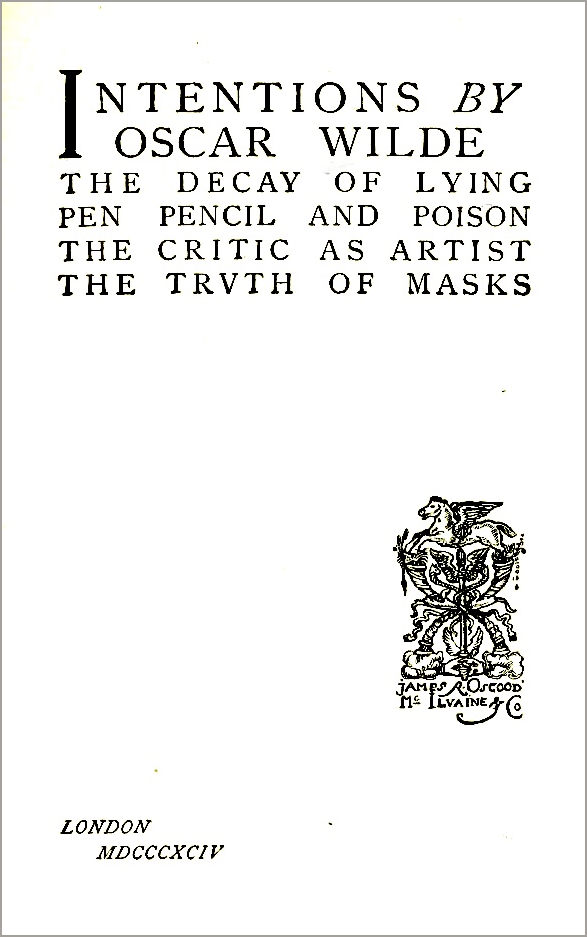
Let us leave contention and enjoy. I have referred to two or three of the interesting qualities in these papers. They are so absolutely alive. Every sentence is full of brain. There is no padding, no vagueness, all is "thought out," as the painters say. One has that safe, untroubled feeling in reading that Matthew Arnold's calm dissecting method gives us — though, needless to say, the austerity of the Essays in Criticism is a very different thing from this luxuriously coloured prose: however difficult the thesis, we leave it to the writer with perfect confidence that he will speedily make all clear. Mr. Wilde has, indeed, a rare power of keeping his eye steadily "on the object." It is doubtless, too, a part of his perversity that while, as we have seen, he will, when it suits him, adhere rigidly to the fixed signification of words, he can at other times exercise a quite remarkable power of reducing them to their elements, of remorselessly forcing them to say what they really mean. "You must not be frightened by words," said Gilbert to his young neophyte; and certainly, if you set such words as "unpractical," "dangerous," or "dreamer" on to Mr. Wilde they will come in for the same summary dissection that befell the lion which attacked the strong man in Holy Writ.
Mr. Wilde's delight in words for their own sake is quite Rabelaisian. He loves so to spread them in heaps, like a child bathing its hands in rich, many-coloured beads, that sometimes he is in danger of a lack of proportion, and catalogues that remind us of the Whitmanese. But some of his tapestries in which, in a brief pageant, he shows us again the Trojan war, or Dante threading the circles of his great dream, are beautiful; and in passages such as the following his technical knowledge of artistic methods, especially handicraft, give us a sense of surefootedness, a pre-Raphaelite distinction of impression very quickening to the imagination:
The sculptor hewed from the marble block the great white-limbed Hermes that slept within it. The waxers and gilders of images gave tone and texture to the statue, and the world, when it saw it, worshipped and was [8/9] dumb. He poured the glowing bronze into the mould of sand, and the river of red metal cooled into noble curves, and took the impress of the body of a god. With enamel or polished jewels he gave sight to the sightless eyes. The hyacinth-like curls grew crisp beneath his graver. ... All subtle arts belonged to him also. He held the gem against the revolving disk, and the amethyst became the purple couch for Adonis, and across the veined sardonyx sped Artemis with her hounds. ... The potter sat in his shed, and, flower-like from the silent wheel, the vase rose up beneath his hands.
This comes of an almost Renaissance gift of curiosity and a power of various appreciation, which is one of Mr. Wilde's surprises, as it is one of the most robust signs about his work. His reverence for Milton means much. In fact, since "The Decay of Lying," which is here reprinted, Mr. Wilde has become quite newly significant. One hardly knows yet what to expect of him, but we may be quite sure that these essays and Dorian Gray are but preludes. At present a delicate literary affectation, which is probably irritating to most, but rather a charm to those who know what it means, a suggestion of insincerity, a refusal to commit himself, to be "the slave of his own opinions," makes him somewhat of a riddle. Will it seem too serious to remind Mr. Wilde of one of his earliest sonnets — "Is that Time Dead?" I think not.
Meanwhile, these Intentions are delightful reading, especially, as was said at the beginning, for their humour; and if I have failed to do them justice, it is but a proof of Mr. Wilde's paradox that it is impossible to do justice to anything we care about.
4. The Star, 15 August 1891
"Logroller" [Richard Le Gallienne], "Oscar Wilde's New Stories," The Star, Saturday, 15 August 1891, p. 4. This review of Wilde's Lord Arthur Savile's Crime, and Other Stories (Osgood, McIlvaine and Co., 1891) was published separately from Le Gallienne's usual Thursday column.
Of all writers Mr. Wilde must be judged by his aim to be enjoyed. He is not a writer for the easily irritated, or the man who expects to order his novelists about like shopmen. People with strong preconceptions, and water-tight formulas may as well give him up at once. It is only people with bend in them, those who don't mind what he says so long as he says it piquantly, it is only those who "ever know the inmost shrine of Art"óas practised by Oscar Wilde.
It is such an obliging reader who would venture to tell him that, with every admission, these stories must never be placed on the same shelf with "Dorian Gray," the "Intentions," the charming "Fairy Tales," or those early "Poems." That they can contain clever things goes without saying, but then a story should be more than a succession of sparks; that the central ideas of the first and second — "The Sphinx without a Secret" — are comic is admitted, and the latter is certainly the best of the four; but Mr. Wilde has not been patient enough in his treatment. He has contented himself with burlesque — and burlesque is a form of industry practised at present by many painstaking people, who thus snatch
Mr. Wilde would not take the bread out of their mouths! No; he is too real a humorist to be allowed this descent to burlesque. We, his admirers, must sorrowfully, but firmly, forbid it. Let him give us a comedy, if he will some more "Intentions," or another story — criticism like "The Portrait of Mr. W. H."; but no more "Lord Arthur Savile's Crimes." The reader may be curious as to what Lord Arthur's crime was. Well, being out one evening at Lady Windermere's he must perforce submit to examination by that lady's new lion a cheiromantist, Mr. Podgers. "Dear Gladys! you are so original" had murmured the Duchess of Paisley, "trying to remember what a cheiremantist really was, and hoping it was not the same as a cheiropodist. Mr. Podgers, on examining "the hand," was noticed by Lord Arthur to turn pale, but he managed to smooth it over and give him a commonplace reading. However, getting Podgers by himself, and offering him a big cheque, he extorted the truth.
was written upon his hand. Lord Arthur became appropriately desperate, and felt at once that with such a doom menacing him it would be wrong for him to prolong his engagement with the lovely Sybil Merton. The only alternative, since the deed apparently must be done, was to get it over so soon as possible. It is hard, but it is duty, it is "for her sake." He thereupon makes two unsuccessful attempts on a dowager aunt and his venerable uncle the Dean of Chichester; but the deed being yet to do, he roams in deep dejection one night along the Thames Embankment. And, behold, there is Mr. Podgers leaning dreamily over the parapet. A brilliant idea comes to Lord Arthur. Quickly seizing him by the calves, he topples him over into the stream. A splash, a gurgle, a floating hat, and all is over. The prophet has thus fufilled his own prophecy. An evening paper confirms the suicide of the famous cheiromantist, and his fate thus fulfilled, Lord Arthur, happy-hearted, flies to the arms of his dear Sybil to offer her his future — now without a cloud. The point of the story is, of course, in its sub-title — "A Study of Duty."
* "Lord Arthur Savile's Crime, and other Stories." By Oscar Wilde, (Osgood, Mcllvaine, and Co.).
5. The Star, 8 October 1891
"Logroller" [Richard Le Gallienne], "Books and Bookmen: The Literary Notes of the Week," The Star, Thursday, 8 October 1891, p. 2. This additional paragraph, which is not covered by a heading, appears at the foot of Le Gallienne's weekly column.
Mr. Oscar Wilde's latest vagary is to republish his poems, through Mr. Elkin Mathews, with a cover designed by Mr. Ricketts. He has an affection, then, after all, for "the song which first of all he made when young." "Inspired prose" has, we know, been his recent enthusiasm, but it is questionable whether he has ever written a passage of it that is worth a line of his sonnet on Milton, or a verse of "Panthes." How happy his Muse must be feeling at this unexpected return to favor.
6. The Star, 23 November 1891
"Logroller" [Richard Le Gallienne], "Oscar Wilde's Fairy Tales," The Star, Monday, 23 November 1891, 2. This is likely one of the first reviews of Wilde's House of Pomegranates (James R. Osgood, McIlvaine & Co.), which was announced as published this day in The Times on Saturday, 21 November.

"The Young King; the Birthday of the Infanta," "and other Beautiful Tales," writes Mr. Wilde as inscription over his "House of Pomegranates." A delightful touch of a charming vanity, which smiles to itself at itself. Those who have heard Mr. Wilde lecture know the smile. It is the smile of a Narcissus with a gift of humor. Narcissus is sometimes born so, and then he is saved from drowning, and lives to write charming autobiography, or give us some other product of his dear self with a daring naiveté that wins the world. So Mr. Wilde has given us this "house not made with hands," this house of pomegranates gathered in Apollo's garden. And with him went two dreamful cunning artists, by name Ricketts and Shannon, and in a nook of the green place they dreamed upon the grass, and builded the house together to the sound of the double flute. Forgive me if this reads more like a fairy tale than a review. Were I to write to my tailor at this moment, I must begin "Fair Sir" — and truly I should bid him see that "seven yellows were woven into my robe."
What a marvellous eye Mr. Wilde has for such beautiful detail, and what a knowledge of precious things. His memory must surely be like the treasure chambers of his own King of Ashter, wherein were —
"huge tortoiseshells full of pearls, and hollowed moonstones of great size piled up with red rubies. The gold was stored in coffers of elephant hide, and the gold dust in leather bottles. There were opals and sapphires, the former in cups of crystal, and the latter in cups of jade. Round green emeralds were ranged in order upon thin plates of ivory, and in one corner were silk bags filled, some with turquoise stones and others with beryls. — And yet have I told thee but a tithe of what was there."
One has often admired the dainty magic with which Keats was able to transmute mere confectionery into
"Candied apple, quince, and plum, and gourd;
With jellies soothor than the creamy curd,
And lucent syrops, tinct with cinnamon."
Milton possessed the same power, especially over strangely vowelled names. "These delicates" are "heap'd with glowing hand" all through these beautiful stories. The hand is perhaps too glowing in its profusion. It is apt to neglect proportion. But never mind that, read this sentence from "The Birthday of the Infanta." Maybe you have known it oft long ago — that sentence telling of the woodland life of the little dwarf —
"All the wind dances he knew — the mad dance in red raiment with the autumn, the light dance in blue sandals over the corn, the dance with white snow wreaths in winter, and the blossom dance through the orchards in spring."
The tragedy of a toadstool, that dreamed it was a rose — a rose worthy to be worn in the little Infanta's bosom — is the story of the poor little dwarf, who never having seen his own face, and knowing nought of a cultivated passion for the ugly, dreamed that the Infanta loved him for his beauty, when she laughed to watch ham dance. Then, seeking her through the palace, he comes to a mirrored room, where all things strangely repeat themselves, "Was it Echo? Could she mock the eye, as she mocked the voice!" very tenderly does Mr. Wilde tell how at last he realises himself in the monstrous little reflection that mimics him in the glass, very tenderly does he lay the little broken hearted figure upon the floor. Happily we need choose no favorite out of these four stories, but this and "The Fisherman and his Soul" are mine. The latter, the longest and most elaborately-wrought of the four, and "The Star-child," have not, I believe, previously appeared. "The Fisherman and his Soul" strikes one first, like all good fairy tales, with its simplicity of motive, and then, how strange to watch the various branches shooting out from the one smooth stem, and filling with clusters of blossom and strange lights and songs. It is art's miracle of the mango-tree.
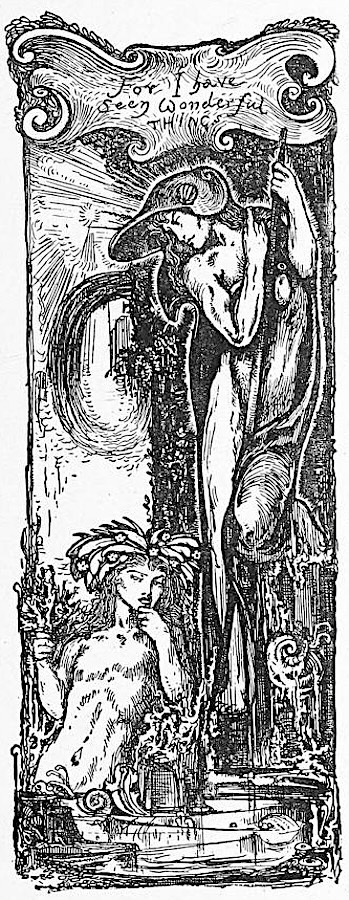
To speak of the "get-up" and "illustrations" of this book as things apart seems absurd, for, indeed, this is one of those rare books of which we know not the body from the soul. It is a unity, and should really be spoken of as a whole. Types, cover, designs, and stories seem not separate things, but only different ways of expressing the one strange fantasy. But I have spoken of the stories apart. Why not the pictures? But they are harder for me to write about than the stories. Especially Mr. Shannon's dim "dreams" or rather the very ghosts of dreams. There is something very fascinating about these silvery grey Impressions, faint as the faintest grey of dawn — so faint that one at first almost takes the page for a blank. But gradually they grow on one like misty fields in the moonlight. And the best of them is actually of the moonlight, when the fisherman far away out on the moonlit sea draws up the little mermaid in his net and smiles, such a secret sweet smile, as he doats [dotes?] on his strange haul. Mr. Ricketts' quaint symbolic art no less beautifully accompanies that more decorative side of Mr. Wilde's writing of which I have spoken. Are we never to have another number of "The Germ"?
LOGROLLER.
* "House of Pomegranates," by Oscar Wilde. Illustrations by C. Ricketts and C. H. Shannon. (Osgood and Co.)
Note: The Germ, a periodical established in 1850 by the Pre-Raphaelite Brotherhood, ceased publication after the release of only four issues.
Related Material
- Introduction to Le Gallienne's Reviews of Wilde, with contents list
- Le Gallienne's (and others') reviews of Wilde's The Sphinx
Created 12 November 2026