

The Sphinx was published on Friday, 8 June 1894. These transcripts of the known British reviews appear in chronological order. More reviews may continue to be identified from newspapers and other periodicals that have not yet been digitised as of 2026. — Philip Jackson
1. The Daily News, 11 June 1894
"Mr. Oscar Wilde and Edgar Poe," The Daily News, Monday, 11 June 1894, 6. 1189 words, including 306 quoted words. The Daily News (1846–1912) was a liberal daily newspaper that had a large circulation.
Sent forth as it is in all the luxury of vellum and gold covers and all the sumptuousness of hand-made paper, broad spaces, and coloured title and initial letters, it is impossible to predict for Mr. Oscar Wilde's new poem called "The Sphinx" anything but an immediate and a complete success. The book is issued at the price of "forty-two shillings nett," which, considering that it is only a small quarto of something less than thirty pages, is in itself enough to arrest at once the attention of that catholic-minded person the enthusiastic collector of first editions, who, when he further learns that the issue is strictly limited to two hundred copies, may be relied on to relieve the market of no inconsiderable proportion of the supply. In brief, "The Sphinx" may be said to be born rare, and it is evidently destined—at least in this its original form—to become rarer still. Some there may be who will not care for mere rarity, but among these there will doubtless be admirers who will be affected by the author's daring eccentricity, and above all by that frequent obscurity and air of mystery which have so great a charm for those who pride themselves upon the faculty of seeing further into millstones than less favoured persons can pretend to do. The title-page itself, like the fancy for printing the whole text in capital letters, is a challenge to conventionalism; for it is not only unlike other title-pages, being nearly all "decoration" with very little in the way of title or imprint, but is inserted hind-part before, so that a careless person in turning over the pages might come to the conclusion that it has no title page, nor even a colophon in lieu thereof. To these tokens of unconventionalism is to be added the fact that the author has invented a new stanza, consisting of two very long lines with rhymes both in the middle and at the end. It is true that had the printer by some accident cut the lines in half, these couplets, save where Mr. Wilde permits himself an occasional license of irregularity, would have assumed the identical form of the stanza made familiar to us all by Tennyson in his "In Memoriam" and other poems. Indeed, as it is, anyone who merely heard them read aloud could not possibly be aware of any difference. This will even be shown to the eye by setting forth a specimen in both arrangements:
AS THE PRINTER GIVES IT.
And take a tiger for your mate, whose amber sides are flecked with black,
And ride upon his gilded back in triumph through the Theban gate.
AS THE PRINTER MIGHT HAVE GIVEN IT.
And take a tiger for your mate
Whose amber sides are flecked with black.
And ride upon his gilded back
In triumph through the Theban gate.
But as a similar objection has been raised to the metrical peculiarities of Edgar Poe's poem of "The Raven," without materially affecting the reputation of its author as a prosodial innovator, Mr. Wilde may hope to be equally fortunate. The coincidence, however, is noteworthy, because "The Sphinx"—so far as we have been able to understand its drift and purpose — appears to be an attempt to imitate Poe's poem — or rather to "go one better," as the sporting world say, upon that popular production by substituting for the American poet's "gaunt and ominous bird of yore," the yet more gaunt and ominous Egyptian Sphinx. How far the design is successful may be judged from the following opening:
In a dim corner of my room, for longer than my fancy thinks,
A beautiful and silent sphinx has watched me through the shifting gloom.
Inviolate and immobile she does not rise, she does not stir,
For silver moons are naught to her, and naught to her the suns that reel.
Red follows grey across the air the waves of moonlight ebb and flow,
But with the dawn she does not go, and in the night-time she is there.
Dawn follows dawn, and nights grow old, and all the while this curious cat
Lies crouching on the Chinese mat with eyes of satin rimmed with gold.
Upon the mat she lies and leers, and on the tawny threat of her,
Flutters the soft and silky fur, or ripples to her pointed ears.
Come forth, my lovely seneschal! so somnolent, so statuesque!
Come forth, yon exquisite grotesque! half woman and half animal!
Come forth, my lovely, languorous sphinx! and put your hand upon my knee!
And let me stroke your throat, and see your body, spotted like the lynx!
And let me touch those curving claws of yellow ivory, and grasp
The tail that, like a monstrous asp, coils round your heavy velvet paws!
Here, at the risk of being thought wholly incapable of the "higher criticism," we venture to ask whether rhyme is to be entirely divorced from its old co-mate reason; and if not, how Mr. Wilde can possibly be able to certify that his visitor with the "eyes of satin" (afterwards described as "large black satin eyes, which are like cushions where one sinks," and finally as "fantastic moons that shiver in some stagnant lake") has been in the room "for longer than his fancy thinks"? And when we have twice been told that his "curious cat" was invariably "immobile," how does it help us to be assured that she does not "rise" or "stir"? And why, after this superfluity of information, do we need to hear that she does not go out with the dawn nor absent herself (as "curious cats" doubtless are prone to do) "in the night time"? But of questions like these there would be really no end. Considerations of space, and we are reluctantly compelled to add, of decency, forbid us to tell how the poet after interrogating his mystic visitor in the harmlessly inquisitive fashion of Horace Smith's address to the Mummy in Belzoni's Exhibition, questions her through page after page of allusions—sometimes covert and sometimes not—regarding the hideous sensualities of the old world, till "the beautiful and silent Sphinx" becomes a creature whose "horrible and heavy breath makes the light flicker in the lamp." Then the lonely student once more reminds us of "the Raven" by dismissing his mystic visitor in a vehement outburst of horror, which in this case is rather unreasonable since the horrible allusions and suggestions that have provoked it have come, not from the Sphinx, but entirely from her offensively garrulous host:
Get hence, yon loathsome mystery, hideous animal, get hence!
You wake in me such bestial sense, you make me what I would not be.
You make my creed a barren sham, you wake foul dreams of sensual life.
And Atys with his blood-stained knife were better than the thing I am.
All which sounds very dreadful, though no doubt it is much less dreadful than it sounds. Mr. Charles Ricketts's "decorations," printed in pale red, are very Blakeish in an uninspired sort of way when not too absurd, and are quite in harmony with the text.
* "The Sphinx." By Oscar Wilde, With Decorations by Charles Ricketts. Elkin Matthews and John Lane.
2. The Glasgow Herald, 14 June 1894
"Poetry, Verse and Drama," The Glasgow Herald, Thursday, 14 June 1894, 10. 769 words, including 49 quoted words. The Sphinx is the third of three books of poetry reviewed in this column. The Glasgow Herald, which was established in 1783 and edited by Charles C. Russell from 1888 to 1907, competed with the Edinburgh-based Scotsman for the position of Scotland's newspaper of record.
The Sphinx. With Decorations by Charles Ricketts. By Oscar Wilde. (London: Elkin Mathews & John Lane.) — It is rather a pity that Mr Wilde in his latest publication has acted on quite a different principle from that of the ruler of the marriage feast at Cana, or of the well-established proverb that good wine needs no bush. The binding, the "decorations," and the text of "The Sphinx" may be fairly arranged in a descending order of attractiveness. The binding, in pure white vellum with a dainty and delicate gold design, which seems to be Mr Ricketts's most successful piece of work, is a triumph in its kind. Of the "decorations," which are all printed in a rather taking tint of pale red, it is not possible to speak with so much certainty. Some of them are really beautiful in design and rendering; others drift into sheer ugliness through that inclination towards the "precious" or the bizarre which seems to act as the fatal slope of Avernus to so many of our younger artists, both in words and in forms, nowadays. And of at least one we can only say, as one of the crowned heads did of Mark Twain's famous map of Paris, that it is difficult to knew which way up one is expected to look at it. But when we descend upon the text, which meanders, in Mr Wilde's usual style, through a meadow of blank paper, all these difficulties are at once intensified. The poem seems to be intended as an allegory upon the banks of the Nile, or "the grey Nilotic flats," as Mr Wilde prefers to call them. But what exactly it is intended to convey to its reader is about as hard to make out as some of Mr Ricketts's more abstruse diagrams. We need not apologise for expecting a work of art to have a meaning, for it is reasonably obvious at the first glance that Mr Wilde has not aimed at mere beauty. If he had, we have no doubt that his poem would have been pleasanter reading. The hero of it is a young student who, as far as one can discover, has had religious doubts, combined with opium visions of a class even superior to these of Dorian Gray. He is visited by "a beautiful and silent Sphinx" with "curving claws of yellow ivory," and a "tail that, like a monstrous asp, coils round her heavy velvet paws." One is left to conjecture whether this "curious cat" is purely a vision of the night, or is a hallucination based upon the hero's harmless necessary pet. In any case the mysterious animal is little else than an embodied note of interrogation. Her presence serves to punctuate a large number of more or less personal questions which the hero puts to her, after the fashion of Horace Smith's Address to the Mummy, or the well-known lines about "My Mother." Only Mr Wilde's hero, less fortunate than the questioner in the last-named effusion, gets no reply. The consequence is that he almost works himself up to embrace that paganism symbolised by his sphinx. His only excuse is that he is very young. Mr Wilde, who evidently remembers his own aphorism, allows him to have "seen some twenty summers cast their green for autumn's gaudy liveries." Happily better thoughts prevail at the end, and the young gentleman, finding that his fancy is really running away with him, bursts out:—
"Get hence, you loathsome mystery! hideous animal, get hence!
You wake in me each bestial sense, you make me what I would not be."
Perhaps this is neither quite true nor quite polite when addressed to so patient a listener, but the morality of it is unimpeachable. Still, even with the details of ancient corrupt practices which Mr Wilde's scholarship supplies throws in, and in a limited edition to boot, this scarcely seems to us to be worth two guineas. Nor is the workmanship of any surpassing merit. The long two-line stanza, which at first sight locks novel, proves on inspection to be simply the stanza of "In Memoriam" printed in two lines instead of four. For instance —
"His face was as the must that lies upon a vat of new-made wine;
The seas could not insapphirine the perfect azure of his eyes."
Mr Wilde's verses are even fuller than Gautier's of the names of strange stones, from beryl to steatite, and he takes a greater delight than Lepidus in strange serpents. As for his notion of printing the whole poem in capital letters, that is "pretty Fanny's way." On the whole most readers will, we fancy, regard this precious volume, like the Sphinx, with "a curved and archaic smile."
3. The Times, 15 June 1894
"Books of the Week," The Times (London), Friday, 15 June 1894, 8. 234 words, including 17 quoted words. The next sentence in this review links Wilde to the "talents" of the new author of the second book that this reviewer more briefly discusses: "If successful writers like him persist, they will succeed more and more in spoiling talents like those of Mr. A.C. Kennedy, whose EROTICA (Gay and Bird) shows a considerable degree of vitiated ability." This review was also printed in the same typesetting in an associated evening newspaper published three times a week (on Monday, Wednesday, and Friday), The Mail (London), Friday, 15 June 1894, 8. In the 1890s, The Times, which was established in 1785, was a prestigious newspaper with a conservative or centre-right political orientation and a relatively small circulation.
Mr. Oscar Wilde's publishers (Messrs. Elkin Mathews and John Lane) invite the public to pay 42s. for a small quarto of 30 pages, some of them containing a few lines of his verse, and some the "decorations" of Mr. C.H. Ricketts. The decorations in question would appear to be rather interesting, though more esoteric than even the modern amateur cares for, but they are blurred and half-effaced by the process-engraver and the printer. As to the poem THE SPHINX, it is written in the metre of "In Memoriam," but by way of variety it is printed in capital letters, and each stanza is made to contain two long lines instead of four short ones. Mr. Wilde meditates upon the past history of a carved sphinx that watches him from a dim corner of his room; and it must suffice to say that his meditations are very erotic and not very nice. With good reason, at the end, he apostrophizes the "hideous animal," "You wake in me each bestial sense; you make me what I would not be." Only, if this is what the sphinx does, why spend time, and trouble, and the midnight oil in polishing its suggestions into choice literary form, so that others may be made "what they would not be"? Mr. Wilde's best course would have been not to write his poem; his next best to burn it when written.
4. The Globe, 18 June 1894
"The Library Table," The Globe, Monday, 18 June 1894, 3. 212 words (counted to the beginning of the comparison to the second book of poetry discussed, which commences after "a theme like this"), including 51 quoted words. The Globe (1803–1921) was a London evening newspaper that in the 1890s was edited by C. Lewis Hind (1862–1897).
Great pains have been taken with the exterior presentment of Mr. Oscar Wilde's new work in verse, "The Sphinx" (Elkin Mathews and John Lane). It is printed (in "caps") on rough paper, furnished with "decorations" in line and colour by Mr. Ricketts, and bound in vellum (also with designs by that artist). The appearance it presents is sumptuous, without being charming. At the same time, one recognises that the "decorations," unpleasing as they are, are well in keeping with the style and tone of the verses with which they are associated. The long tirade which the writer is supposed to address to "a beautiful and silent sphinx" has a certain measure of imaginative force, but is distinctly disagreeable in the ideas and pictures it conjures up. Of this the author would seem to be conscious, for he addresses the sphinx finally as follows:—
"Get hence, you loathsome mystery! Hideous animal, get hence!
You wake in me each bestial sense, you make me what I would not be.
You make my creed a barren sham, you wake foul dreams of sensual life,
And Atys with his blood-stained knife was better than the thing I am."
It is a pity, one feels, that Mr. Wilde should waste his powers upon a theme like this, and one turns with something more than relief to another and much more creditable work sent out by the same publishers—"A London Rose, and other Rhymes," by Mr. Ernest Rhys, admirably printed, prettily bound, and as wholesome as "The Sphinx" is repellent. No doubt there is less strength in Mr. Rhys's verses than in Mr. Wilde's, but they reveal a kindly personality, and have some technical merit, their only marked defect being an occasional poor rhyme. Mr. Rhys is happiest, perhaps, in his handling of octo-syllabics. Of none of his pieces can we say that they are done perfectly, once for all; but most are happily conceived, and all are carefully—some gracefully—turned. Mr. Rhys, evidently, has the poetic instinct and something of the artistic gift.
5. The Westminster Gazette, 18 June 1894
"Mr. Oscar Wilde's 'Sphinx,'" The Westminster Gazette, Monday, 18 June 1894, 3. 316 words, including 164 quoted words. The Westminster Gazette (1893–1928), edited by Edward Tyas Cook (1857–1919) until his resignation in 1895, was a Liberal newspaper established by George Newnes (1851–1910) and some of the former political staff of the Pall Mall Gazette who left after that journal was purchased by Conservative interests in 1892.
"The Sphinx." By Oscar Wilde, with decorations by Charles Ricketts. (Elkin Mathews and John Lane.) — "Get hence, you loathsome mystery! hideous animal, get hence! You wake in me each bestial sense … you wake foul dreams of sensual life." So says the student in this poem after an evening with the Sphinx, and he says very truly. Instead of the Sphinx propounding questions, the student puts questions to her — questions full of sensual imaginings and bestial amours. This much it is necessary to say to explain to the reader the unpleasant theme of the poem; but it remains to add that the theme is treated with undeniable power. Among the lines which it is possible to quote, the following are of the best, and are really impressive. We print the Tennysonian stanzas as we find them in the book:—
Ten hundred shaven priests did bow to Ammon's altar day and night,
Ten hundred lamps did wave their light through Ammon's carven house — and now
Foul snake and speckled adder with their young ones crawl from stone to stone, For ruined is the house and prone the great rose-marble monolith!
And on the summit of the pile the blue-faced ape of Horus sits,
And gibbers while the fig-tree splits the pillars of the peristyle.
The god is scattered here and there; deep hidden in the windy sand
I saw his giant granite hand still clenched in impotent despair.
And many a wandering caravan of stately negroes silken-shawled,
Crossing the desert, halts, appalled before the neck that none can span.
And many a bearded Bedouin draws back his yellow-striped burnous
To gaze upon the Titan thews of him who was thy paladin.
"The Sphinx" is published with all those accompaniments of blank pages, huge margins, quaint print, and unintelligible illustrations which are de rigueur nowadays in the case of limited editions of "curious" works. Mr. Ricketts' design for the fig-tree and peristyle line given above is one of the best of the illustrations.
6. Richard Le Gallienne, Pall Mall Budget, 21 June 1894
"The Crier" [Richard Le Gallienne, 1866–1947], "The City of Books," Pall Mall Budget, Thursday, 21 June 1894, 9–10. Reprinted in Karl Beckson (ed.), Oscar Wilde: The Critical Heritage (London: Routledge & Kegan Paul, 1970), 164–166, omitting the last 282 words after "absolutely edifying." A forthcoming article by the compiler of this collection of reviews identifies Le Gallienne as responsible for this column in the Pall Mall Budget. For most of its life, the content of the Pall Mall Budget (1868–1920) mainly consisted of a weekly collection of selected articles reprinted from the daily Pall Mall Gazette, but from 7 June 1894 to 28 March 1895 (when publication of this completely independent new series was suspended), the Budget was edited by Lewis Hind and lavishly funded (in attempt to make the paper the best British mass market weekly) by William Waldorf Astor and his wife Mary, who took a special interest in the magazine until her death on 22 December 1894. Astor then seems to have decided that the publication should cease, although his decision took some time to implement. Le Gallienne's column ran for the entirety of this period. This review appeared between a first paragraph on "a scientific volume that has somewhat quaintly strayed into my unscientific clutches, 'Marsupials and Monotremes!'" (the spine title of Richard Lydekker's A Hand-book to the Marsupialia and Monotremata) and a last paragraph that focuses on George H. Radford's Shylock and Others: Eight Studies. As he turns his attention to The Sphinx, Le Gallienne concludes his first paragraph by again reciting "Marsupials and Monotremes" with the exclamation, "What a title for a volume of poems!"
What a pity Mr. Oscar Wilde has no acquaintance with marsupials and monotremes before he wrote his poem of The Sphinx, in which we encounter many strange beasts, but ne'er a marsupial or a monotreme. By the side of these, mere hippogriffs and basilisks, "gryphons" and "gilt-scaled dragons" seem commonplace monsters. He must at least introduce a monotreme in the second edition. That none of us would know what it meant matters little. Indeed, for poetical purposes, it were better not! The meaning might clash with the beautiful sound, and, at any rate, it would be as intelligible to most of us as some of the strangely named beings and things that load every rift of Mr. Wilde's curious poem with magnificence and horror. How many of us, I wonder, know the nature of "rods of oreichalch"?—but the phrase serves none the less, but doubtless all the more, to give that sense of mysterious luxury at which Mr. Wilde is aiming. So, I am reminded, Tennyson used "white samite," because "six-ply" "shot-silk" would hardly have sounded so "mystic, wonderful." Few of us know the nature of "samite," so it remains a poetical dress-material.
Though there is a meaning underlying Mr. Wilde's poem — the keen olfactory nerves of the Nonconformist conscience would not, I fear, find it a difficult one to scent — its motive is mainly important as affording Mr. Wilde a theme for the display, in a sort of processional, of beautiful words strangely shaped and coloured, and far-sought pictures of ancient Egyptian luxury and legend. The monsters of the Egyptian room at the British Museum, half-human, half-animal, and wholly infernal, live again in his weird, sometimes repulsive, but all the same stately and impressive lines. We are introduced, as in Poe's poem, to a student sitting solitary in his room at night, and contemplating with fascinated eye a small Egyptian sphinx that gazes at him day and night from the corner of his room. Presently he falls to pondering upon the past it symbolises for him, and bids it sing to him all its memories.
O tell me were you standing by when Isis to Osiris knelt?
And did you watch the Egyptian melt her union for Antony,
And drink the jewel-drunken wine and bend her head in mimic awe
To see the huge proconsul draw the salted tunny from the brine?
And did you mark the Cyprian kiss white Adon on his catafalque?
And did you follow Amenalk, the god of Heliopolis?
And did you talk with Thoth, and did you hear the moon-horned Io weep?
And know the painted kings who sleep beneath the wedge-shaped pyramid?
Mr. Wilde proceeds to ask "Who were your lovers? Who were they who wrestled for you in the dust?" and thereupon, like poverty, introduces us to some strange companions of his terrible goddess. Among these the least inappropriate for quotation is the fine picture of Ammon, whose fallen state is celebrated in these nobly imaginative and tenderly cadenced lines:
The god is scattered here and there: deep hidden in the windy sand,
I saw his giant granite hand still clenched in impotent despair.
And many a wandering caravan of stately negroes silken-shawled,
Crossing the desert, halts appalled before the neck that none can span.
And many a bearded Bedouin draws back his yellow striped burnous
To gaze upon the Titan thews of him who was thy paladin.
Go, seek his fragments on the moor and wash them in the evening dew,
And from their pieces make anew thy mutilated paramour!
Go, seek them where they lie alone and from their broken pieces make
Thy bruised bedfellow: and wake mad passions in the senseless stone!
Charm his dull ears with Syrian hymns! he loved your body! oh, be kind,
Pour spikenard on his hair, and wind soft rolls of linen round his limbs!
When asked some years ago why he did not publish this poem, which has long had a reputation in MS., Mr. Wilde replied that its publication "would destroy domesticity in England"! Are we to infer from its publication to-day that Mr. Wilde considers the time ripe for thus dynamiting our family life? It will be interesting to watch the effect of this poem on the eminently respectable newspapers. But though Ashtaroth be his muse through the greater part of the poem, the very proper frame of mind in which he draws to a close must not be overlooked. I am afraid that Mr. Wilde's crucifix is no less an artistic property than his nenuphars and monoliths, but, all the same, he has the right to say that from a moral point of view the "lesson" to be drawn from his poem is absolutely edifying. Addressing his Sidonian muse, of whom by this time he has apparently grown weary — when the Devil was bored the Devil a saint would be! — he says:
What songless tongueless ghost of sin crept through the curtains of the night,
And saw my taper burning bright, and knocked, and bade you enter in.
Are there not others more accursed, whiter with leprosies than I?
Are Abana and Pharpar dry that you come here to slake your thirst?
Go hence, you loathsome mystery! hideous animal, get hence!
You wake in me each bestial sense, you make me what I would not be.
[…]
False sphinx! false sphinx! by reedy Styx old Charon, leaning on his oar,
Waits for my coin. Go thou before, and leave me to my crucifix.
Whose pallid burden, sick with pain, watches the world with wearied eyes,
And weeps for every soul that cries, and weeps for every soul in vain.
Has the reader noticed that this hymn to deities of dark desire, ancient but by no means unworshipped, is written in the pure measures of "In Memoriam" — a particularly wicked touch, and cleverly half-concealed by the four rhyming lines being printed as two long ones. I have left little space to speak of the format of the poem. The vellum binding, the various symbolic designs, the quaint rubricated initials, and the general arrangement of the text, which is printed throughout in capitals; all, by Mr. Ricketts' sympathetic art, are most subtly infused by the spirit of the poem. The designs on the cover are particularly striking, and Mr. Ricketts has never made a lovelier thing than the group of maidens clustering round "the moon-horned Io" as she weeps.
7. Richard Le Gallienne, The Star, 28 June 1894
"Logroller" [Richard Le Gallienne], "Books and Bookmen," The Star, Thursday, 28 June 1894, 1. 146 words. The Star (1888–1960) was a left-leaning London evening newspaper edited from 1891 to 1908 by Ernest Parke (1860–1944). Le Gallienne probably formally replaced Clement Shorter (1857–1926) as the paper's "Logroller," responsible for their literary coverage, in June 1891. This brief review appeared at the foot of Le Gallienne's weekly "Books and Bookmen" column, signed "Logroller," which is headed "Mr. G. H. Radford's Essays; Mr. Ernest Rhys's Poems; Mr. Oscar Wilde's 'Sphinx.'" A misprint of "Huysmann" for "Huysmans" has been corrected in this transcript.
If you want to feel wicked and don't mind expense, expend two guineas on Mr. Oscar Wilde's new poem of "The Sphinx" (Mathews and Lane). This being a column of pure literature I have nothing to say about the morals of this truly remarkable poem. Mr. Wilde, with characteristic art, sets those right in the concluding passage, in which he calls for his crucifix to exorcise the Venus Pandemos, who, under various similitudes, has been the muse of the majority of his weirdly imaginative lines. Mr. Wilde proved in "Dorian Gray" that he had learnt from Rabelais — and Huysmans! — the trick of accumulation. Very striking is the manner in which, by piling detail upon detail, he builds up an impression of mystic wickedness; conveying to one the "authentic" shudder of the dark old Phallic worships, of which, I suppose, our Cleopatra's Needle is an unsuspected symbol.
8. The National Observer, Saturday, 7 July 1894
"The Sphinx," The National Observer, Saturday, 7 July 1894, 206–207. 483 words, including 122 quoted words. The National Observer (1890–1897), formerly the Scots Observer (1888–1890), was a conservative weekly edited by W. E. Henley (1849–1903) after it moved from Edinburgh to London in 1889. In July 1892 Wilde told his publisher John Lane that no review copy of The Sphinx should go to the National Observer because Henley was "too coarse, too offensive, too personal, to be sent any work of mine" (Merlin Holland & Rupert Hart-Davis, eds., The Complete Letters of Oscar Wilde, London: Fourth Estate, 2000, 533–534). However, after the paper's sale in March 1894 Henley was no longer at the helm and thus would have had no influence on this review.
Clothed in white samite, mystic, wonderful is Mr. Oscar Wilde's new poem. The outward aspect of the little volume must gladden the heart of the collector; every detail is curious and exquisite; the paper unbleached, the binding delicate, the gold tooling perfectly executed, the printing quite novel and the illustrations (or decorations, as the artist, Mr. Ricketts, calls them) Blake-like, Botticellian, and yet modern. The matter of the poem is not out of keeping with its dress. It is strange and original, and it differs from the decorations only in being perfectly intelligible. The verse is clear and flowing, and is easily construed at sight. Taken as a whole, the poem can hardly be said to be unedifying, but its details are, it is true, not suitable for the "young person." What the heart of the young man says to the Sphinx is fanciful and imaginative, and perhaps it stretches curiosity to an extreme; but incidentally Mr. Wilde calls forth all that strikes one as most picturesque for literary purposes in the poetical treasure-house of ancient Egypt.
The young student who has
hardly seen
Some twenty summers cast their green
For autumn's gaudy liveries,
conjures up the wondrous sights that must have passed before the Sphinx's eyes, and then falls to speculating upon the strange creature's lovers. "Great Ammon" is imagined to have been the most favoured. The description of him gives occasion for some of the best lines in the poem:
His face was as the must that lies
Upon a pot of new-made wine;
The seas could not insapphirine
The perfect azure of his eyes.
***
On pearl and porphyry pedestalled
He was too bright to look upon:
For on his ivory breast there shone
The wondrous ocean-emerald.
That mystic moonlit jewel which
Some diver of the Colchian caves
Had found beneath the blackening waves
And carried to the Colchian witch.
Before his gilded galiot
Ran naked vine-wreathed corybants,
And lines of swaying elephants
Knelt down to draw his chariot, [206/207]
And lines of swarthy Nubians
Bare up his litter as he rode
Down the great granite-paven road
Between the nodding peacock-fans.
It is impossible not to feel that here and there Mr. Wilde has come under Mr. Swinburne's influence, just as it is impossible to say that he has anywhere touched the level of Mr. Swinburne's Cleopatra. The Sphinx is dedicated to M. Schwob, reputed to be one of the most promising members of the young French school of "symbolistes," and whatever one may think of the merit of Mr. Wilde's choice of topics in the course of his poem it may safely be asserted that he has combined realism and symbolism with uncommon skill. It should be added that the verses here printed for convenience as four-line stanzas are given by Mr. Wilde as couplets. The metre is that of "In Memoriam," but the pause in the sense is differently arranged.
9. W.E. Henley, The Pall Mall Gazette, 9 July 1894
[W.E. Henley, 1849–1903], "The Sphinx Up To Date," The Pall Mall Gazette, Monday, 9 July 1894, 4. 1147 words, including 38 quoted words. Summarised in Karl Beckson, The Oscar Wilde Encyclopedia (New York: AMS Press, 1998), 359, and accurately reprinted in Karl Beckson (ed.), Oscar Wilde: The Critical Heritage (London: Routledge & Kegan Paul, 1970), 167–170, except for the retention of an unnecessary end-of-line hyphen in "vouch-safing" (p. 168, line 20) and the addition of an unnecessary quote after "crucifix" (p. 169, line 33). In "Occasional Notes," Pall Mall Gazette, Tuesday, 25 September 1894, 2, an anonymous contributor (possibly Henley again?) comments regarding "the very pretty quarrel which is now raging between Mr. Oscar Wilde and the Sunday Sun" and Wilde's response in that issue of the Pall Mall Gazette (headed "The Ethics of Journalism," 25 September 1894, 3; reprinted in Merlin Holland & Rupert Hart-Davis, eds., The Complete Letters of Oscar Wilde, London: Fourth Estate, 2000, 613–614), that we "beg our readers not to let one priceless gem in Mr. Wilde's last contribution escape their notice. 'Only mediocrities,' says Mr. Wilde in his most magnificent strain, 'progress. An artist revolves in a cycle of masterpieces, the first of which is no less perfect than the last.' We must really look up Mr. Wilde's Newdigate prize poem and compare it with the Sphinx, and we shall doubtless find his theory confirmed." The attribution of this anonymous review to Henley was first made by "Stuart Mason" (Christopher Sclater Millard, 1872–1927), in his Bibliography of Oscar Wilde (1914). Mason probably drew on information supplied by Wilde's executor and friend Robert Ross or the proprietors of The Pall Mall Gazette. The Pall Mall Gazette (1865–1923) was a major evening newspaper that in 1894 was conservative in its orientation under Henry Cust (1861–1917), who was the editor from 1892 to 1896, when Cust was sacked for not following the directions of the paper's owner, William Waldorf Astor.
Not to be remarked is not to live; and we are all Strug-for-Lifers now. If Hughie went forth without his coat, and walked in Piccadilly, Ernie would take off his waistcoat, and do likewise; and Bobbie and Freddie would each of them go one better than Ernie; till in due course the police must interfere. It is thus with the New Style, or Fin-de-Siècle, Minor Poet. His ancestors were modest — after their kind; they wrote and they printed, being to the manner born; but all the[167/168] while they knew that in the end the Twopenny Box was theirs until the crack of doom. Their latest-born is of less abject mould. He may despair of being read; but he will be remarked, or he will die. So he goes forth into the world, year after year, as MM. Ernie and Co., into "Piccadilly, that immortal street," still shedding something—some rag of style or sentiment, or decent manners—as he goes; and in the end one looks to see him without his gaskins (so to speak), marching to some literary Vine-street between two brutal literary "slops." Not yet—we haste to add—is this the fortune of the learned and enterprising author of "The Sphinx." He has discarded certain lendings, it is true; but he has retained enough for Mrs. Grundy and the suburbs, and the fashion of that he has retained is so deliberately frantic, its hues are of so purposeful a violence, that his end is gained, and immediate conspicuousness assured. To put his case in a figure: You mark, in front of you, under a pea-green umbrella, in a magenta chlamys, fleshings of mauve, and a yellow turban, an antic thing, whose first effect is that of a very bedlamitish bookie. You approach the creature with a view to business — when lo! you are aware that it is only Mr. Wilde's last avatar after all! Then you note that he is trading in a novel sort of fancy goods; and, vouchsafing unto him that smile of amazed amusement which it has ever been his chief ambition to win, you proceed to the examination of his wares. And wonderful wares you find they are.
What are they like? Conceive a largish quarto, bound in white and gold, and composed of some twenty leaves of fair, rough paper (many of them blank); ten designs by Mr. Charles Ricketts, all printed in a pale red-brown; thirteen initials by Mr. Charles Ricketts, all printed in a curious green; and eighty-five couplets by Mr. Oscar Wilde, all printed in small caps. and in decent black. Also, the distribution of these precious eighty-five is about as Fin-de-Siècle a business as you ever saw; for on one page there are as many as nine, and on another there are as few as one, and on another you shall count some five, and on another yet are four, or six, or two, as Providence hath willed. And the reason thereof let no man seek to know; for, if he do, the half of it shall not be told to him. This caution applies with equal force and pertinency to the couplets—they are really quatrains, as the staves of "In Memoriam," but by a special stroke of art they are printed as something else—thus thoughtfully displayed. "In a dim corner of my room," the Poet starts,
Far longer than my fancy thinks,
A beautiful and silent Sphinx
Has watched me through the shifting gloom
She is something, it would seem, of a Christmas monster, is this "lovely seneschal, so somnolent and statuesque:" having "heavy velvet paws," and "claws of yellow ivory," and "agate breasts," and "flanks of polished brass;" to say nothing of "large black satin eyes," which have the curious property of being "like cushions where you sink", and nothing of a "horrible and heavy breath." But the owner of "my room" is not a bit afraid of her. On the contrary, he trots her out upon his hearth-rug, and after divers compliments, and a passing invitation to sing to him, he falls to cross-examining her, with great strictness and particularity, on the matter of her sexual experiences. In the course of this exercise he puts her leading questions concerning the "ivory body" of Antinous—Antinous of the "pomegranate mouth"; a certain "twy-formed Bull," whose conduct was so shocking (it appears) that it caused "a horrid dew" to drip from "the moaning mandragores"; a special and peculiar Chimæra; Behemoth and Leviathan; a "Nereid wild in amber foam with curious rock-crystal breasts"; Ashtaroth; Apis; a swarthy Æthiop; "the ivory horned Tragelaphos"; not to mention gilt-scaled dragons, giant lizards, gryphons with great metal flanks, and "sidling" hippopotami. The Sphinx declining to own up—declining, indeed, to make him even an evasive answer—he changes his note, taxes her with improper intercourse with "great Ammon," and proceeds to ply her with an amount of information concerning the state, the morals, the goings-on of that deity—"his wit, his humour, his pathos, and his umbrella," so to speak—which must prove to her, you would think, that he knows all about it, and she needn't try to come the old soldier over him. She does not; and he, reflecting that Ammon is dead, advises her to go back to Egypt, and see if she cannot make it up with "dog-faced Anubis," or "Gaunt Memnon," or "Nilus with his broken horn;" or, failing these, at least to take on some "roving lion," some tiger "whose amber sides are flecked with black." The Sphinx refusing to admit the fact of his existence, he gets rather afraid of her, implores her to go for "others more accursed, whiter with leprosies" than he is, calls her a "hideous animal," and urges her to leave him to his crucifix. "You make my creed a barren sham," he pleads (always in small caps.).
You wake foul dreams of sensual life,
And Atys with his blood-stained knife
Were better than the thing I am.
This happens in Couplet Eighty-three; and inasmuch as he is left pleading in Couplet Eighty-five, the sole inference possible is that this is no Sphinx, but a kind of cultured and undraped Mrs. Harris.
There can be no mistake about the Gamp; but, for this other, "there never was no sich a person." Such as she is, she is an effect of (1) an indigestion of Flaubert's "Tentation" and Gautier's "Roman de la Momie," and (2) an heroic resolve to make "talc" rhyme with "orischalch." It is fair to add that the poet's grammar is above the average; that his style is ever on a level with his description of Cleopatra's Antony as "the huge Proconsul"; that this edition of his book is limited to two hundred copies at fifteen shillings apiece; and that the whole thing is dedicated to M. Marcel Schwob — who deserves a vastly better fate.
* "The Sphinx." By Oscar Wilde. (London: Elkin Mathews and John Lane).
10. Ada Leverson, Punch, 21 July 1894
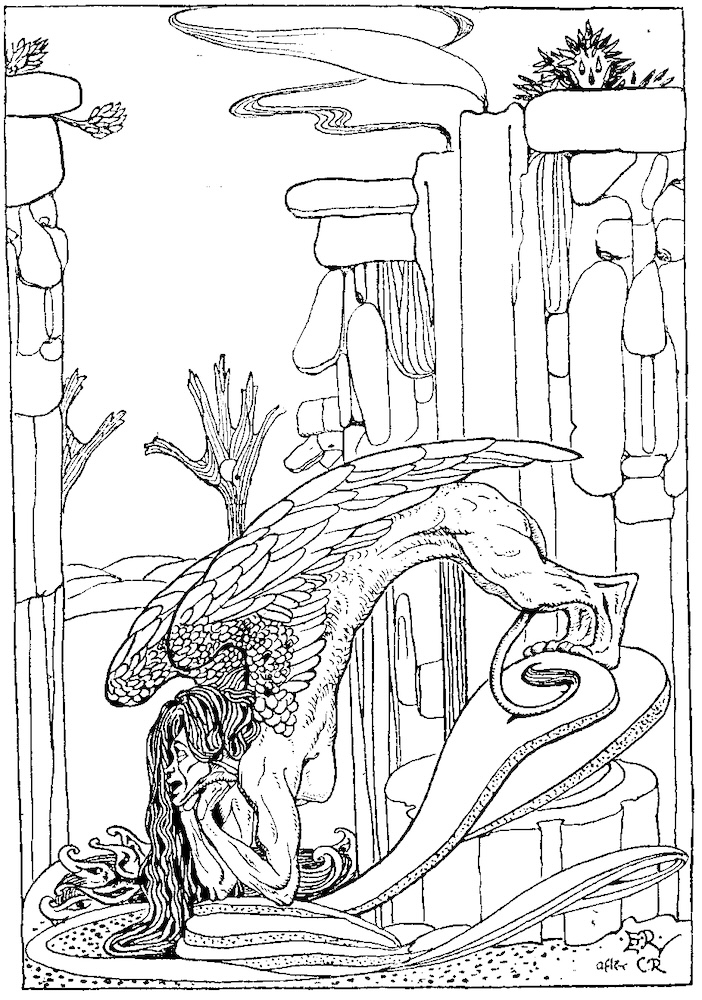
[Ada Leverson, 1862–1933], "The Minx: A Poem in Prose," Punch, or the London Charivari, vol. 107, Saturday, 21 July 1894, 33. 483 words. Strictly speaking, this is a parody, rather than a review, illustrated with a caricature of a Rickett illustration by Edward Tennyson Reed, signed "EER after CR." Wilde first met Leverson, who became one of his best women friends, in 1892, and by 28 June 1893 was addressing her as "The Sphinx of Modern Life," (Merlin Holland & Rupert Hart-Davis (eds), The Complete Letters of Oscar Wilde, London: Fourth Estate, 2000, 568) which helps to explain the response by the "author of The Sphinx that "Punch is delightful and the drawing a masterpiece of clever caricature. I am afraid she really was a minx after all. You are the only true Sphinx" (Holland & Hart-Davis, 593). This is only one of several similar "skits" that Leverson published in Punch, a weekly magazine issued from 1841, which soon gained a broad popular middle class readership, and is generally considered the most important satirical publication of the Victorian era. Francis Burnand (1836–1917), who was Punch's editor from 1880 to 1906, probably published fewer political parodies and caricatures than some of his more radical predecessors, but he accepted the work of more female contributors, and more comment on contemporary literature.
Poet. IT's so good of you to see me. I merely wished to ask one or two questions as to your career. You must have led a most interesting life.
Sphinx. You are very inquisitive and extremely indiscreet, and I have always carefully avoided being interviewed. However, go on.
Poet. I believe you can read hieroglyphs?
Sphinx. Oh yes; I can, fluently. But I never do. I assure you they are not in the least amusing.
Poet. No doubt you have talked with hippogriffs and basilisks?
Sphinx (modestly). I certainly was in rather a smart set at one time. As they say, I have "known better days."
Poet. Did you ever have any conversation with THOTH?
Sphinx (loftily). Oh, dear no! (Mimicking.) Thoth he wath not conthidered quite a nice perthon. I would not allow him to be introduced to me.Poet. You were very particular?
Sphinx. One has to be careful. The world is so censorious.
Poet. I wonder, would you give me the pleasure of singing to me? "Adrian's Gilded Barge," for instance?
Sphinx. You must really excuse me. I am not in good voice. By the way, the "Gilded Barge," as you call it, was merely a shabby sort of punt. It would have had no effect whatever at the Henley Regatta.
Poet. Dear me! Is it true you played golf among the Pyramids?
Sphinx (emphatically). Perfectly untrue. You see what absurd reports get about!
Poet (softly). They do. What was that story about the Tyrian?
Sphinx. Merely gossip. There was nothing in it, I assure you.
Poet. And APIS?
Sphinx. Oh, he sent me some flowers, and there were paragraphs about it — in hieroglyphs — in the society papers. That was all. But they were contradicted.
Poet. You knew AMMON very well, I believe?
Sphinx (frankly). AMMON and I were great pals. I used to see a good deal of him. He came in to tea very often — he was quite interesting. But I have not seen him for a long time. He had one fault — he would smoke in the drawing-room. And though I hope I am not too conventional, I really could not allow that.
Poet. How pleased they would all be to see you again! Why do you not go over to Egypt for the winter?
Sphinx. The hotels at Cairo are so dreadfully expensive.
Poet. Is it true you went tunny-fishing with ANTONY?
Sphinx. One must draw the line somewhere! CLEOPATRA was so cross. She was horribly jealous, and not nearly so handsome as you might suppose, though she was photographed as a "type of Egyptian Beauty!"
Poet. I must thank you very much for the courteous way in which you have replied to my questions. And now will you forgive me if I make an observation? In my opinion you are not a Sphinx at all.
Sphinx (indignantly). What am I, then?
Poet. A Minx.
11. The Saturday Review, 11 August 1894
"Recent Verse," The Saturday Review, Saturday, 11 August 1894, 159. 259 words. The Saturday Review of Politics, Literature, Science and Art (1855–1938) was a conservative weekly that was edited by Walter Herries Pollock (1850–1926) from 1883 to November 1894. The Sphinx is the fourth of eight books covered in this review. The Curran Index to Nineteenth-Century Periodicals [offsite link] has only a limited number of citations for the Saturday Review, but indicative of one of their contributors at around this time, Arthur Symons (1865–1945) was responsible for their reviews of "Verlaine's New Poems," 10 November 1894, 511; and "Some Light Verse," 17 November 1894, 541–542.
Mr. Oscar Wilde's soliloquy with a sphinx is put forth with such circumstances of strangeness as ingenuity might devise and as are becoming to the theme. It is printed in all the glory of "small caps," and the metrical form, which is a compact little stanza, as ordinary poets use it, is made to fit the handsome proportions of the page by a novel method of gauging that serves to attract, if not to bewitch, the eye. With these devices the decorative designs of Mr. Charles Ricketts cleverly assimilate. They move a languid curiosity and are singularly unimpressive — weak essays in the manner of Blake, notwithstanding. Mr. Wilde's poem is profusely embellished with tropical phrase, and a very museum of historical and archæological allusion. But the lavish display is marred somewhat by a sad indiscretion of epithet. The poet, when he has done well, will not leave well alone. He fails, also, to establish the mystery and terror of the situation, as is so effectively done by Poe in the poem which is strongly suggested by Mr. Wilde's opening verses. Thus he is open to the charge of being too easy and familiar. We feel he can only too safely address questions to the Sphinx that might have gravelled Œdipus, and insinuate ill of her antecedents, and finally hurl insults at her, since he is secure from retaliation. Her "curving claws" and "velvet paws," her "horrible and heavy breath," the "cushions" of her satin eyes, her pulse of poisonous melodies, are nothing but the stage "properties" of the poet.
12. Basil Williams, The Athenaeum, 25 August 1894
[Basil Williams, 1867–1950], "Recent Verse," The Athenaeum, Saturday, 25 August 1894, 252. 685 words, with 148 words quoted from The Sphinx and a second quote of 51 words from Wilde's "youthful" "The Burden of Itys," which appeared in his Poems (1881). The Sphinx is the second of two books reviewed. Summarised in Karl Beckson, The Oscar Wilde Encyclopedia (New York: AMS Press, 1998), 359, and reprinted in Karl Beckson (ed.), Oscar Wilde: The Critical Heritage (London: Routledge & Kegan Paul, 1970), 170–171, omitting the last 64 words on Ricketts's illustrations. The Athenaeum (1828–1921) was a major London weekly that has been called a mirror of Victorian culture. From 1871 to 1900 the journal was edited by Norman MacColl (1843–1904), who was praised in the journal's own obituary as a "wonderfully fair" editor who allocated books not to an author's friend or enemy but to a "competent and dispassionate stranger." The attribution of this review is derived from The Curran Index to Nineteenth-Century Periodicals, which draws on The Athenaeum's ledgers and their marked-up bound office copies of each issue.
If any fresh proof were needed of the cynical humour which distinguishes Mr. Wilde, it would be found in his idea of writing such a poem as "The Sphinx" in the metre of "In Memoriam." Like its predecessor, too, the poem is written in an autobiographical form; but there the resemblance ceases. The poet imagines himself as a youth of twenty summers, and luxuriates in the licence of that callow age by limning in luscious lines the lewd imaginings suggested to him by a sphinx that has found its way into his study. The whole poem, which consists of about two hundred lines, is a catalogue (put in the form of questions) of the Sphinx's amours, which, in the words of the American humourist, would appear to have been "frequent and free." Not very much is known about the Sphinx, and still less about her amours, and, at any rate, no one has before brought to her charge the reckless riot of self-indulgence of which she is here accused, so that the fullest credit may be given to Mr. Wilde for the ingenious fertility of his new conception of her. And certainly the most praiseworthy industry is here displayed in the collection of possible and impossible gods and other beings represented as attempting to satisfy the Sphinx's apparently insatiable desires; while the turbid splendour in which the thoughts are clothed fully equals their Oriental profusion. Such lines, for example, as these might create astonishment elsewhere, but in the context they pass almost unobserved:—
Or did you love the god of flies who plagued the Hebrews and was splashed
With wine unto the waist? or Pasht, who had green beryls for her eyes?
Or that young god, the Tyrian, who was more amorous than the dove
Of Ashtaroth? or did you love the god of the Assyrian
Whose wings, like strange transparent talc, rose high above his hawk-faced head,
Painted with silver and with red, and ribbed with rods of oreichalch?
Or did huge Apis from his car leap down, and lay before your feet
Big blossoms of the honey-sweet and honey-coloured nenuphar?
It really comes almost as a shock, certainly as a surprise, at the end of the poem to find that the youthful poet is quite disgusted at all these revelations, and wearies of the Sphinx's "somnolent magnificence":—
Are there not others more accursed, whiter with leprosies than I?
Are Abana and Pharpar dry, that you come here to slake your thirst?
Get hence, you loathsome mystery! hideous animal, get hence!
You wake in me each bestial sense, you make me what I would not be;
and so on for a few more lines, until the poem fitly concludes with an allusion to Christianity. Admirers of some of Mr. Oscar Wilde's previously published poems, such as "Ave Imperatrix," "The Garden of Eros," or "The Burden of Itys" will not welcome this poem with enthusiasm. They will miss the more restrained charm of such lines as:—
And sweet to hear the cuckoo mock the spring
While the last violet loiters by the well,
And sweet to hear the shepherd Daphnis sing
The song of Linus through a sunny dell
Of warm Arcadia, where the corn is gold
And the slight lithe-limbed reapers dance about the wattled fold;
they will criticize the poverty of motive, disguised by the gorgeousness of diction, and will quarrel with such defects as the too frequent use of the word "paramour" or the employment of "curious" in a somewhat precious sense at least three times in such a short poem; but even they will not be able to deny the skilfulness with which the metre is handled, and the easy flow and sonorousness of the lines. Mr. Ricketts's designs suffer from the villainous way in which they have been reproduced. As far as can be judged their scheme of decoration is beautiful, and the first two designs, which are better printed than the others, are very successful indeed. The Sphinx, however, as he represents her, is an ugly beast. The green initial letters are appropriate, and are graceful in themselves.
Note: The "words of the American humourist" are likely those of Bret Harte, who in "His Answer to 'Her Letter'" refers to language that "Is frequent and painful and free."
Created 27 October 2026