

“He has Great Expectations.”
Arthur A. Dixon
1905
Lithographic reproduction of watercolour
5 inches high by 3 ¼ inches wide (12.9 cm high by 8.5 cm wide)
“He has Great Expectations.” — fourth illustration in the Collins Pocket Edition (1905), facing p. 160
[Click on the image to enlarge it and mouse over text for links.]
Scanned image and text by Philip V. Allingham.

Passage Illustrated
"My name," he said, "is Jaggers, and I am a lawyer in London. I am pretty well known. I have unusual business to transact with you, and I commence by explaining that it is not of my originating. If my advice had been asked, I should not have been here. It was not asked, and you see me here. What I have to do as the confidential agent of another, I do. No less, no more."
Finding that he could not see us very well from where he sat, he got up, and threw one leg over the back of a chair and leaned upon it; thus having one foot on the seat of the chair, and one foot on the ground.
"Now, Joseph Gargery, I am the bearer of an offer to relieve you of this young fellow your apprentice. You would not object to cancel his indentures, at his request and for his good? You would want nothing for so doing?"
"Lord forbid that I should want anything for not standing in Pip's way," said Joe, staring.
"Lord forbidding is pious, but not to the purpose," returned Mr Jaggers. "The question is, Would you want anything? Do you want anything?"
"The answer is," returned Joe, sternly, "No."
I thought Mr. Jaggers glanced at Joe, as if he considered him a fool for his disinterestedness. But I was too much bewildered between breathless curiosity and surprise, to be sure of it.
"Very well," said Mr. Jaggers. "Recollect the admission you have made, and don't try to go from it presently."
"Who's a-going to try?" retorted Joe.
"I don't say anybody is. Do you keep a dog?"
"Yes, I do keep a dog."
"Bear in mind then, that Brag is a good dog, but Holdfast is a better. Bear that in mind, will you?" repeated Mr. Jaggers, shutting his eyes and nodding his head at Joe, as if he were forgiving him something. "Now, I return to this young fellow. And the communication I have got to make is, that he has great expectations."
Joe and I gasped, and looked at one another.
"I am instructed to communicate to him," said Mr. Jaggers, throwing his finger at me sideways, "that he will come into a handsome property. Further, that it is the desire of the present possessor of that property, that he be immediately removed from his present sphere of life and from this place, and be brought up as a gentleman — in a word, as a young fellow of great expectations." [Chapter Eighteen, pp. 165-166]
Commentary
The scene in the local public house in which attorney Jaggers (by coincidence the agent for Miss Havisham and Magwitch both) in the unillustrated pages of All the Year Round, the illustrated folio sheets of Harper's Weekly in serialization, and in various illustrated editions other than the Chapman and Hall 1862, 1864, and 1868 volumes with wood-engravings by Marcus Stone is memorable enough, but its significance in the novel is certainly underscored by the presence in the text of such illustrations as the frontispiece Mr. Jaggers at The Three Jolly Bargemen, one of just four plates by A. K. Kipps in the 1862 Gardner A. Fuller (pirated) edition. With his detailed knowledge of the law and his penchant for cross-examining his interlocutors in the public house, as well as his London clothing denoting his professional status, Jaggers is exotic to the frequenters of the pub. As a criminal attorney, Jaggers translated from the text to an image must retain his distinctive manner (suggestive of his unique "voice") and a knowing, enigmatical presence quite out of keeping with the sleepy atmosphere of the Kentish village. Exuding an air of mystery, Jaggers (based, according to Paroissien on an actual lawyer, James Harmer [1777-1853]), carries with him the taint of the criminal underworld of London. His image is much sharper in this lithograph by Dixon than in the small-scale wood-engraving by John McLenan, who nevertheless distinguishes the attorney as a professional among the village yokels by his beaver hat and tailcoat.
Like the book's first illustrator, John McLenan, A. A. Dixon seems to have understood the critical role that the criminal attorney will play in Pip's London existence, although McLenan (working only from one serial instalment to another) could not have known at the point he created his image of Jaggers for the 9 February 1861 instalment how the legal mastermind would ultimately connect Miss Havisham and Magwitch to Pip and Estella. Whereas American illustrator A. K. Kipps shows Jaggers' impact upon those gathered in the taproom — including Wopsle (left, reading newspaper account of "a highly popular murder"), an unidentified agricultural labourer in a linen smockfrock, as well as Pip and Joe to the right — A. A. Dixon focuses on the impact of Jaggers' news on Pip and Joe only. While Jaggers seems calm enough as he points to Pip, the recipients of his message seem utterly stunned, and blond-haired Joe protectively moves to put his arm around the boy, guessing perhaps that the "Great Expectations" will mean his loss of Pip as his apprentice and companion at the forge. Such details of the inn's interior setting as Dixon provides (the table, chairs, the curtain, and the small glass panes characteristic of an eighteenth-century building) contrast the fashionably dressed figure of the lawyer, whose books, top-hat, and gloves Dixon adds with almost photographic precision — in contrast to the impressionist verve and energy of the theatrical scene At The Three Jolly Bargemen by Harry Furniss in The Charles Dickens Edition (1910).
Not all illustrators of the nineteenth century editions have chosen to depict this pivotal moment: Marcus Stone in his 1862 frontispiece Taking Leave of Joe, for example, depicts the consequences of Jaggers' announcement, and both Sol Eytinge, Jr., in Jaggers (1867) and F. A. Fraser in the 1876 Household Edition volume show Jaggers in his usual milieu, carrying on transactions in the street in Little Britain near his office with members of the criminal underclass in Say another word. . .. Dixon's treatment of his subject seems most closely related to H. M. Brock's illustration, although (rather more plausibly) Brock shows both Joe and Pip sitting down as they receive the momentous news.
Pertinent Illustrations in Other Editions: 1860, 1864, 1867, 1876, 1885, 1903, and 1910



Left: John McLenan's uncaptioned headnote vignette, "Saturday Night at The Three Jolly Bargemen" and Marcus Stone's "Taking Leave of Joe." Centre: Sol Eytinge's "Jaggers." Right: F. A. Fraser's "Say another word — one single word — and Wemmick shall give you your money back." [Click on images to enlarge them.]

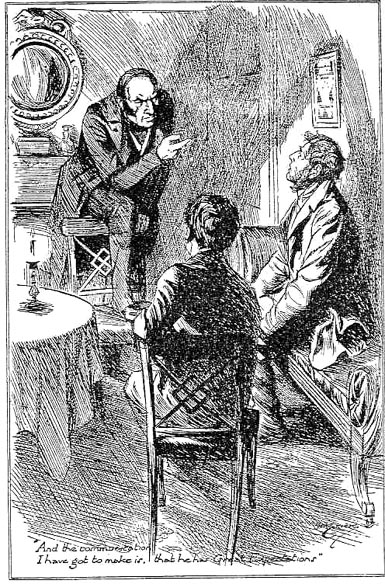

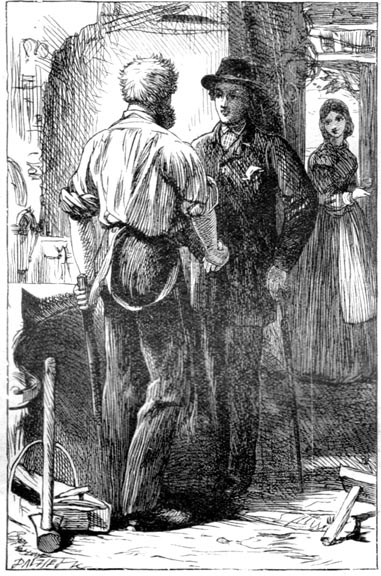
Left: F. W. Pailthorpe's A Stranger at the Jolly Bargemen. Centre: H. M. Brock's "And the communication I have got to make is, that he has Great Expectations." Right: Harry Furniss's At The Three Jolly Bargemen (1910). [Click on the images to enlarge them.]
Bibliography
Dickens, Charles. Great Expectations. Harper's Weekly: A Journal of Civilization. Illustrated by John McLenan. Vol. V. (9 February 1861): 85.
Dickens, Charles. ("Boz."). Great Expectations. With thirty-four illustrations from original designs by John McLenan. Philadelphia: T. B. Peterson (by agreement with Harper & Bros., New York), 1861.
Dickens, Charles. Great Expectations. Illustrated by F. O. C. Darley. Volume 1. The Household Edition. New York: James G. Gregory, 1861.
Dickens, Charles. Great Expectations. Illustrated by John McLenan. Philadelphia: T. B. Peterson, 1861.
Dickens, Charles. Great Expectations. Illustrated by Marcus Stone. The Illustrated Library Edition. London: Chapman and Hall, 1864.
Dickens, Charles. Great Expectations. Illustrated by Sol Eytinge, Junior. Diamond Edition. 14 vols. Boston: Ticknor & Fields, 1867. Vol. XIII.
Dickens, Charles. Great Expectations. Illustrated by F. A. Fraser. Volume 6 of the 22-Volume Household Edition. London: Chapman and Hall, 1876.
Dickens, Charles. Great Expectations. Illustrated by F. W. Pailthorpe. London: Robson & Kerslake, 23 Coventry Street, Haymarket, 1885.
Dickens, Charles. Great Expectations. Illustrated by H. M. Brock. Imperial Edition. 16 vols. London: Gresham Publishing Company [34 Southampton Street, The Strand, London], 1901-3.
Dickens, Charles. Great Expectations. Illustrated by A. A. Dixon. Collins Pocket Edition. London and Glasgow: Collins' Clear-Type Press, 1905.
Dickens, Charles. Great Expectations. Illustrated by Harry Furniss. Charles Dickens Library Edition. 18 vols. London: Educational Book Company, 1910. Vol. XIV.
Dickens, Charles. Great Expectations. Illustrated by Edward Ardizzone. Heritage Edition. New York: Heritage Press, 1939.
Created 18 March 2014
Last updated 21 August 2026