

“Her calm face was like a statue's.”
A. A. Dixon
1905
Lithographic reproduction of watercolour
12.7 cm high by 8.5 cm wide (4 ⅞ inches high by 3 ¼ inches wide)
“Her calm face was like a statue's,” fifth illustration in the Collins Pocket Edition (1905), facing p. 353.
[Click on the image to enlarge it and mouse over text for links.]
Scanned image and text by Philip V. Allingham.

Passage Illustrated
It was no laughing matter with Estella now, nor was she summoning these remembrances from any shallow place. I would not have been the cause of that look of hers for all my expectations in a heap.
"Two things I can tell you," said Estella. "First, notwithstanding the proverb that constant dropping will wear away a stone, you may set your mind at rest that these people never will — never would, in hundred years — impair your ground with Miss Havisham, in any particular, great or small. Second, I am beholden to you as the cause of their being so busy and so mean in vain, and there is my hand upon it."
As she gave it to me playfully — for her darker mood had been but momentary — I held it and put it to my lips. "You ridiculous boy," said Estella, "will you never take warning? Or do you kiss my hand in the same spirit in which I once let you kiss my cheek?"
"What spirit was that?" said I.
"I must think a moment. A spirit of contempt for the fawners and plotters."
"If I say yes, may I kiss the cheek again?"
"You should have asked before you touched the hand. But, yes, if you like."
I leaned down, and her calm face was like a statue's. "Now," said Estella, gliding away the instant I touched her cheek, "you are to take care that I have some tea, and you are to take me to Richmond." [Chapter Thirty-three, pp. 318]
Commentary
The scene once again is an inn, but the backdrop only serves to underscore the social distance that Pip has travelled since we last encountered him at the Three Jolly Bargemen, where Jaggers first broke the news of his having received . . . Great Expectations in chapter eighteen, towards "the end of the first stage of Pip's expectations" (chapter 19, p. 193).
Among the illustrated folio sheets of Harper's Weekly in serialization fopr 13 April 1861, and subsequently in various illustrated editions, including the Chapman and Hall 1862, 1864, and 1868 volumes with wood-engravings by Marcus Stone, readers of the novel during the nineteenth century would have encountered images of the grown-up Pip and Estella which underscore Pip's hopeless devotion and Estella's aloofness. Eytinge captures the severe, determined look in Estella's countenance admirably in his 1867 wood-engraving Miss Havisham and Estella, but not her elegance or demureness. The novel's other early American illustrator, John McLenan, gives one the sense of Pip and Estella equally being "fashion plates" in We walked round the garden twice or thrice more 30 March 1861, — and of Estella's being a petite beauty with drak ringlets (although her hooped skirt is more consistent with the fashions of the 1860s than of the 1820s). Her beauty and something of her reluctance to yield to Pip McLenan conveys adroitly in the same scene as Dixon's, "If I say yes, may I kiss the cheek again?" (13 April 1861). Like Dixon, McLenan clearly depicts Estella's smart "furred travelling dress" and even offers details of furnishing (particularly pictures involving horsemanship, suggestive perhaps of her ability to manage members of the masculine gender so effectively) to reinforce the setting of a coaching inn. But, whereas Mclenan's room merely situates two attractively dressed young people, Dixon's composition uses the details of the setting as a frame for a dual character study of unhappiness contrasting the outward signs of affluence.
Like the book's first illustrator, John McLenan, A. A. Dixon seems to have understood the anguish of Pip, so well graphed by his contemporary, Harry Furniss, in the frontispiece of the 1910 Charles Dickens Library Edition, Pip fancies he sees Estella's Face in the Fire. Never entirely comfortable in the high society to which his Expectations have miraculously translated him, Pip is always something of an outsider in illustrations such as "Why should I look at him?" returned Estella; a pretty twenty-year-old with a certain undermining hardness in her face, she is always immaculately dressed in the height of Regency fashion, whereas Pip (as in Fraser's frontispiece for the 1876 Household Edition seems stilted and awkward. What Dixon adds with almost photographic precision is the flat affect and deadened gaze of Estella, and the deep unhappiness of Pip. Everything about Dixon's Estella, from her fur muff to her elegant millinery and flounced silk skirt, is gorgeous; however, within this elegant frame is the emotionally-scarred face of an extremely depressed young woman.
Not all illustrators of the nineteenth century editions have chosen to depict this pivotal moment: Marcus Stone in his 1864 Library Edition wood-engraving A Rubber at Miss Havisham's, for example, does not depict Pip as a melancholy, thwarted lover or Estella as a belle dame sans merci, but rather as gamesters, trying to determine what is in the other's hand. Perhaps the illustrations that come closest to the moods of the figures in Dixon's illustration are those in Charles Green's Pip and Estella in London and H. M. Brock's inn-yard portrait of the couple, in which Pip is turned away from the reader so that one must surmise from the text what he is feeling in "I am going to Richmond," she told me. Dixon's treatment of his subject is, however, far more psychological as he attempts to convey through their postures and expressions what these adopted members of the upper-class feel about the positions in which their guardians have placed them.
Pertinent Illustrations in Other Editions: 1860, 1867, 1876, 1897, 1902, and 1910

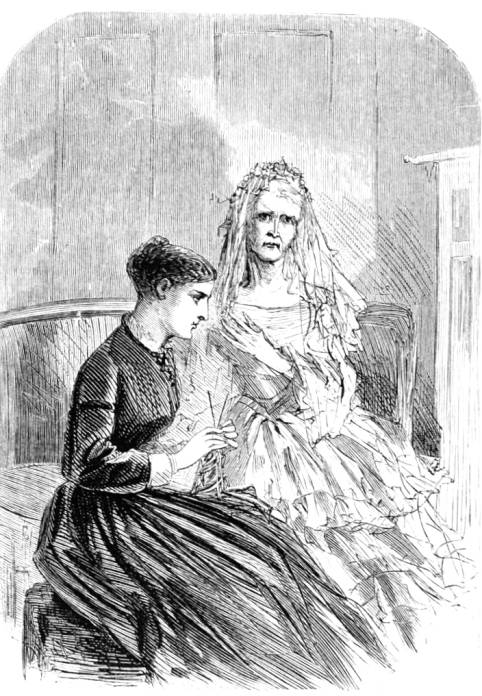
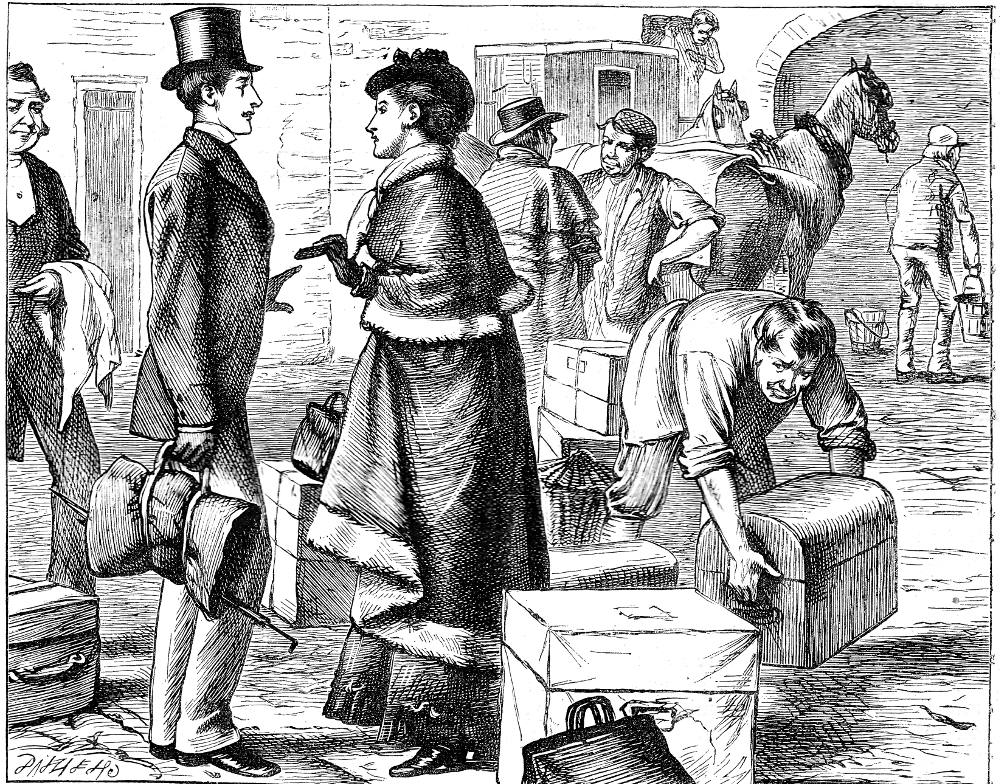
Left: John McLenan's "If I say yes, may I kiss the cheek again?" Centre: Sol Eytinge's "Miss Havisham and Estella." Right: F. A. Fraser's "Oh, but you must take the purse!." [Click on images to enlarge them.]
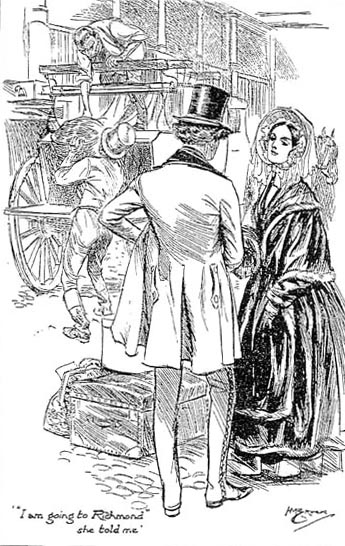
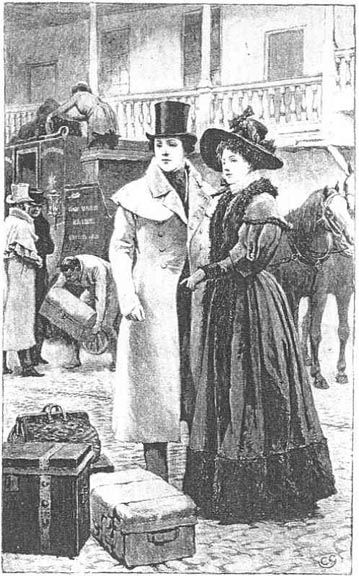

Left: H. M. Brock's "I am going to Richmond," she told me (1902). Centre: Charles Green's Pip and Estella in London. Right: Harry Furniss's Estella and Pip in Miss Havisham's Garden (1910). [Click on the images to enlarge them.]
Bibliography
Dickens, Charles. Great Expectations. Harper's Weekly: A Journal of Civilization. Illustrated by John McLenan. Vol. V. (13 April 1861): 229.
Dickens, Charles. ("Boz."). Great Expectations. With thirty-four illustrations from original designs by John McLenan. Philadelphia: T. B. Peterson (by agreement with Harper & Bros., New York), 1861.
Dickens, Charles. Great Expectations. Illustrated by F. O. C. Darley. Volume 1. The Household Edition. New York: James G. Gregory, 1861.
Dickens, Charles. Great Expectations. Illustrated by John McLenan. Philadelphia: T. B. Peterson, 1861.
Dickens, Charles. Great Expectations. Illustrated by Marcus Stone. The Illustrated Library Edition. London: Chapman and Hall, 1864.
Dickens, Charles. Great Expectations. Illustrated by Sol Eytinge, Junior. Diamond Edition. 14 vols. Boston: Ticknor & Fields, 1867. Vol. XIII.
Dickens, Charles. Great Expectations. Illustrated by F. A. Fraser. Volume 6 of the 22-Volume Household Edition. London: Chapman and Hall, 1876.
Dickens, Charles. Great Expectations. Illustrated by F. W. Pailthorpe. London: Robson & Kerslake, 23 Coventry Street, Haymarket, 1885.
Dickens, Charles. Great Expectations. Illustrated by H. M. Brock. Imperial Edition. 16 vols. London: Gresham Publishing Company [34 Southampton Street, The Strand, London], 1901-3.
Dickens, Charles. Great Expectations. Illustrated by A. A. Dixon. Collins Pocket Edition. London and Glasgow: Collins' Clear-Type Press, 1905.
Dickens, Charles. Great Expectations. Illustrated by Harry Furniss. Charles Dickens Library Edition. 18 vols. London: Educational Book Company, 1910. Vol. XIV.
Dickens, Charles. Great Expectations. Illustrated by Edward Ardizzone. Heritage Edition. New York: Heritage Press, 1939.
Created 19 March 2014
Last updated 21 August 2026