
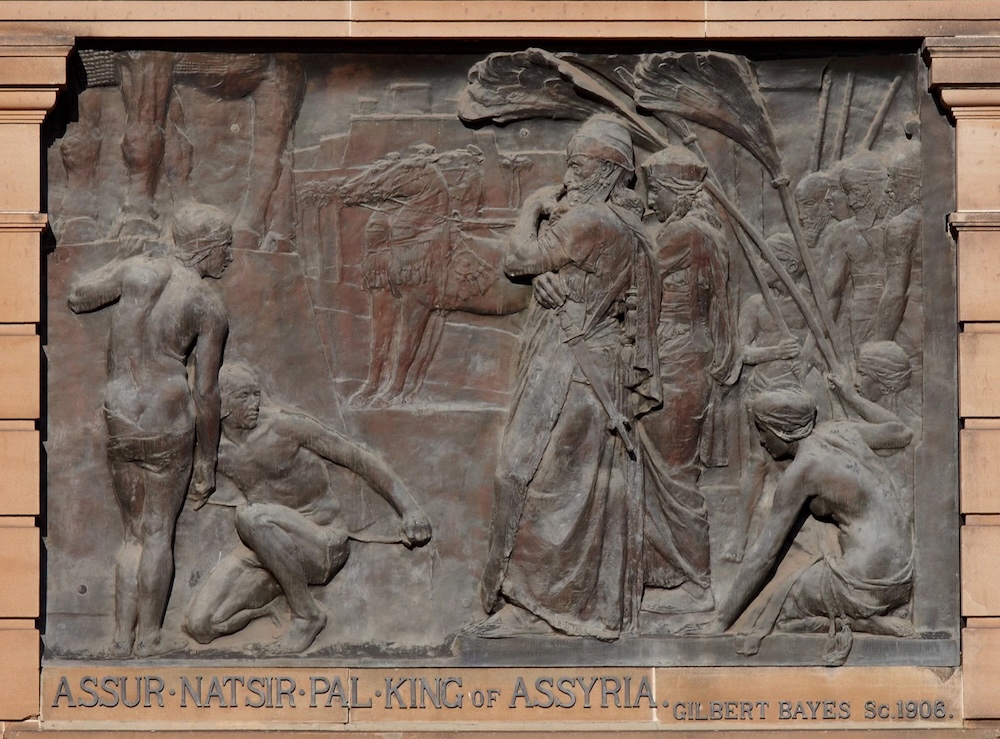
Assur Natsir Pal, King of Assyria by Gilbert Bayes (1872-1953). The bas relief was cast in London and shipped to Sydney, in 1906, and installed the next year on the façade of the Art Gallery of New South Wales. [Photograph © Gilbert Bayes Charitable Trust, courtesy the Art Gallery of New South Wales, reproduced here for research and study purposes. Click on the image to enlarge it.]
The original plan was for a series of six such panels, epitomising the Arts and Industries in six distinctive historical periods of art: the Assyrian, Egyptian, Grecian, Roman, Gothic, and Renaissance, was never fulfilled, most probably because Percival Ball, the sculptor who proposed and initiated the project, and was originally expected to produce the whole series, died in London before the first panel was even cast.
There was some confusion, too, about the commission awarded to Gilbert Bayes in 1903. Those considering the project apparently confused the subject of Assur Natsir Pal, King of the Neo-Assyrian Empire (883-859 BC), supervising the construction of his palace at Nimrud, with another episode in Middle Eastern history: that of the famous Middle Eastern monarch Sennacherib (705–681 BC), viewing the progress of the construction of his palace at Nineveh. This was an episode referred to by Byron in his poem, "The Destruction of Sennacherib" (1815), which appeared in his Hebrew Melodies. Yet Bayes had provided a clear inscription on the bottom of the work, and the legs of an Assyrian winged bull-deity are perfectly visible in the top left of his panel (as the gallery's entry, "Bronze reliefs, 1900-31" points out). Bayes himself would, of course, have been well aware of the difference because of his familiarity with the collections in the British Museum in London. Confusion aside, the general idea, of the architectural decoration of a splendid new building, and of an important personage contemplating its progress, was an appropriate one for the new art gallery.
Here, the King and his consort are fanned by attendants as bare-chested workers pause to look at them, against the backdrop of a completed architectural carving of caparisoned horses. The whole scene captures such general characteristics of Assyrian art as grandeur and regularity, the former through the dominance of the central couple, and the latter in the sculptural decoration shown. The workmen and attendants, however, are depicted with a fluid and sympathetic naturalism. It is a thoughtful as well as striking composition. — Philip V. Allingham, with additional comments by Jacqueline Banerjee.
Related Material
- The first panel, Phryne before Praxiteles, by Percival Ball (1903)
- Feodora Gleichen's Queen Hatasu of Egypt (1908)
- William Dick Reid's Augustus at Nîmes (1931)
- Bayes's own statues in the forecourt of the gallery, The Offerings of Peace and The Offerings of War
Bibliography
"Bronze reliefs, 1900-31." Art Gallery NSW. Web. 9 March 2026. https://www.artgallery.nsw.gov.au/about-us/history/history-of-the-building/the-unfinished-bronze-reliefs-on-the-exterior-of-the-building-1900-31/

Free, Renée. "Late Victorian, Edwardian and French Sculptures." Art Gallery of New South Wales Quarterly: 651 (January 1972).
Irvine, Louise, and Paul Atterbury. Gilbert Bayes, Sculptor (1872-1953). Exhibition catalogue. Shepton Beauchamp: Richard Dennis, 1998.
"Works by Gilbert Bayes." Art Gallery NSW. https://www.artgallery.nsw.gov.au/collection/works/?artist_id=bayes-gilbert.
Created 9 March 2026