
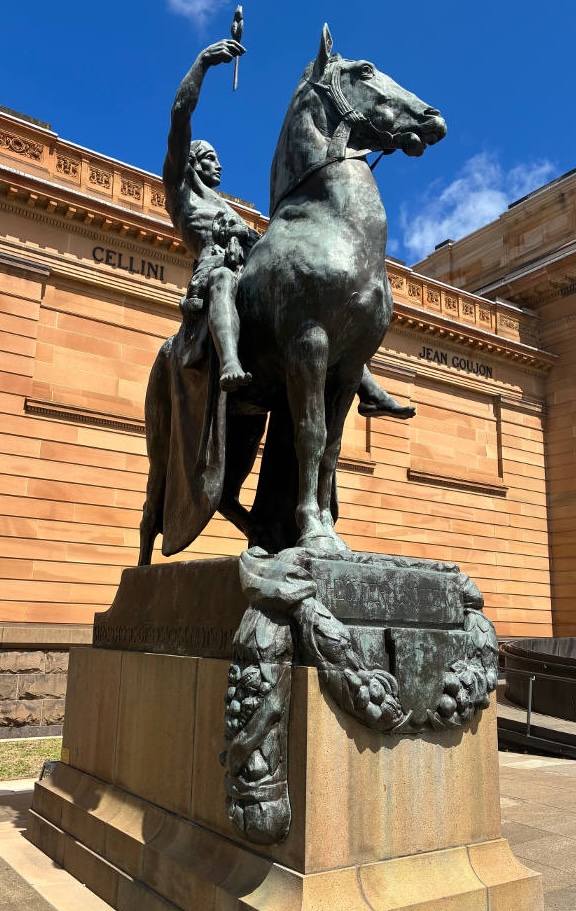
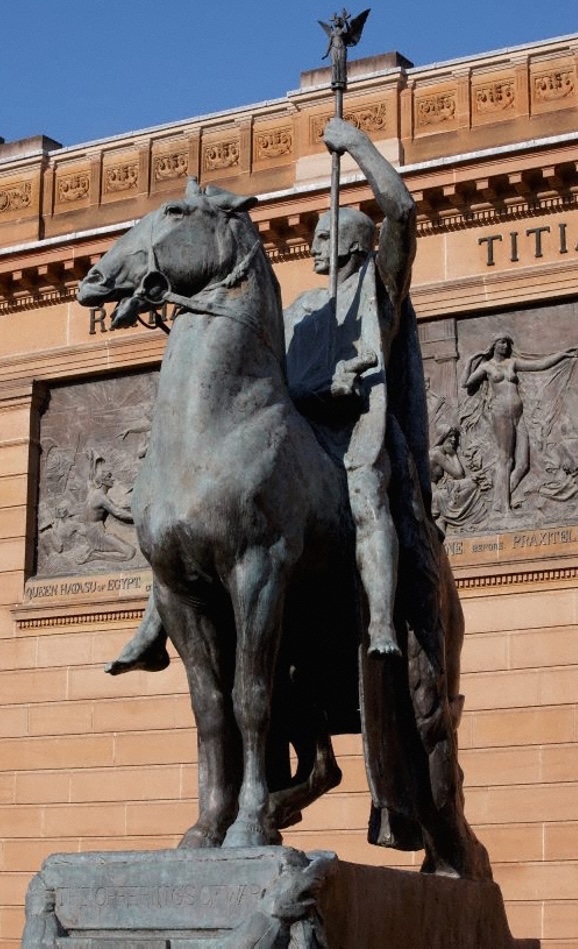
The Offerings of Peace (seen in close-up on the left above) and The Offerings of War (whole equestrian statue with top of plinth, on the right above). Gilbert Bayes (British, 1872-1953), after the Elgin Marbles. Commissioned in 1919, at £1500 each. Completed 1923. Bronze, each fourteen feet high. Forecourt of the Art Gallery, Sydney, New South Wales. [Click on all the images to enlarge them.]
The Trustees of the gallery, having studied the 18-inch bronzed maquettes that he submitted in 1915, commissioned English sculptor Gilbert Bayes to provide monumental equestrian statues to flank the Gallery's main entrance. However, his work was delayed because wartime shortages made it difficult for him to obtain the necessary metal; it was 1923 before he was able to cast the pair. The statues were then shipped separately from England, and unveiled in the forecourt of the gallery on 15 October 1926. The olive branch and wheat sheaf which Peace holds signify peace, and its attendant fruits. The inscription on the base of the statue reads: "The Real and Lasting Victories Are those of Peace and Not of War." On the other side of the gallery's entrance is the statue's complement, The Offerings of War, whose rider holds aloft a staff and broken spear shafts to symbolise the assertion of a new order — and the sacrifice entailed. The inscription on the base of this statue reads: "That our House may stand forever and that Justice and Mercy grow."
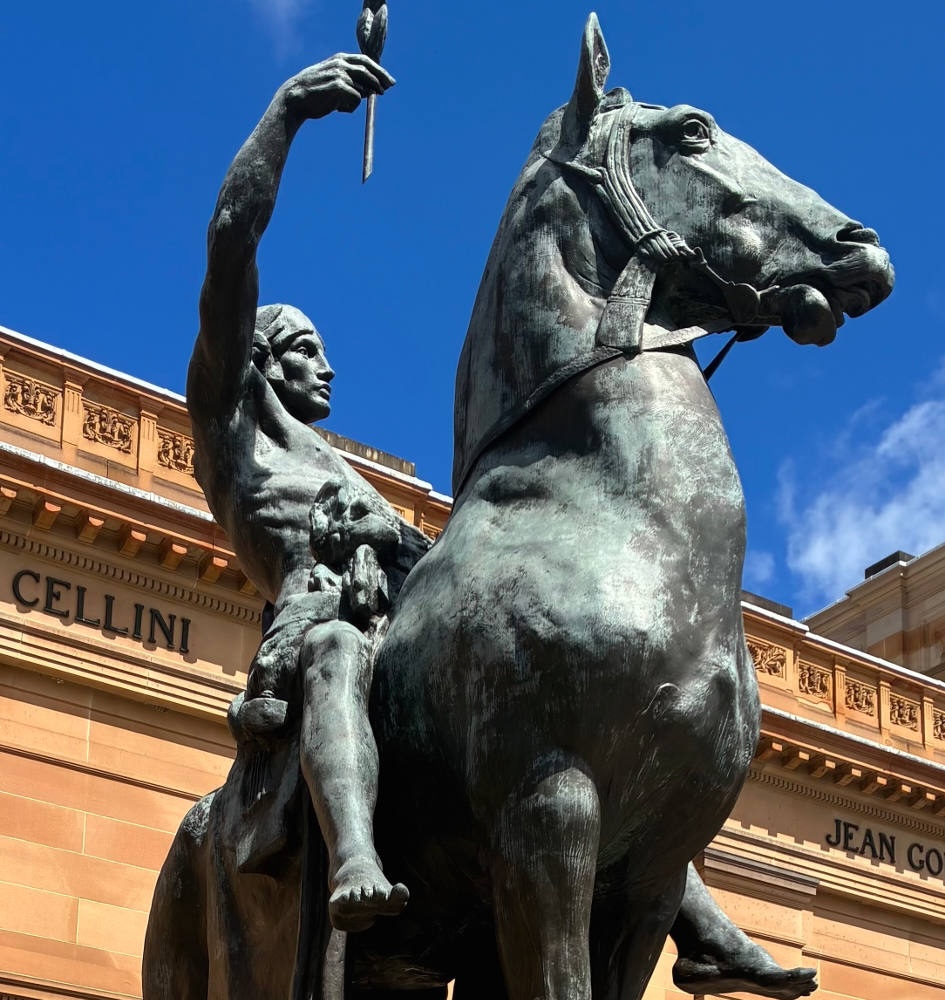

Left: The Offerings of Peace, a partial but more dynamic view. Right: Engraving of War before being "executed in bronze" for the gallery (Marriott 101).
Since Bayes was inspired by the Elgin Marbles — the classical bas reliefs from the Temple of Athena or The Parthenon (432 B.C.) in Athens — there is reference here to the two great genres of classical theatre. The equestrian figure of Peace carries on his right side the theatrical masks of Tragedy and Comedy to represent the flourishing of the arts, possible only in times of peace and stability. As mentioned above, War's accoutrements, better seen in the engraving of the original plaster version, suggest a more mixed view of the fruits of conflict.
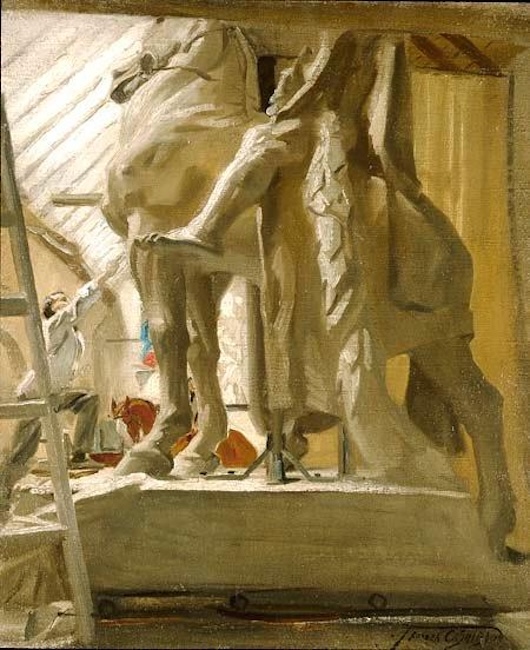
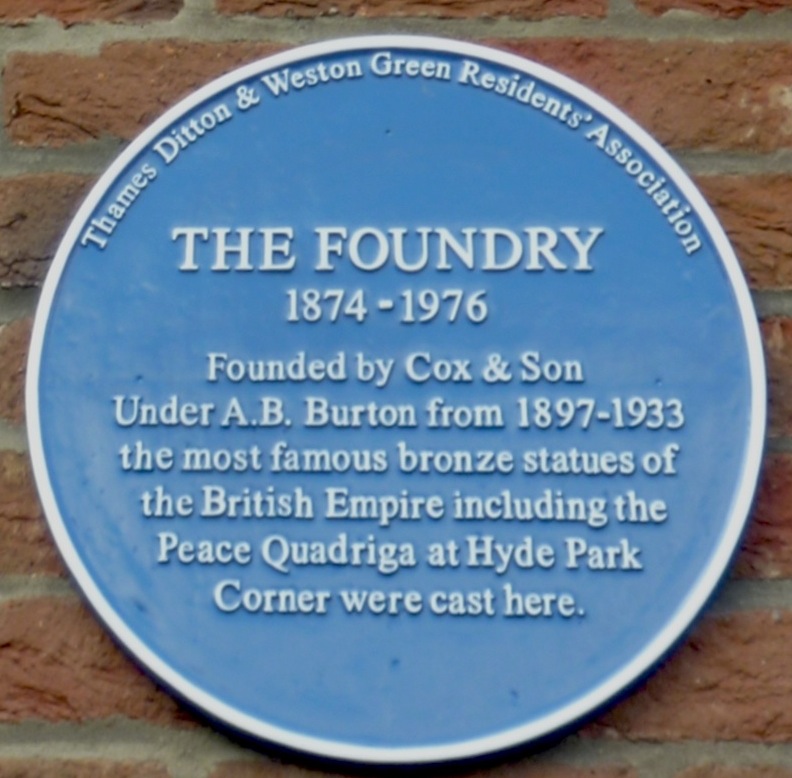
Right: Gilbert Bayes at Work on the Plaster for War 1918, by Frank Owen Salisbury. Left: Blue plaque at the site of the famous foundry at Thames Ditton.
Derived from classical models, the figures are perfectly consonant with gallery's classical façade, though perhaps not as dynamic as they would have been if seen at an angle, as originally intended. A contemporary report in the Sydney Morning Herald reads:
There is no doubt that the new arrangement, in preserving the massiveness of the building design, has sacrificed some of the viour of the sculpture. Alongside the steps the figures would have been set at an angle of fourty-five degrees, so that people going in could obtain a side view of both of them as if they were leaping out from each corner. As it is, they are being set at right angles to the main wall, so that to see them in full length one has to walk between the steps and the pedestal.... [2]
Both equestrian statues, now left and right of the gallery's main entrance, were cast at A.B. Burton's Thames Ditton Foundry in Surrey.
Related Material
Text by Philip V. Allingham and Jacqueline Banerjee. The three colour photographs of the statues were taken by Allingham, while the image scan was by Banerjee. Click on the blue plaque for more information about it. You may use all of the images without prior permission for any scholarly or educational purpose as long as you (1) credit the photographer or the person who scanned the image and (2) link your document to this URL in a web document or cite the Victorian Web in a print one.
Bibliography

Free, Renée. "Late Victorian, Edwardian and French Sculptures." Art Gallery of New South Wales Quarterly: 651 (January 1972).
Irvine, Louise, and Paul Atterbury. Gilbert Bayes, Sculptor (1872-1953). Exhibition catalogue. Shepton Beauchamp: Richard Dennis, 1998.
Marriott, Charles."The Recent Work of Gilbert Bayes." The International Studio Vol.63 (1917-1918): 100-112. HathiTrust, from a copy in Harvard Univeristy. Web. 9 March 2026.
"National Gallery: Gilbert Bayes' Statues." Sydney Morning Herald. 16 October 1926: 12. Trove. Web. 9 March 2026. https://trove.nla.gov.au/newspaper/article/16317824/1211236
"Works by Gilbert Bayes." Art Gallery NSW. https://www.artgallery.nsw.gov.au/collection/works/?artist_id=bayes-gilbert
Created 4 March 2026