
The son of a stone-carver, Edward Henry Ball, Percival Ball (17 February 1845 – 4 April 1900) was born in Westminster, but today is largely remembered in Australia, where his bronze relief, Phryne before Praxiteles (cast in 1900 and installed in 1903) can be seen on the façade of the Art Gallery of New South Wales.
Ball's earliest successes were in England. He trained first at the Lambeth School of Art, and was just nineteen when he was recommended for the position of pupil-teacher there (Beattie 18). According to Desmond Eyles, he also fulfilled a commission which Henry Doulton gave the school for a series of terracotta heads on the façade of the extension to the nearby Doulton Pottery building, portraying "Wedgwood, Bottger, Palissy and other famous potters, the head of each potter alternating with a female head" (36).
Ball completed his training at the Royal Academy Schools, winning several gold medals, and was awarded a prize scholarship in 1865. This was the year, too, in which he first exhibited at the Academy. Clearly very gifted, he soon established "a sound reputation among informed critics for work which reflects the influence of his master Henry Weekes's homely neo-classicism" (Beattie 18). He would continue to exhibit at the RA until 1882, showing twenty-four works there in all.
However, from about 1870 Ball lived abroad, first travelling to Paris, and then to Munich and Rome, joining painter Edward T. Haynes "to run art classes (presumably for English-speaking students and tourists) in the Via degli Avignonesi in Rome" (information from a hand-written advertisement, cited by Marsh). Amelia Edwards visited the studio and this was probably where she sat for her bust, although the first version was apparently in terracotta (see Marsh). Ball remained in Rome for the next eight years, all the while receiving high praise for his sculpture.
Nevertheless, he emigrated to Australia in 1884, hoping that the milder climate would ameliorate his bronchitis and asthma, both of which his heavy drinking exacerbated. From his studio in Collins Street East in Melbourne over the next two decades he produced a series of notable works: the statue of Sir Redmond Barry (1886-87), the portrait bust of publisher George Robertson (1889), and the bronze memorial to Francis Ormond (1892). The important commission for Phryne before Praxiteles had tragic consequences: he returned to England to supervise the casting, and died of heart failure due to asthma and bronchitis there in 1900, leaving the casting unfinished. Philip V. Allingham and Jacqueline Banerjee
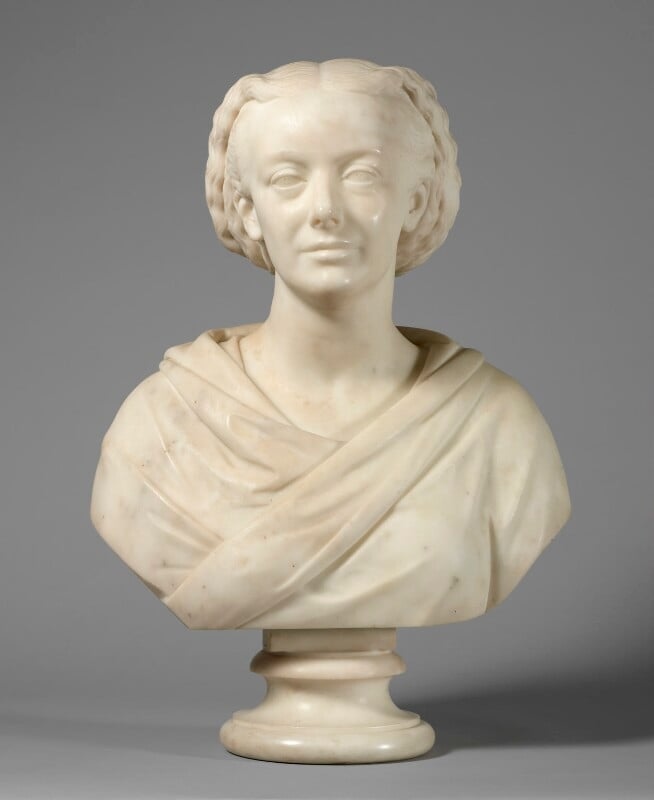
Works
Bibliography
Beattie, Susan. The New Sculpture. New Haven and London: Yale University Press, 1983.
Eyles, Desmond, revised by Louise Irvine. The Doulton Lambeth Wares. Shepton Beauchamp, Somerset: Richard Dennis, 2002.
Free, Renée. "Late Victorian, Edwardian and French Sculptures." Art Gallery of New South Wales Quarterly (January 1972): 651.

Marsh, Jan. "This Portrit" (extended catalogue entry for the Amelia Edwards bus). National Portrait Gallery. Web. 8 March 2026.
"Percival Ball." . University of Glasgow History of Art and HATII, online database 2011. Web. 8 March 2026. https://sculpture.gla.ac.uk/mapping/public/view/person.php?id=msib2_1213974517
Scarlett, Kenneth William. "Ball, Percival." Australian Sculptors. West Melbourne: Thomas Nelson Australia, 1980.
Scarlett, Kenneth William. "Percival Ball 1844-1900." Australian Dictionary of National Biography. Volume 7 (1979). https://artuk.org/discover/artists/ball-percival-18441900. Accessed 5 March 2026.
Created 8 March 2026