
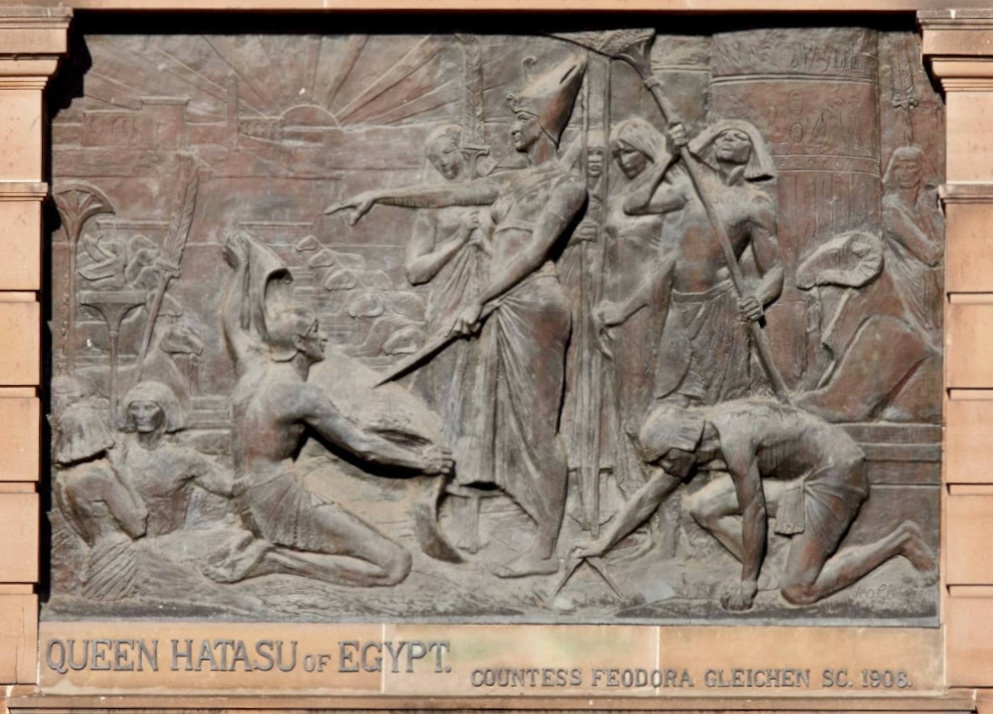
Queen Hatasu of Egypt or Hatshepsut (1908) by the Countess Feodora Gleichen (1861-1922), on the facade of the Art Gallery for New South Wales, Sydney. [Photograph courtesy the Art Gallery of New South Wales, reproduced here for research and study purposes. Click on the image to enlarge it.]
The bronze relief panel intended to depict ancient Egyptian artistic culture on the exterior of the Art Gallery of New South Wales (AGNSW) was cast in 1907, and installed in 1908. Part of an unfinished series of exterior bronze reliefs (1900–31), this panel was designed by the Countess Feodora Gleichen after the committee had received the submissions of Gilbert Bayes (1872-1953) and Percival Ball (1845-1900).
The Art Gallery trustees, at the prompting of Ball, had "called for competitive designs for the Assyrian and Egyptian panels on 23 October 1903. The conditions required 'quarter size models' to be sent to Alfred East in London. Four submissions were received from Australia and another three from London" ("Bronze reliefs, 1900-31"). Countess Feodora Gleichen's design was selected for the Egyptian panel: it showed Queen Hatasu, or Hatshepsut, "giving directions for the construction of her famous avenue of Ram-headed sphinxes" to mark the route of the Opet Festival at Karnak ("Queen Hatasu of Egypt"). Although the ram-headed sphinxes symbolized the male fertility god Amun, the Countess had viewed the subject from an emphatically female angle: Queen Hatasu points imperiously at the architectural plans with one hand, while gesturing equally imperiously at the work in progress with the other. Obedience is clearly the order of the day.
Both Bayes and Gleichen modelled their full plaster casts in 1906. Bayes's plaque was cast and shipped in the same year, and installed in February 1907, whereas Gleichen’s was cast in 1907, and installed in 1908. It could be a long process, and because of the time and also the costs involved in awarding the commissions and following them through, the project was then dropped. It might well have been different if Ball had lived to see the whole project through, as originally expected. Several other sculptors did send in submissions, though, and a fourth was completed by William Reid Dick (Augustus at Nimes), and installed in 1931. Dick's subject was "the influence of Roman Art as shown in the use of the Arch in architectural and other works of construction (qtd. in "Bronze reliefs, 1900-31"). But that was the last to be added. — Philip V. Allingham, with additional comments by Jacqueline Banerjee.
Related Material
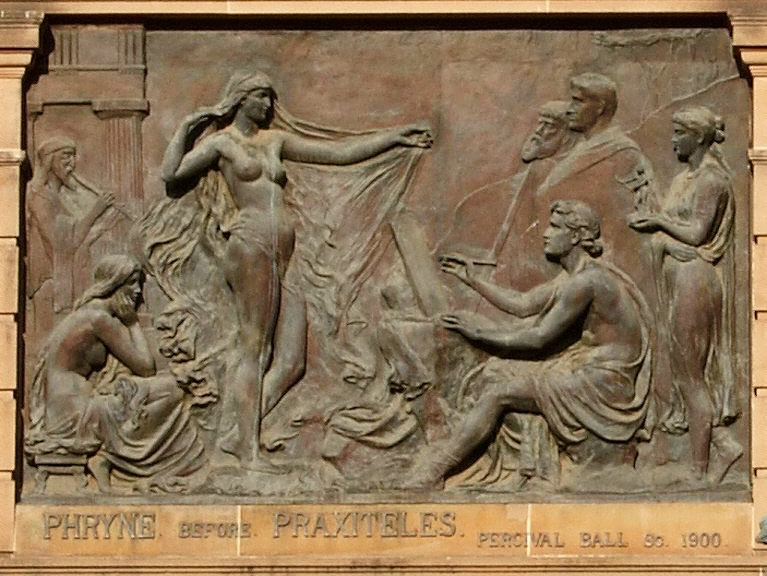
- Ball's Phryne before Praxiteles (1900)
- Bayes' Assur Natsir Pal, King of Assyria (1906)
- William Dick Reid's Augustus at Nîmes (1931)
Percival Ball's Phryne before Praxiteles (1898, 1900), the original plaque, intended to epitomize the arts of ancient Greece.
Bibliography
Augustus at Nimes. Art Gallery NSW. Web. 11 March 2026.
"Bronze reliefs, 1900-31." Art Gallery NSW. Web. 11 March 2026. https://www.artgallery.nsw.gov.au/about-us/history/history-of-the-building/the-unfinished-bronze-reliefs-on-the-exterior-of-the-building-1900-31/
Free, Renée. "Late Victorian, Edwardian and French Sculptures." Art Gallery of New South Wales Quarterly: 651 (January 1972).

“ HSH Countess Feodora Maud Georgina Gleichen.” Mapping the Practice and Profession of Sculpture in Britain and Ireland 1851-1951. University of Glasgow History of Art and HATII, online database 2011. Web. 11 May 2011.
Irvine, Louise, and Paul Atterbury. Gilbert Bayes, Sculptor (1872-1953). Exhibition catalogue. Shepton Beauchamp: Richard Dennis, 1998.
"Queen Hatasu of Egypt." Art Gallery NSW. https://www.artgallery.nsw.gov.au/collection/works/3258/
Scarlet, Kenneth William. "Ball, Percival." Australian Sculptors. West Melbourne: Thomas Nelson Australia, 1979. Vol. 7. https://adb.anu.edu.au/biography/ball-percival-5116/text8549."Ball, Percival." Web. 5 March 2026.
Spielmann, Marion Harry. British Sculpture and Sculptors of Today. London: Cassell, 1901. Internet Archive. Web. 22 December 2011.
Created 13 March 2026