
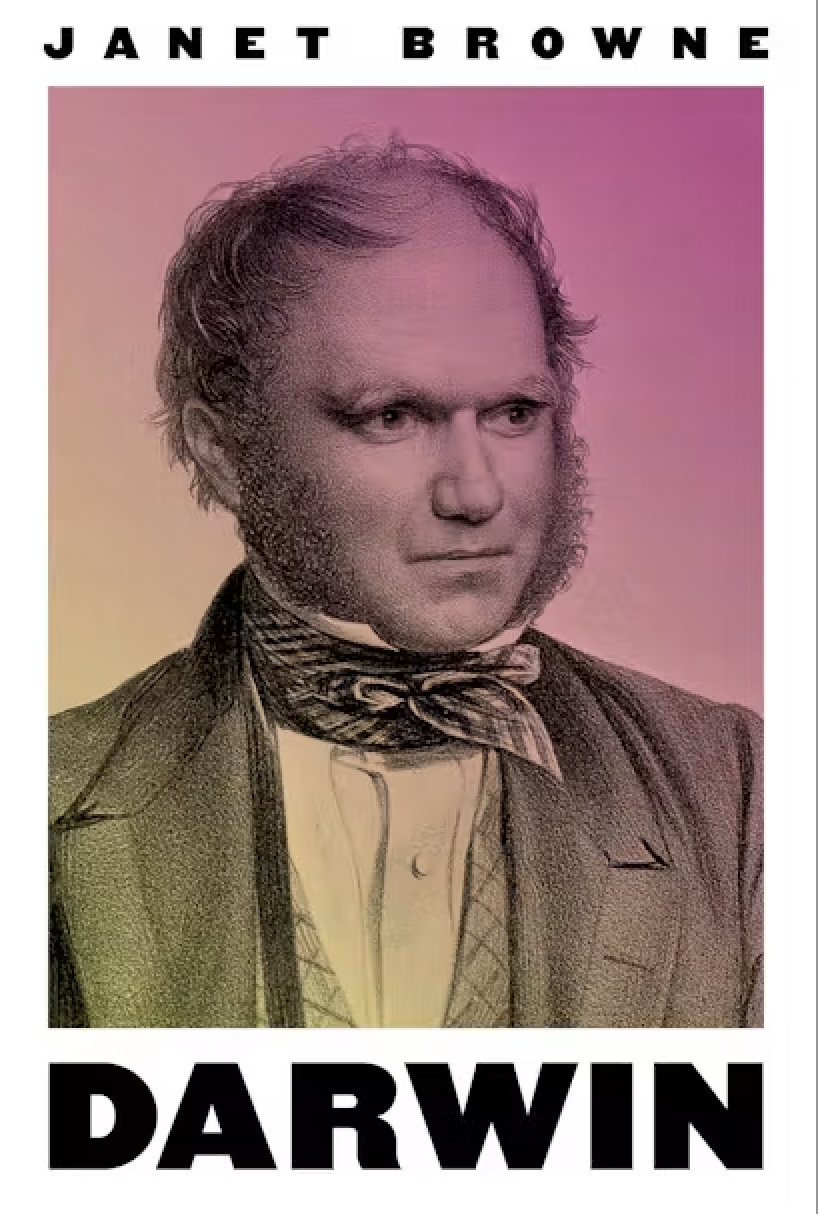

itled simply Darwin, Browne's definitive and fully updated, one-volume biography takes advantage of her familiarity with the Correspondence of Charles Darwin (1985-2024) as well as her own two-volume biography, Voyaging (1995) and The Power of Place (2002), along with other books on Darwin and nineteenth-century science. As Aramont Professor of the History of Science at Harvard University, Browne has focused her research on the intersection of the life sciences, geographical expeditions, and natural history, with an emphasis on the life and works of Charles Darwin (1809-1882). The biography, however, ventures beyond this narrow scope to provide a clear overview of the entirety of nineteenth-century thought as Europe and North America were rocked by social, economic, and political change.
Browne's newly abridged biography will be accessible to both general readers and to scholars in history, politics, science, and literature. Readers will come to understand that while Darwin spent his life attempting to answer questions that had plagued people for centuries, he was also a gentleman farmer, an animal lover, a son, a brother, a husband, a father, and a friend. Tracing Darwin's life as he attempted to follow in his father's footsteps as a physician before transferring to Christ's College, Cambridge (1828-1831) where he studied to be a pastor in the Anglican Church, Browne demonstrates the extent to which Darwin was shaped by his past before his travels on the Beagle (1831-1836) provided him with the tangible evidence to break with the established belief that the world had been established at creation and instead that it was the result of small, incremental changes.
In her Introduction, Browne provides an overview of the work and conveys her intent to look at Darwin as an individual whose life was affected by the changes taking place over the course of his long life and over the even longer period that historians now describe as the Long Nineteenth Century. Non-scientists will appreciate her intent to deal less with the science and to focus more on the "cultural conditions" (xi) that influenced Darwin's thought. Of major significance is her attention to the development of the empire and the changes in economic conditions, both of which influenced Darwin's life and ideas.
Brown's last word—aside from 19 pages of notes, a 25-page bibliography, and 17-page index—is to note that the abridged version addresses the objection lodged against the original two-volume edition by numerous people who complained that "two volumes were too much." The result is a "shorter read" (543). Readers desiring more detail may wish to consult the two-volume biography.
The biography is divided into five sections, each titled for a different role that Darwin played in his lifetime. The first part, "Collector," explores Darwin's family and education. This is followed by "Traveler," which examines the impact of his travels on HMS Beagle. The third part, "Naturalist," looks at the years following his return to England, as he came to terms with the evidence from his travels while he and his wife Emma were establishing their family. "Author" focuses on the impact of The Origin of Species (1859) and its effects on Darwin's relationships with his fellow scientists; and "Celebrity" considers Darwin's ongoing scientific research and its impacts on both science and culture.
Divided into four chapters, Part I ("Collector") describes the world and the family into which Darwin was born. Browne emphasizes that the Darwin and Wedgwood families were socially progressive and politically liberal but also notes that their connections to medicine and industry prepared them to take advantage of the economic changes taking place at the time. In fact, the same forward thinking that led Darwin's father to be an early investor in roads and railroads also inclined him to agree to allow his son to join the expedition on the Beagle, a small surveying ship, as a naturalist and companion to its captain, Robert FitzRoy, in 1835. It was a decision that changed both his son's life and the history of science.
Part I also introduces readers to Darwin's extended family, his early education at Shrewsbury School (1818-1825), and his education at both Edinburgh Medical School (1825-1827) and Cambridge University (1828-1831), and to the friends and professors who shaped his thinking. Even though Dr. Darwin had feared that his son would turn into an "idle sporting man," Browne reveals the inquisitiveness that would ultimately result in a new way of seeing the natural world. Not only did the young Darwin collect beetles, he and his brother also experimented with chemistry, "establishing the footing for a lifetime in investigative science" (20). At Edinburgh, he joined the "Plinian Society, a group of undergraduates who liked natural history and antiquarian research and met regularly" (37). Darwin was especially fortunate to be educated at a time when science was emerging as a field that required the use of evidence and to be surrounded by other individuals who were also interested in science.
Darwin's long journey on the Beagle, originally supposed to last two years but later extended to almost five (December 27, 1831, to October 2, 1836), is the focus of the book's second part, "Traveler." In addition to examining Darwin's sometimes contentious relationship with the Beagle's captain, Robert FitzRoy, the six chapters comprising Part II explore what Darwin saw on his travels, evidence that would ultimately result in the transformation of natural history. These chapters also reveal the perils of travel at the time, as Darwin encountered native people and animals and dealt unsuccessfully with seasickness. He also read widely in the books that would influence his thinking, including Charles Lyell's Principles of Geology (1830-33). Darwin's exploration of the Andes and of coral reefs corroborated Lyell's theory that small events occurring over long periods are responsible for changes in geological formations while his experiences on the Galápagos revealed subtle changes in similar species.
While much of what Browne covers in Part II will be familiar to people who have read other biographies of Darwin as well as to those who have read works by Darwin, Browne provides fresh insights into Darwin's writing process and to the extent to which the copious notes that he took in his journals produced both scientific evidence and highly readable prose. What is also new to this biography is the extent to which the Beagle voyage was part of England's imperial endeavors or what Browne accurately calls "the imperial gaze" (100). Though Darwin benefitted by living during a period when England was interested in establishing power throughout the world, Browne also demonstrates that he had clear thoughts of his own. For example, Brown shows how Darwin's argumentative relationship with FitzRoy stemmed from their different attitudes to abolitionism and from Darwin's clear-eyed assessment of the impact of colonialism on indigenous peoples. She indicates that Darwin shared the perspective of the argument advanced by the physician J. C. Pritchard in Researches into the Physical History of Man (1813), that "aboriginal peoples were usually decimated by the ‘civilized' races who invaded or appropriated their territory" (237). Part II also touches on what Darwin saw on the Galápagos as well as on the possible cause of the chronic illness that plagued him for the remainder of his life.
The six chapters in Part III ("Naturalist") explore what Darwin did with the experiences he gained from his five-year travels as he connected with the scientific establishment of his day, and specifically with its leading figures: Charles Lyell, Richard Owen, J.D. Hooker, and Thomas Henry Huxley. This section also shows the former adventurer turning inward as he worked to make sense of what he had witnessed during his travels and the surprising extent to which his family allowed him to wrestle with this evidence. While other biographies of Darwin tend to downplay the significance that Darwin's wife played, Darwin takes their close relationship into account. Never a convert to Darwin's way of thinking, Emma nonetheless provided her support to him as well as to their ten children, seven of whom survived to adulthood. The information about the Darwin family reveals a great deal about country life during the Long Nineteenth Century. Not only does Browne provide insights into Darwin as a father, she also demonstrates the extent to which he was involved in gardening and acting as a magistrate and a philanthropist in the village, establishing a Coal and Clothing Club in 1850 and serving as its treasurer for thirty years. The grounds of Down House provided the materials for "innumerable small botanical experiments" that would "scale up to provide insights into much larger philosophical questions" (294).
Part III also addresses a characteristic element of Darwin's thinking: his use of detailed examination of individual species and discrete problems to provide evidence for his larger theory. Browne succinctly describes his scientific approach as his "zest for innumerable small botanical experiments [...] that would scale up to provide insights into much larger philosophical questions" (294), an interplay of large ideas and small to which Browne returns throughout the biography as a way of showing Darwin's mind at work. Concerned about the impact that his theory would have on the thought of the time, Darwin devoted time to the study of barnacles and pigeons during a period when he suffered from chronic illness and the death of his eleven-year-old daughter Anne in 1851, a loss from which he never entirely recovered.
Browne also reveals in Part III how reading the Essay on the Principle of Population by Thomas Robert Malthus in 1838 ultimately led Darwin to the concept of natural selection, the mechanism that controlled his theory of evolution. A key chapter, "Forestalled but Forewarned," brings in the impact that other work, such as the anonymously published Vestiges of the Natural History of Creation (1844) by the Scottish journalist Robert Chambers, and a letter from Alfred Russel Wallace that forced Darwin finally to articulate his radical conclusions about evolution.
Comprising six chapters that focus on what history knows as Darwinism, Part IV ("Author") provides insights into Darwin's reluctance to announce publicly what he had already hinted at to his scientific peers about the changing nature of species as well as the geological landscape. It also demonstrates the impact of his relationship with Wallace, who had arrived at similar notions regarding evolution. While scholars of the biological sciences may find that these chapters don't provide enough specific detail about his theory, curious general readers and scholars of literature will appreciate Browne's exploration of Darwin's "likeable, autobiographical style" and his sensitivity to his reader (339). Other readers will appreciate her overview of the publication process as Origin went through multiple editions. The chapters also reveal Darwin's ongoing curiosity and provide a behind-the-scenes look at the personalities of the scientists of the day and their sometimes-petty feuds.
The four chapters in Part V ("Celebrity") depict Darwin's continued scientific curiosity as well as his relationships to the rest of the scientific community and to his family and friends. While The Descent of Man (1871) may have sparked the most controversy, Darwin's work with orchids, insectivorous plants, and earthworms — whose slow activity, he noticed, produced significant changes on the soil in which they lived — also attracts Browne's attention. More surprising is her brief coverage of Darwin's attendance at a séance arranged by his son in 1874 that was also attended by his brother as well as George Lewes and George Eliot. Browne's commentary on his response to the séance as "rubbish" (493) is less surprising, though the fact that he attended at all is indicative of his desire to engage with the larger world in which he lived. Browne quotes from Darwin's description of the séance, but his son Francis offers a more nuanced response, noting that "his father regretted the enormous energy people poured into investigating the supernatural when the same effort might be directed into understanding reality" (494). His response to vivisection also reveals his complex attitude to one of the major questions of the day. As a scientist, he was invested in the entire realm of scientific research, but he was also a life-long animal lover who worried about the potential poor treatment of laboratory animals.
Part V reveals that, while Darwin stayed close to home at the end of his life, he remained curious, moving once again from exploring the natural world in its entirety to focusing on local examples that provided evidence for his theory. While he never overcame his worries about the reception to his controversial ideas, he was nonetheless buried at Westminster Abbey rather than in the churchyard at Downe with his brother Erasmus and two of his three deceased children. The boy who had worried his father because of his apparent lack of seriousness had received full recognition for his efforts even if his demonstration that the world was in a constant state of change with no divine oversight worried many who considered his impact.
Links to Related Material
Bibliography
[Book under review] Browne, Janet. Darwin. Abridged ed. Princeton: Princeton University Press, 2026. 624 pages. Hardcover $35. ISBN 9780691232256.
Costa, James T. and David Collard, eds. An Alfred Russel Wallace Companion. University of Chicago Press, 2019.
Hewitt, Martin. Darwinism's Generations: The Reception of Darwinian Evolution in Britain, 1859-1909. Oxford University Press, 2024. [Review by Diane Josefowicz]
Levine, George. Darwin the Writer. Oxford: Oxford UP, 2011.
Created 13 August 2026
Last modified 17 August 2026