

or many years after the Dissolution of the Monasteries under Henry VIII, monks and nuns ceased to figure in English life. Sir Walter Scott would later describe the wholesale rejection of their old powers and privileges in the Scottish Borders too, in The Monastery: A Romance (1820), one of his immensely popular Waverley novels. There, it was not by royal decree but because of "the fury of the populace" and the depredations of the Reformed Protestant nobility (378), and it seemed all the more impossible to imagine any future for monasticism in the post-Reformation era. But several factors in the late eighteenth and early nineteenth century came together to promote its return, and, despite early opposition and some longer-lasting prejudice, monks and nuns once again found a place in the religious life of the country.
The single most important factor in this re-emergence was the easing of restrictions on Roman Catholicism, starting with the Catholic Relief Act of 1791, and culminating in the Catholic Emancipation Act of 1829. Once this process started, England became a haven for the many men and women across the Channel with religious vocations who faced brutal persecution during the French Revolution: "By 1794 a vast number of bishops, priests, monks and nuns had found new homes in England. These ‘displaced persons' from overseas were treated like heroes by 'John Bull.' Their Popery was either ignored or forgotten..." (Anson 14). Indeed, sympathy for their predicament at the hands of irreligious revolutionaries was another major factor in changing attitudes here.
In a short space of time, therefore,
there were Benedictine nuns at Winchester, Hammersmith, Marnhull (Dorset), Preston (Lancs.); Canonesses of St Augustine at Hengrave (Suffolk); Canonesses of the Holy Sepulchre at Holme Hall (Yorkshire); Carmelite nuns at Lanherne (Cornwall), Bishop Auckland (Co. Durham), and Acton, near London. Dominican nuns had settled at Hartpury Court (Gloucestershire); Franciscan Third Order Regular Sisters at Winchester; Poor Clares at Haggerston Hall (Northumberland), and another community at Britwell (Oxfordshire). English Benedictine monks from Douai in France had found a home at Acton Burnell near Shrewsbury. Many more of them were scattered over England with no fixed abode. [Anson 14]
Such an influx was bound to have consequences for the established church as well as for the local population, and indeed for the cultural and spiritual life of the whole country.
Thomas Weld and the Cistercian Refugees in Dorset
Not even mentioned among those listed above was a small group of Trappist monks (strictly observant monks of the Cistercian order), who had originally planned to carry on to Canada. These were made welcome in Dorset by Thomas Weld of Lulworth Castle.
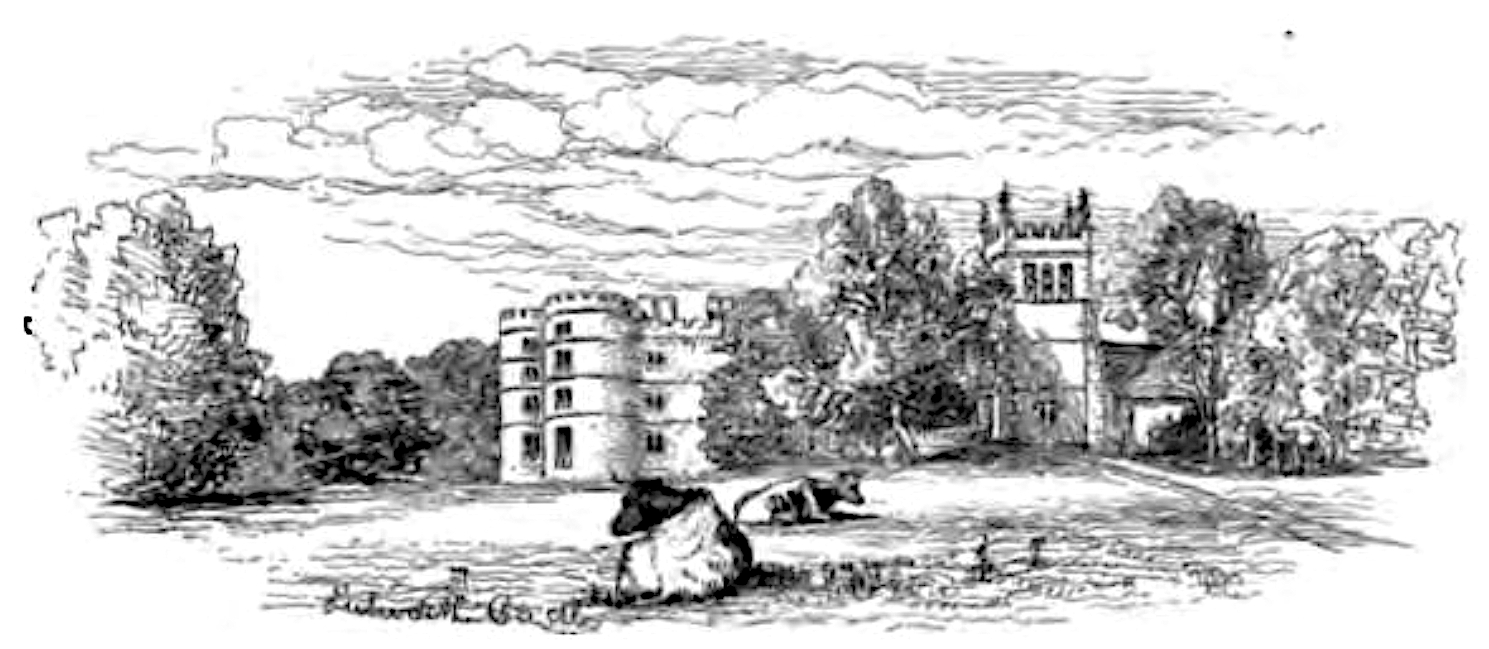
Lulworth Castle, Thomas Weld's ancestral home, drawn by Alfred Dawson. Source: Robinson 168.
Weld was himself a Catholic — a highly respected and philanthropic member of the old Catholic gentry, so well-connected that he moved in royal circles. Having "at his command a noble fortune" ("A Cistercian Monk" 194), in 1796 he built the refugees a small monastery near the castle, where they stayed until 1817; and in 1798, George III and members of his family made one of several visits to the castle, during which the King inspected the Catholic chapel of St Mary's in its grounds — a chapel deliberately planned not to draw attention to itself as a house of worship, but nevertheless richly appointed with Tuscan columns and a painted ceiling. This was the first Catholic chapel to be built here after the Reformation. In his approval of it, the King was far ahead of his times.
According to a slightly later visitor to the monastery itself, who reported his findings in the Monthly Magazine of October 1800, the monks' habitation was very much simpler than the chapel, "built of very rude materials, and in a very rude style" (P.F., 231), no doubt to suit the monks' needs as ascetics. Nevertheless, here was another first — the first new purpose-built monastery building since the Reformation. It came to be called St Susan's Abbey. Although the monks eventually returned across the Channel to the re-founded Cistercian abbey of Melleray in Brittany, it was the forerunner of a number of permanent and considerably more impressive such establishments.
Reintroduced in this way, the stripped back, solitary way of life of those pioneering monastics at Lulworth shocked and alienated the visitor whose account appeared in that Monthly Magazine of 1800. But attitudes softened. Writing thirteen years later, in the Gentleman's Magazine in 1813, a certain Father Paul made his own visit to the monastery. He too outlined the monks' highly disciplined and abstemious devotional life, but accorded it more respect, and concluded by giving an idyllic picture of the Lulworth settlement: "The most perfect silence and tranquility reigned throughout this little Vale, with nothing to interrupt it but the Convent bell, and the dashing of the waves on the shore: even the winds of heaven are restrained from visiting this place too roughly, for the Down protects it from their fury" (321).
Here was a clear expression of the mystical aura that had come to surround not only nature itself in these years, but also those vestiges of the past that it harboured. In The Monastery, Scott was concerned with the early modern period, but he mined medieval history for atmosphere, setting and intrigue in other, more famous novels like Ivanhoe (written the year before, 1819): as Joseph Crawford says, the "imaginations of all the major British Romantics were haunted by the Middle Ages" (125; emphasis added). Helped by this medieval revivalism in the wider culture and as well as by recent political events at home and in France, monasticism was taking firm root here again.
In fact, what another critic, Dominic Aiden Bellinger, describes as "the first experiment in fully observant monastic life in England for two hundred and fifty years" had immediate and significant fruit in the founding, not far from Lulworth, of Holy Cross Abbey, Stapehill (also in Dorset), for Trappist nuns who were also fleeing from the continent en route to Canada. Thanks to the welcome they received from Weld, these refugees too stayed on. Indeed, this new community, founded as early as 1802, thrived and is still thriving here, although not in Lulworth: it moved to Whitland, Pembrokeshire, in South Wales, in 1991 (see Bell xvi). This was the first of the many sisterhoods, both Catholic and Anglican, that followed it in the nineteenth century.
The Benedictines at Downside Abbey in Somerset
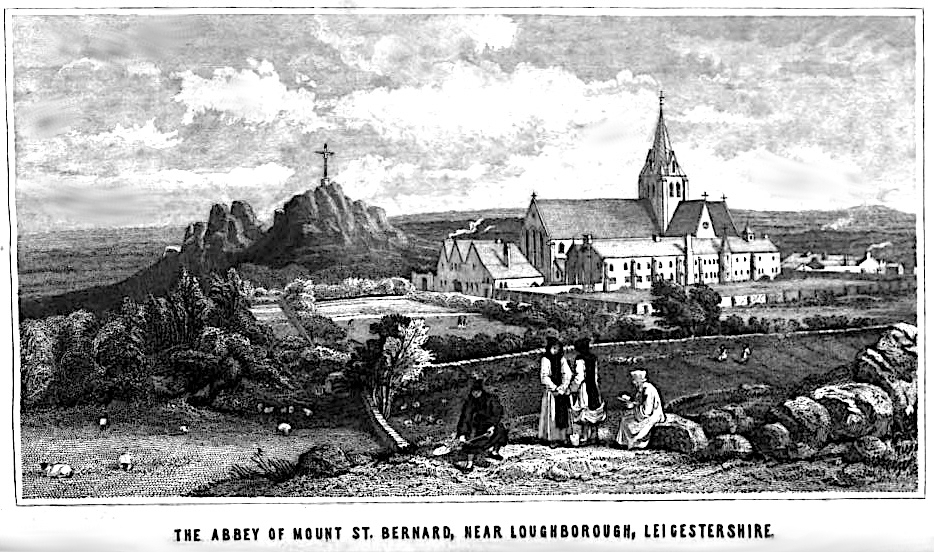
School buildings, shewing the "Old House" in the foreground. Source: Birt 183.
One of the best-known early Benedictine communities was the one that founded the monastery of Downside Abbey near Bath in Somerset. These were the monks of St Gregory the Great in Douai, a part of Northern France, who, as mentioned by Peter Anson above, had first been given shelter at Acton Burnell in Shropshire. Long ago, their community in Douai had given refuge to English Catholics after the Dissolution of the Monasteries, and they now left Douai and fled to England, around the same time as the Cistercians, and for the same reason — that is, oppression by the French during the period of revolution. Having settled eventually in Somerset, the Benedictines adapted an old manor for schoolrooms and chapel purposes here in 1823. The monastery itself was not completed (by the architectural partnership of Dunn and Hansom) until the 1870s, but after further work by Giles Gilbert Scott in the twentieth century it was given the accolade, by no less an architectural historian than Nicholas Pevsner, of being "the most splendid demonstration of the renaissance of Roman Catholicism in England" (70).
Ambrose de Lisle and the Cistercians in Leicestershire
After the Benedictines' move to Downside, the next significant development in the spread of monasteries was the founding of Mount Saint Bernard Abbey in 1835. Again, the inspiration came from the French. More specifically, the impetus came through Ambrose de Lisle, who was born into the Leicestershire gentry, but who was influenced in his schooldays by the Abbé Giraud, a French émigré priest. Despite family opposition, de Lisle later converted to Roman Catholicism, and met one of the Mellary monks who took refuge in Ireland after the July Revolution of 1830. He decided to buy an estate and present land near Whitwick in Leicestershire to the Cistercians for a new monastery. The 16th Earl of Shrewsbury, himself "the most prominent Catholic layman in England" (Hill 169), along with other donors, came forward with the necessary funds, and the great Gothic Revivalist architect A.W.N. Pugin designed the permanent buildings for the monastery free of charge. It was opened in 1844, and was raised to the status of an Abbey four years later, with Dom Bernard Palmer, another of the English monks who had been at both Lulworth and Melleray, as the Abbot. Dom Bernard was the first to hold such a position since the Reformation. Sealing the connection with France, in 1849 a papal brief united the abbey with the Cistercians in France (see "Post-Dissolution house...").
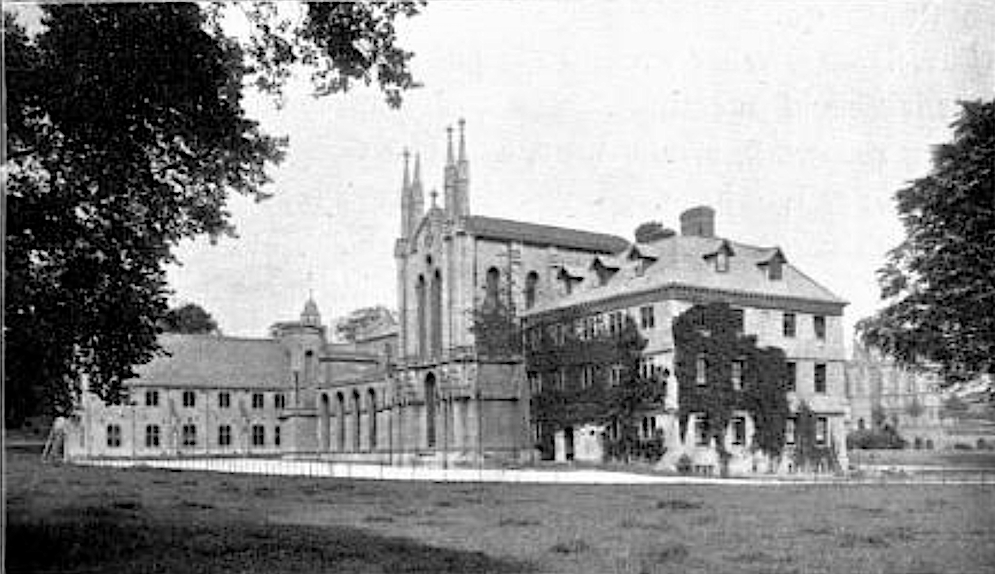
The Abbey of Mount St. Bernard, near Loughborough, Leicestershire. Source: "A Cistercian," frontispiece.
St Augustine's in Pugin-Land
Bearing in mind that the Benedictines' monastery at Downside had yet to be completed, when Pugin's eldest son Edward Welby Pugin built St Augustine's Monastery for them in the early 1860s, just over the road the family home, The Grange in Ramsgate, it could claim to be the country's first new Benedictine monastery. The younger Pugin used the same materials as those used for his father's church, just a little further down the road to The Grange: knapped flint with narrow stone bandings and stone dressings. The gabled dormers also resemble those of his father's St Edward's Presbytery, adjacent to the church. The flint wall along St Augustine's Road, with its brick banding, buttresses, and gabled gateway on St Augustine's Road, contributes to the sense of unity.

St Augustine's Abbey, Ramsgate. [Click on this image for more information.]
Although no longer use by Benedictine monks, the monastery stands as testimony to the faith of the Pugin family.
In the spate of Catholic church-building that followed Catholic Emancipation, more monasteries were built. One was the monastery (first a Priory, then an Abbey) at Erdington, taken over by the Benedictines in 1876, and now part of a private school; a later one, High Church Anglican at first, was Caldey Monastery, off the coast in Pembrokeshire, South Wales, now housing monks of the Reformed Cistercian Order.
New Sisterhoods
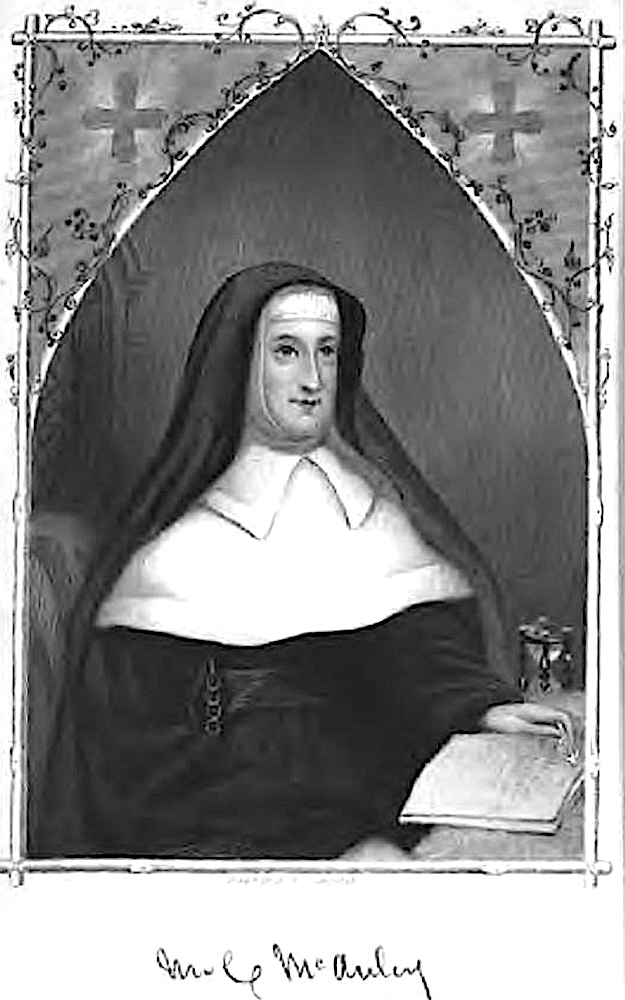
Catherine McAuley. Source: frontispiece to Carroll.
From around the end of the 1830s, convents had begin to appear in many localities. The first was built at Bermondsey in 1838, by Pugin again, this time for the Venerable Catherine McAuley, who came from Ireland and whose home-grown mission was to help the sick and needy in the London docklands. That convent was not very satisfactory: "The sleeping rooms are too large the other rooms too small, the corridors confined and not well lighted," complained McAuley (qtd. in Hill 229-30). Architecturally speaking, it was the larger ones at Mount Vernon in Liverpool (1841) and Derby Road, Nottingham (1844) that set the pattern for the future (see Brittain-Caitlin 5). These were Gothic Revival buildings that included a prominent chapel, a refectory and so on, set around a courtyard with roofed passages, with the individual bedrooms or "cells" upstairs. However, the Institute of Our Lady of Mercy at Bermondsey set the pattern in another way. Community outreach was an important aspect not only of the Sisters of Mercy, but of other new convents as well. The nuns often ran schools and other charitable operations like orphanages and facilities for "fallen women."
Religious Crosscurrents
These developments were not without some opposition. After the period of revolution abroad, and in an age of new religious controversy at home, such Catholic communities were not always welcome. That great reformer, the Seventh Earl of Shaftesbury, who had himself voted for Catholic emancipation in 1829, later founded an organisation that still exists today, called the Protestant Alliance. At that time, its avowed purpose was to "invite all Christians to resist the influence of Popery" ("The Protestant Alliance," 100). And Shaftesbury was far from alone in being wary of the influence of Catholicism. Scottish Protestants, upset by the incursion of Irish immigrants after the potato famine, were also involved in the Alliance, and many Victorians were uneasy about High Church practices, especially Ritualism, that suggested a drift back to Rome.
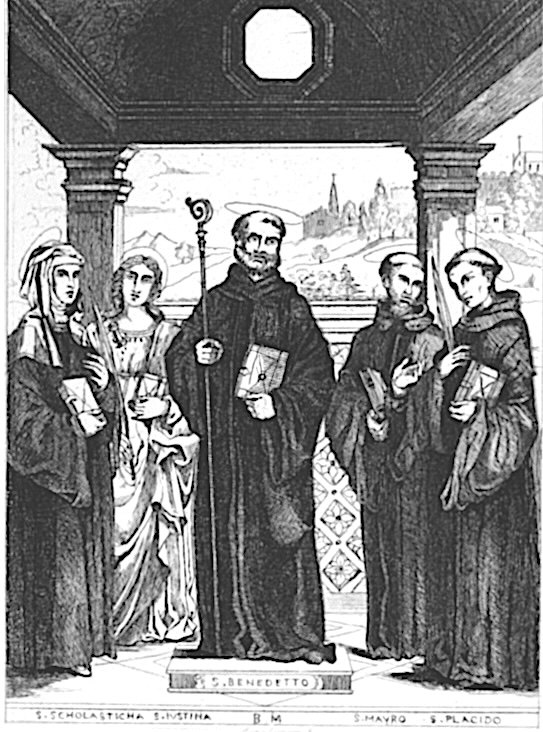
The Benedictine Saints: St Benedict, flanked by St Scholastica and St Justina on the left, and St Maurus and St Placido on the right. Etching after a design by Benedetto Montagna. Source: Jameson, facing p. 14.
Even the art historian Anna Jameson, who was evidently fascinated with monasticism, was at pains to dissociate herself from Catholicism when writing about it in Legends of the Monastic Orders as Represented in the Fine Arts (1850). Having stated categorically in her preface that she was not a Roman Catholic herself, she adds, "from the beginning to the end of this book there is not one word false to my own faith — my own feeling — so I truly hope there is not one word which can give offence to the earnest and devout reader of any persuasion" (xiv).
Nevertheless, Jameson's fascination with the medieval past was conveyed to her readers in numerous editions and reprints of the book, and tapped into the broader stream of the medieval revival. In general, "a distinct, if uneven, decline in anti-Catholicism" was occurring (Janes 354). Support for this view can be found in the poor attendance of Shaftesbury's Protestant Alliance meeting mentioned above, as well as the reviewer's criticism of him for meddling with "the religion of other people" (101). Indeed, it seemed that that the ascetic, cloistered life first encountered at Lulworth held an appeal even for some Anglicans.
Anglican Sisterhoods

Park Village West. [Click on this image for more information.]
Home-grown Anglican sisterhoods like McAuley's Catholic one began to appear in the 1840s, inspired largely by those drawn to High Church Tractarianism. The very first was established in the spring of 1845 at a steeply gabled Gothic-style house at Park Village West, a smart new development near Regent's Park in London. Today this has a blue plaque stating it was where "the first Religious Sisterhood in the Church of England since the Reformation" was founded. Local suspicions were confirmed when none other than Dr Pusey came to call, and it was Pusey who drew up the first guidance for the Sisterhood's practices in 1848, with much care and deliberation about what women might be expected to endure — right down to the details of their clothing and diet (see Trench 272). In 1854 the sisterhood would became a part of Lydia Sellon's Devonport Sisterhood, the new foundation then becoming the Society of the Most Holy Trinity. Sisters from these groups were active amongst the poor and needy, and some went out with Florence Nightingale to help nurse the casualties of the Crimean War. Other communities were established in Wantage, Oxfordshire, in 1848, and East Grinstead in 1855, and so on.
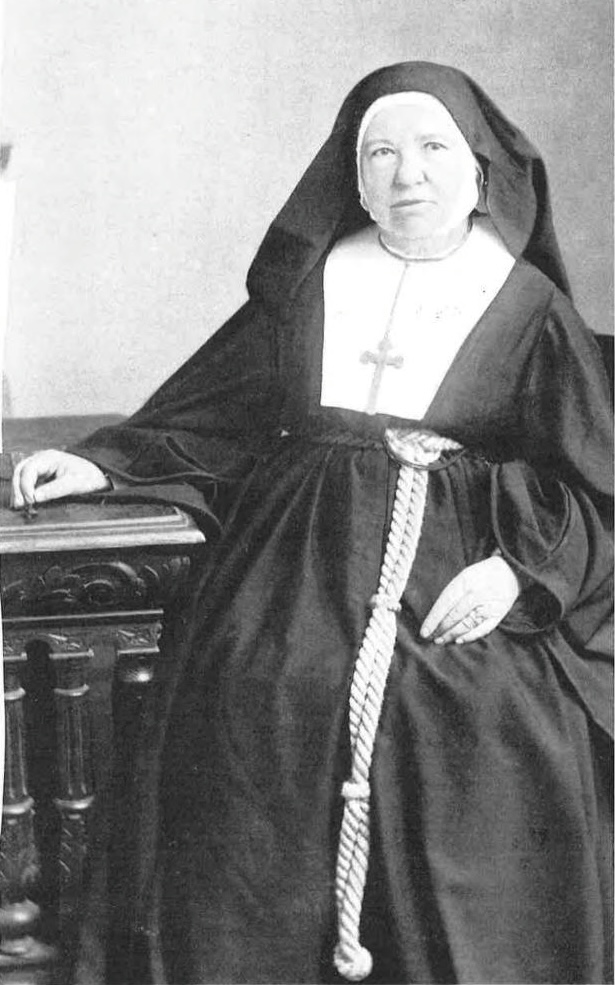
Elizabeth Neale, Mother Foundress. Source: Russell, facing p. 12.
There were also, rather confusingly, Anglican sisterhoods that adopted the Benedictine Rule. The first of these was the Community of the Holy Cross, founded in 1857 by Mother Elizabeth Neale, sister of another High Church Anglican, John Mason Neale. Like McAuley's, her first convent was in London's dockland, in fact only about a mile from Bermondsey in Wapping. There was plenty of good work to be done in this insalubrious area, and the sisterhood focused on this and other areas of special need for the next few decades, helping, for example, during the terrible cholera epidemic of 1866: "No one who has not seen it ... can imagine what such a visitation is like," wrote Elizabeth Neale.
it seems like a sheet of death let down on a district. Our work was among the people in their own homes, but ... I used daily to go into the three Cholera Hospitals to see any patients whom we had sent there, and into the Work-house.... We used daily to cook for and distribute food to numbers varying between 100 and 300, and one room in our house was given up as a refuge, to which the infants of those sick or dead of the cholera could immediately be brought. [qtd. in Russell 27]
However, once the motherhouse moved to Haywards Heath in Sussex in 1887, Anson explains, "the life became more enclosed and contemplative. Today this community, which observes the full Benedictine Rule, spends most of its time on the celebration of the Divine Office in choir" (268).
Other Anglican sisterhoods followed these pioneering communities. Susan Mumm makes the point that entering these sisterhoods could enlarge rather than narrow women's lives (although, clearly, the experience was hard won), and that "more than 10,000 had tried the life by the end of the century" (xii).
Perhaps few are now aware of this aspect of Victorian religious life, or of its varied manifestations. Yet the return of monasteries and convents to these shores was one of the features of the era, enhancing the spiritual life of individuals, making great contributions to many communities, and having an impact (hard to measure though that may be) on the culture of the whole country.
Associated Churches: A Note by Rev. Paul O'Connor
The continuing influence of monastic orders may also surprise many. In our own times, several churches are served from Douai: St Gregory in Stratford; Our Lady and St Joseph in Alcester; St Mary's in Studley, and (though part of the Clifton Diocese) Kemerton Church in Worcestershire. In Worcestershire, St Wulstan in Little Malvern is now served from Belmont Abbey but was previously a Downside parish, as was St Joseph's, Malvern, until passed to the Archdiocese about 35 years ago. Belmont now serves all the parishes in Herefordshire (Cardiff Archdiocese). St Mary's Abbey, Colwich is also Benedictine (now an American order). A number of the parishes in Staffordshire were once run by Benedictines (St Austin's, St Giles, and St Mary's, Leek), but these have been the responsibility of the Archdiocese for a long time now. The Church of St Thomas and St Edmund, Erdington, Birmingham, no longer served by the Benedictines, is now in a Redemptorist parish.
Bibliography
Anson, Peter F. Building up the Waste Places: The Revival of Monastic Life on Medieval Lines in the post-Reformation Church of England. Leighton Buzzard: The Faith Press, 1973.
Bell, David N. Strangers in a Strange Land: The Trappist Monastery of Saint Susan at Lulworth, Dorset, 1794-1817. Cistercian Studies, No.299. Collegeville, Minnesota: Liturgical Press, 2024.
Bellenger DA. "A Standing Miracle": La Trappe at Lulworth, 1794–1817. Studies in Church History. 22 (1985): 343-350. doi:10.1017/S0424208400008056
Birt, Henry Norbert. Downside: The History of St. Gregory's School from Its Commencement at Douay to the Present Time. London: K. Paul, Trench, Trübner & Co., 1902. Internet Archive, from a copy in the University of California Libraries. Web. 16 August 2026.
Brittain-Catlin, Timothy. 19th- and 20th-Century Convents and Monasteries: Introductions to Heritage Assets. Web. 15 August 2026. https://historicengland.org.uk/images-books/publications/iha-19-20-century-convents-monasteries/heag129-19and20c-convents-and-monasteries-iha/
Carroll, Austin. Life of Catherine McAuley: Foundress and First Superior of the Institute of Religious Sisters of Mercy. New York: D. & J. Sadlier, 1866. Internet Archive. Web. 19 August 2026.
A Cistercian Monk. A Concise History of the Cistercian Order: with the lives of SS. Robert, Alberric and Stephen; with its revival in England at St. Susan's, Lullworth and Mount St. Bernard, Leicestershire. London, Dublin and Derby: Thomas Richardson and Son, 1852. Internet Archive, from a copy in the University of California Library, Davis. Web. 16 August 2026.
Crawford, Joseph. "The Romantic Gothic Imagination." The Oxford Handbook of Victorian Medievalism, edited by Joanne Parker and Corrine Wagner. Oxford: Oxford University Press, 2020. 125-138.
Father Paul. "The Monks of La Trappe." The Gentleman's Magazine: and Historical Chronicle. Vol. LXXXIII (January-June 1813): 319-321. Google Books. Free to read. Web. 16 August 2026.
Hill, Rosemary. God's Architect: Pugin and the Building of Romantic Britain. London: Penguin, 2008.
"History of Downside Abbey." Downside Abbey. Web. 16 August 2026. https://www.downsideabbey.co.uk/benedictine-monastery/downside-abbey-church/history-of-downside/
"History of Mount St Bernard." https://www.mountsaintbernard.org/wp-content/uploads/2020/07/History-of-Mount-St-Bernard.pdf
Jameson, Anna. Legends of the monastic orders: as represented in the fine arts. Forming the second series of Sacred and legendary art. London: Longmans, Green, 1867. Internet Archive, from a copy in the Harold B. Lee Library, Brigham Young University. Web. 16 August 2026.
Janes, Dominic. "The Oxford Movement, Asceticism, and Sexual Desire." The Oxford Handbook of Victorian Medievalism, edited by Joanne Parker and Corrine Wagner. Oxford: Oxford University Press, 2020. 353-369.
Mumm, Susan. All Saints Sisters of the Poor: An Anglican Sisterhood in the Nineteenth Century. Woodbridge, Suffolk: Boydell, 2001.
P.F. Letter to the Editor. The Monthly Magazine Vol. 10, issue 64 (1 October 1800): 230-32. Internet Archive. Web. 16 August 2026.
Pevsner, Nikolaus. South and West Somerset. Harmondsworth: Penguin, 1958.
"Post-Dissolution House: Cistercian abbey of Mount Saint Bernard." A History of the County of Leicestershire. Vol. 2. Edited by W G Hoskins, R A McKinley (London, 1954), British History Online. Web. 13 August 2026. https://www.british-history.ac.uk/vch/leics/vol2/pp53-54
"The Protestant Alliance." The Saturday Review. Vol. 8 (23 July 1859): 100-01. Web. 19 August 2026.
Robinson, C.E. A Royal Warren, or Picturesque Rambles in the Isle of Purbeck. London: The Typographical Etching Co., 1882. Internet Archive, from a copy in Harvard University Library. Web. 16 August 2026.
Russell, Alan. Community of the Holy Cross, Haywards Heath: A Short History of Its Life and Work. Haywards Heath, Sussex: Holy Cross, 1957. Internet Archive, digitized by Richard Mammana, August 2022 and available on the Attribution-NonCommercial-NoDerivs 4.0 International Creative Commons License. Web. 19 August 2026.
Trench, Maria Marcia Fanny. The Story of Dr Pusey's Life. London and New York: Longmans, Green, 1900. Internet Archive, from a copy in the University of California Libraries. Web. 15 August 2026.
Young, Victoria M. "A.W.N. Pugin's Mount Saint Bernard Abbey: The International Character of England's Nineteenth-Century Monastic Revival." Nineteenth-Century Art Worldwide: A Journal of Nineteenth-Century Visual Culture. Vol I, 1 (Spring 2002). Web. 11 August 2026. https://19thc-artworldwide.org/spring02/
Created 20 August 2026