
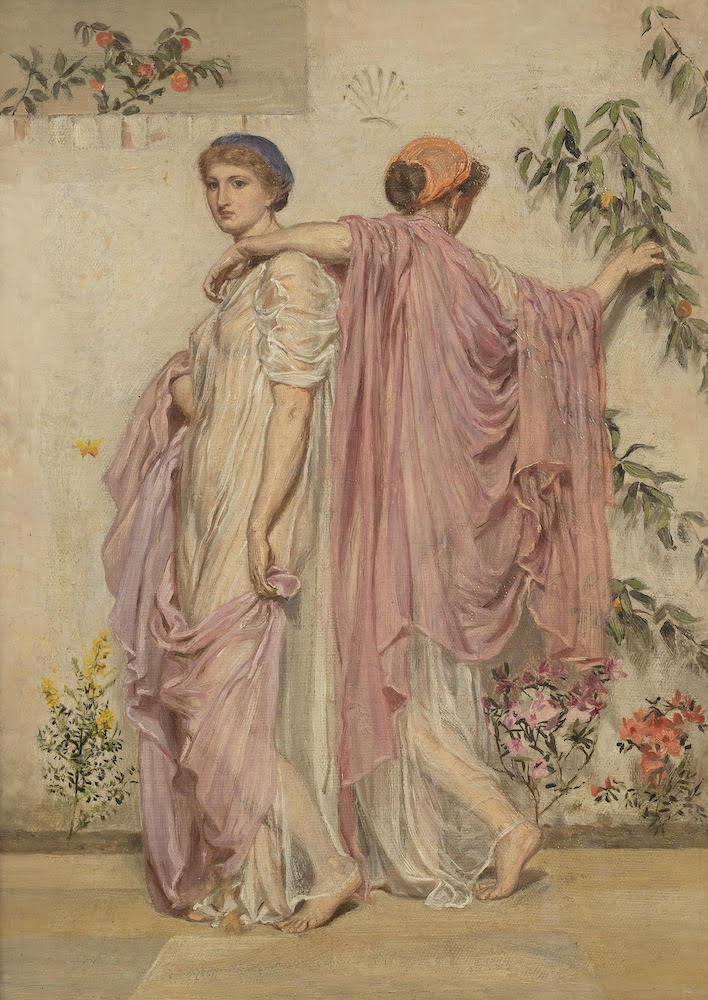
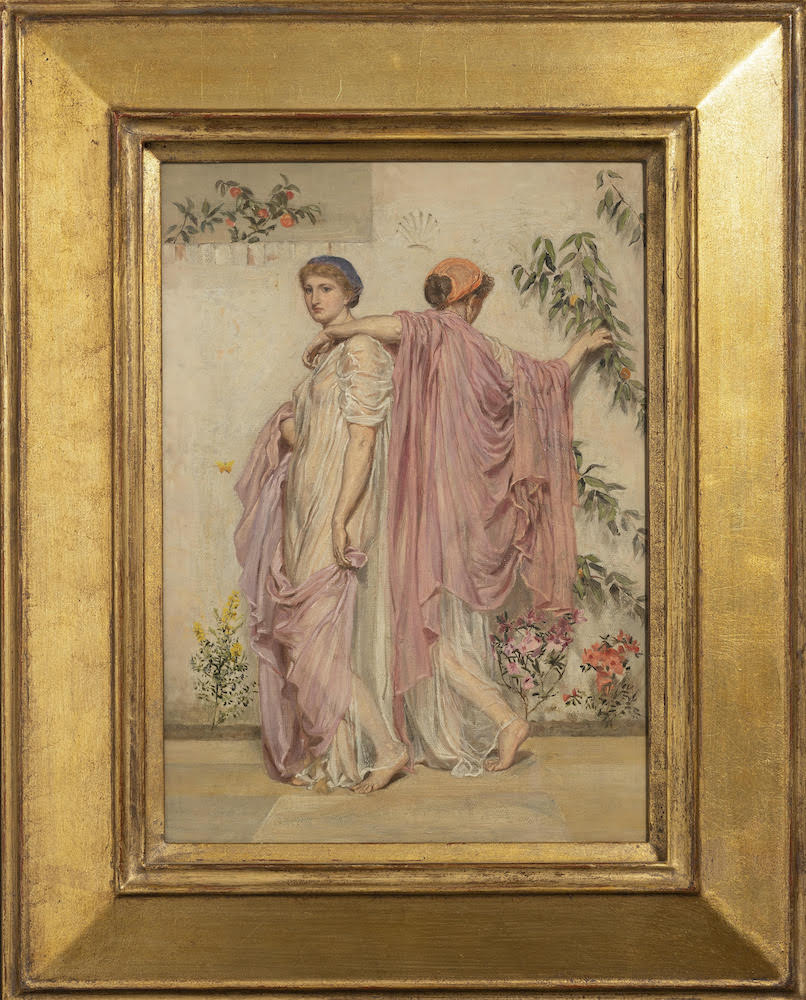
Apricots by Albert Joseph Moore, ARWS (1841-1893). 1866. Oil on canvas. 16 ¾ x 11 ¼ inches (42.5 x 28.5 cm). © Cecil French Bequest, London Borough of Hammersmith and Fulham. Photograph credit: Jaron James. Reproduced here by kind permission, for purposes of a review of Victorian Treasures from the Cecil French Bequest and Scott Thomas Buckle Collection (24 May-21 September 2025). [Click on the images to enlarge them.]
Moore exhibited Apricots at the Royal Academy in 1866, no.190. It features two young women in white semi-transparent classical garments with pink overmantels standing in a garden before a white wall. One woman looks outwards with downcast eyes while her companion is facing backwards, picking an apricot from a tree, with her left arm resting on her friend's left shoulder. The girl to the right wears an orange cap while her friend's is blue. In the flower bed in front of the wall to the right are two azalea shrubs, one pink and one coral coloured, while another shrub with yellow flowers is to the left. A yellow butterfly hovers to the left of the first woman. The title is based purely on the minor detail of the apricots in the picture. As Robyn Asleson has explained:
With Pomegranates and Apricots, Moore initiated his practice of employing titles that refer to natural objects within the painting. In truth, he disliked using titles at all, and informed one appalled patron that the picture he had commissioned had no name and he could call it whatever he liked…. The titles disassociate Moore's works from any nuance of sentimental or historical meaning, indicating that his paintings are no more "about" the women on whom we instinctively focus than the flowers and fruit we might otherwise have overlooked. [87]
Apricots is also the first oil painting Moore signed with his anthemion device as his signature. He had signed his gouache The Elements that he showed at the Dudley Gallery that same year in a similar fashion. As John Christian pointed out: "Even a signature can be turned to decorative account" (Beauty Never Fails, 51). Moore's use of the anthemion device preceded James Whistler's similar use of his famous butterfly signature. Interestingly a yellow butterfly hovers to the left of the first woman.
Contemporary Reviews of the Painting
The critic of The Art Journal felt Moore was uncertain in his aim for exhibiting such a work but the truth was, in fact, that it was the critic who just did not understand Moore's artistic intent:
Mr. Moore contributes two minor pieces, bearing the fancy titles, Apricots (190) and Pomegranates (194), which, as they are at any rate innocuous, have obtained good places. Perhaps such attempts to rehabilitate the antique should not receive discouragement. There is, at the present moment, room in our English school for such a line of subject. The French have several painters who with success reanimate classic life and manners. Apricots and Pomegranates then, may be accepted, because of an intent which points to the antique. The motive, however, is merely decorative; certainly the forms have little of the exactness and severity which are supposed to comport with classic times. Yet the Greeks and Romans were themselves many-sided in all things. But no young artist should indulge in an art uncertain in aim. Mr. A. Moore, if we mistake not, possesses powers which he should not squander. [164]
F.G. Stephens in The Athenaeum appreciated the elegance of Apricots' style and the originality of its colouring:
A few more figure-pictures remain to be noticed by us. Remarkable among these are three charming compositions by Mr. A. Moore, two of which deserve the highest commendations for the elegance of their style, the breadth and freedom of their designs, the singular knowledge of line they evince, and, notwithstanding a certain roughness, – that is far from being the result of ignorance or lack of purity of taste, – the real beauty and actual originality of their colouring. These are qualities that are hardly to be found, in an equal degree, in any works here of the same class. The uneducated eye would recognize in these pictures more than it already does but for the lamentable roughness of the pair to which we have referred…. The two former pictures are representatively styled Apricots (190) – two damsels before a sunny wall; one plucks fruit from a tree: a charming study in white and rose colour. The other picture is No.194, Pomegranates, – girls at a cupboard: a study of the most exquisite quality in red and white. Notice the mastery of form and the noble draperies in all these pictures. [742]
Bibliography
Apricots. Art UK. Web. 23 August 2026.
Asleson, Robyn. Albert Moore. London: Phaidon, 2000. 86-87.

Baldry, Alfred Lys. Albert Moore: His Life and Works. London: George Bell and Sons, 1894. 32-33.
Christian, John. Beauty Never Fails. London: Fulham Palace, 2008, cat. 37, 51.
Christian, John. Victorian Dreamers. Masterpieces of Neo-Classical and Aesthetic Movements in Britain. Tokyo; The Tokyo Shimbun, 1989, cat. 44, 125.
Green, Richard. Albert Moore and his Contemporaries. Newcastle Upon Tyne: Laing Art Gallery, 1972, cat. 11, 14.
Prettejohn, Elizabeth. Art for Art's Sake. Aestheticism in Victorian Painting. New Haven and London: Yale University Press, 2007. 107.
"The Royal Academy." The Art Journal New Series V (1 June 1866): 161-72.
Staley, Allen. "Albert Moore." The New Paintings of the 1860s. New Haven and London: Yale University Press, 2011. 130.
Stephens, Frederic George. "Fine Arts. Royal Academy." The AthenaeumNo. 2014 (2 June 1866): 742-43.
Created 3 June 2025
Last modified 23 August 2026