
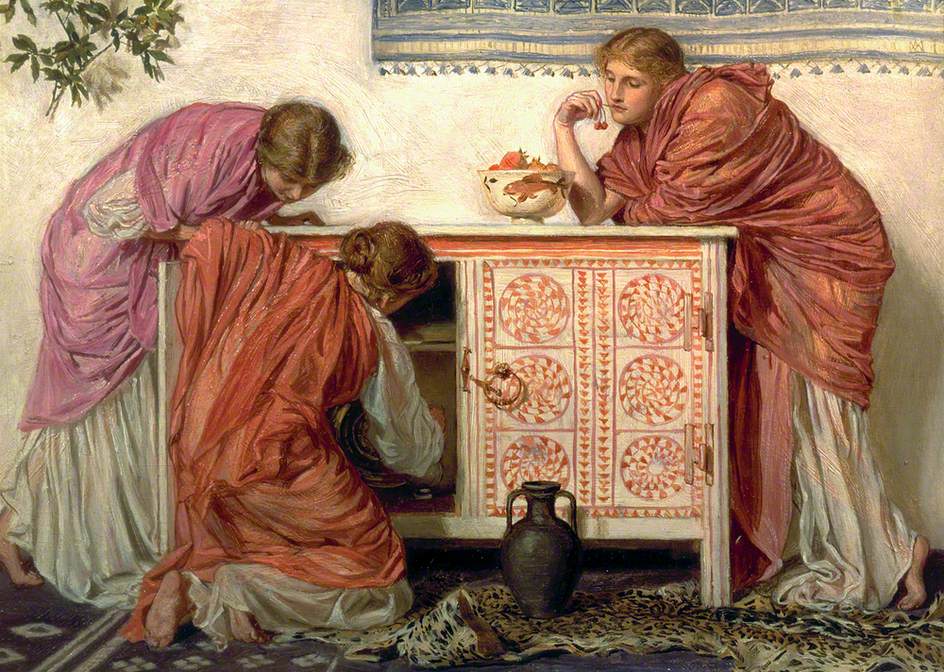
Pomegranates by Albert Joseph Moore, ARWS (1841-1893). 1866. Oil on canvas. 9 7/8 x 14 3/16 inches (25 x 36 cm.) Collection: Guildhall Art Gallery, accession no. 1512. Bequeathed by Cecil French, 1954. Image courtesy of the Guildhall Art Gallery under the terms of the Creative Commons Attribution-NonCommercial licence (CC BY-NC). [Click on the image to enlarge it.]
Pomegranates, surely one of the most beautiful and graceful paintings of Moore's entire career, was exhibited at the Royal Academy in 1866, no. 194. A harmony in orange, pink and white, it features three young women in white classical robes with pink or red overmantels gathered around an unusual cabinet. Two of the women are looking into its interior, one of whom is kneeling before its open door. The third is standing leaning on the cabinet and eating cherries. A bowl containing pomegranates with the Japanese decoration of a koi sits on the cabinet. The cabinet itself is white and ornamented with an intricate circular pattern in red and orange. In front of the cabinet is a leopard skin upon which sits a two-handled black jar. Pomegranates is a perfect fusion of the influences of Japanese and classical art. Robyn Asleson sees Moore beginning to utilize a more clearly articulated geometric scheme here, something that will become still more obvious in some of his later paintings (see Asleson 1999). Baldry too finds that the painting represents a great advance in Moore's work: "The painting of this work, the drawing and composition of the figures and draperies, the manner in which great difficulties of colour arrangement and juxtaposition are in it met and solved, are supremely skillful, and show what rapidity of development the capacities of the young artist were growing to maturity" (33).
Asleson's view of the progress demonstrated in Pomegranates is explained in detail here, with particular reference to the influence of Japanese art:
A more accurate assessment of the state of his art in 1866 is provided by the smaller pictures he exhibited at the Academy that year, Pomegranates and Apricots. Of the two, Pomegranates marks the most dramatic advance over the diffuse organization of The Shulamite and provides the clearest evidence of the systematic investigation of formal principles that Moore carried out during this period. The orange discs ornamenting the cabinet supply the key to the entire composition, which is built upon round forms and concentric curves. The most important of these are the curved backs of the two standing women, which generate a unifying, circular motion that enhances the picture's cohesion. The transitional nature of Pomegranates is confirmed by the combination of familiar props (such as the mosaic floor, leopard skin and wall hanging employed previously in Dancing Girl Resting) with allusions to Japanese art, which according to Baldry ranked alongside Greek art as a seminal influence on Moore's evolving formal system. Not only is a scene reminiscent of an ukiiyo-i print, but the carp bowl, the radically truncated wall hanging, the suspended spray of foliage and the ornamentation of the cabinet all imitate Japanese artefacts and pictorial conventions. Moore also emulated the precise mapping of shapes and colours by Japanese artists, ensuring that areas of whiteness balance darker areas, and that the various pigments fall into harmonious relationships. The unmodulated contrast between the vibrant orange and pink drapery, and the stark white backdrop emphasizes the silhouettes of the figures, which read as two-dimensional shapes. The artist's instinctive minimization of spatial depth and chiaroscuro attain greater clarity here from the examples of Japanese art. [Asleson 2000, 85-86]
The decorative features included in the painting appealed to Allen Staley, who shows how they combine to make a successful decorative ensemble:
Moore's repeated circular designs decorating his cabinet may have been conceived to resemble the geometric patterns on early Greek vase painting, but they also recall the circular whorls or cartwheel patterns, that decorate the furniture in many of Rossetti's watercolors, including The Blue Closet, and decorate some of his and William Morris's actual painted furniture. Despite the inventive elaboration of the furniture in The Blue Closet, and despite the absence of recognizable subject, Rossetti's furniture is less important than the figures who make use of it. In Pomegranates the relationship, if not reversed, is more balanced. The painting is as much a portrayal of things as it is of people, and it is not really about people or things, but about itself. Everything in it is integrated into a decorative whole to which shapes, colors, patterns, and the texture of paint contribute more significantly than the figures and objects they are employed to describe. [129]
John Christian has pointed out that Pomegranates may have inspired James Whistler's later painting Three Figures: Pink and Grey of c.1868-78: "Not only are the figures arranged similarly but several compositional motifs, such as a horizontal band across the top of the picture (a device borrowed from Japanese prints), are repeated" (126).
Contemporary Reviews of the Painting
W.M. Rossetti in The Spectator rightly recognized the beauty and grace of this work: "Yet even from nature, he could scarcely learn more consummate grace than that of his little picture fancifully called Pomegranates (194)" (579) The reviewer for The Art Journal obviously had no concept of Moore's intention in exhibiting this painting, likely being unaware of the Théophile Gautier's concept of l'art pour l'art [art for art's sake]:
Mr. Moore contributes two minor pieces, bearing the fancy titles, Apricots (190) and Pomegranates (194), which, as they are at any rate innocuous, have obtained good places. Perhaps such attempts to rehabilitate the antique should not receive discouragement. There is, at the present moment, room in our English school for such a line of subject. The French have several painters who with success reanimate classic life and manners. Apricots and Pomegranates then, may be accepted, because of an intent which points to the antique. The motive, however, is merely decorative; certainly the forms have little of the exactness and severity which are supposed to comport with classic times. Yet the Greeks and Romans were themselves many-sided in all things. But no young artist should indulge in an art uncertain in aim. Mr. A. Moore, if we mistake not, possesses powers which he should not squander" (164).
F. G. Stephens in The Athenaeum praised this charming composition with its exquisite colour harmonies:
A few more figure-pictures remain to be noticed by us. Remarkable among these are three charming compositions by Mr. A. Moore, two of which deserve the highest commendations for the elegance of their style, the breadth and freedom of their designs, the singular knowledge of line they evince, and, notwithstanding a certain roughness, – that is far from being the result of ignorance or lack of purity of taste, – the real beauty and actual originality of their colouring. These are qualities that are hardly to be found, in an equal degree, in any works here of the same class. The uneducated eye would recognize in these pictures more than it already does but for the lamentable roughness of the pair to which we have referred…. The two former pictures are representatively styled Apricots (190) – two damsels before a sunny wall; one plucks fruit from a tree: a charming study in white and rose colour. The other picture is No.194, Pomegranates, – girls at a cupboard: a study of the most exquisite quality in red and white. Notice the mastery of form and the noble draperies in all these pictures. [742]
Related Material
Bibliography
Asleson, Robyn. Albert Moore. London: Phaidon, 2000. 85-87.
Asleson, Robyn. "Nature and abstraction in the aesthetic development of Albert Moore." In After the Pre-Raphaelites. Edited by Elizabeth Prettejohn. Manchester: Manchester University Press, 1999. 115-34.
Baldry, Alfred Lys. Albert Moore: His Life and Works. London: George Bell and Sons, 1894. 32-33.
Christian, John. Victorian Dreamers. Masterpieces of Neo-Classical and Aesthetic Movements in Britain. Tokyo: The Tokyo Shimbun, 1989, cat. 45, 125-26.

Green, Richard. Albert Moore and his Contemporaries. Newcastle Upon Tyne: Laing Art Gallery, 1972, cat. 12, 14.
Pomegranates. Art UK. Web. 23 August 2026.
Prettejohn, Elizabeth. Art for Art's Sake. Aestheticism in Victorian Painting. New Haven and London: Yale University Press, 2007. 107, 116.
Rossetti, William Michael. "Art. The Royal Academy." The Spectator XXIX (26 May 1866): 578-79.
"The Royal Academy." The Art Journal New Series V (1 June 1866): 161-72.
Spencer, Robin. The Aesthetic Movement: Theory and Practice. London: Studio Vista, 1972. 34.
Staley, Allen. "Albert Moore." The New Paintings of the 1860s. New Haven and London: Yale University Press, 2011. 128-30.
Stephens, Frederic George. "Fine Arts. Royal Academy." The Athenaeum No. 2014 (2 June 1866): 742-43.
Created 12 February 2015
Last modified 23 August 2026