
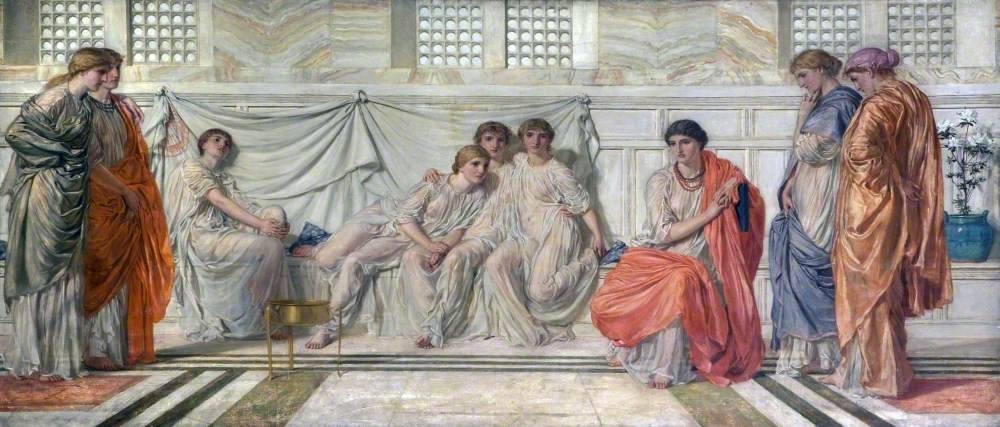
The Shulamite by Albert Joseph Moore, ARWS (1841-1893). 1864-66. Oil on canvas. 38 3/16 x 84 1/4 inches (97 x 214 cm). Collection of the Walker Art Gallery, Liverpool, accession no. WAG 2904. Image via Art UK courtesy of the Walker Art Gallery, under the terms of the Creative Commons Attribution-NonCommercial licence (CC BY-NC). [Click on this and the image below for larger pictures.]
Moore exhibited The Shulamite [The Shulamite relating the Glories of King Solomon to her Maidens] at the Royal Academy in 1866, no. 354. It was accompanied in the exhibition catalogue by these lines from the Song of Solomon, Chapter V, verses 10 and 11. "My beloved is white and ruddy, the chiefest among ten thousand, His head is as the most fine gold, his locks are bushy, and black as a raven." The Shulamite featured in the painting was a woman from Shulem [Shunem], a small village located in the Jezreel Valley, north of Mount Gilboa. She was the female protagonist in the Song of Songs, also known as the Song of Solomon, an erotic biblical poem celebrating human love. The name "Shulamite" is derived from VI, 13: "Return, return, O Shulamite; return, return, that we may look upon thee." Gregory Hedberg states that the Shulamite was widely identified with Abishag, the beautiful Shunammite who was brought to King David in his old age (140). The Shulamite differs fundamentally from Moore's other early religious paintings in that it does not illustrate a specific event that is described in the Bible but "the groupings of the figures and their draperies reflect Moore's study of the Elgin marbles in the British Museum, rather than any literary description" (Hedberg 140).
This is not only the largest painting Moore had executed to this point, but also the last of the biblical pictures he exhibited early on at the Royal Academy. Despite being a biblical subject, the nine women are dressed in the classical robes of Ancient Greece. A group of four attendants are standing, while another four are seated on a marble bench. They are grouped around the Shulamite, who is seated, her hands clasped together, and wearing a rose overmantle around her semi-translucent white garment. The palette is largely a monochromatic silver colour except for accents of rose, orange, green and blue-grey in the outfits of the figures. Behind the women is a white marble wall partially covered with looped-up white drapery. The background, above the panelling, is of white marble with pale orange and green veins running through it. In the foreground the floor is again white marble with green lines and orange squares. In the midground at the extreme right is a blue pot with a flowering white azalea shrub.
Robyn Asleson has interpreted the scene:
Eschewing the drama and emotion of his earlier Old Testament scenes, Moore adapted a passage from the Song of Solomon in which the lovesick bride catalogues the attributes of her absent loved one. Sumptuous in imagery and amorous in tone, these verses enjoyed considerable vogue in the 1860s among artists like Moore who were increasingly engaged by beauty and mood at the expense of action and emotion. Moore suggested the impact of her words on a listening audience…. As the bride speaks, her spellbound maidens unconsciously embrace and hold hands. Their instinctive response to beauty is physical intimacy and affection. The resulting figural group conveys a mood of pleasurable, passive response (81).
There is a preparatory watercolour study for Moore's The Shulamite in the collection of the Walker Art Gallery, Liverpool:
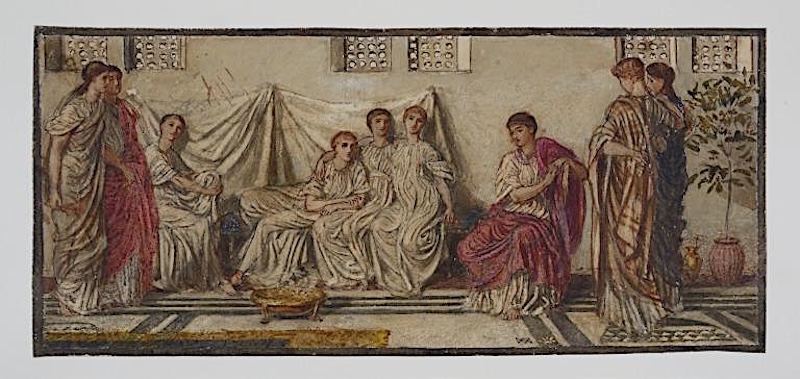
Study for "The Shulamite." 1864-66. Pen and ink and watercolour on card. 6 1/4 x 13 3/4 inches (16 x 35 cm) – sheet size. Collection of the Walker Art Gallery, Liverpool, accession no. WAG 10554. Image courtesy of the Walker Art Gallery, reproduced for purposes of non-commercial academic research.
In the study, the figural groups are more compressed and the poses of some of the women, particularly the standing figures, are somewhat altered. The mosaic floor is also treated in a slightly more elaborate manner. There are four figure studies for the composition in the Victoria and Albert Museum and at least two drawings in private collections, one in Canada and one in the United States.
Contemporary Reviews of the Painting
A critic for The Art Journal found it had nothing to recommend it:
Mr. A. Moore last year, even by his eccentricities, excited curiosity, and raised expectations not wholly unfavourable. Elijah's Sacrifice, however, scarcely prepared us to expect anything quite so exceptional and abnormal as the artist's latest manifesto, The Shulamite (354). We frankly admit that we do not know what the hangers could do, save what they have done – place this picture out of the way over the door. The work has no beauty or charm to recommend its singularity. The heads are without variety; the drapery repeats itself; and there is not the slightest approach to composition or concentration, either in the forms, colours, light, or shade. [164]
F.G. Stephens in The Athenaeum admired the picture except for what he considered its eccentric style: "The last named is The Shulamite (No. 354), here placed above the door to the North Room, – a subject from 'The Song of Solomon,' painted with great ability in the disposition of drapery, colour, and tone; withal in so novel a style that the artist must expect some time to pass before it is popularly mastered " (742). The Illustrated London News merely mentioned: "three pictures (of which No. 354 is the largest) by A. Moore; possessing much and original, though peculiar, merit, founded evidently on study of antique statues and bassi-relievi" (498). W.M. Rossetti in The Spectator praised the picture, although wondering quite rightly why women from biblical times were clad in the fabrics of ancient Greece: "Mr. A Moore finds food congenial to his sense of beauty and grace in the study of the queenly forms and flowing draperies of the later Greek art. Why he should illustrate the Song of Solomon with ladies barely clad, in the Coa vestis is neither here nor there. The picture shows a rare power of composition and a sense of beauty which the artist will probably someday cultivate at the fountain head" (579).
J.B. Atkinson in the Fine Arts Quarterly Review compared this work to a Pompeian wall fresco, although this was much more true of Moore's gouache The Elements that he exhibited that same year at the Dudley Gallery:
We are at a loss to know what Mr. A. Moore means by The Shulamite. He would seem to have aimed at a revival of Greek or rather Roman style, displayed in such works as the Aldobrandini Marriage, and the mural paintings of Pompeii. Hence it can scarcely be tested by modern standards. We cannot admit, however, that the picture is good of its kind. Panoramic composition, evenly diffused light, and a certain chalkiness of colour, might indeed be sanctioned in Pompeian decorations. Examination, however, shows that the mannerism rather than the merit of the originals has been caught. The composition is not well managed; it is loose and out of balance, the forms suffer from repetition, and the drapery is unfortunately not cast like the best Grecian style, but after the manner of the corrupt Roman. Mr. Moore, however, need not be discouraged, even by the treatment of the hangers. The newly opened mine he attempts to work is rich; the sphere in which he labours is scarcely preoccupied; and the success which may be attained has been already proved in pictures by Gêrome and other French artists. [347]
Bibliography
Atkinson, J. Beavington. "Exhibitions of the Year." Fine Arts Quarterly Review I (1 October 1866): 343-74.
Asleson, Robyn. Albert Moore. London: Phaidon, 2000. 81-86.
Baldry, Alfred Lys. Albert Moore: His Life and Works. London: George Bell and Sons, 1894. 30 & 32.
"Fine Arts. Exhibition of the Royal Academy." The Illustrated London News XLVII (19 May 1866): 496-98.
Green, Richard. Albert Moore and his Contemporaries. Newcastle Upon Tyne: Laing Art Gallery, 1972, cat. 13, 14.
Hedberg, Gregory. "Albert Moore." The Victorian High Renaissance. London: Lund Humphries, 1978, cat. 70, 140-41.
Prettejohn, Elizabeth. Art for Art's Sake. Aestheticism in Victorian Painting. New Haven and London: Yale University Press, 2007. 105-07.
Rossetti, William Michael. "Art. The Royal Academy." The Spectator XXIX (26 May 1866): 578-79.
"The Royal Academy." The Art Journal New Series V (1 June 1866): 161-72.
The Shulamite. Art UK. Web. 22 August 2026.
Staley, Allen. "Albert Moore." The New Paintings of the 1860s. New Haven and London: Yale University Press, 2011. 124, 130.
Study for "The Shulamite". National Museums Liverpool. Web. 22 August 2026.
Stephens, Frederic George. "Fine Arts. Royal Academy." The Athenaeum No. 2014 (2 June 1866): 742-43.
Created 22 August 2026