
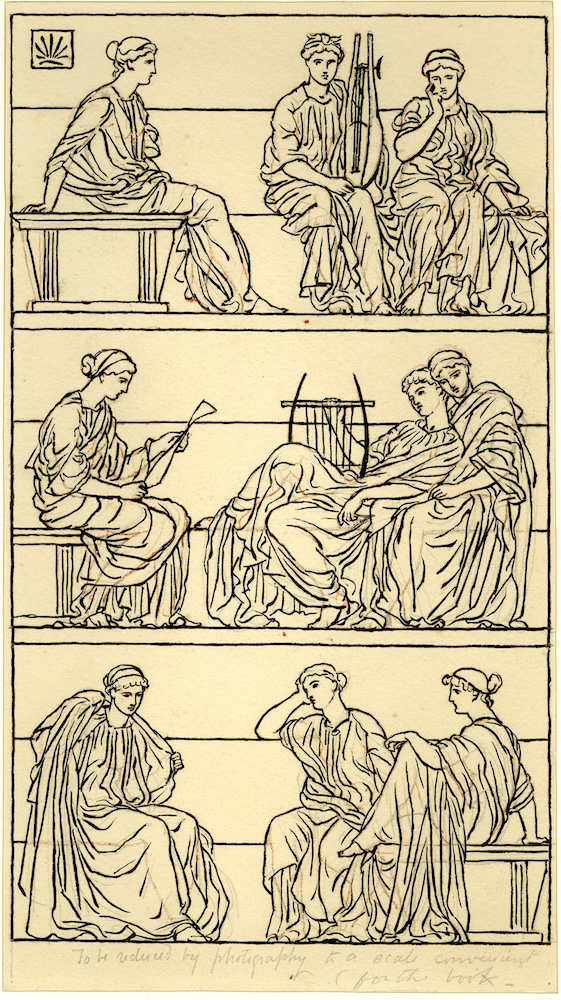
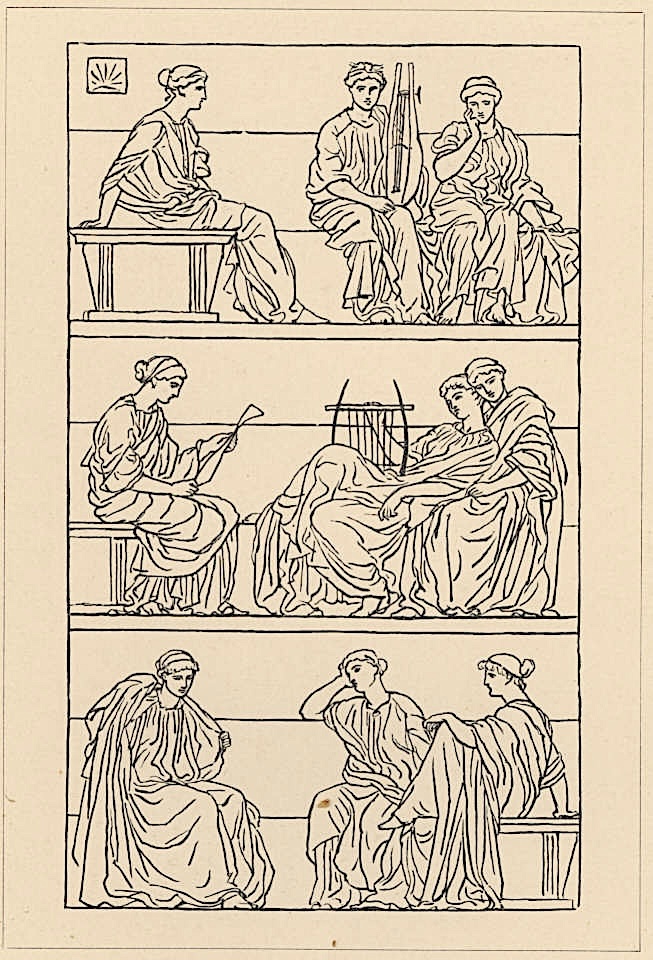
The Muses, by Albert Joseph Moore, ARWS (1841-1893). Left: The Muses. Brush drawing in black ink, over graphite and red chalk. 16 x 7 1/8 inches (31.8 x 18.1 cm). Collection of the British Museum, asset no. 312394001. Image © The Trustees of the British Museum, shared under a Creative Commons Attribution-NonCommercial-ShareAlike 4.0 International (CC BY-NC-SA 4.0) licence. Right: The Muses. Wood engraving on paper; dimensions unknown. Image courtesy of the University of South Carolina Irvin Department of Rare Books, Columbia, SC.
The Muses is a study for an illustration to John Milton's Ode on the Morning of Christ's Nativity. Illustrated by Eminent Artists, published in London by James Nisbet and Co. in 1868. The study features decorative panels of contemplative female figures, representing the nine Muses, in three compartments. In Greek mythology, the Muses are the nine sister goddesses representing science, literature and the liberal arts. Some of the figures represented play ancient musical instruments like the lyre, while in the central panel one figure holds a scroll she is reading. Originally, the muses were likely the patron goddesses of poets. This print was intended to represent these lines from Milton's poem:
"And with your ninefold harmony
Make up full consort to the angelick symphony"
A curator from the British Museum has pointed out the strong resemblance between the two muses at the right of the centre compartment to a group of figures from the east pediment of the Parthenon. The general arrangement of figures in this central panel, particularly the two to the right, formed the basis for the composition of Moore's painting A Musician of c.1867.
Forrest Reid, in his ground-breaking publication Illustrators of the Sixties, did not rate these illustrations highly, and believed that it was only Moore's eminence as a painter that gave them any interest at all: "For though these outlined classical figures are characteristic in grouping and type, they are too slight, too empty of content, to be of much intrinsic importance. They are not in the least in the tradition of the sixties; in fact, they can hardly be called illustrations at all. They are decorations" (204).
Related Material
Bibliography
Asleson, Robyn. Albert Moore. London: Phaidon, 2000. 94.
Reid, Forrest. Illustrators of the Sixties. London: Faber & Gwyer Ltd., 1928. 204.
Created 9 October 2026