
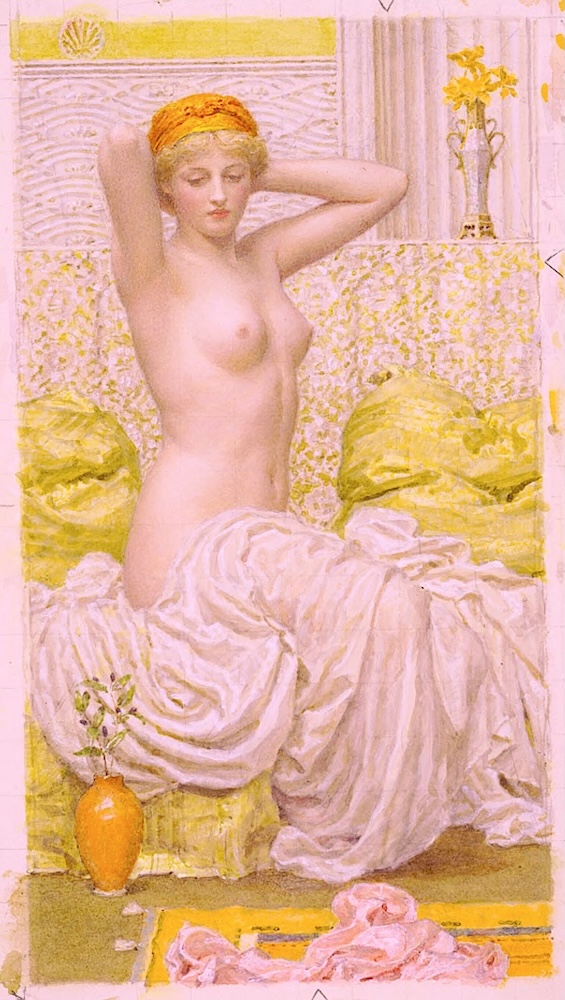
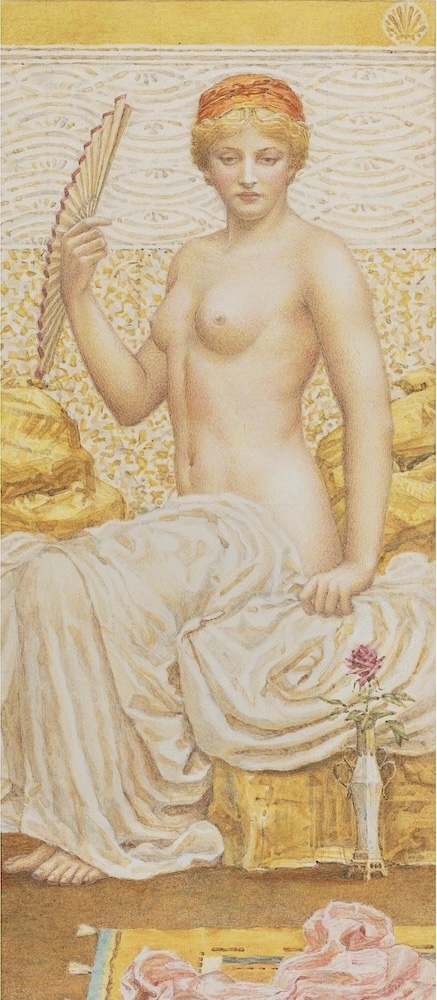
Left: Myrtle, by Albert Joseph Moore, ARWS (1841-1893). 1886. Watercolour and gouache over graphite. 13 1/16 x 7 11/16 inches (33.2 x 19.5 cm). Collection of the Fogg Museum, Harvard Art Museums, object no. 1943.909. Image courtesy of Harvard Art Museums/Fogg Museum. Right: The Toilette. Watercolour on paper. 12 x 5 ½ inches (30.5 x 14 cm). Private collection. Image courtesy of Sotheby's.
Moore exhibited another variant of the same composition seen in Silver and The Toilette at the Society of Painters in Water Colours in 1886, entitled The Myrtle, no. 238. It is similar in its composition to The Toilette in the Tate Britain, but it is more vivid in its colour scheme and the figure is nude from the waist up rather than being lightly draped in a semitransparent silk fabric. In Myrtle the model's hair is blonde, while it is brown in The Toilette. Their compositions differ in many details, such as accessories, the colours chosen for the fabrics on the sofas and pillows, and how the wall in the background is treated. In Myrtle, for instance, a vase of yellow flowers is seen in a niche in the upper right. In The Toilette the vase at the lower left of the composition is an olive-green colour, whereas it is orange in Myrtle and contains a sprig of myrtle that has given the watercolour its title. Both the floor and the rugs on the floor are also different in the two versions.
Another even more startling variation on this same theme, again entitled The Toilette, sold at Sotheby's, New York, in 2009. In this version the model is again nude from the waist up but is looking straight ahead, and instead of binding an orange ribbon around her head, she is holding a fan in her right hand while her left arm rests straight downwards on the sofa. The colour schemes are again slightly different and the vase seen in the niche in the upper right in Myrtle is now seen on the floor to the right and contains a single red flower.
Contemporary Reviews of Myrtle
Frederick Wedmore in The Academy was high indeed in his praise of this picture:
For Mr. Albert Moore, the chosen hour, the chosen form, the chosen light, the chosen accessory. Myrtle is what he calls his drawing. The composition is akin to that of the picture [Silver] which gleams upon us in the fourth room of the Royal Academy; the pose of the single model is almost the same; but the part of the drapery vouchsafed at the Royal Academy is withheld in Pall Mall, and the whole scheme of colour is different in the two places. It has now become one of the common-places of criticism to lament Mr. Moore's paucity of visible theme. It would seem to me better, however, if greater recognition were accorded to the skill with which he subtly varies his decorative schemes, to the disposition of his figures, to the choice and graduation of his hues. Myrtle – not withstanding anything it may contain to annoy us – is the finest work that has been wrought in watercolour by a unique artist. For myself therefore, I thankfully accept its grace and subtlety, the exquisiteness of its modelling of the torso – in water-colour an unusual feat – and the delicate modulation of its tints and hues" [404].
A critic from The Art Journal found this watercolour charming: "One of the best drawings is Mr. Albert Moore's Myrtle, an unusually favourable example of his powers – a colour and line harmony characteristically charming" (223). F.G. Stephens in The Athenaeum spent more time reviewing this watercolour than he did the related oil painting Silver at the Royal Academy:
The Myrtle (238) of Mr. A. Moore has a distinct relationship to his picture of a Greek virgin which is at the Royal Academy and called Silver, No. 372. Here the damsel, who is naked to the hips, sits upright on a couch and binds an orange kerchief about her fair hair; her lower limbs are covered by loose white drapery, and the couch is of yellow citron colour. This combination of colours is not unusual in the art of the painter, who has treated it and all the other elements of this picture with a degree of care and self-respect his works of recent years have not encouraged us to expect from him. It is an exercise in the carnations, yellow, and white. The torso, the treatment of which shows the artist has reverted to his older studies, has been drawn and modelled with much skill and exemplary taste; the grace of the action and the flower-like head are first rate. The thighs are too short, and the legs cannot be understood because the draperies are not allowed to show what they clothe. The colour of the flesh has been well studied. A quasi-classic character expresses itself, as in all Mr. Moore's productions, in the type chosen for the figure, its illumination, contours, expression, and costume. It is to be hoped he has resolved to abandon the slovenly style of his recent draftsmanship; such disproportions, careless drawing, and mannered work as he has indulged in of late are unworthy of his powers. His productions of the season, whether they are here, at the Academy, or at the Grosvenor Gallery, are of a quality which seems to encourage the hope that he will escape at last from a very undesirable technical position [623].
The Artist gave Moore first place amongst the painters chiefly concerned with decorative art:
Pre-eminent among those that have been designed in accordance with the principles of classic or decorative art is Mr. Albert Moore's Myrtle, a study of a female figure, semi-nude, and seated in an attitude of studied grace. This drawing is yet another exposition of the theories to which the artist has, during many years, consistently sought to give expression. To him beauty of line and colour is the worthiest aim of the painter, and in his pursuit of this aim he has steadily lavished personal gifts, and a technical capacity such as few others can boast. His artistic zeal and his executive powers are in the Myrtle sufficiently apparent, but we may better appreciate their significance if we compare with this work the feebly incapable Pomegranates of Mr. Radford [Edward Radford] or the well-meaning but undisciplined prettiness of Miss Phillott [Constance Philott]. [181]
Bibliography
19th Century European Art including Orientalist Paintings, Drawings and Sculpture. New York: Sotheby's (24 April 2009): lot 44. https://www.sothebys.com/en/auctions/ecatalogue/2009/19th-century-european-art-including-orientalist-paintings-drawings-sculpture-n08542/lot.44.html
Asleson, Robyn. Albert Moore. London: Phaidon, 2000. 226n.173 and 228n.36.
Asleson, Robyn. In A Private Passion: 19th-Century Paintings and Drawings from the Grenville L. Winthrop Collection, Harvard University. Ed. Stephan Wolohojian. New Haven: Yale University Press, 2003, cat. 180, 404-05.
Baldry, Alfred Lys. Albert Moore. His Life and Works. London: George Bell and Sons, 1893. 60.
"Exhibitions. Royal Society of Painters in Water Colours." The Artist VII (1 June 1886): 180-81.
Newall, Christopher. Victorian Watercolours. London: Phaidon, 1987. 106.
Paintings and Drawings of the Pre-Raphaelites and their Circle. Cambridge MA: Fogg Art Museum, 1946), cat. 62, 69.
Stephens, Frederic George. "Fine Arts. The Society of Painters in Water Colours." The Athenaeum No. 3054 (8 May 1886): 622-23.
"Summer Exhibitions." The Art Journal XLVIII (July 1886): 223.
Wedmore, Frederick. "The Royal Society of Painters in Water-Colours", The Academy XXIX (5 June 5 1886): 404.
Created 9 October 2026