
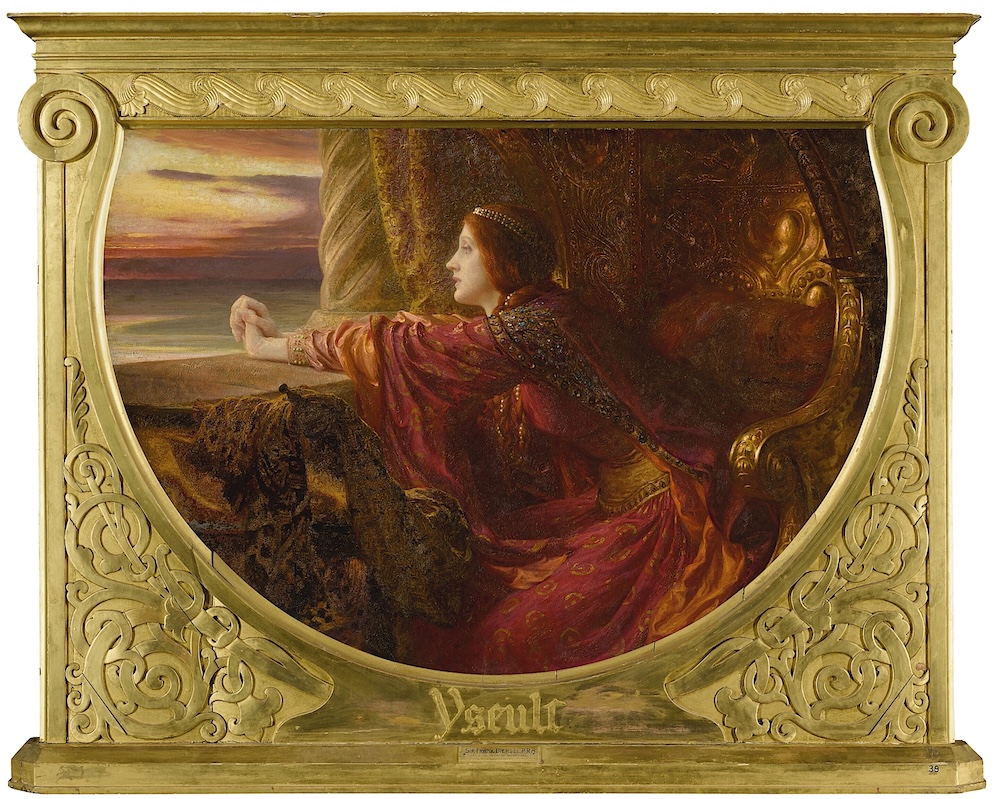
Yseult, by Sir Frank Dicksee (1853–1928). 1901. Oil on canvas. 41 x 60 1/4 inches (104.1 x 153 cm). Private collection, image courtesy of Sotheby's. [Cick on this image and the one below to enlarge them.]
The oil version of Yseult was shown at the Royal Academy in 1901, no. 52, and then later that same year at the Liverpool Autumn Exhibition. A watercolour version, which Dicksee titled Iseult, is in the collection of the Leighton House Museum:
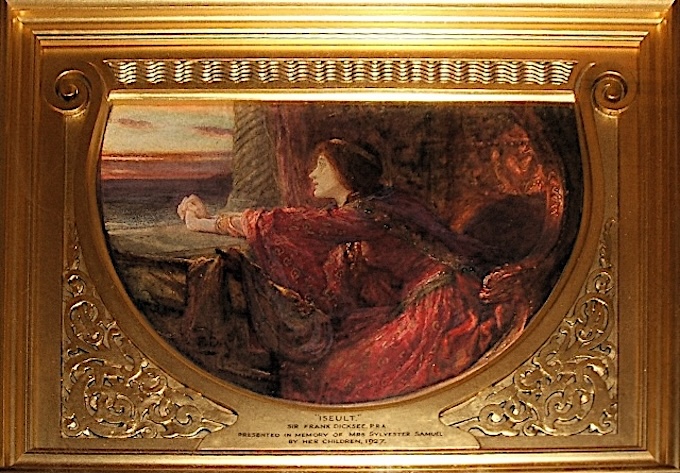
Iseult. 1901. Watercolour and gouache, heightened with white. 9 7/8 x 13 inches (25 x 33 cm). Collection of Leighton House, accession no. LH0159. Image courtesy of Leighton House, the Royal Borough of Kensington and Chelsea, via Creative Commons.
Yseult shows a beautiful red-haired young woman, an anxious expression on her face and her hands clasped together and resting on a stone parapet, gazing out to sea. She is clad in a crimson dress and a cloak encrusted with gemstones. A circlet of pearls is around her head. She is seated at her balcony on a gilded throne. The model for Yseult may be the red-haired Rachel Lee who is known to have posed for other paintings by Dicksee. The subject of the painting had been inspired by one of the drawing exercises at the Langham Sketching Club when the theme chosen had been Evening. The pose of Yseult was based upon that of the dying daughter in Dicksee's earlier painting The Confession of 1896. The elaborate gilt frame in the shape of a Celtic lyre was designed by Dicksee. The decoration in the spandrels was inspired by Viking strap-work.
The subject of this painting was derived from Sir Thomas Malory's Le Morte d'Arthur. Yseult depicts the daughter of King Hoel of Brittany, Princess Yseult of the White Hands, the wife of Sir Tristram. Seated at an open balcony off her bedchamber in a great palace built into the cliff at the side of the ocean, the princess searches the horizon for a sight she has been dreading in the light of early dawn. She has passed the long night weaving at her tapestry and watching for a ship bearing her rival, also named Yseult. In another chamber deep within the palace lies the subject's husband, Sir Tristram, clinging to life, waiting for the arrival of his beloved Yseult, the daughter of the King of Ireland, whose magic is the only cure for his mortal wounds. Tristram has sent word asking her to attend him in a ship with white sails, signaling that she is safely aboard. Many years have passed since the love affair of their youth and she is now the wife of King Mark of Cornwall, but their love was then bound by an enchanted philter and only she can save his life now. Princess Yseult of Brittany will soon rise from her seat at the window, driven by deceit and jealousy, and will slowly move through the corridors of the palace to her husband's chamber, where she will kneel at his side and whisper into his ear that the sails on the ship which has appeared on the horizon are black, signaling that Tristram's love, and only hope for survival, is dead. Tristram perishes in grief as the white-sailed ship sails into the harbour.
The two heroines with the same name sowed confusion among the critics and writers when the painting was first exhibited. The Art Journal assumed that Yseult depicted an earlier event from a different version of the tale…. The critic clearly had not interpreted the true meaning of Dicksee's portrayal of the Princess battling her envy and despair.
The subject of Tristram and Yseult was popular with Victorian artists, although it is generally Yseult, the wife of King Mark of Cornwall, who is portrayed. In 1862 a series of stained-glass windows by Morris, Marshall, Faulkner and Company was commissioned by Walter Dunlop, to tell the story of Tristram and Isoulde: this is now at the Bradford Museums and Galleries. William Morris's La Belle Iseult, his only known surviving oil painting, dates to 1858. Perhaps the best-known Pre-Raphaelite work is D.G. Rossetti's watercolour Sir Tristram and La Belle Yseult Drinking the Love Potion of 1867. Frederick Sandys Ysoude with the Love Philtre dates from 1870. Edward Burne-Jones began his version of Trisram and Yseult in 1872 but never completed it. The tale of the doomed lovers also greatly appealed to a later generation of artists like Sydney Meteyard ( Tristram and Yseult), John William Waterhouse, Edmund Blair Leighton, and John Duncan. At the same Royal Academy exhibition of 1901 that featured Dicksee's Yseult it was overshadowed by Herbert Draper's version of Tristram and Iseult.
Contemporary Reviews of the Painting
A critic of The Art Journal praised this painting despite misinterpreting its subject:
In addition to his portrait of the Duchess of Buckingham and Chandos — than whose robe of cloth of gold there is no more exquisite piece of texture at Burlington House — Mr. Frank Dicksee shows us Iseult seated solitary on her throne, placed on a balcony overlooking the sea, in King Marc's palace. With clasped hands on the wide balustrade in front of her, she gazes across the waste of waters towards the setting sun, dreaming of that day when she and Tristram were spiritually wed, of her lover, now wandering over Spain, whose grave in Brittany, set with rose and vine bush intertwined, she later shared. [165]
Marion Spielmann in The Magazine of Art admired its rich colouring: "Mr. Frank Dicksee's Yseult is a graceful composition (of unusual shape) in an opulent scheme of colour from pale yellow through coppery reds to purple. The beautiful princess looks out to sea, her fair face fine in expression, and the hands drawn with great elegance and delicacy" (439). Henry Blackburn in his Academy Notes also interpreted the subject of the painting incorrectly: "Small single figure in inverted semi-circular frame. The bride of Mark of Cornwall, in sumptuous rose and scarlet robe with purple drapery at her back, and with a wealth of jewels, sits on a golden throne in a loggia, looking wistfully seaward at the sunset" (10).
F.G. Stephens in The Athenaeum felt the work was lacking in imaginative power: "The latter artist's Yseult (52) shows us once more how far his imagination can carry him. How much pleasure those people miss in life for whom the expensive tawdriness of the modern stage does not represent the highest and sincerest imaginative reality! That Mr. Dicksee is not one of these is evident from this vision, which is, if possible, more meretricious, more devoid of any real conception of character, passion, or situation, than its prototypes on the stage. Like them, however, it makes up for the want of imagination and taste by the expensiveness of its accessories" (636).
Related Material
- The Arthurian Revival as an Answer to a Changing World
- The Legend of King Arthur: Pilgrimage, Place and the Pre-Raphaelites, edited by Natalie Rigby [Review]
- The Legend of King Arthur: A Pre-Raphaelite Love Story [Exhibition Notice]
Bibliography
19th Century European Art. New York: Sotheby's (1 February 2019): lot 426. Web. 8 July 2026. https://www.sothebys.com/en/auctions/ecatalogue/2019/european-art-n10009/lot.426.html?locale=en
Blackburn: Henry. Academy Notes XXVII London: Chatto and Windus (May 1901): 10.
Dibdin, E. Rimbault. "Frank Dicksee - His Life and Work." The Art Annual (December 1905): 18, 26 & 32.
"The Royal Academy, First Notice." Illustrated Sporting and Dramatic News (11 May 1901): 395.
"The Royal Academy of 1901."' The Art Journal LXIII (June 1901): 161-76.
"The Royal Academy, A Rapid Review." The Sketch: A Journal of Art and Actuality (8 May 1901): 82.
"The Royal Academy, Subject Pictures." Supplement to The Illustrated London News (18 May 1901): 42.
Spielmann, Marion H. "At the Royal Academy Exhibition 1901, Part III - The Figure Subjects." The Magazine of Art XXV (1901): 439-43.
Stephens, Frederic George "Fine Arts. The Royal Academy." The Athenaeum No. 3838 (18 May 1901): 636-37.
Toll, Simon. Frank Dicksee 1853-1928: His Art and Life. Woodbridge, Suffolk: ACC Art Books, 2016, cat. no. FD.1901.1, 120-21 & 234 and cat. no. FD.1901.1.C, 121 & 234.
Created 8 July 2026
Last modified 10 July 2026