
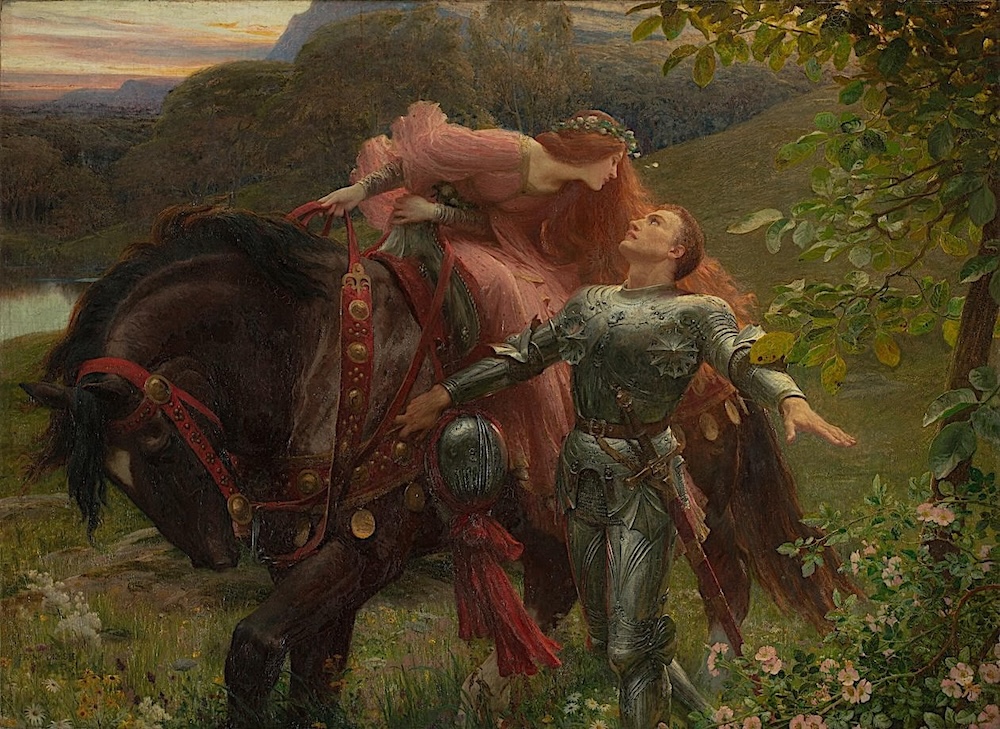
La Belle Dame Sans Merci, by Sir Frank Dicksee (1853–1928). c. 1902. Oil on canvas. 54 x 74 inches (137.2 x 188 cm). Collection of Bristol Museum & Art Gallery, Bristol, accession no. K328, Image courtesy of Bristol Museums, Galleries & Archives, reproduced for purposes of non-commercial academic research. [Click on the image to enlarge it.]
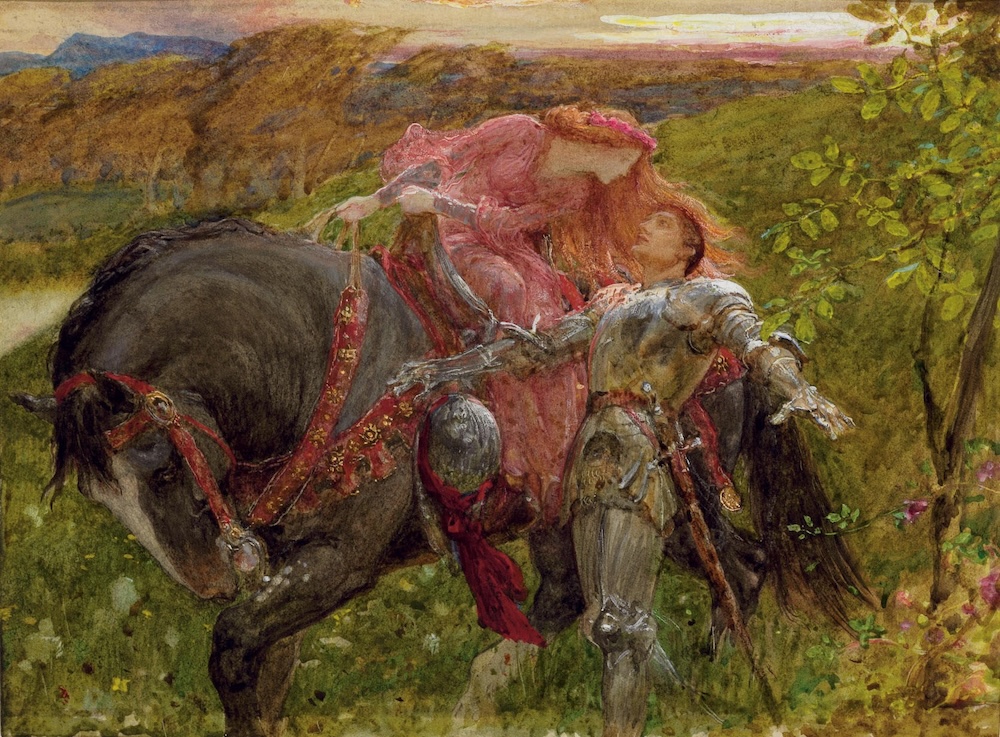
Study for La Belle Dame Sans Merci, c.1902. Pencil, watercolour and gouache with scratching out on paper. 8 5/8 x 11 1/8 in. (21.8 x 30.2 cm). Private collection, image ©2010 Christie's Images Limited. [Right click disabled; not to be reproduced.]
The oil painting, which was exhibited at the Royal Academy in 1902, no. 13, shows a knight in full armour, dramatically throwing his arms back, and gazing upwards spellbound at the beautiful maiden in a pink gown he has put up on his black steed. She is gazing downwards at the knight as though she is preparing to kiss him. Their encounter takes place in a meadow surrounded by a forest. This femme fatale subject is taken from John Keats's 1819 poem of the same title as the painting, described on the Art UK website as "a rather morbid meditation in which the knight is left 'so haggard and so woe-begone' after his encounter with 'la belle dame sans merci.'" In Dicksee's version, however, as the Art UK comment points out, the only hint of trouble "is the blighted leaves brushing the knight's arm. The predominant mood is one of enchantment, intensified by the idyllic setting of the English countryside." The Art UK comment also praises Dicksee's "innovative approach to the subject in his use of vibrant colours and dramatic spatial construction."
The Victorians' continuing fascination with chivalry is demonstrated by another of Dicksee's paintings, actually entitled Chivalry, in which, as so often, the lure of romantic escapism is blended with a sense of danger. The subject of "La Belle Dame Sans Merci" itself greatly appealed to the Victorians, with a drawing by D.G. Rossetti and paintings by Arthur Hughes, Walter Crane, John William Waterhouse, Henry Meynell Rheam, and Frank Cadogan Cowper.
Contemporary Reviews of the Painting
By 1902 paintings such as this were becoming increasingly old-fashioned as can be seen in the reviews. A critic for The Academy questioned why Dicksee chose to paint this subject in the first place: "no doubt Mr. Dicksee had some motive in painting his theatrical illustration of a poem that cries aloud against pictorial treatment of this kind. But the intentions are to find, unless it be that hundreds of painters having once begun, must produce their picture or pictures each year with the regularity of an audit" (512). Roger Fry, the reviewer for The Athenaeum, mentions it only in passing: "Nothing, it seems, will restrain the theatrical bravura of Mr. Frank Dicksee" (599). Henry Blackburn in his Academy Notes describes the picture as: "An illustration to Keats, where the knight-at-arms has placed the pink-robed lady on his chestnut horse, her pale golden hair lit up with the sunset" (10).
The Magazine of Art gave it its most favourable assessment, but even he implied that the work was more decorative than original: "Mr. Frank Dicksee is more obvious but not so persuasive in his large composition, La Belle Dame sans Merci," feeling that "he does not value reticence so much as sumptuousness of effect, and consequently he has gone as far as possible in the direction of gorgeous elaboration of detail. Every part of his picture is, as it were, embroidered with accessories which leave nothing to the imagination, and the actors in his drama are making the most of themselves. Such art is always popular on account of its combination of strenuous expression and learned execution" (393-94).
Bibliography
"Art. 'It's human, but is it Art?'" The Academy LXII (17 May 1902): 512-13.
Blackburn, Henry. Academy Notes XXVIII London: Chatto and Windus (May 1902): 10 & 38.
"Current Art: The Royal Academy Exhibition. – II." The Magazine of Art XXVI (1902): 393-404.
Fry, Roger. "Fine Arts. The Royal Academy." The Athenaeum No. 3889 (10 May 1902): 599-600.
La Belle Dame Sans Merci. Art UK. Web. 9 July 2026.
La Belle Dame Sans Merci. Bristol: Bristol Museum & Art Gallery. Web. 9 July 2026.
The Nicolette Wernick Collection British Watercolours and Paintings (1800-1950) . London" Christie's (16 June 2010): lot 38, 26. https://www.christies.com/en/lot/lot-5318365
"The Royal Academy of 1902." The Art Journal LXIV (June 1902): 212.
Toll, Simon. Frank Dicksee 1853-1928, His Art and Life. Woodbridge: ACC Art Books, 2016, cat. no. FD.1902.1, 126-29 & 234.
Created 9 July 2026