
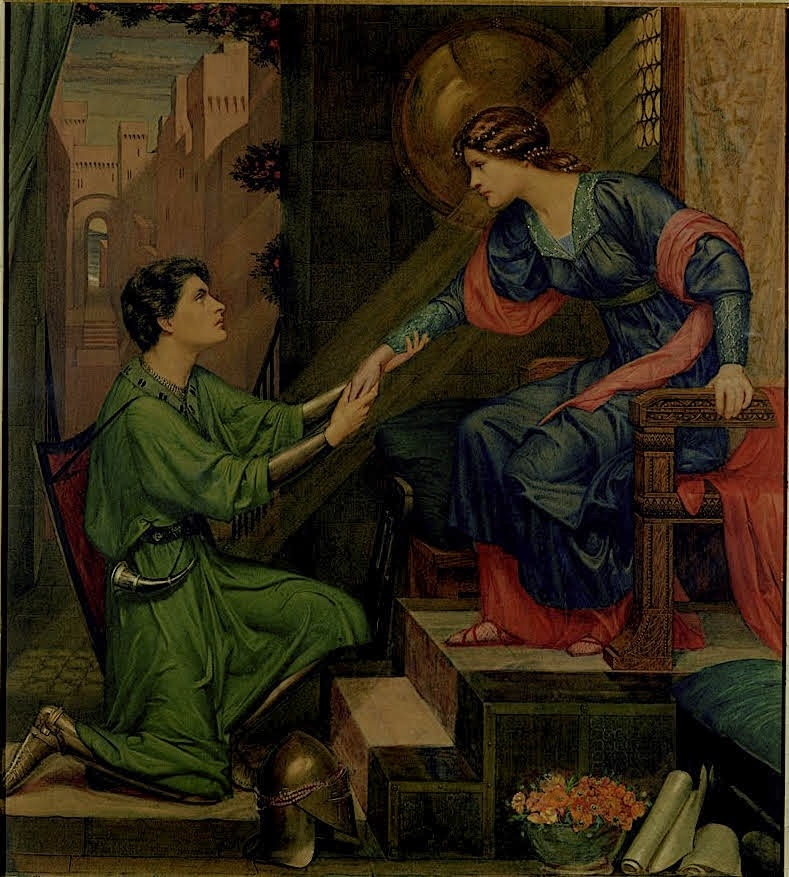
Tristram and Yseult by Sidney Harold Meteyard (1868-1947). 1907. Watercolour, gouache and tempera. 24 x 21 inches (61 x 53 cm). Private collection. Image courtesy of Sotheby's, New York. [Click on the images to enlarge them.]
Meteyard exhibited Tristram and Yseult at the Royal Academy in 1907, no. 993. This Arthurian legend was originally derived from an old Celtic one, but is most familiar from Sir Thomas Malory's Le Morte d'Arthur. King Mark of Cornwall sends his nephew Tristram (Tristan) to Ireland to win in his name the hand of the beautiful princess Yseult (Iseult; Ysoude; Isolde). Unfortunately, on the trip back to Cornwall, Tristram and Yseult mistakenly drink a love potion given to her by her mother that was intended for King Mark and Yseult on their wedding night. The young couple fall deeply in love with each other. Although Yseult marries King Mark, the two lovers continue their forbidden adulterous relationship with tragic consequences to all concerned. The deaths of Tristram and Yseult vary according to various versions of the legend. In Malory's version Tristram is dying from a wound from a poisoned lance. He sent his friend Kahedin to find his beloved Yseult of Ireland, who is the only one who can heal him. He tells Kahedin that if Yseult agrees to come to his aid his ship is to have a white sail, but a black sail if she refuses. Tristram's jealous wife, Iseult of the White Hands, discovered this secret pact. On seeing the ship approach on which Yseult is hastening to Tristram's aid, she tells Tristram that it carries a black sail. Tristram dies of grief believing that Yseult has betrayed him. Yseult, arriving too late to save him, dies over his corpse in a final embrace.
Meteyard's picture shows an early episode in the story when the young Sir Tristram arrives at Yseult's castle in Ireland to plead the cause of his uncle King Mark of Cornwall. Tristram is clad in green, kneeling at the feet of Princess Iseult, and holding out his hands to grasp her right hand. She is clad in garments of blue and red. The two future lovers gaze intensely into each other's eyes, Tristram and Yseult was not the only work Meteyard completed based on the Arthurian legends. Others include his Merlin and Vivien of 1908 and I Am Half-Sick of Shadows," Said the Lady of Shalott of 1913.
The subject of Tristram and Yseult was popular amongst Victorian artists, particularly those within the wider Pre-Raphaelite circle. The firm of Morris, Marshall, Faulkner & Co. did a series of thirteen small stained-glass panels telling the story of Tristram and Isolde for Harden Grange, the home of Walter Dunlop, near Bingley in Yorkshire. The designers for this series included D.G. Rossetti, Edward Burne-Jones, William Morris, Ford Madox Brown, Arthur Hughes and Val Prinsep. D.G. Rossetti executed a watercolour, Sir Tristram and La Belle Yseult Drinking the Love Potion, based on his design in 1867. Edward Burne-Jones painted two watercolours based on his designs, King Mark and La Belle Iseult on one, and The Madness of Sir Tristram, based on another, both in 1862. Burne-Jones later executed an unfinished oil of Tristram and Yseult of c.1871-72. Ford Madox Brown painted a watercolour of The Death of Sir Tristam of 1864 based on his stained-glass design of 1862. Other oil versions of this story include Frederick Sandys's Ysoude with the Love Philtre of 1870, Herbert James Draper's Tristam and Yseult of 1901, Frank Dicksee's Yseult of 1901. Edmund Blair Leighton did two quite different versions of this story. His Tristam and Iseult [The End of the Song] dates to 1902 while his later Tristram and Isolde dates to 1907. John Duncan painted his Tristan and Isolde in 1912, while John William Waterhouse's Tristan and Isolde with the Potion dates from 1916.
Bibliography
"Modern English Art." The English Illustrated Magazine (February 1908): 439 and 441-42.
Victorian, Pre-Raphaelite & British Impressionist Art. London: Sotheby's (12 July 2018): lot 27, 36-37. https://www.sothebys.com/en/auctions/ecatalogue/2018/victorian-pre-raphaelite-british-impressionist-art-l18132/lot.27.html?locale=en
Victorian, Pre-Raphaelite & British Impressionist Art. London: Sotheby's (11 July 2019): lot 43, 45. https://www.sothebys.com/en/buy/auction/2019/victorian-pre-raphaelite-and-british-impressionist-art/sidney-harold-meteyard-tristram-and-yseult
Created 26 March 2026