
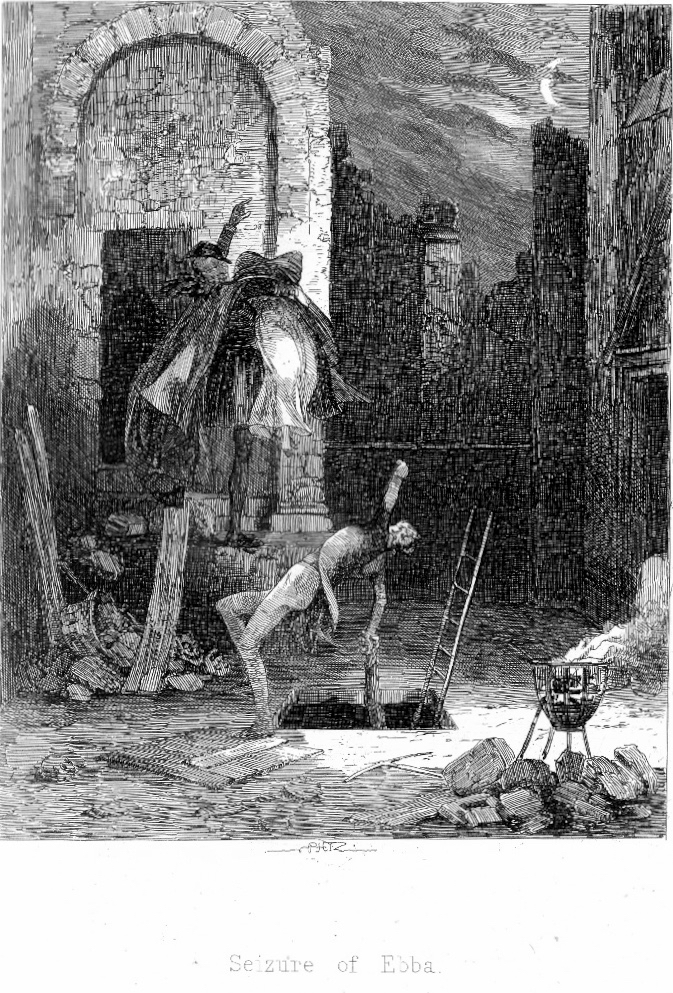
The Seizure of Ebba
Phiz
January 1845 (4th serial number)
12.7 cm high by 10 cm wide (5 ⅛ by 4 inches), framed
Eighth monthly serial illustration for William Harrison Ainsworth's Auriol; Or, The Elixir of Life, facing p. 1 in serial, p. 108 in volume.
[Click on the image to enlarge it and mouse over text for links.]
Scanned image & text by Philip V. Allingham.
[You may use this image without prior permission for any scholarly or educational purpose as long as you (1) credit the person who scanned the image and (2) link your document to this URL in a web document or cite the Victorian Web in a print one.]

Passage Illustrated: The Mysterious Stranger in the Cape Mentions a "Compact"
"Remember your compact," rejoined the stranger, with a mocking laugh.
"Oh, Auriol!" cried Ebba, "I fear for your soul. You have not made a compact with this fiend?"
"He has," replied the stranger; "and by that compact you are surrendered to me."
And, as he spoke, he advanced towards her, and enveloping her in his cloak, her cries were instantly stifled.
"You shall not go!" cried Auriol, seizing him. "Release her, or I renounce you wholly."
"Fool! cried the stranger, "since you provoke my wrath, take your doom."
And he stampted on the ground. At this signal an arm was thrust from the trap-door, and Auriol's hand was seized with an iron grasp.
While this took place, the stranger bore his lovely burden swiftly up the plank leading to the narrow doorway in the wall, and just as he was passing through it he pointed towards the sky, and shouted with a mocking smile to Auriol — "Behold! the moon is in her first quarter. My words are fulfilled!"
And he disappeared. (Chapter IX, "The Moon In The First Quarter," Vol. VIII in serial p. 3, volume p. 108)
Commentary: Ebba Snatched from Auriol's Grasp in a Ruined Gothic Abbey
"Oh, Ebba," he replied, "I must leave you. I have allowed myself to dream of happiness too long. I am an accursed being, doomed only to bring misery upon those who love me. I warned you on the onset, but you would not believe me. Let me go, and perhaps it may not yet be too late to save you."
"Oh no, do not leave me!" cried Ebba. "I have no fear while you are with me." (105)
Who is this mysterious figure (already encountered twice) who seems to flying off with Ebba Thorneycroft, the daughter of a scrap-iron dealer and Auriol's primary romantic interest? And what is the meaning of the hand that pulls Auriol himself back to earth as he reaches skyward, trying to rescue Ebba from the supernatural agent's clutches? Phiz makes the cloaked stranger appear to fly off with Ebba when, in the letterpress, merely he mounts a plank, carrying her enfolded in his cloak, and then disappears through a narrow doorway, the black rectangle behind the figure at the centre of the plate. Although this is technically not a "dark plate" (a technique that Phiz first used in 1847), here Phiz has used dense cross-hatching to create a mysterious and suitably sinister atmosphere. The nocturnal scene in the ruined abbey is exactly as Ainsworth describes it for Gothic effect. Having left the riverbank, the couple climb a spiral staircase, and enter
a roofless chamber, which it was evident, from the implements and rubbish lying about, was about to be razed to the ground. On one side there was a large arch, partly bricked up, through which opened a narrow doorway, though at some height from the ground. With this a plank communicated, while beneath it lay a great heap of stones, amongst which were some grotesque carved heads. In the centre of the chamber was a large square opening, like the mouth of a trap-door, from which the top of a ladder projected, and near it stood a flaming brazier, which had cast forth the glare seen from below. Over the ruinous walls on the right hung the crescent moon, now emerged from the cloud, and shedding a ghostly glimmer on the scene. (pp. 106-107)
The abduction plot is compelling. Although Auriol has warned her that he is cursed to bring misery to any unfortunate woman who loves him, Ebba refuses to leave his side. Mocking laughter announces the arrival of a sinister stranger in a black cloak. He demands that Ebba surrender herself to him under the terms of the "compact" he has already negotiated with her lover. The fiend then "advanced towards her, and enveloping her in his cloak, her cries were instantly stifled" (108). When Auriol attempts to intervene, the fiend stomps on the floor to summon the assistance of a hand that rises through the trapdoor. "Uttering ejaculations of rage and despair, [Auriol] was dragged forcibly backwards into the vault" (108). Ebba's abduction here prompts the hero to undertake a desperate rescue mission, despite whatever "compact" Auriol may have made with the fiend, whom we suspect to be Cyprian de Rougement, last encountered in Hyde Park.
Related Material
- Hablot Knight Browne, 1815-1882; A Brief Biography
- William Harrison Ainsworth (1805-1882)
- William Harrison Ainsworth (1805-1882) — King of the Historical Potboiler: A Brief Biography
Bibliography
Ainsworth, William Harrison. Auriol; Or, The Elixir of Life. London: Chapman and Hall, 1850; George Routledge and Sons, 1865.
Ainsworth, William Harrison. Revelations of London. Ainsworth's Magazine. Vol. VIII (January — May 1845).
Lester, Valerie Browne. Phiz: The Man Who Drew Dickens. London: Chatto and Windus, 2004.
Steig, Michael. Dickens and Phiz. Bloomington & London: Indiana U. P., 1978.
Sutherland, John A. "Auriol." The Stanford Companion to Victorian Fiction. Stanford, Cal.: Stanford U. P., 1989, rpt. 1990, 33.
Vann, J. Don. "Auriol; Or, The Elixir of Life in Ainsworth's Magazine, October 1844 — May 1845." Victorian Novels in Serial. New York: Modern Language Association, 1985. Pp. 24-25.
Victorian
Web
Illus-
tration
Phiz
Auriol
Next
Created 5 August 2002 Last updated 9 October 2026