
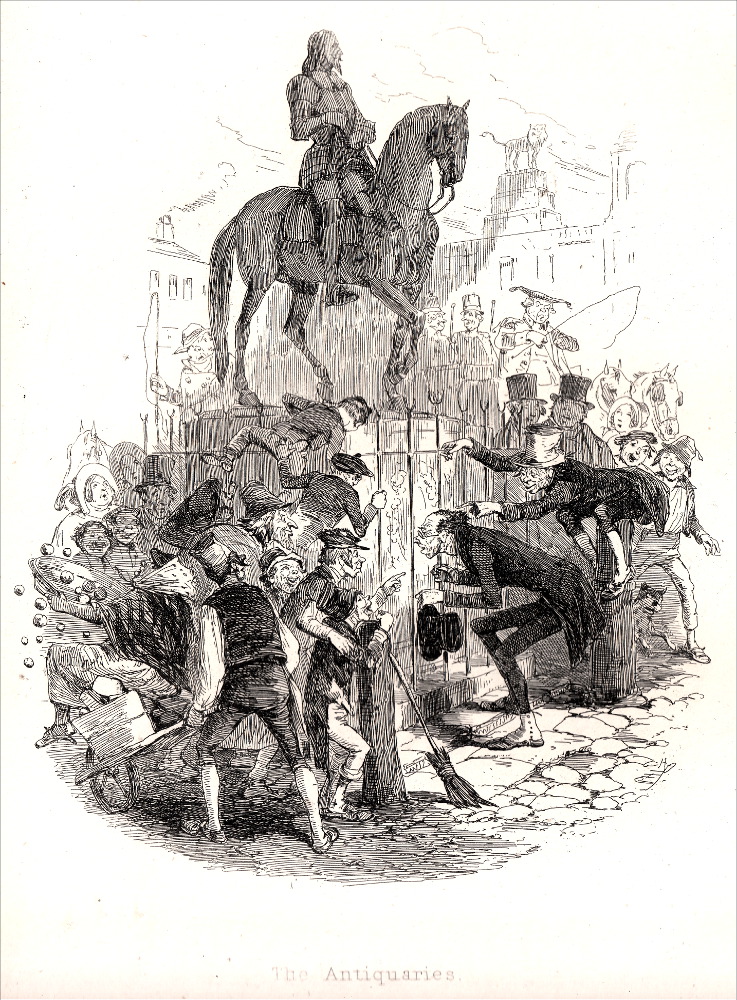
The Antiquaries
Phiz
February 1845
14.1 cm high by 11.6 cm wide (5 ½ by 4 ½ inches), vignetted
Facing page 38 in serial, page 113 in volume, for William Harrison Ainsworth's Auriol; Or, The Elixir of Life (London: Chapman and Hall, 1850; rpt., 1865)
[Click on the image to enlarge it and mouse over text for links.]
Scanned image & text by Philip V. Allingham.
[You may use this image without prior permission for any scholarly or educational purpose as long as you (1) credit the person who scanned the image and (2) link your document to this URL in a web document or cite the Victorian Web in a print one.]

Passage Illustrated: The Two Coves inspect the Equestrian Statue of Charles the First
"My eyes!" cried the street-sweeper, "only twig these coves. If they ain't green 'uns, I'm done."
"Old Spectacles thinks he has found it all out," remarked the porter; "ve shall hear wot it all means by-and-by."
"Plesh ma 'art," cried the Jew, "vat two funny old genelmen. I vonder vat they thinks they sees?"
"I'll tell 'ee, master," rejoined the butcher's apprentice; "they're a tryin' vich on 'em can see farthest into a millstone."
"Only think of living all my life in London, and never examining this admirable work of art before!" cried Loftus, quite unconscious that he had become the object of general curiosity.
"Look closer at it, old gem'man," cried the porter. "The nearer you get, the more you'll admire it."
"Quite true," replied Loftus, fancying Morse had spoken; "it'll bear the closest inspection."
"I say, Ned," observed one of the charity-boys to the other, "do you get over the railin'; they must ha' dropped summat inside. See what it is."
"I'm afraid o' spikin' myself, Joe," replied the other; "but just give us a lift, and I'll try." ["Book the First — Ebba," Chapter X. "The Statue at Charring Cross," pp. 112-113]
Commentary: Ginger offers the two "Coves" assistance in retrieving the missing Ebba
The two antiquarian "coves" who are enjoying inspecting the famous bronze statue at Charring Cross are Mr. Loftus of Abingdon Street, a bachelor and retired London merchant and amateur antiquarian, and Flapdragon (Gregory Morse), formerly Dr. Lamb's assistant. Morse remembers hundreds of years of English history, and knows the complete backstory of the statue as he once worked for the brazier John Rivers, who bought the statue for scrap from the Cromwellian administration and then buried it until the Restoration.
However, retailing arcane tidbits of English history is not Ainsworth's goal in this chapter, which seems to accord so well with the serial novel's original title, Revelations of London. Rather, the amateur antiquarian Mr. Loftus, it turns out, is the brother-in-law of the iron-monger of Vauxhall Road, Mr. Thorneycroft. The distraught father breaks the news that his daughter has run away (he is unaware that she has been abducted). The purpose of the sight-seeing tour now becomes apparent: Ginger, "The Dog-Fancier," reveals that she has fallen into the clutches of the black-cloaked evil "gentleman," whom Morse describes as the devil. Ginger offers to undertake her rescue, as well as that of Auriol Darcy. "But come to me at eleven o'clock to-night, at the Turk's Head, at the back o' Shoreditch Church, and I'll put you on the right scent. You must me alone" (117).
Other Views of Charring Cross
- The Eleanor Cross (Restored in 1865)
- Charring Cross — Baked Potatoes, All Hot! (1847)
- Charring Cross and The Strand (c. 1906)
Related Material
- Hablot Knight Browne, 1815-1882; A Brief Biography
- William Harrison Ainsworth (1805-1882)
- William Harrison Ainsworth (1805-1882) — King of the Historical Potboiler: A Brief Biography
Bibliography
Ainsworth, William Harrison. Auriol; Or, The Elixir of Life. London: Chapman and Hall, 1850; George Routledge and Sons, 1865.
Ainsworth, William Harrison. Revelations of London. Ainsworth's Magazine. Vol. VIII (January — May 1845).
Lester, Valerie Browne. Phiz: The Man Who Drew Dickens. London: Chatto and Windus, 2004.
Steig, Michael. Dickens and Phiz. Bloomington & London: Indiana U. P., 1978.
Sutherland, John A. "Auriol." The Stanford Companion to Victorian Fiction. Stanford, Cal.: Stanford U. P., 1989, rpt. 1990, 33.
Vann, J. Don. "Auriol; Or, The Elixir of Life in Ainsworth's Magazine, October 1844 — May 1845." Victorian Novels in Serial. New York: Modern Language Association, 1985. Pp. 24-25.
Victorian
Web
Illus-
tration
Phiz
Auriol
Next
Created 9 October 2026