
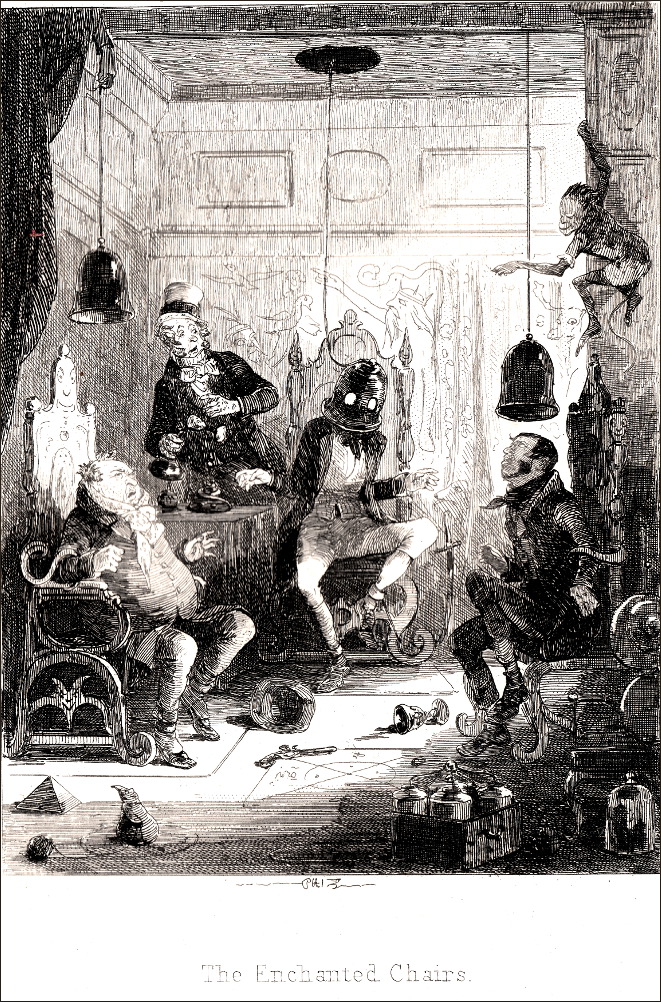
The Enchanted Chairs
Phiz
May 1845
12.9 cm high by 9.7 cm wide (5 ⅛ by 3 ⅞ inches), framed
Facing page 176 in the volume, for William Harrison Ainsworth's Auriol; Or, The Elixir of Life (London: Chapman and Hall, 1850; rpt., 1865); in serial, facing p. 377.
[Click on the image to enlarge it and mouse over text for links.]
Scanned image & text by Philip V. Allingham.
[You may use this image without prior permission for any scholarly or educational purpose as long as you (1) credit the person who scanned the image and (2) link your document to this URL in a web document or cite the Victorian Web in a print one.]

Passage Illustrated: The Three Would-be Rescuers Tortured and Murdered?
But the worst was to come. From the holes in the ceiling already alluded to, descended three heavy bell-shaped helmets, fashioned like those worn by divers at the bottom of the sea, and having round eyelet-holes of glass. It was evident, from the manner of their descent, that these helmets must drop on the heads of the sitters — a conviction that filled them with inexpressible terror. They shouted, and swore frightfully; but their vociferations availed them nothing. Down came the helmets, and the same moment the monkey, which had been seen by Reeks, issued from a cupboard at the top of a cabinet, and grinned and gibbered at them.
Down came the first helmet, and covered the Tinker to the shoulders. His appearance was at once ludicrous and terrible, and his roaring within the casque sounded like the bellowing of a baited bull.
Down came the second helmet, though rather more slowly, and the Sandman was eclipsed in the same manner as the Tinker, and roared as loudly.
In both these instances the helmets had dropped without guidance, but in the case of Mr. Thorneycroft, a hand, thrust out of the hole in the ceiling, held the helmet suspended over his head, like the sword of Damocles. While the poor iron-merchant momentarily expected the same doom as his companions, his attention was attracted towards the monkey, which, clinging with one hand to the side of the cabinet, extended the other skinny arm towards him, and exclaimed — "Will you swear to go hence if you are spared?"
"No, I will not," replied the iron-merchant. He had scarcely spoken, when the helmet fell with a jerk, and extinguished him like the others.
Ginger alone remained. ["Book The Second — Cyprian Rougement," Chapter Two, "The Enchanted Chairs," pp. 176-177]
Commentary: Ginger and His Associates come to rescue Ebba from the Dark Powers
After the "Intermean," set in 1800, we return to the main action in the 1830s. And having had scenes of character study and of melodrama, Phiz clearly felt that some visual comedy was in order.
Having broken into the Gothic ruin where de Rougement is holding Ebba and Auriol captive, Mr. Thorneycroft, Ginger, The Sandman, and The Tinker find themselves in a cell with three chairs, each with a bell-shaped helmet above it that will apparently extinguish the life of the unfortunate wearer. The figure with the startled expression and holding a bottle of liquor is Ginger. Missing entirely from the scene and therefore possibly the key to their rescue is the masked Reeks, who turns out to be Gerard Paston. Lever now reveals that the crepe-masked man is present to avenge his sister, Clara, the second female victim of the curse imposed upon Auriol by Rougement. Momentarily, it seems that this unmasked avenger may prove the saviour of Auriol and the four rescuers, as well as of Ebba. Another sort of unmasking occurs here as the speaking monkey (which Phiz depicts clearly as a small creature) is in fact Flapdragon, Dr. Lamb's dwarf deputy, and more recently amateur antiquarian Mr. Loftus's valet.
Related Material
- Hablot Knight Browne, 1815-1882; A Brief Biography
- William Harrison Ainsworth (1805-1882)
- William Harrison Ainsworth (1805-1882) — King of the Historical Potboiler: A Brief Biography
Bibliography
Ainsworth, William Harrison. Auriol; Or, The Elixir of Life. London: Chapman and Hall, 1850; George Routledge and Sons, 1865.
Ainsworth, William Harrison. Revelations of London. Ainsworth's Magazine. Vol. VIII (January — May 1845).
Lester, Valerie Browne. Phiz: The Man Who Drew Dickens. London: Chatto and Windus, 2004.
Steig, Michael. Dickens and Phiz. Bloomington & London: Indiana U. P., 1978.
Sutherland, John A. "Auriol." The Stanford Companion to Victorian Fiction. Stanford, Cal.: Stanford U. P., 1989, rpt. 1990, 33.
Vann, J. Don. "Auriol; Or, The Elixir of Life in Ainsworth's Magazine, October 1844 — May 1845." Victorian Novels in Serial. New York: Modern Language Association, 1985. Pp. 24-25.
Victorian
Web
Illus-
tration
Phiz
Auriol
Next
8 October 2026