
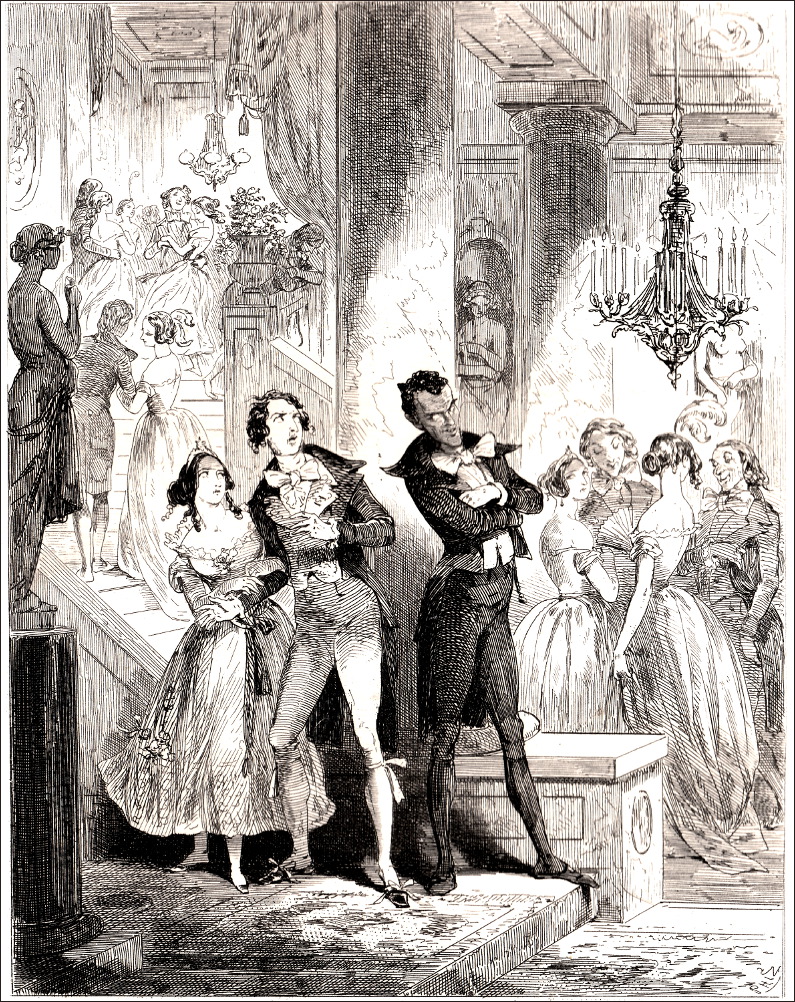
The Significant Whisper
Phiz
April 1845
12.5 cm high by 9.7 cm wide (5 by 3 ¾ inches), framed
Facing page 455 in serial, p. 157 in volume, for William Harrison Ainsworth's Auriol; Or, The Elixir of Life (London: Chapman and Hall, 1850; rpt., 1865)
[Click on the image to enlarge it and mouse over text for links.]
Scanned image & text by Philip V. Allingham.
[You may use this image without prior permission for any scholarly or educational purpose as long as you (1) credit the person who scanned the image and (2) link your document to this URL in a web document or cite the Victorian Web in a print one.]

Passage Illustrated: Auriol and His Bride, Edith Talbot, Dogged by Rougemont
Night came, and with it began to arrive the guests who were bidden to the ball. No expense had been spared by Auriol to give splendour to his fete. It was in all respects magnificent. The amusements of the evening commenced with a concert, which was performed by the first singers from the Italian Opera; after which, the ball was opened by Auriol and his lovely bride. As soon as the dance was over, Auriol made a sign to an attendant, who instantly disappeared.
"Are you prepared to quit this gay scene with me, Edith?" he asked, with a heart swelling with rapture.
"Quite so," she replied, gazing at him with tenderness; "I long to be alone with you."
"Come, then," said Auriol.
Edith arose, and passing her arm under that of her husband, they quitted the ball-room, but in place of descending the principal staircase, they took a more private course. The hall, which they were obliged to cross, and which they entered from a side-door, was spacious and beautifully proportioned, and adorned with numerous statues on pedestals. The ceiling was decorated with fresco paintings, and supported by two stately scagliola pillars. From between these, a broad staircase of white marble ascended to the upper room. As Auriol had foreseen, the staircase was thronged with guests ascending to the ball-room, the doors of which being open, afforded glimpses of the dancers, and gave forth strains of liveliest music. Anxious to avoid a newly-arrived party in the hall, Auriol and his bride lingered for a moment near a pillar.
"Ha! who is this?" cried Edith, as a tall man, with a sinister countenance, and habited entirely in black, moved from the farther side of the pillar, and planted himself in their path, with his back partly towards them.
A thrill of apprehension passed through Auriol's frame. He looked up and beheld Rougemont, who, glancing over his shoulder, fixed his malignant gaze upon him. Retreat was now impossible.
"You thought to delude me," said Rougemont, in a deep whisper, audible only to Auriol; "but you counted without your host. I am come to claim my victim."
"What is the matter with you, that you tremble so, dear Auriol?" cried Edith. "Who is this strange person?" ["The Intermean — 1800," Chapter Five, "The Seventh Night," in serial pp. 455-456; in volume, pp. 156-158]
Commentary: After Auriol's marrying Edith, Rougement claims his bargain that very night
In the "Intermean," set in 1800, Auriol, dressed in the latest (Regency) fashion and his bride encounter the satanic but immaculately dressed Rougement at the bottom of the grand staircase in the youth's elegantly furnished mansion in St. James's Square, London. As Lever has described her, Phiz depicts the bride as a dainty brunette with tiny feet, utterly ignorant of the identity of the malevolent stranger who has come to claim her soul on her wedding night, although her father has already mentioned de Rougement to Auriol as persona non grata. Phiz has given Rougement a very knowing look, smugly having gained access to the ball despite the groom's best efforts to exclude him. In sharp contrast is Auriol's being obviously shocked to see his nemesis after he had strictly instructed the servants not to admit him.
How, readers wonder, will Auriol prevent the sinister guest from claiming his price for the opulent mansion, the setting of the illustration, and the hundred thousand pounds in bank-notes? Rather than rebelling or resisting, Auriol acquiesces, instructing Edith to accompany Rougement to the carriage waiting at the door to take the couple to their honeymoon in Richmond. As soon as Auriol tries to enter the carriage after her, he receives a violent blow to the chest, and the horses dash off at lightning speed. When Auriol reveals to Mr. Talbot what has happened, the distraught father suffers a heart attack or stroke: "Horror!" exclaimed the old man, falling backwards" (159). Auriol, equally distraught, dashes off, "utterly unconscious whither he went." At the end of "The Intermean," therefore, we can only assume that Ebba Thorneycroft awaits the same fate as Edith Talbot.
Related Material
- Hablot Knight Browne, 1815-1882; A Brief Biography
- William Harrison Ainsworth (1805-1882)
- William Harrison Ainsworth (1805-1882) — King of the Historical Potboiler: A Brief Biography
- Dickens and the Gothic
Bibliography
Ainsworth, William Harrison. Auriol; Or, The Elixir of Life. London: Chapman and Hall, 1850; George Routledge and Sons, 1865.
Ainsworth, William Harrison. Revelations of London. Ainsworth's Magazine. Vol. VIII (January — May 1845).
Lester, Valerie Browne. Phiz: The Man Who Drew Dickens. London: Chatto and Windus, 2004.
Steig, Michael. Dickens and Phiz. Bloomington & London: Indiana U. P., 1978.
Sutherland, John A. "Auriol." The Stanford Companion to Victorian Fiction. Stanford, Cal.: Stanford U. P., 1989, rpt. 1990, 33.
Vann, J. Don. "Auriol; Or, The Elixir of Life in Ainsworth's Magazine, October 1844 — May 1845." Victorian Novels in Serial. New York: Modern Language Association, 1985. Pp. 24-25.
Victorian
Web
Illus-
tration
Phiz
Auriol
Next
8 October 2026