
rthur Murch is best described, in the words of Gregory Suriano, as a ‘shadowy artist’ (317) about whom little is known. Born in Bath in 1836, Murch trained under Charles Gleyre in Paris, and lived and worked in Italy in the 1870s. His wife was the painter Edith Edinborough; the couple lived in Rome from 1880 to 1884 and became part of a coterie of visiting British artists, among them Frederic Leighton, J. M. Whistler, Walter Crane, Val Prinsep and William Frederick Yeames. Italy was the Murches’ home, but they also travelled around other countries: both were landscape painters and went in pursuit of European scenery. Murch died at the age of 49 in 1886 in Aachen, Germany, having suffered ill-health for many years. His wife Edith married the artist Mathew Ridley Corbet in 1891 and continued to paint as one of ‘Etruscan group’
Of Murch’s work little is known. He seems to have been hampered by his health problems and perfectionism; as Crane observes, he was ‘singularly painstaking [and] did not produce much’ (142). Unlike his wife – who exhibited widely – he left no trace of completed work in oil or in watercolour. His reputation is therefore entirely based on just two wood-engravings, which were published by the Dalziel brothers in their monumental Bible Gallery (1880–81): The Flight of Adrammelech, and The Arrow of Deliverance. These designs are highly accomplished. Crane describes them as ‘striking’ (142) and Suriano writes of the first illustration as ‘one of the more outstanding pieces in the book’ (317): high praise indeed for a compendium that contains some first-rate work by Simeon Solomon, Leighton, and Edward Poynter.
Murch’s designs, in accordance with all of the others in the collection, are in the grand rhetorical style of Victorian neo-classicism, offering a visual match with the biblical subject matter. The epic tone is registered in The Arrow of Deliverance, which shows the moment when the prophet Elisha instructs King Joash of Israel to shoot an arrow out of a window – a symbol of God’s intention to ensure Israel’s victory over Syria (2 Kings: 13–17). It is a prophetic event, and Murch invests his image with dramatic and psychological intensity by creating a contrast between Joash’s muscular pose and Elijah’s feeble inertness. He also embodies the dynamism of the action by juxtaposing the arc-shape of the drawn bow with the static verticals and horizontals of the setting.
For sure, this is a moment that disturbs the everyday rhythm of history, and it interesting to compare it with William Dyce’s treatment of the same theme (1844, Collection of Hamburger Kunsthalle). Dyce’s painting is more gestural, with Elijah urging the arrow to fly, but Murch’s is perhaps a more accurate representation insofar as Elijah is supposed to be dying. Murch’s figure can barely move, but Dyce makes the prophet far more active than the biblical source suggests.
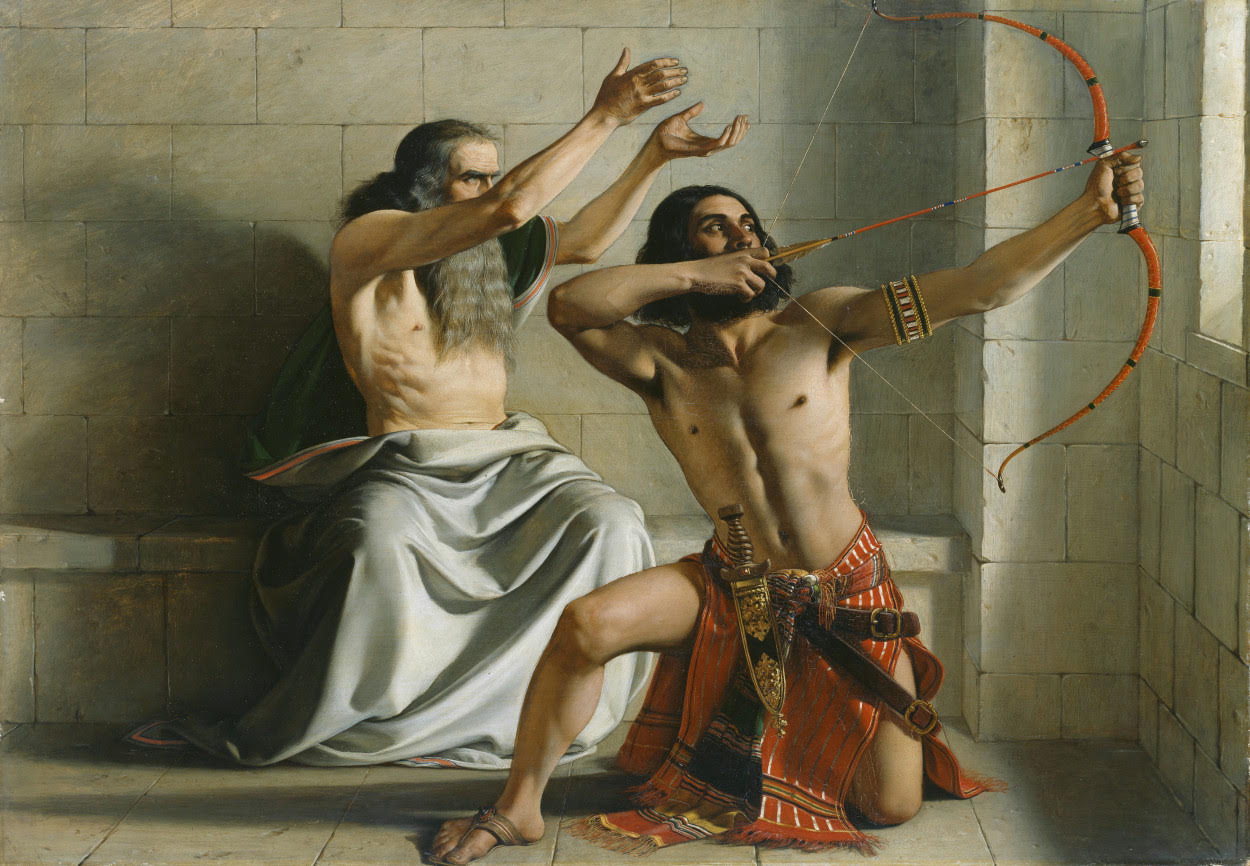

Two versions of the same subject. Left: Dyce’s treatment of the shooting of the Arrow of Deliverance (1844) and right: Murch’s wood-engraving of 1881.
In The Flight of Adrammelech, Murch’s emphasis is purely on the crisis of the moment, showing the two brothers fleeing; having murdered their father King Sennacherib of Assyria for worshipping the god Nisroch in the temple, they make their escape in panic (2 Kings 19:37). Murch effectively captures the scene’s physical and emotional turmoil, contrasting the running figures with the prostrate figure of the slain monarch and the still solidity of the architecture. He accentuates the speed of their escape by showing the characters mid-stride, with Adrammelech’s cloak blowing behind him in a swirl of blowing incense, and both feet off the ground. The figures’ contrapuntal movements further add to the sense of tension as Adrammelech looks around for witnesses, and Sharezer glances back at his father’s body.
Murch deploys these devices to stress the psychological drama, but equally important are the background and accessories. The bird of prey in the foreground acts as an emblem of predatoriness that reflects on the brothers’ patricide, and the reliefs of kings on either side of the composition suggest the authority and natural order that they have overthrown.


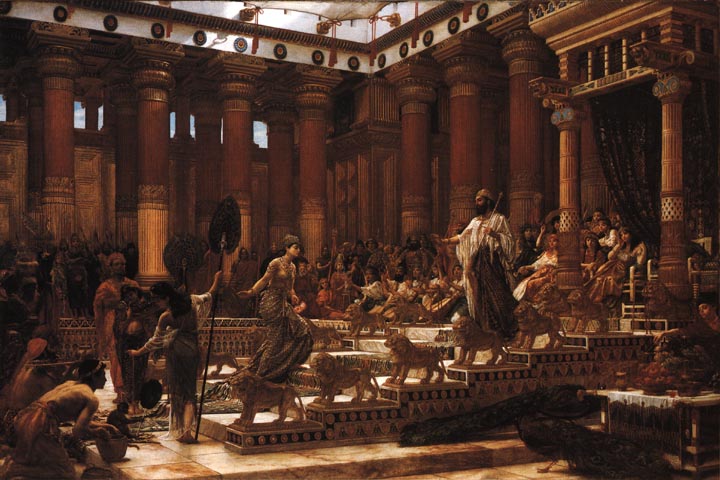
Left: Murch’s The Flight of Adrammelech (and his Brother Sharezer); Middle: Murch’s model, a lion sculpture at the British Museum; and Right: Poynter’s The Visit of the Queen of Sheba to King Solomon (1890).
This use of Assyrian archaeological details – which were taken from exhibits at the British Museum – positions the engraving within the discourse of narrative painting that was designed to be ‘read.’ Most important are the two prominent lions (883-859 BC) which Murch copied from the Guardian Lions at the Temple of Ishtar in Nimrud (Moser 126). These dramatic sculptures, excavated by Henry Layard in 1849 and installed in the Museum in 1851–52, have an interesting dual function in Murch’s design and are much more than historical reference. First of all, the artist employs them to assert, once again, an authority that has been broken: intended to be guardians, they have failed, metaphorically speaking, to protect the king. At the same time, Murch exploits them for an expressive, imaginative purpose to project the noise of panic and commotion as the murderers rush by; their gaping jaws suggest a roaring alarm. Interestingly, the same lions feature in a work by Poynter, The Visit of the Queen of Sheba to King Solomon (1890, The Art Gallery of New South Wales, Sydney), where they are reduced in scale, used ornamentally, and have far less impact than they do in Murch’s composition. For Poynter they are merely part of the faux– historical décor, but for Murch they are central to his dramatic effects.
How, then, to assess this elusive artist’s work? His pair of Dalziel engravings suggest he possessed a powerful imagination and considerable technical ability, producing effects that are significantly enhanced by the quality of the engravers’ work. What he made of other work is unknown, and, in the absence of any further designs, we can only speculate.
Bibliography
Crane, Walter. An Artist’s Reminiscences . London: Methuen, 1907.
Dalziel Brothers. Dalziels’ Bible Gallery. London: Routledge, 1881 [1880].
_____. A Record of Work, 1840-1890. Foreword by Graham Reynolds. 1901; reprinted London: Batsford, 1978.
Moser, Stephanie. Painting Antiquity. Oxford: Oxford University Press, 2020.
Suriano, Gregory R. The Pre-Raphaelite Illustrators. Newcastle, Delaware: Oak Knoll Press, 2000.
Created 25 June 2026