
Photograph by Robin Banerjee. Image scans and commentary by Jacqueline Banerjee. You may use the images without prior permission for any scholarly or educational purpose as long as you (1) credit the photographer or person who scanned the images, and (2) link your document to this URL or cite it in a print one.
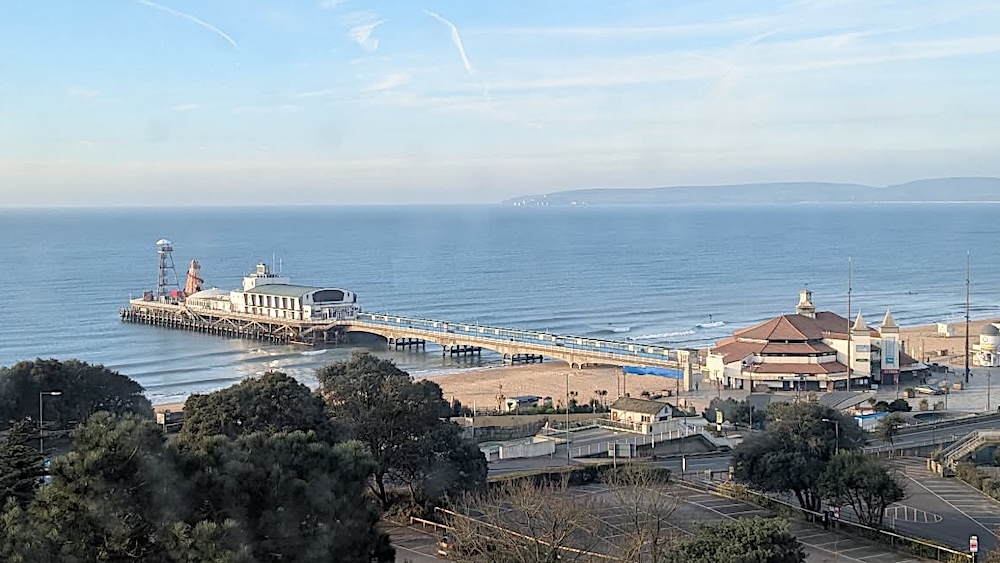
Bournemouth Pier, on the coast of the ceremonial county of Dorset. The first structure built here was a short wooden jetty of 1856. This was replaced by a much longer wooden pier in 1861, designed by George Rennie (1791-1866, son of the John Rennie of bridge-building fame).
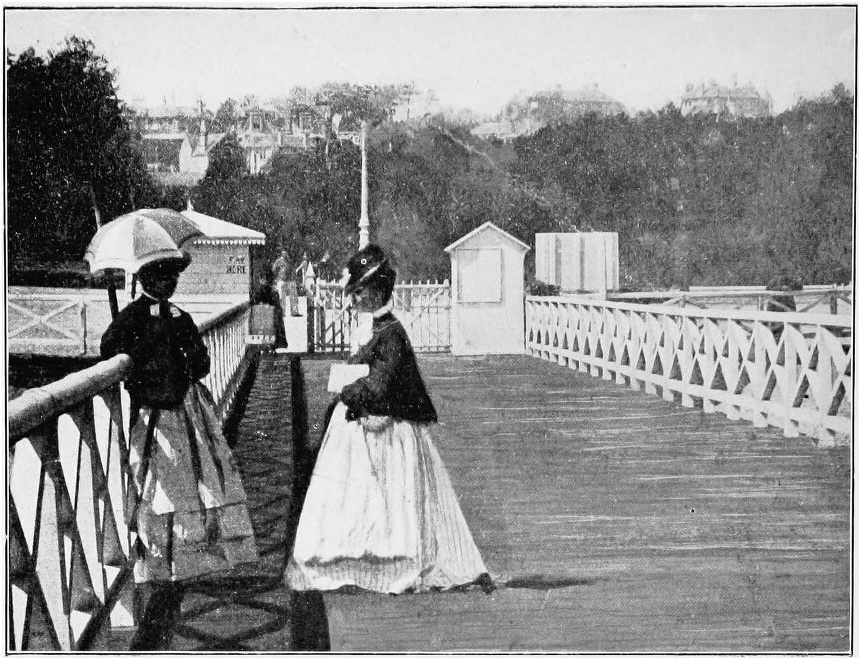

Two views of the Wooden Pier, 1861-80 (Mate, facing pp. 128, 160).
The wooden pier had a "chequered career," being "again and again wrecked" (Mate 160), and at length it too was not rebuilt but replaced, this time by an altogether more substantial iron pier to the designs of Eugenius Birch (1818-1882) in 1880. The new pier acquired the usual seaside-resort amenities over the following decades: attractive shelters, a pier-end bandstand and so on. When a new landing stage was built, it reached as far as 1000' out to sea. No doubt the many problems and changes that have occurred since then explain why Historic England has not given the pier listed status.
The opening, in August 1880, was a grand occasion, at which the Lord Mayor of London, his wife and the Sheriffs of London and Middlesex were all present. The Graphic recorded it in some detail, following the report with a page of engravings, including the one of the right below, of the central figures in the formalities:
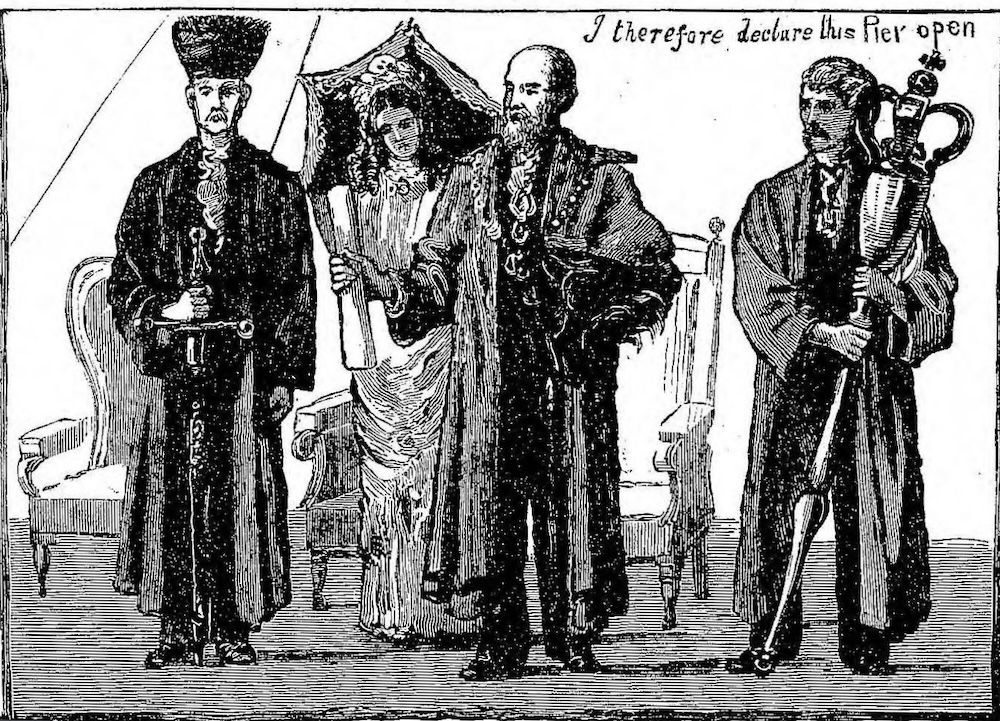
the ceremony of opening the pier was performed with great eclat.... the Lady Mayoress unlocked the gates with a golden key presented to her by the Chairman of the Pier Committee, and the Lord Mayor received and responded to an address from the inhabitants, and congratulated them on the success of the undertaking. The ceremony was followed by a luncheon in the Winter Garden, and in the afternoon there was a regatta and some aquatic sports in front of the pier; while in the evening there was a display of fireworks on the sea, brilliant illuminations in the town, and the Lord Mayor and suite were entertained by the Improvement Commissioners at a banquet given at the Royal Bath Hotel.... [182].
The report also comments on the "handsome building" at the entrance, "of pitch-pine and plate glass, decorated with majolica panels" (182) seen here in this Raphael Tuck postcard featuring a view of the pier by the well-known landscape artist Henry B. Wimbush (1861-1943), sent through the post in 1906:
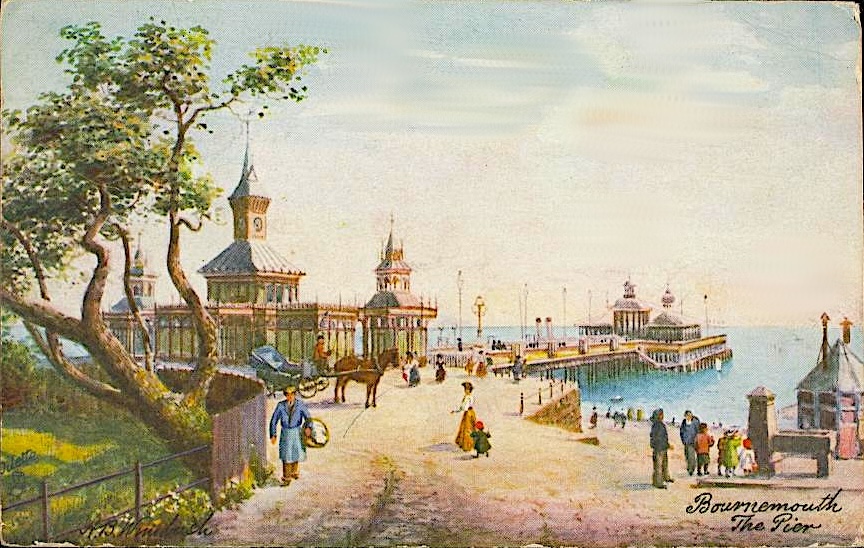
This fine late-Victorian structure was appropriate for the high-class resort that Thomas Hardy christened "Sandbourne" in several of his novels: it is, for example, the fashionable seaside town in which Angel Clare finds Tess living with Alec d'Urberville towards the end of Tess of the D'Urbervilles (Ch. LV). However, it was replaced later, most recently in 1981. Today's pier-entrance building, an entertainment complex and events venu, projects quite a different atmosphere, as do the covered rock-climbing facility and other allurements offered at the seaward end of the pier.
Bibliography
Bournemouth Pier: History. National Piers Society. Web. 29 March 2026.
Mate, Charles Henry. Bournemouth: 1810-1910, the history of a modern health and pleasure resort. Bournemouth: W. Mate, 1910. Internet Archive, from a copy in Cornell University Library. Web. 29 March 2026.
"The Opening of the New Pier at Bournemouth." The Graphic, 21 August 1880. Internet Archive. Web. 29 March 2026,
Wimbush, Henry B. Postcard of the pier. Internet Archive, from the Newberry Library. Web. 29 March 2026.
Created 29 March 2026