
Andrew Laing's obituary by an anonymous author, and the accompanying photograph of him, appeared in the Engineer of 1 January 1931 (see bibliography for full details). Formatted, linked, with added notes and illustrations, by Jacqueline Banerjee. Click on all the images to enlarge them.

he marine engineering profession has suffered a very severe loss in the death of Mr. Andrew Laing, the managing director of the Wallsend Slipway and Engineering Company, Ltd., of Wallsend-on-Tyne. Mr. Laing was in London about a week before his death and attended to business matters with his wonted zest and interest. He caught a chill, double pneumonia supervened, and he died at his home, 15, Osborne-road, Newcastle, on Saturday afternoon last, January 24th. Despite his seventy-five years, Mr. Laing led an active and creative life full of interest to the end.
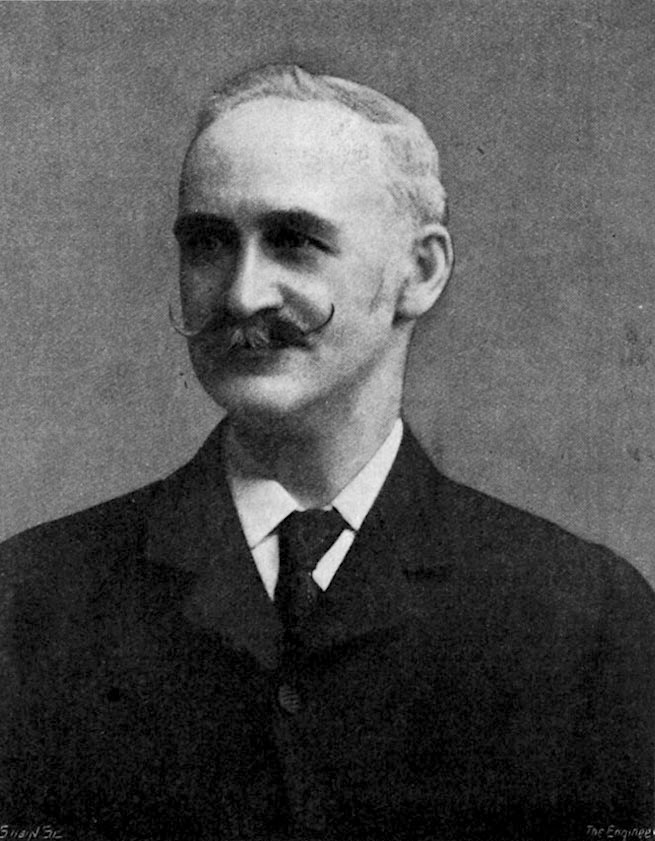
He was born in Edinburgh, and received his early education at the Normal School in that city. With the intention of entering the business of his father, namely, that of a contractor and builder, young Laing completed his studies at the private school of James Baillie at Morningside, an establishment which was then famed for its business bent. At an early age he expressed an intense desire to become an engineer, and with that end in view was duly apprenticed to the firm of Messrs. Hogg and Walker, of Edinburgh, millwrights and engineers. The training which he received with that firm proved most valuable to him in later life, for besides acquiring a wide knowledge of engineering practice, he found many opportunities of developing his own resources. An important part of the experience Mr. Laing gained at that time was an intimate knowledge of the control of costs and the general financial side of engineering work, which stood him in good stead in the positions he was subsequently called upon to take up.
It was in the early days of March, 1877, that he was appointed to his first position in the designing department of John Elder and Co., of Govan, Glasgow, a firm which at a later date became the Fairfield Shipbuilding and Engineering Company, Ltd. At the time when he entered the Govan drawing-office the engineering department of the works was under the charge of the late Dr. Kirk, and it was Dr. Kirk’s successor, Mr. Bryce Douglas, who in 1881 appointed Mr. Laing chief draughtsman in the engineering department. Four vears later he took on the additional duties of assistant manager, and in 1887 was appointed general manager, with full control of the engine works, by the late Sir William Pearce. He held that position until 1890, when he was elected a director of the Fairfield Company. That office he continued to fill with great success until October, 1896, when he left the Clyde to become the general manager of the Wallsend Slipway and Engineering Company, Ltd.
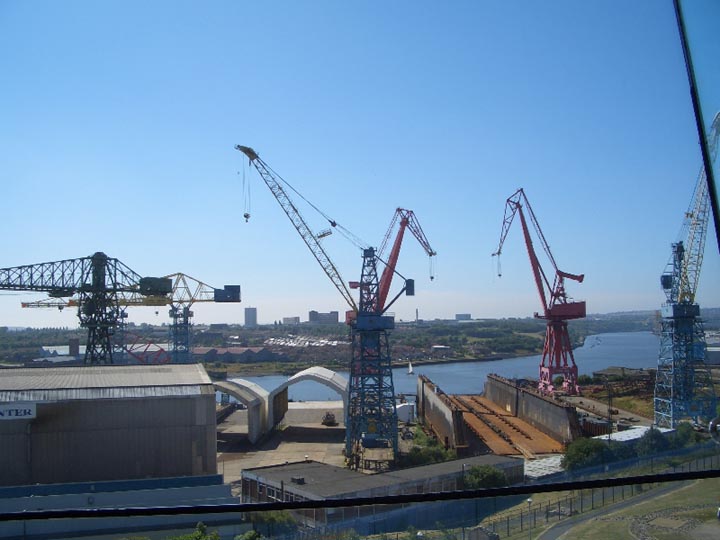
An echo of the past: the Swan Hunter Shipyard, with which the Wallsend Slipway and Engineering Company merged in 1880, photographed in July 2006 just prior to the shipyard's closing. (Photo by JB.)
The period of eighteen years during which Mr. Laing was with the Fairfield Company was particularly noteworthy for the progress made in the design and construction of steam propelling machinery, particularly for fast Atlantic liners. During it no less than twenty-seven hours were taken off the time required for the Atlantic passage, and the increase in the indicated horse-power of liners was about 30,000, with a great reduction in the fuel expended. The first engines with which Mr. Laing began his acquaintance with fast liner machinery were those of the “Arizona,” in which three-cylinder compound engines were installed.* The "Alaska" was laid down shortly afterwards, and other outstanding liners for which Mr. Laing designed the engines were the "Oregon" and the Cunard Line ships "Umbria,” "Etruria,” "Campania” and "Lucania.” The engines for the "Campania," it may be recalled, had five cylinders, with the high and low-pressure cylinders placed tandem-wise on both the forward and after cranks, the intermediate cylinder being placed in the middle. This arrangement of cylinders was first introduced by Mr. Laing on the North German Lloyd liner “Lahn,” for which company seventeen ships were built at the Fairfield yard. Other noteworthy liners of this period included several for the Union-Castle Line, the last being the “Dunvegan Castle,” with 8500 I.H.P. engines. Mr. Laing’s work at the Fairfield yard gained for him a wide reputation, both in this country and on the Continent, especially the America and North German Lloyd lines. He also designed several sets of engines for naval vessels and fast cross-Channel steamers. In his eighteen years Fairfield machinery aggregating 677,000 1.H.P. was constructed, for most of which he was directly responsible. Before he left for the Tyne he planned and carried out large extensions at the Fairfield yard, including new engine and boiler shops and fitting-out basins and a set of 130-ton shear legs. Mr. Laing also completely reorganised the machinery equipment of the engine works.
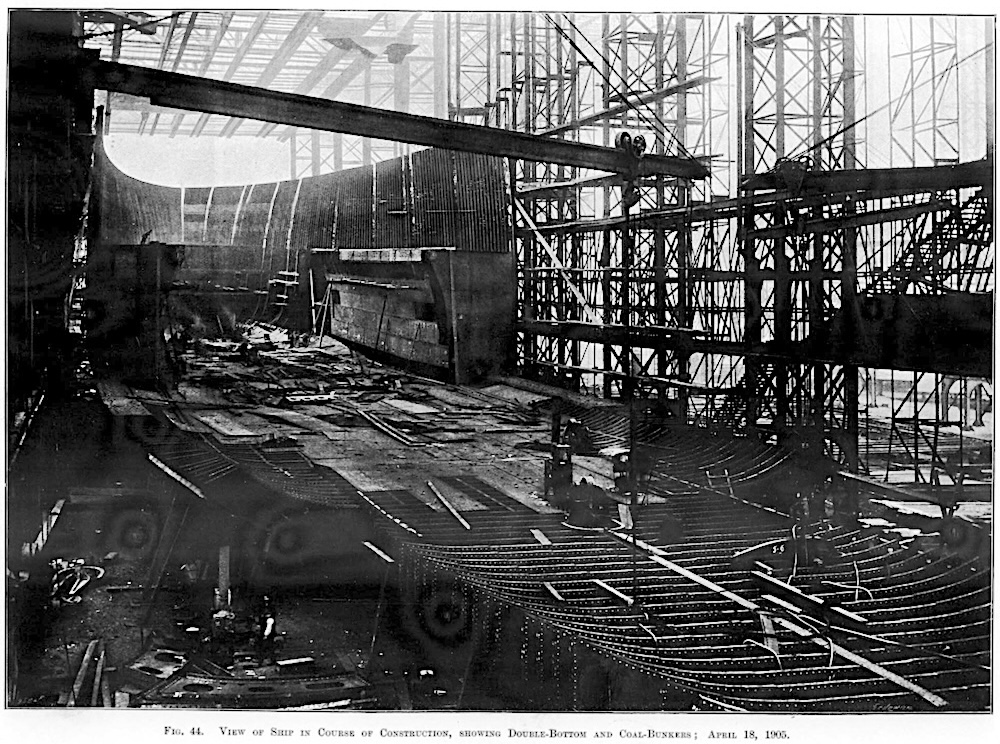
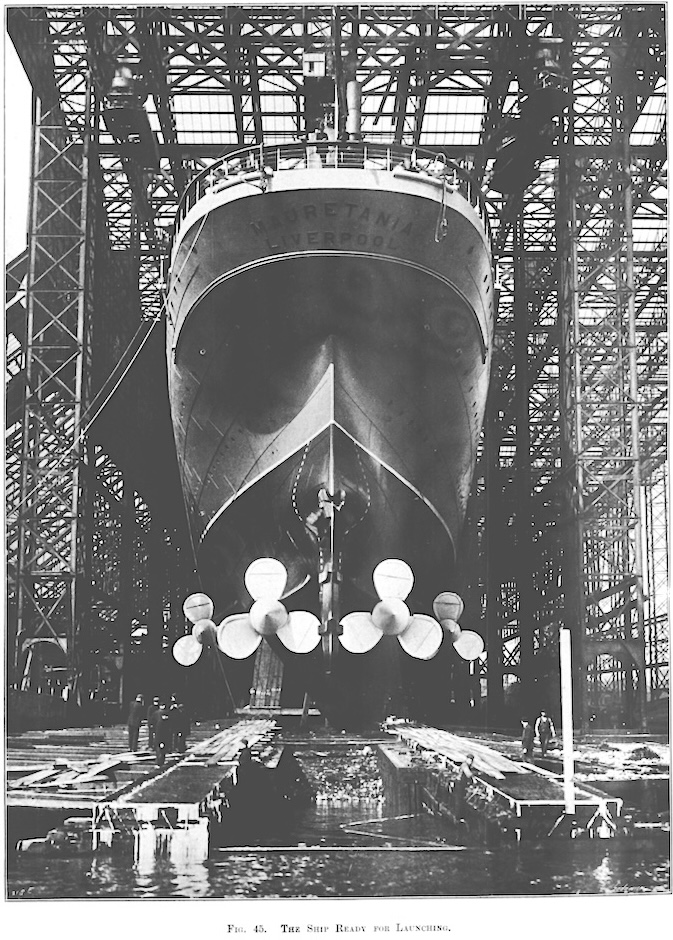
Quardruple-screw turbine driven Cunard liner Mauritania. Left: View of ship in course of construction, showing double-bottom and coal bunkers, April 18, 1905 (Plate LXVII). Right: The ship ready for launching (Plate LXVIII). Engineering, 8 November 1907.
At the time he joined the Wallsend Slipway and Engineering Company, Ltd., at the end of 1896 as general manager and director, the works of that company were mainly laid out for the building of small and medium-sized engines, but he prepared and undertook a far-reaching scheme of reorganisation, which brought the plant quite up to date and made possible the economic construction of machinery for large naval vessels and the largest passenger and cargo liners. Under his direction the ship repairing department at Wallsend was greatly developed, and some noteworthy repair jobs were carried out. The principal Cunard Line ships, the machinery of which was built at Wallsend by Mr. Laing, included the “Invernia,” “Carpathia,”† "Franconia,” and the “Mauretania,” the last-named liner being Mr. Laing’s crowning achievement. The design and construction of the quadruple-screw 70,000 8S.H.P. turbines for the “Mauretania" was carried out under his close personal supervision, and the success of the design may be best judged by the remarkable performance of that liner over a period of twenty-three years. When it was decided to recondition her turbines about two years ago Mr. Laing’s advice was sought, and the record-breaking performance which the ship gave after her machinery had been reconditioned was largely due to the interest he took in that work.
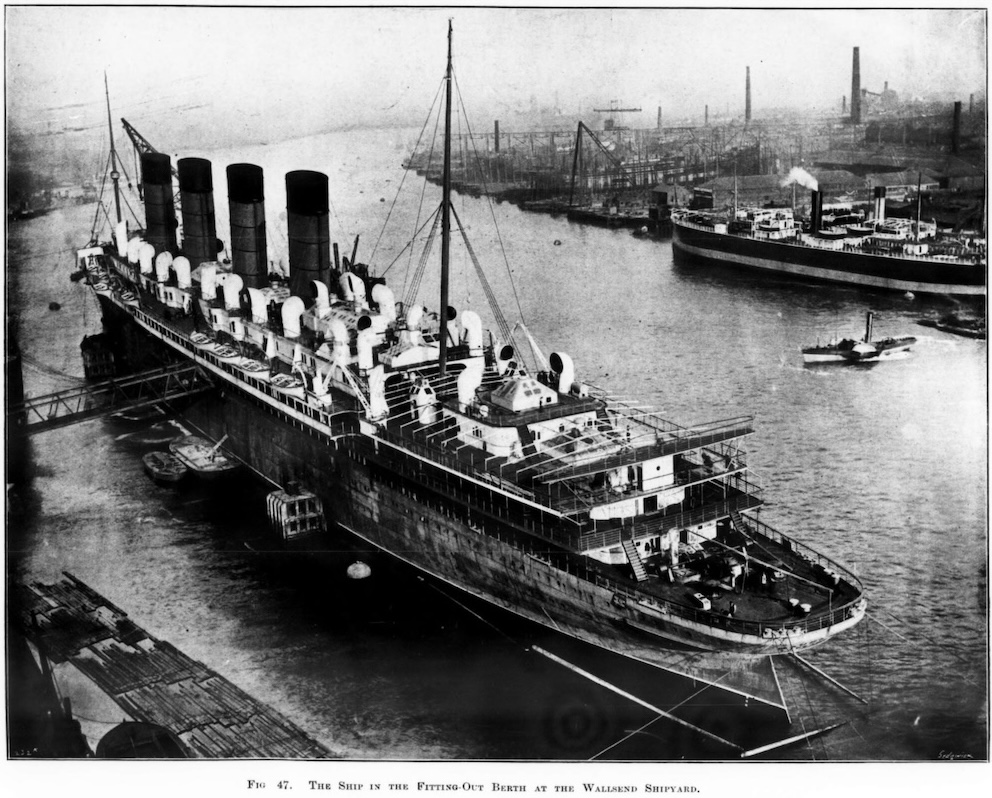
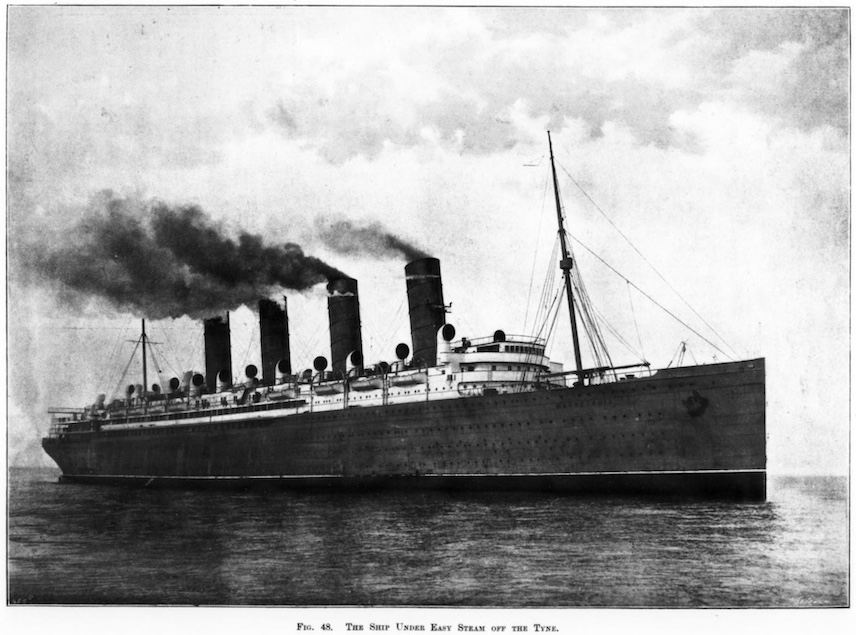
Quardruple-screw turbine driven Cunard liner Mauritania. Left: The ship in fitting-out berth at the Wallsend Shipyard (Plate LXIX). Right: The ship under easy steam off the Tyne. (Plate LXX). Engineering, 8 November 1907.
The account of the work done by Mr. Laing at Wallsend would not be complete without some reference to the steamers and warships other than those already mentioned which were engined by the firm. One outstanding ship engined at Wallsend was the powerful ice breaker “Ermak,” which was built for the Russian Government by Sir W.G. Armstrong, Whitworth and Co., Ltd. During the war no less than sixty-eight naval and mercantile ships were engined at Wallsend, amongst them two battleships, four cruisers, twenty-six torpedo-boat destroyers, besides submarines, sloops, mine-sweepers train ferries and ice-breakers. Some of the largest machinery installations completed under Mr. Laing’s supervision were those of the battleships “Queen Elizabeth” and “Malaya” and the mystery ship "Furious,” which was later used as an aircraft carrier. The total tonnage represented by this machinery was over a million and a quarter.
In May, 1917, his Majesty; bestowed the honour of C.B.E. on Mr. Laing in recognition of the services he had so unselfishly given to the country and to the marine engineering profession. In addition to being the managing director of the Wallsend Slipway and Engineering Company, Ltd., Mr. Laing was also a director of Swan, Hunter and Wigham Richardson, Ltd., and the Newcastle and Gateshead Gas Company.
His post-war work did not lack interest or creative genius. On the naval side he was directly responsible for carrying out the contract for the construction of the turbines of H.M.S. "Nelson," and the trials of that battleship. It is well known that for economy of fuel, both at high and low powers, no ship of this class has exceeded the standard of efficiency established by Mr. Laing’s designs. The high-speed performance of the recently completed flotilla leader "Codrington," which was built by Swan, Hunter and Wigham Richardson, Ltd., and engined by the Wallsend Slipway Company, was another remarkable instance of the success which attended Mr. Laing’s work.
While he shouldered with ease the heavy responsibilities which attached to his high office, he was always ready to help and to give credit to his colleagues and assistants. The able work done by the late Mr. Robert Traill is a remarkable instance of the inspiration which Mr. Laing’s work gave to those who were privileged to co-operate with him. He was a great believer in the necessity for the team spirit. and although a born leader he was always glad to help in any difficulty which presented itself.
Apart from his official duties he found time for a remarkable amount of committee work, and those who were called upon to serve with him on the "Cunard” Committees, the Board of Trade Committees, the British Engineering Standards Committees. Llovd’s Technical Committee, the Institution of Naval Architects’ Committees, the British Marine Engineering, Design and Construction Committee, and the Cast Iron Research Association Com mittee will not readily forget his remarkable personality or the value of his work.
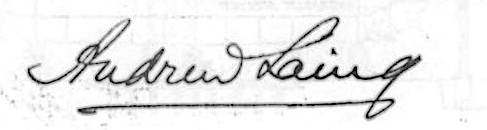
Laing's signature, shown with a portrait of him (similar to the one shown above) in the Engineer of 8 November 1907: 615.
He was a member of the Institution of Civil Engineers, the Institution of Naval Architects, the North-East Coast Institution of Engineers and Shipbuilders, and the Institution of Engineers and Shipbuilders in Scotland, and of the American Society of Naval Engineers, and the American Society of Naval Architects and Marine Engineers in New York. Last March the North-East Coast Institution of Engineers and Ship-builders fittingly bestowed upon him the highest honour which it can give to its members by electing him to an honorary fellowship. He received this well-deserved honour almost with embarrassment, and in a characteristic reply spoke more of the work of his colleagues than of that which he himself had done.
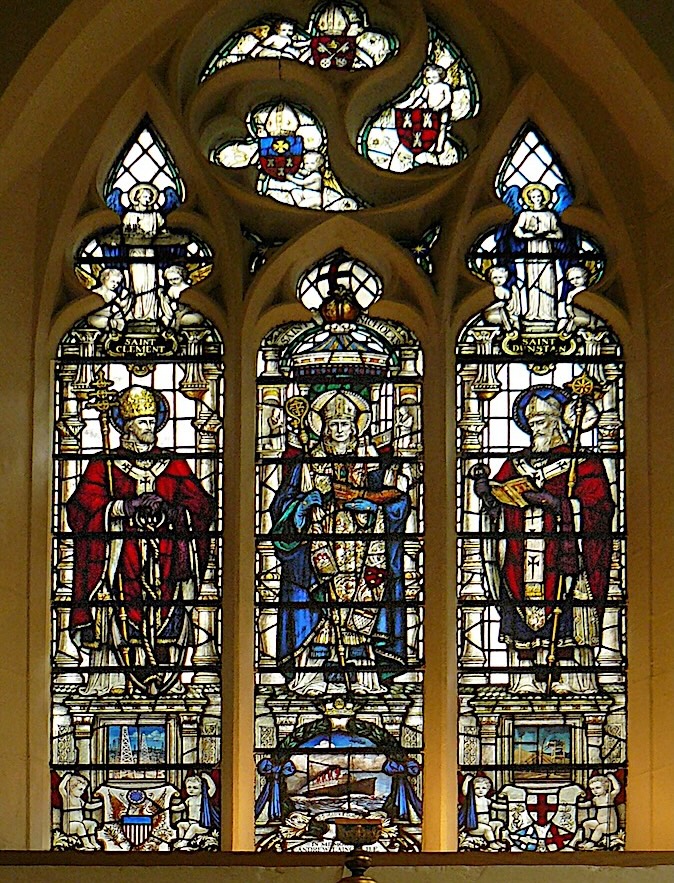
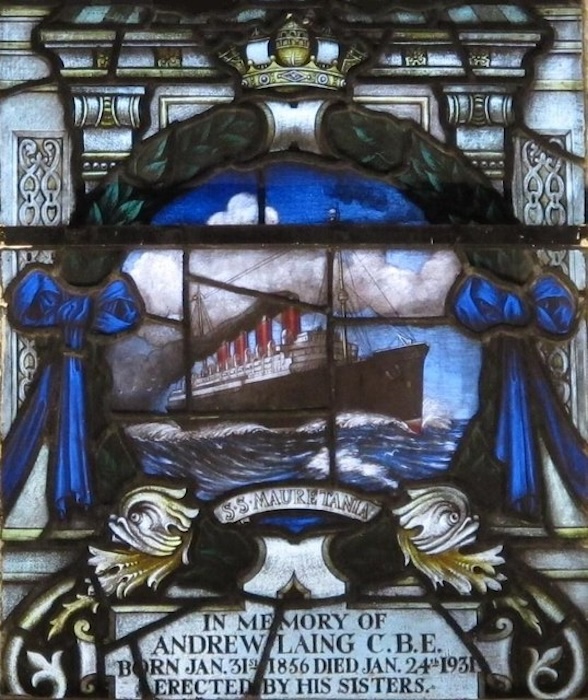
The Andrew Laing memorial window in the righthand window of St George's Chapel, Newcastle Cathedral, by A.K. Nicholson showing the Mauretania in the panel directly under St Nicholas. Left: Whole window (photo by Colin Price. Right: Close-up of the panel showing the Mauretania, by Mike Quinn (posted on Geograph website, and reused under the terms of the Creative Commons Attribution-ShareAlike 2.0 Generic Deed).
Andrew Laing was perhaps the greatest marine engine builder of his day, and his name will long be honoured in our own country, in America and on the Continent of Europe. He saw propelling machinery change from the reciprocating steam engine of a few thousand horse-power, through the direct turbine to the geared turbine, culminating in the very large quadruple-screw installation for the new Cunarder now under construction, in connection with the machinery of which his advice was sought and given. He gladly accepted the newer form of propelling machinery, such as exhaust turbines and marine oil engines, and along with the system of oil firing, for which his firm is so well known, he left his own mark on all these developments. It has been granted to few men in recent years to spend such a full and useful life, and we feel sure that the example of Andrew Laing will go far to influence those who eventually must fill the great gap which his sudden death has created.
•The Arizona made news on several occasions, for its record-breaking speed, for surviving a collision with an iceberg, and for its association with Oscar Wilde, who later sailed to New York on it in style in 1882 (see Brinnan 267-68).
†The Carpathia was the first ship to reach the Titanic when that too hit an iceberg: the outcome in this case was, of course, less fortunate (see Brinnan 370-383).
Related Material
- Nineteenth-Century Ships, Boats, and Naval Architecture and Engineering
- Tyneside
- Cranes along the Tyne, with Ferry crossing
- Return from Work in a Shipyard, by Frank Brangwyn
Bibliography
Primary Source
"Obituary. Andrew Laing." The Engineer, Vol. 151 (1 January 1931): 130. Internet Archive. Web. 28 December 2025.
Sources of Illustrations and Notes
Brinnan, John Malcolm. The Sway of the Grand Saloon: A Social History of the North Atlantic. New York: Delacorte Press, 1971.
"The Cunard Turbine-driven Quardruple-screw Atlantic Liner Mauritania." Engineering Vol. 84 (July-December 1907): 610-647, with every aspect explained, including the various classes of passenger accommodation, all copiously illustrated with 186 photographs and diagrams. Internet Archive. Web. 28 December 2025.
Created 28 December 2025