
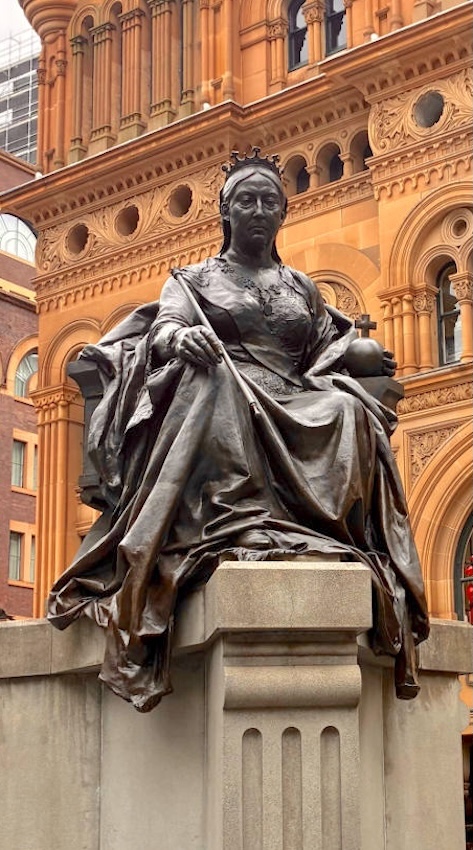
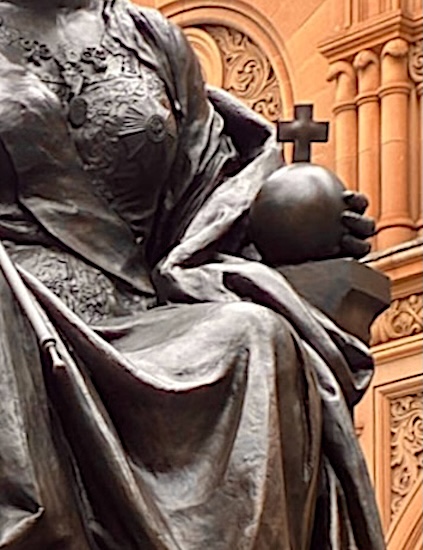
Statue of Queen Victoria, by John Hughes (1865-1941). Commissioned in 1903, and completed in 1908, the seated statue is of bronze, and well over lifesize. Approximately three metres (9.8 feet) in height, much larger than he himself had originally intended, it was produced by the lost-wax method of casting, and mounted on an impressive Portland stone pedestal with further figures at the base. It is now located in front of Sydney's Queen Victoria Building at the intersection of Druitt and George Streets, New South Wales, Australia.
The statue has an interesting history, which began not in Australia, but in Ireland. The Queen, nearing the conclusion of the longest reign in English history, had visited the Irish capital in April 1900, and had died only nine months later. The Royal Dublin Society proposed erecting a monument to her in the courtyard of Leinster House, and the people of Ireland initially welcomed the prospect. John Hughes was duly commissioned as sculptor. The statue was unveiled by the Lord Lieutenant of Ireland in a grand ceremony involving about a thousand soldiers, and in the presence of many guests, on 15 February 1908: “The ceremony was made the occasion of an imposing military display, but the lustre of the pageant was to some extent marred by a somewhat heavy shower which fell shortly before the formal part of the proceedings commenced,” reported The Irish Times.
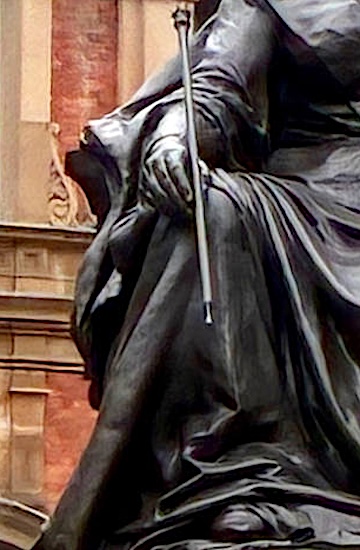
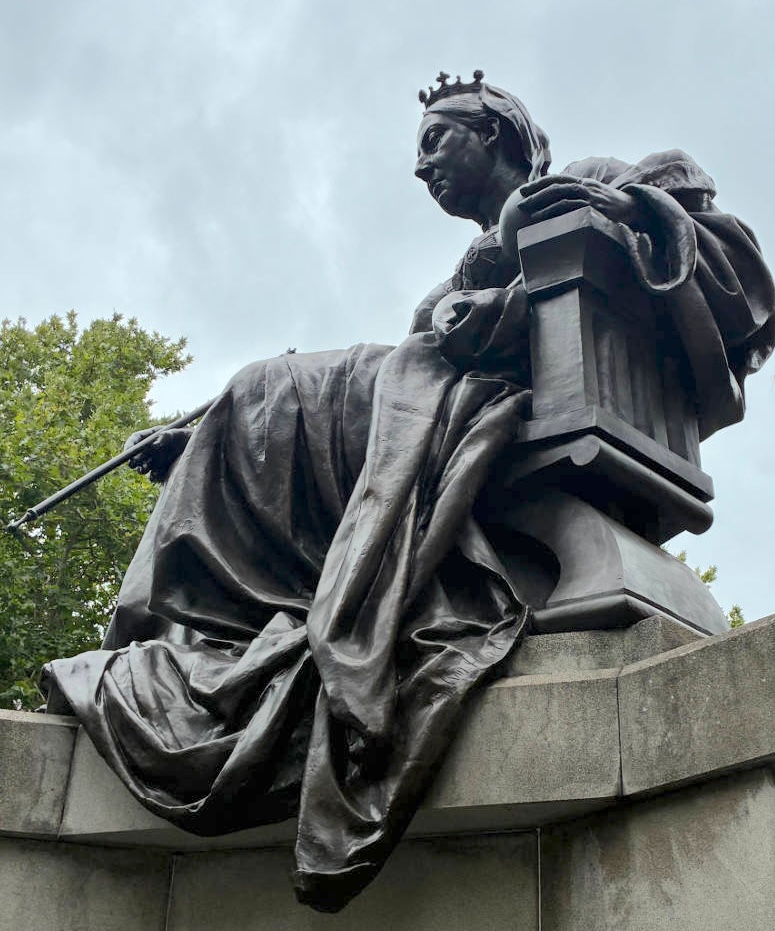
The Queen as Hughes has depicted is captured as she would have appeared at the time of the Diamond Jubilee (1897-98). She holds a sceptre as a symbol of her authority. Her gown falls in graceful folds over the top of the pedestal in front, and a cloak falls over the back. The finer details, hands, sceptre and orb, the brocade and the Star of the Garter (see top right), are all beautifully realised. However, the inauspicious weather on the day of the unveiling proved prophetic. Nationalist sentiment in the 1920s resulted in a generally negative opinion of the statue. The Queen was now being remembered far less favourably. The Irish Times echoed popular sentiment by dubbing Hughes' work "The Famine Queen," in reference to the Irish Famine of the late 1840s. The Queen would only have been between twenty-five and thirty years of age then; but now, it seems, the statue showed the aged monarch brooding.
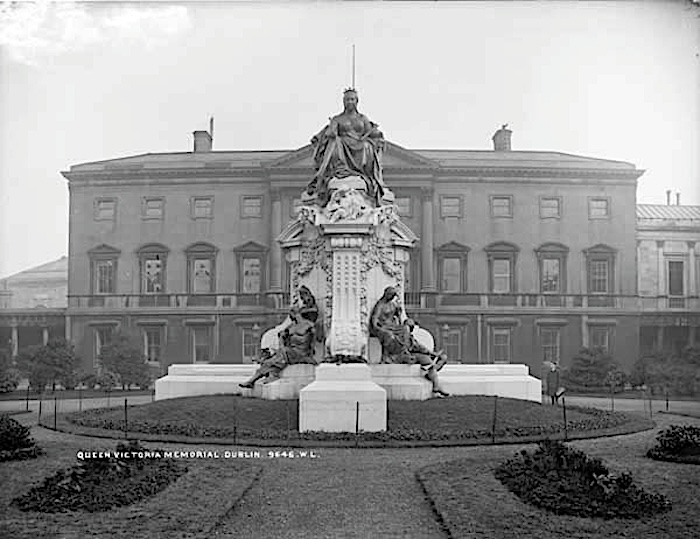
Queen Victoria Statue, Leinster House, Dublin, in a black and white print of about 1935, from the Catholic Archives Catalogue (added by JB).
There was much for her to brood about, particularly the horrible legacy of the Hungry Forties in a country where the blight on potatoes in particular and Conservative economic policies generally had had such disastrous social consequences. These had been recalled more recently in such English works as Thomas Hardy's socially realistic novel The Mayor of Casterbridge (1886). She might also have been brooding over the transportation of convicts (for the most part, women convicted of petty theft) from Ireland to Australia (notably Van Dieman's Land and the Port Phillip District of New South Wales); or such disturbing elements of the fin de siècle as the Boer War (originally memorialised in one of the statues at the base), when so many Irish soldiers fell. Thus The Irish Times said in 1943 that the structure would be removed “possibly to some new and friendly site, more probably to the scrapheap.” At length, in July 1948, Hughes's masterwork was removed and placed in the courtyard of the Royal Hospital Kilmainham, then later put into storage at the old Daingean reformatory about fifty miles from Dublin.
Years after this part of Ireland had broken away to become an independent republic, then, no one was very sorry to see the back of the memorial statue. The move came about at last when the Queen Victoria Building in downtown Sydney was being restored in the 1980s, and the developers began trawling the Commonwealth for a suitable statue to place in front of it. People were generally reluctant to part with their historic statues, but the search was rewarded at Daingean, where Hughes's statue was now sitting in tall grass behind the old reformatory. There was some hesitation, and indeed some opposition to its relocation — after all, the statue was an important work by an Irish artist and part of the country's history. But in August 1986 the Irish Prime Minister, Garret FitzGerald, agreed to give the statue to Australia, officially describing the transaction as a "loan until recalled." Arrangements were made for the abandoned statue to be shipped out, and on Sunday, 20 December 1987, a second installation ceremony took place, when the Chief Commissioner of Sydney officially "recommemorated" the statue in its new location, in front of the restored Romanesque building. The Irish media found it quite funny that the British Queen herself was "transported" to Australia by ship, just as convict-labour prisoners used to be!
A plaque at the front of the newly constructed triangular sandstone pedestal reads: "At the request of the City of Sydney, this statue waas presented by the Government and people of Ireland in a spirit of Goodwill and Friendship. Until 1947 it stood in front of Leinster House, Dublin, the seat of the Irish Parliament." The plaque on the panel facing George Street continues: "This Plaque commemorates the visit to this site by Her Majesty Queen Elizabeth II and His Royal Highness the Duke of Edinburgh on the occasion of the Bicentenary of Australia, 4th May 1988."
Missing from the present structure are the three smaller statues from its original tall Portland stone plinth: Fame, Hibernia at Peace, and Hibernia at War, which featured Erin and the Dying Soldier as the Boer War memorial mentioned above. These remain on display in the grounds of Dublin Castle.
Related Material
- Edgar Boehm's statue of the Queen on Macquarie Street, Queen's Square, Sydney
- A Gallery of Portraits in Stone and Bronze of Queen Victoria
- The Irish Famine
- Boer War Memorial for the King’s Royal Irish Hussars, at St. Patrick’s Cathedral, Dublin
Photographs by Philip V. Allingham, except for the black-and-white historic one from the Catholic Archives Catalogue, added by Jacqueline Banerjee, who also edited this essay. You may use the images without prior permission for any scholarly or educational purpose as long as you (1) credit the photographer and (2) link your document to this URL in a web document or cite the Victorian Web in a print one.]
Bibliography
Lynch, Sighle Bhreathnach. "John Hughes: The Italian Connection." Irish Review, 1994-01 (vol. 10): 195-201.
"Mr John Hughes ARHA, RHA." Mapping the Practice and Profession of Sculpture in Britain and Ireland 1851-1951, University of Glasgow History of Art and HATII, online database 2011. Web. 27 February 2026. https://sculpture.gla.ac.uk/mapping/public/view/person.php?id=msib3_1204539504
"Queen Victoria." Monument Australia 2010-2026. Web. 27 February 2026. https://www.monumentaustralia.org/themes/people/imperial/display/23254-queen-victoria
Queen Victoria Statue, Leinster House, Dublin. Catholic Archives Catalogue. Web. 6 March 2026.
Turpin, John. "Nationalist and Unionist Ideology in the Sculpture of Oliver Sheppard and John Hughes, 1895-1939." Irish Review, 1997-01 (vol. 20): 62-75.
Created 26 February 2026