
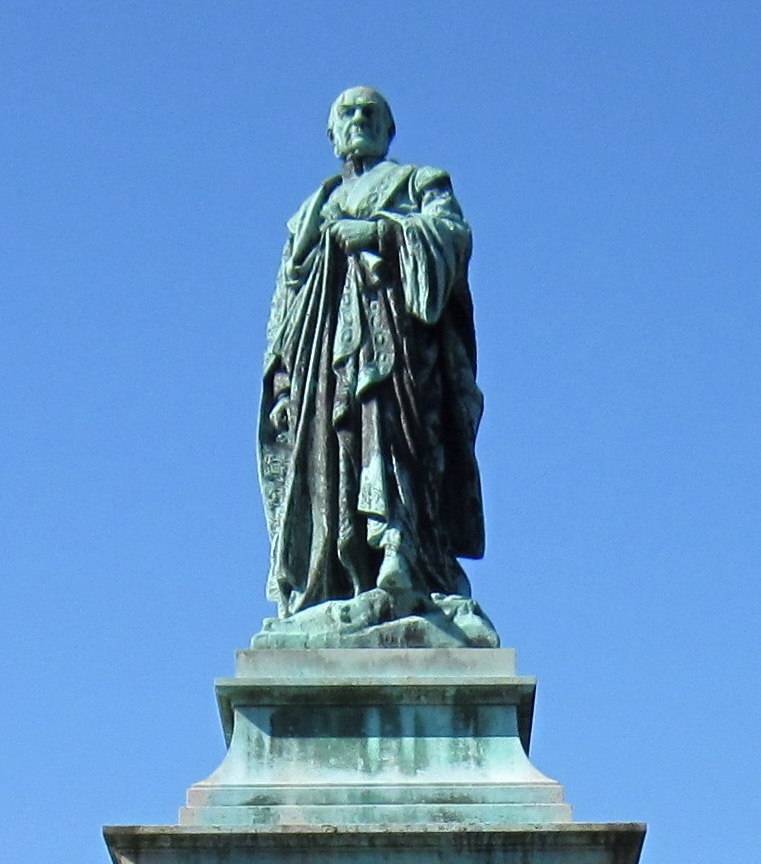
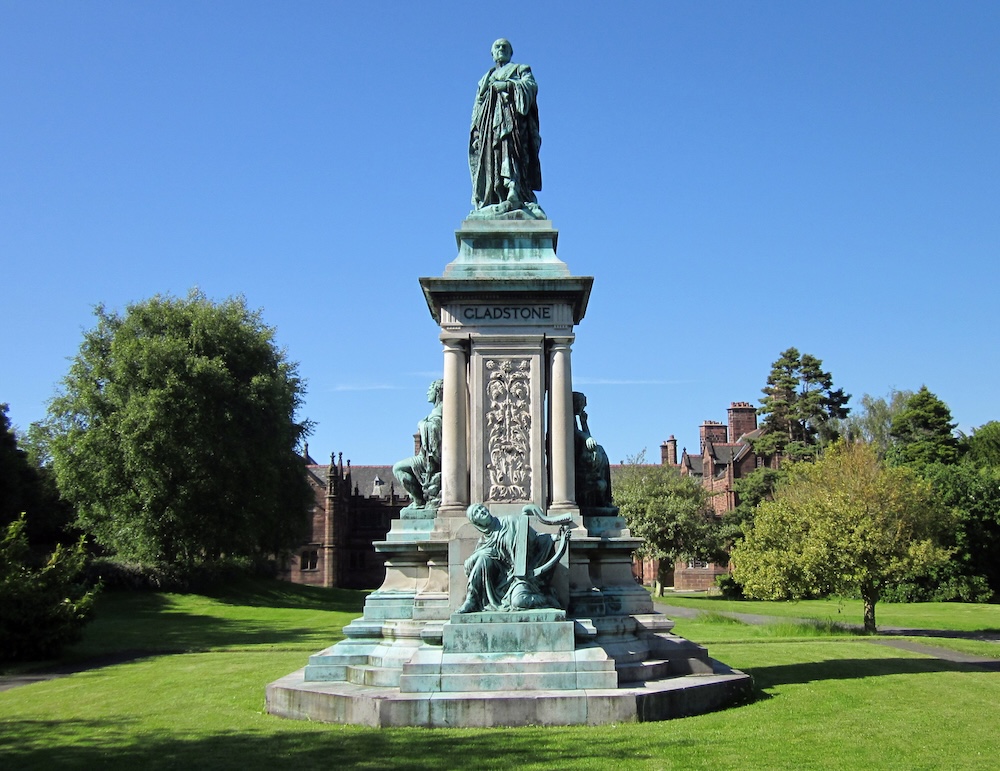
The Gladstone Monument. Left: Gladstone himself. Right: The whole monument. All photos on this page © Jeff Buck, originally posted on the geograph website, and kindly made available on the Creative Commons Attribution-ShareAlike 2.0 Generic CC BY-SA 2.0 Deed. [Click on all the images to enlarge them.]
Monument to William Gladstone (1809-1898), by John Hughes (1865-1941). This was commissioned in 1910 by the National Gladstone Memorial Committee which had been raising money since 1898 for "monuments of a stately and conspicuous character in London, Edinburgh, and Dublin, and of a building at Hawarden erected to contain the library which Mr. Gladstone gave in his lifetime for the use of the public" ("An appeal has been issued..."). The first commission went to Hamo Thornycroft for the one in the Strand (1905); James Pittendrigh MacGillivray's monument to Gladstone was unveiled in Edinburgh in 1917, and Hughes was commissioned in 1910 for one in Dublin. Again, this was a major recognition for Hughes, but again the outcome for him was poor. Delayed by the war, he completed it in 1923. Bronze on a Portland stone pedestal, it has four subsidiary allegorical figures, representing Classical Learning, Finance, Eloquence and Erin (Ireland), the latter in front with a harp. The statue itself is nearly 2.5 metres tall, and the pedestal more than 4.5 metres high.
However, by the time it was ready this impressive monument no longer had a place in post-independence Dublin. Instead, it was erected close to Catherine Gladstone's family estate, Hawarden Castle in Flintshire, in 1925. Here, it was warmly received: Catherine had been born here, the couple had lived here from the time of their marriage in 1839 onwards, and this was where Gladstone died in 1888. The statue was fittingly located outside the renowned Gladstone Library, to which also the Commission's funds had been allocated.
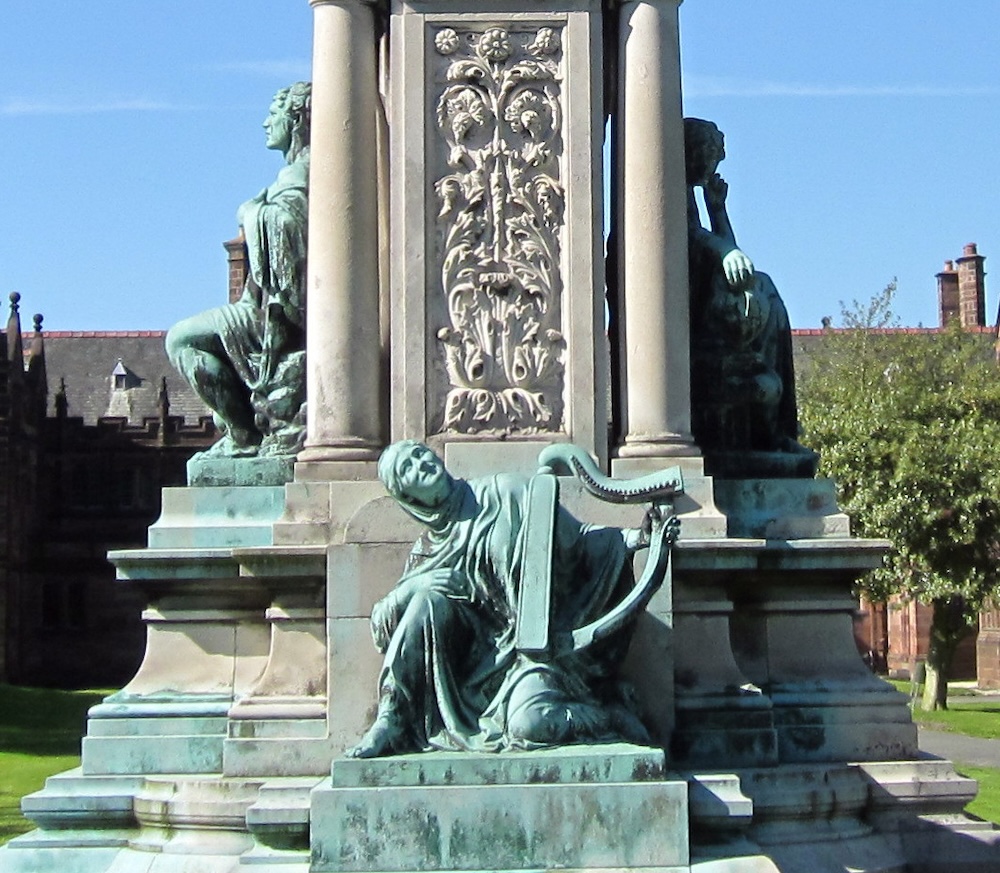
The monument itself is a fine one, noted by Edward Hubbard for the Renaissance-style ornament and Doric columns of the pedestal, as well as the allegorical figures at the base (369) — these exhibit the finesse and flow for which Hughes strove, with a considerable degree of success. Unfortunately though, the masterpiece which had cost him so dear in both time and work has once again become an object of contention, because of the contribution made to the Gladstone family's wealth by the slave trade, and the massive compensation they received on its abolition — even though, in later life, Gladstone himself strongly condemned slavery. — Jacqueline Banerjee

Bibliography
"An appeal has been issued...." The Speaker. Vol. XVIII. 30 July 1898: 128. Google Books. Free to read.
Buck, Jeff. The Gladstone Memorial, Hawarden. Geograph. Web. 6 March 2026.
Darke, Jo. The Monument Guide to England and Wales: A National Portrait in Bronze and Stone. London: Macdonald Illustrated, 1991.
Ferriter, Diarmaid. "Hughes, John." Dictionary of Irish Biography. Web. 6 March 2026.
"The Gladstone Monument." VADS (University of the Creative Arts). Web. 6 March 2026.
Hubbard, Edward. Clwyd (Denbighshire and Flintshire). Buildings of Wales series. Harmondsworth/Cardiff: Penguin / University of Wales Press, 1986.
"John Hughes." Mapping the Practice and Profession of Sculpture in Britain and Ireland 1851-1951. University of Glasgow History of Art and HATII, online database 2011. Web. 6 March 2026. https://sculpture.gla.ac.uk/mapping/public/view/person.php?id=msib3_1204539504&search=Hughes
Created 6 March 2026