
Queen Victoria Building. Sydney, Australia. Architect: Edinburgh-born George McRae (1857-1923), who went out to Sydney in 1884 and rose swiftly to become City Architect and City Building Surveyor, a position he held from 1889-97, while this building was under construction. Eventually he became Government Architect to New South Wales. He was responsible for many of Sydney's key buildings. This one, of local sandstone, five storeys in height with impressive front and side elevations, and an equally impressive iron-and-glass interior, was opened in 1898. Bounded by George, Market, York and Druitt Streets, it occupies a whole block.
The Queen Victoria Building . . . [replaced] the original Sydney markets on the site. Built as a monument to the long reigning monarch, construction took place in dire times, as Sydney was in a severe recession. The elaborate Romanesque architecture was specially planned for the grand building so the Government could employ many out-of-work craftsmen — stonemasons, plasterers, and stained window artists — in a worthwhile project. Originally, a concert hall, coffee shops, offices, showrooms, warehouses and a wide variety of tradespeople, such as tailors, mercers, hairdressers and florists, were accommodated." [www.qvb.com.au]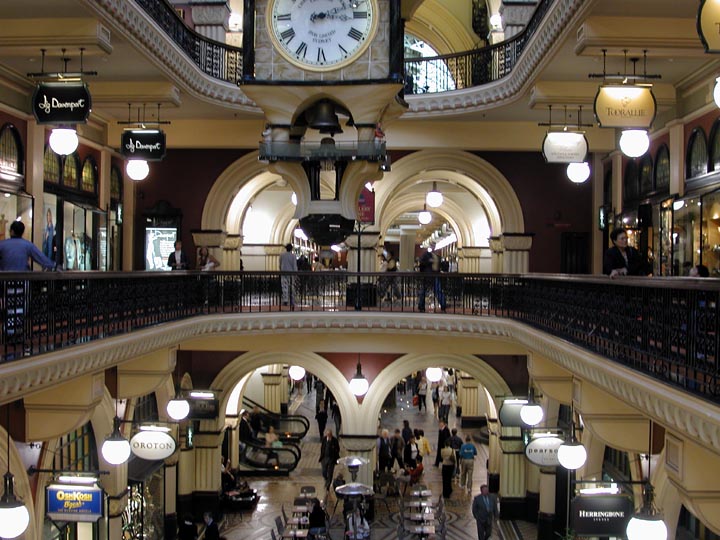
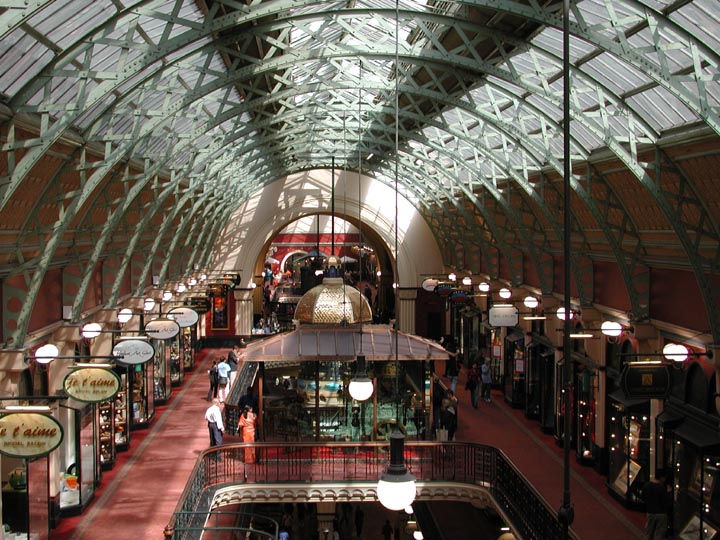
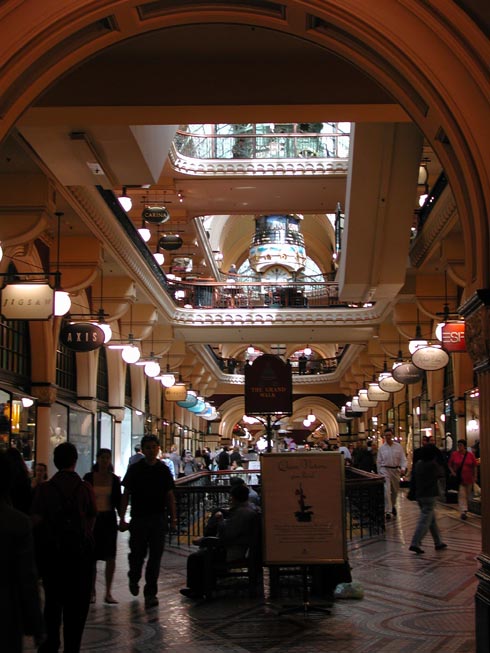
Left: The magnificent arched ceiling. Right: View from ground floor. [Click on images to enlarge them.]
As noted above, the interior is every bit as impressive as its exterior. Its "dominant feature is the mighty centre dome, consisting of an inner glass dome and an exterior copper-sheathed dome. Glorious stained glass windows and splendid architecture endure throughout the building and an original 19th century staircase sits alongside the dome. Every detail has been faithfully restored, including arches, pillars, balustrades and the intricate tiled floors thus maintaining the integrity of the building" (www.qvb.com.au).
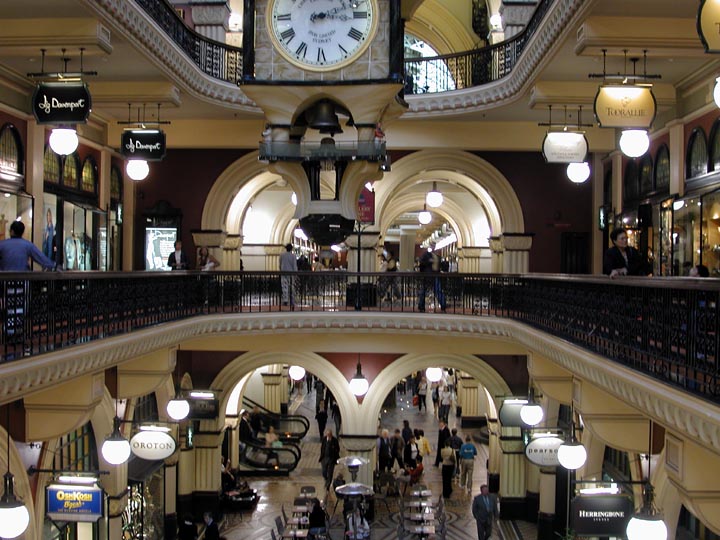
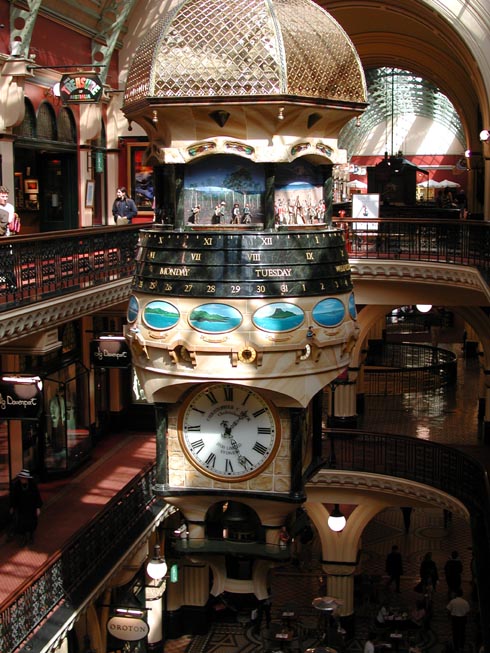
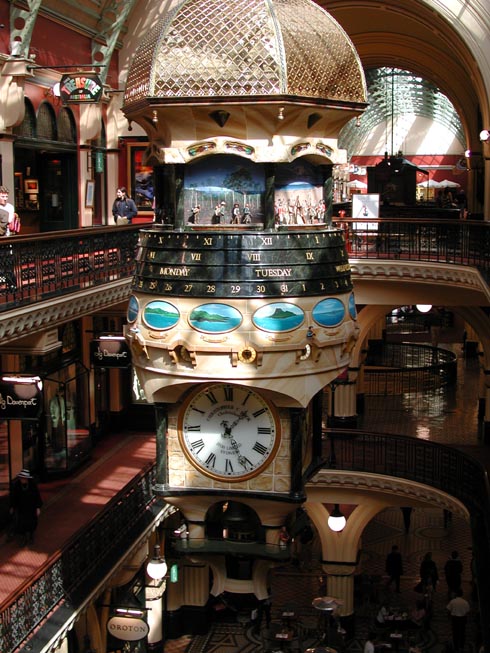
Left: The second storey. Right: The spectacular clock.
Another excerpt from the same account explains: "There is a marvellous hanging clock that displays a series of mechanically moving tableaux of British kings and queens every hour on the hour. This 'exhibition' is heralded by loud trumpeters and ends with the beheading of Charles I. Permanent and temporary exhibitions have a home at different points on each level and include replicas of the British crown jewels and a highly ornamental, full-scale oriental coach. The building accomodates a series of royal paintings."
Related Material
Photographs of the exterior, 2026, by Philip V. Allingham; photographs of the interior, 2002, and quoted text, by George P. Landow, with linking material by JB. You may use the images without prior permission for any scholarly or educational purpose as long as you (1) credit the photographer and (2) link your document to this URL in a web document or cite the Victorian Web in a print one. [Click on the images to enlarge them.]
Bibliographical Note
The QVB site has changed since this account was originally transcribed by George Landow. There is an informative "History of QVB" there now, with a detailed timeline: https://www.qvb.com.au/centre-info/history-of-qvb. But since this does not include some of the useful details given above, we have retained the quotations from the original version cited here. — Jacqueline Banerjee
Last modified 6 March 2026