

histler has long been viewed as a pioneer – an American innovator who revolutionized Victorian painting and helped to lay the foundations of Modernism. He was also a charismatic wit who rubbed shoulders with Dante Gabriel Rossetti and Oscar Wilde; positioning himself as the quintessential maverick, he challenged social norms, criticised what he saw as the philistinism of the Victorian establishment, and sued Ruskin for defamation of his work. His was a complex, bohemian life, and his art was equally complicated and difficult to define. The current exhibition at Tate Britain, entitled simply James McNeill Whistler (21 May – September 27, 2026), is a large retrospective of his career, displaying a number of his most significant paintings along with many etchings and lithographs. The wide scope provides a panoramic view of Whistler’s achievements, and offers an opportunity to consider some of the prevailing understandings of his art.
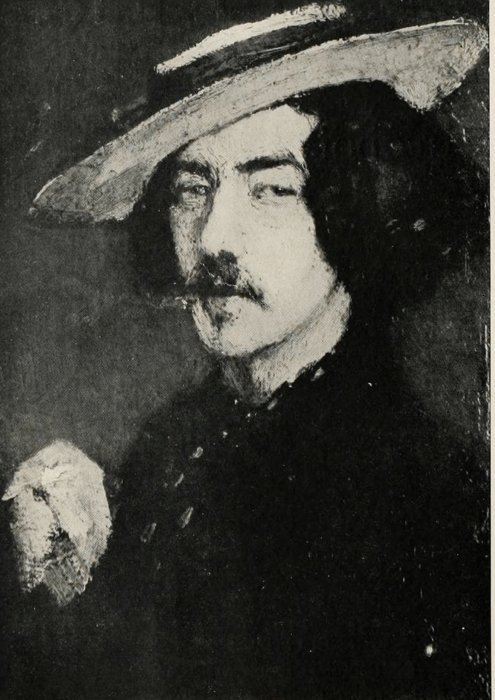

Whistler’s self-portraits: Left: Painted 1859–60, when the artist was 25; and right: 1872, when he was 39 or 40. [Click on all the images for larger pictures and more details.]
Whistler is usually viewed as supremely self-confident, projecting himself in a series of self-portraits as either a dandy or a modern Rembrandt, whom he regarded as his model. The exhibition telling displays a couple of these pieces, one showing him as a young man and another in middle age; in both the eyes are impertinently angled at the viewer, looking out under tilted hats, with a face embellished with a rakish moustache and a contemptuous curl playing on the lips. These are self-portraits as narcissistic assertions of self-worth, the artist not so much as poet or sage, but as man-about-town, the master of his profession: petulance, vanity itself.
This was, of course, the arrogant posture adopted by the French artists of the avant-garde, and Whistler would have thought of himself as having equal status with Manet and Courbet, whom he met during his sojourn in Paris. It is noticeable, however, that the American’s earliest work has none of the originality that one might expect. Rather than making a distinctive contribution from the start he seems at first an imitator, one who came under the spell of his friend Courbet, noticeably in some early portraits which deploy the French realist’s dark tones; and he was perhaps more influenced by Manet’s seemingly spontaneous take on the urban experience.
The display of Whistler’s apprentice pieces is important, because it establishes a significant fact: he was an eclectic artist. Influenced by Parisian artists, he also responded to Rembrandt and Dutch portraiture more generally, Dutch landscape, and Japanese woodcuts and Chinese ceramics. The art of the Far Eastern had a huge impact on his work, and the show tellingly opens with a room of Japanese prints by Hiroshige and a hoard of chinoiserie. The simplified patterns appearing in these artefacts provided Whistler with a model of abstraction, and although they are not placed together it is easy to make the connection between the Oriental designs and paintings such as Nocturne, Blue and Gold: Old Battersea Bridge (1872–5). The Japanese influence is similarly apparent in the many examples of graphic art exhibited in tandem with the paintings.

Whistler, Nocturne, Blue and Gold, Old Battersea Bridge.
Absorbing these elements, Whistler went about creating his own voice, and two distinctive strands emerge. One is the concern with evoking the ‘modern’ experience of city life in the industrial cityscapes of London, and the other is his focus – the element for he is best known – abstraction. Each of these is well-drawn out in a series of key works which acts to shape our understanding of Whistler’s oeuvre.
Whistler’s evocation of urban modernity is enshrined in Wapping (1864) – a great painting from the National Gallery of Art in Washington, rarely seen in the United Kingdon. Redolent of Manet and informed with the ideas of Baudelaire’s essay ‘The Painter of Modern Life’ (1860), Wapping establishes Whistler’s capacity to catch the poetry of the ordinary. In the foreground is a casual scene of a bar including portraits of Alphonse Legros and Joanna Heffernan, Whistler’s muse and mistress, overlooking the river; and in the background is a panoply of everyday events as ships and boats swarm over the Thames. Though surrounded by activity, the characters, who are about to be joined by a third individual – or perhaps he is serving the table? – are quiet and self-contained. The overall effect is one of vivid synthesis, formal and psychological, as Whistler’s urbanites live their lives surrounded by noise and movement but still preserve a sense of their own interiority. This is the very essence of the modern city experience and is still as relevant today as it was in the bustling London of the nineteenth century.
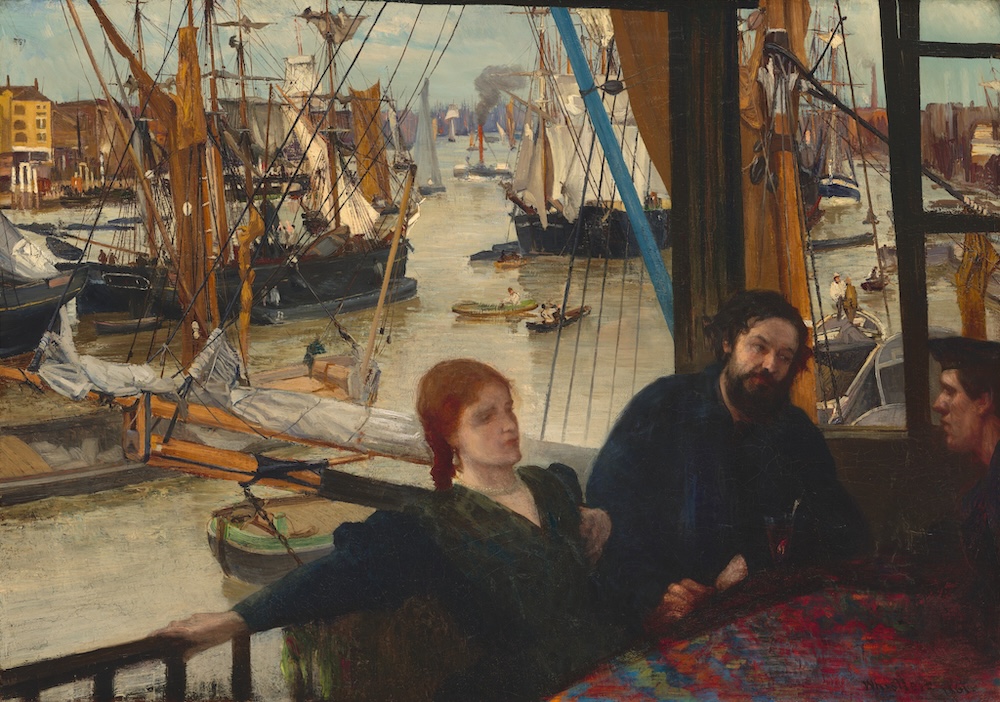
Whistler, Wapping.
But Wapping is so much more than a piece of naturalism. Though apparently a snapshot with edited space and spontaneous movement, it also works as a pattern and colour-scheme. The masts and ropes in the background are organized to form a series of complex diagonals, and the surface is divided into a near-equivalent of the golden mean; the colours, likewise, seem to be just what happened to appear in the eye, but are part of a modulated play on varieties of brown. Carefully placed, Wapping is a transitional work between Whistler’s Manet-esque visions of the city and what would become his more familiar idiom of paintings as abstract designs, compositions of colours and forms as much as realistic representations.
The exhibition displays a superb variety of these later paintings, including the city nocturnes and several portraits. Influenced by Walter Pater’s pronouncement in The Renaissance (1873) that all art aspires to the condition of music, Whistler dubs his semi-abstractions as ‘symphonies’ and ‘arrangements,’ and numbers them. Not to be seen in terms of verisimilitude, the artist argues, they are really patterns in white, black, gold, blue or silver.
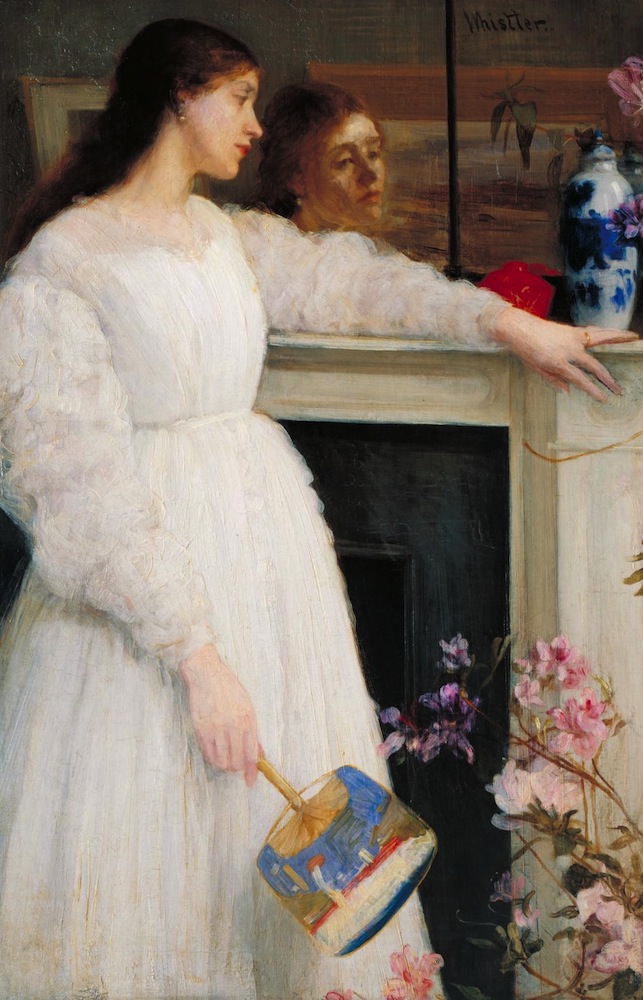
Whistler, Symphony in White, No. 2.
This idea is teased out in portraits in which the subjects are made as blank as possible, with inexpressive faces and languorous poses, doing nothing, saying nothing, waving Japanese fans or just existing. In Symphony in White, No.2 (1864,Tate Britain) the subject (again Jo Heffernan) is presented as a form, a harmonious arrangement of whites, and the same approach is followed in the lesser-known No.3, another outstanding piece (Barber Institute, University of Birmingham). Don’t look at what each picture shows, Whistler urges us, but at how: respond to the shapes and colours, and not to the motif; look through it, not at it; see the patterns as a flat, rhythmic design, as in Japanese art; absorb the sensory impressions just as we allow music to flow into our ears; and allow the painting to arouse whatever associations or emotions that come into your mind. The subject is just a vehicle.
At the heart of the matter is the famous Arrangement in Grey and Black, No. 1, the portrait of Whistler’s mother (1870–71, Musée d'Orsay, Paris), another work rarely seen in Britain. This image sums up the artist’s project to focus on abstract structure, presenting his subject as an arrangement of shapes of colours, with the outlines of picture-frames acting to assert an underlying geometry and emphasis on the formal.

Whistler, Arrangement in Grey and Black, No. 1 (Whistler’s Mother).
This (apparently) subject-less type of painting looks forward to many experiments and was influential in Whistler’s own time and in the twentieth century. His representation of languid or static women establishes the key formulation of Aestheticism – of beautiful forms and colours, of Art-for-Art’s Sake. Such compositions were a crucial influence on the Aesthetic paintings of Albert Moore, in which the artist, following Whistler, presents his neo-classical subjects – more women doing nothing – as harmonious, colour-modulated patterns. And the Nocturnes have an even broader impact in the development of Modernist abstraction, prefiguring the colour-field paintings of Mark Rothko and the American expressionists of the second part of the twentieth century.
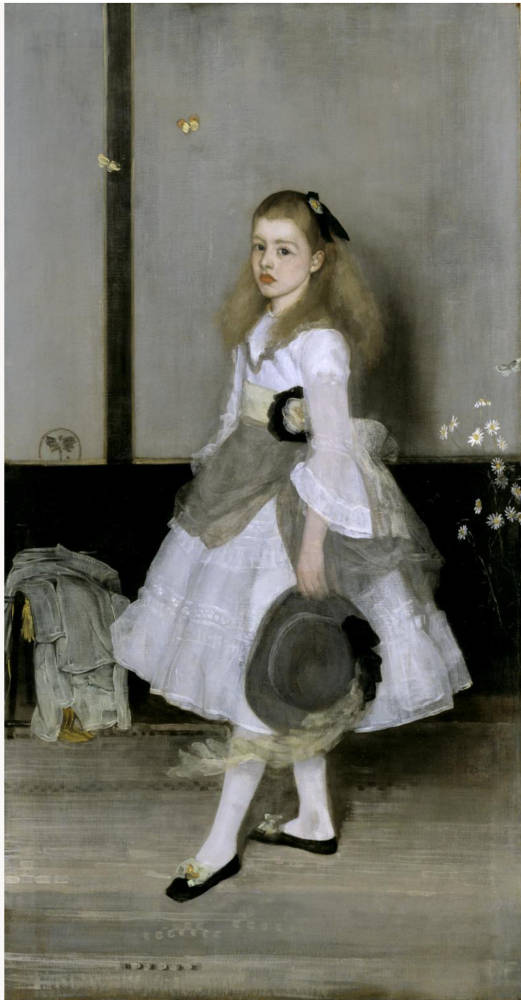
Whistler, Harmony in Grey and Green: Portrait of Miss Cicely Alexander.
The exhibition invites us to contemplate these connections, to view Whistler absolutely as a pioneer. But it suggests inconsistencies too, the work of a practitioner who created an art full of audacious suggestion and ambivalence. The portraits, especially, demand a dual perception: we have seen how Wapping is both realistic and an abstract pattern, but in at least some of Whistler’s likenesses it is difficult to disentangle the sitter from the representation. Is it really possible to see Whistler’s mother as just a design? Whistler’s detailed treatment of her face and melancholy expression surely require a psychological explanation, as does her dress. The artist passes it off as a passage of black, but the caption card tells us that she was wearing widow’s weeds in remembrance of Whistler’s father. Such emotional baggage is hard to put to one side. Likewise in Harmony in Grey and Green: Portrait of Miss Cicely Alexander (1873, Tate Britain), it is practically impossible to view the painting purely as an arrangement when the girl’s facial expression focuses our attention on what she is thinking. Like it or not, Whistler struggles to cast off the Victorian desire to narrativize, a situation hugely complicated by his titles embodying both abstract and figurative reference, offering portraits that are said to be arrangements or harmonies and (after the colon) the face of a real person, identified by name. Which half of the title (and painting) should take preference? Or both equally? Is it a balance, or is it a conflict? Whistler never manages to resolve the situation, and neither can we.
The climax of that ambiguity is of course exemplified by the Whistler vs. Ruskin trial. Ruskin had described Whistler’s Nocturne in Black and Gold: The Falling Rocket (1875) as a matter of ‘flinging a pot of paint in the public’s face.’ Ruskin, the champion of Pre-Raphaelitism, story-telling, moralizing, and the observation of nature, couldn’t understand Whistler’s move towards abstraction (though he had earlier promoted exactly such abstractions in the work of Turner.) Whistler sued, won, was given a farthing in damages, was bankrupted, and forever changed perceptions of painting. He opened the space for Arts for Art’s Sake to occupy the middle ground. But this pivotal Nocturne (Detroit) doesn’t feature in the current show, and there is very little reference to what was one of the key moments in the development of Victorian aesthetics. It is the only disappointment in what is otherwise a fabulous exhibition that reveals so much about this brilliant, exasperating inventor of new pathways in the development of British and international art. Restless to the end – his late portraits are especially provocative – Whistler straddles the old and the new, the Victorian and the modern world, and challenges what painting could or should do.
Created 15 August 2026